What Are Bonded Washers Used For?
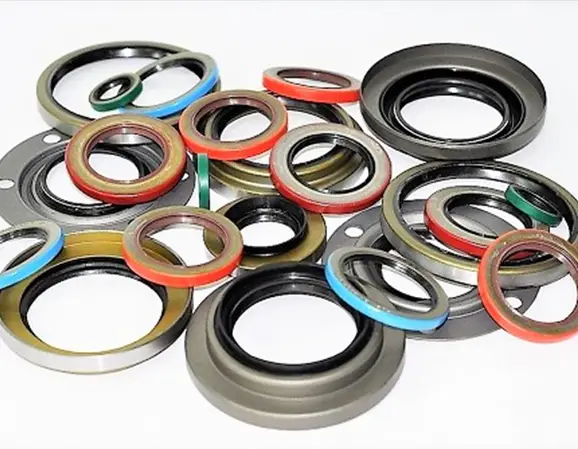
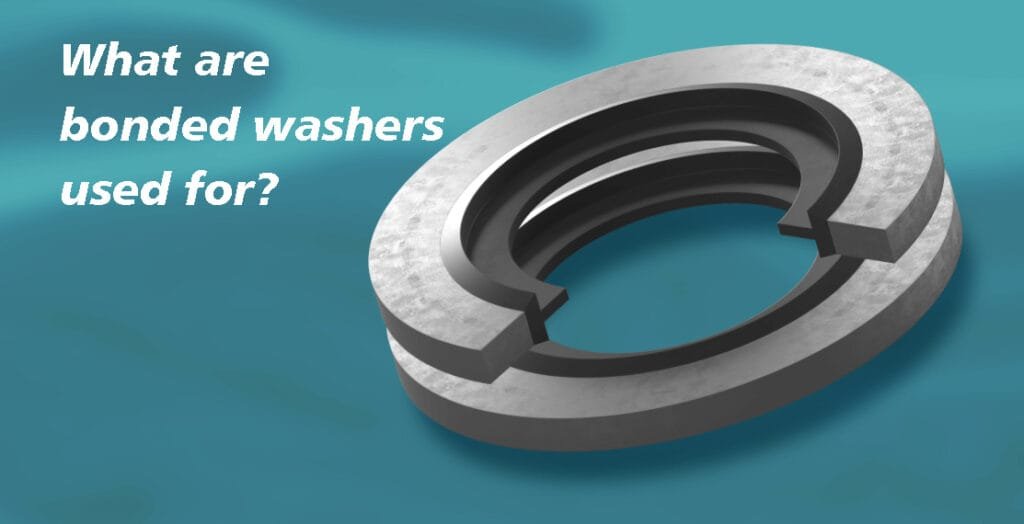
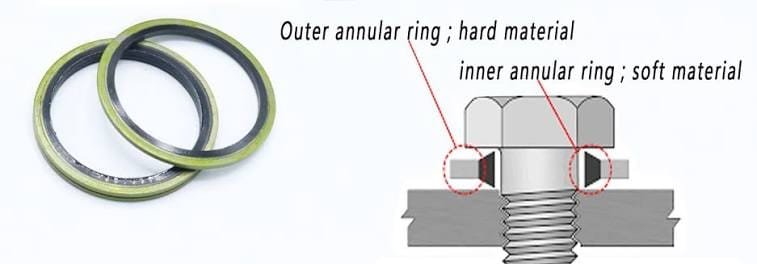
Bonded washers are specialized sealing components designed to prevent fluid or gas leakage around bolts, screws, plugs, threaded connections, and other fasteners. Unlike a conventional flat metal washer, a bonded washer combines a rigid metal ring with an elastomeric sealing element that is permanently bonded to the metal. This construction allows the component to provide both mechanical load distribution and sealing performance in a single part.
In practical engineering, bonded washers are commonly used where a threaded or bolted connection must retain oil, hydraulic fluid, fuel, coolant, water, compressed air, or another medium. They are particularly valuable when the designer needs a compact static seal that can tolerate vibration, pressure fluctuations, moderate surface imperfections, and repeated mechanical loading.
The fundamental idea is simple: the metal portion provides mechanical support while the elastomer provides the actual compliant sealing interface. The metal ring also helps limit excessive compression of the elastomer when the fastener is tightened correctly.
🔧 Key takeaway: Bonded washers are primarily used to create reliable static seals around fasteners and threaded connections. They are especially useful in hydraulic, pneumatic, automotive, machinery, fluid-handling, construction, HVAC, and other applications where preventing leakage is more important than simply distributing bolt load.
What Is a Bonded Washer?
The metal ring is usually manufactured from carbon steel, stainless steel, or another suitable metal. The elastomer may be NBR, HNBR, FKM, EPDM, or another compound selected according to the operating environment.
When installed beneath a bolt head, nut, plug, or fitting face, tightening the fastener compresses the elastomer against the mating surface. The elastomer fills microscopic surface irregularities and establishes a barrier against fluid or gas migration.
This is fundamentally different from the function of an ordinary flat washer. A conventional washer mainly distributes mechanical load and protects the mating surface. A bonded washer performs those mechanical functions while also creating a sealing interface.
How Do Bonded Washers Work?
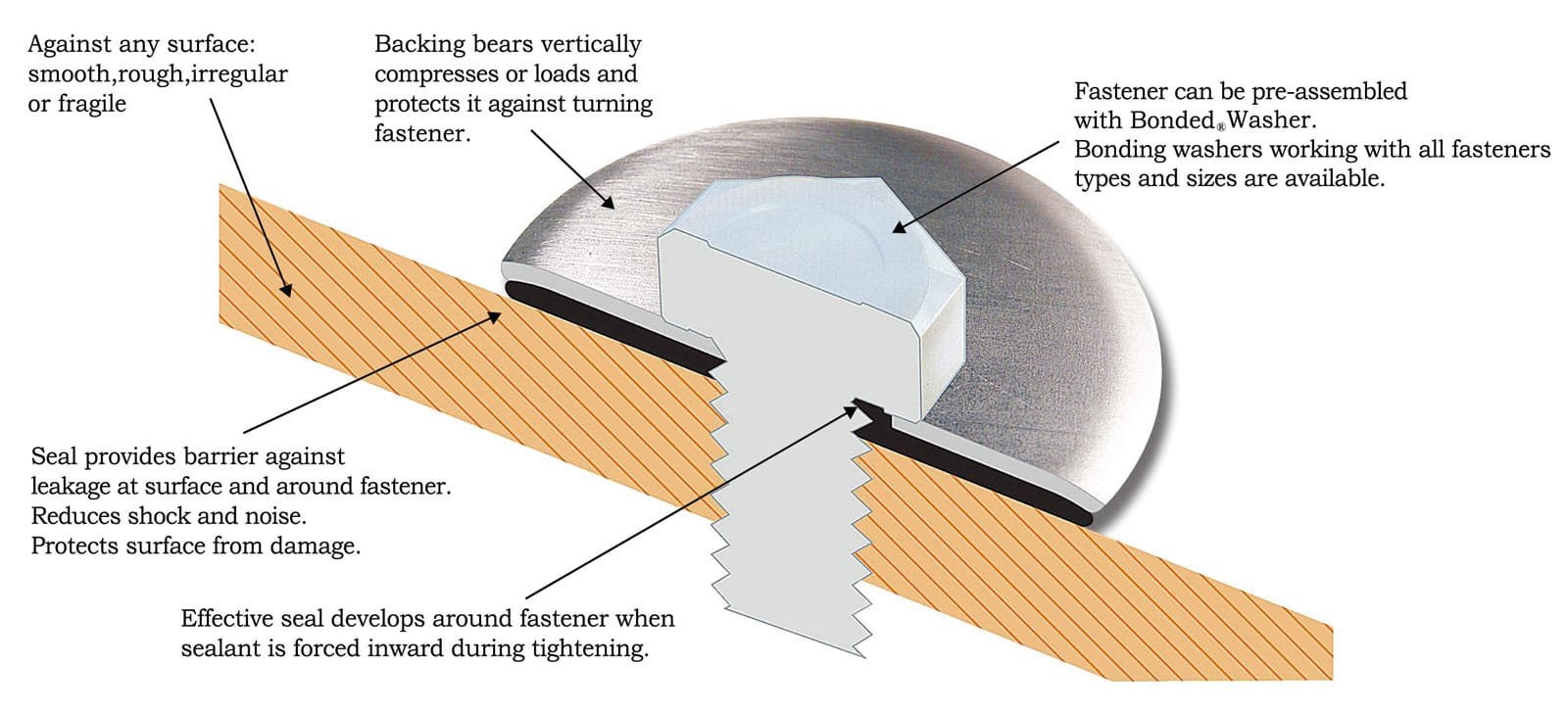
The sealing mechanism is based on controlled compression of the elastomeric element. When a fastener is tightened, the metal ring contacts the surrounding surfaces and the rubber sealing element is compressed into the available sealing space.
Because elastomers are flexible, the sealing element can conform to microscopic surface irregularities that a rigid metal washer cannot easily accommodate.
At the same time, the metal ring provides structural support. It helps distribute the fastener load and limits excessive deformation of the elastomer.
The sealing principle can be summarized in three stages:
① The fastener generates clamp load.
② The elastomer compresses against the mating surface.
③ The compressed elastomer blocks the leakage path while the metal ring controls and supports the assembly.
Under suitable pressure conditions, system pressure can also contribute to sealing by increasing contact at the elastomer interface. However, the exact pressure behavior depends on the bonded-washer profile, elastomer geometry, compression, mating surfaces, and installation conditions. It is therefore incorrect to assume that every bonded washer has the same pressure capability.
What Are Bonded Washers Mainly Used For?
The most common application is sealing a fastener connection where a fluid or gas must remain contained. Typical applications include hydraulic ports, hydraulic pumps, valves, cylinders, gearboxes, automotive assemblies, fuel systems, pneumatic equipment, machinery housings, pipe connections, and various industrial fittings.
Bonded washers can also be used in applications where moisture exclusion is important. Specialized versions are used under screws and fasteners on outdoor panels, roofing systems, HVAC equipment, electrical enclosures, solar equipment, and sheet-metal assemblies. The appropriate design and material are different from those used for high-pressure hydraulic service.
| Application | Typical Medium / Environment | Primary Requirement |
|---|---|---|
| Hydraulic equipment | Hydraulic oil | Pressure and fluid resistance |
| Automotive systems | Oil, fuel, coolant, hydraulic fluid | Chemical compatibility and vibration resistance |
| Pneumatic equipment | Compressed air or gas | Gas retention and pressure resistance |
| Outdoor panels | Rain, humidity, UV | Weather and water resistance |
| HVAC systems | Refrigerants and oils | Refrigerant and lubricant compatibility |
| Industrial machinery | Oil, grease, coolant, water | Durability and leak prevention |
Bonded Washers vs. Ordinary Flat Washers
One of the most common misunderstandings is treating a bonded washer as simply a “rubber washer.” The design objective is considerably more sophisticated.
A standard metal washer distributes the clamp load over a larger area. It does not normally provide a dedicated elastomeric sealing barrier. A bonded washer incorporates the sealing element directly into the washer assembly.
| Feature | Flat Metal Washer | Bonded Washer |
|---|---|---|
| Load distribution | Yes | Yes |
| Fluid sealing | Normally no | Yes |
| Elastomer element | No | Yes |
| Vibration isolation | Limited | Potentially improved depending on design |
| Leak prevention | Not its primary function | Primary function |
Bonded Washer Construction
1. Metal Support Ring
The metal ring provides stiffness and mechanical support. Common choices include carbon steel, stainless steel, and other metals selected for strength and corrosion resistance.
For general industrial applications, plated carbon steel may be suitable where the environmental conditions are controlled. Stainless steel becomes attractive where moisture, corrosion, cleaning chemicals, or marine exposure are significant considerations.
Material selection should consider not only corrosion resistance but also strength, hardness, manufacturing tolerances, temperature, galvanic compatibility, and contact with the surrounding equipment.
2. Elastomeric Sealing Ring
The elastomer is the active sealing component. Its function is to deform under compression and maintain contact with the mating surfaces.
Common elastomer families include NBR, HNBR, FKM, and EPDM. The correct material depends primarily on the fluid, temperature, environmental exposure, and mechanical requirements.
3. Bonding Interface
The elastomer is permanently attached to the metal support. The quality of this bond matters because separation, delamination, or damage can compromise the sealing system.
A bonded washer should therefore be evaluated as a composite component rather than as two unrelated parts.
What Materials Are Bonded Washers Made From?
Material selection is one of the most important factors determining where a bonded washer can be used.
NBR Bonded Washers
Nitrile rubber, commonly abbreviated NBR, is widely used where resistance to petroleum-based oils, fuels, and hydraulic fluids is required. It offers a useful balance of mechanical properties, oil resistance, abrasion resistance, and cost.
General NBR temperature capability is commonly around -30°C to +100°C, although actual limits depend on the compound formulation and application.
HNBR Bonded Washers
Hydrogenated nitrile rubber, or HNBR, provides improved resistance to heat, ozone, oxidation, and aging compared with conventional NBR.
HNBR is frequently considered for demanding automotive, hydraulic, and industrial applications where elevated temperature and long-term durability are important.
Typical HNBR service ranges can extend to approximately 150°C or higher for specific compounds, but the exact maximum must always be obtained from the compound specification.
FKM Bonded Washers
FKM, commonly known as a fluorocarbon elastomer, is selected when high temperature and chemical resistance are important. Depending on formulation, FKM can operate around 200°C and sometimes above that temperature for specialized applications.
FKM is often attractive for high-temperature automotive, fuel, chemical, and industrial environments.
EPDM Bonded Washers
EPDM provides excellent resistance to water, weathering, ozone, and many aqueous environments. It is frequently considered for outdoor sealing, water systems, HVAC-related applications, and weather-exposed assemblies.
However, EPDM is generally not appropriate for many petroleum-based oil and fuel applications. This is a critical selection issue: excellent water resistance does not mean universal chemical compatibility.
| Elastomer | General Strength | Typical Applications | Important Limitation |
|---|---|---|---|
| NBR | Oil and fuel resistance | Hydraulics, automotive, machinery | Less suitable for severe ozone/weather exposure |
| HNBR | Heat and aging resistance | Automotive, demanding hydraulics | Higher cost than standard NBR |
| FKM | High temperature and chemical resistance | Hot oil, fuel, chemical applications | Low-temperature behavior varies by grade |
| EPDM | Water, weather and ozone resistance | Outdoor, water, HVAC applications | Generally unsuitable for petroleum oils |
Hardness and Compression of Bonded Washers
Elastomer hardness is commonly measured on the Shore A scale according to ASTM D2240. Bonded washer compounds may commonly fall within approximately 70–90 Shore A, depending on design and manufacturer specification.
Hardness affects how the elastomer responds to compression. A softer compound generally conforms more easily to irregular surfaces, while a harder compound can provide greater resistance to deformation under certain conditions.
However, selecting a bonded washer solely by hardness is poor engineering practice. Hardness should be evaluated together with tensile strength, elongation, compression set, tear strength, abrasion resistance, fluid compatibility, and temperature capability.
⚠️ Important: A higher Shore A value does not automatically mean a better bonded washer. The correct hardness is the value that works with the sealing geometry, compression, pressure, temperature, and mating surfaces.
Compression Set and Long-Term Sealing
Compression set describes the tendency of an elastomer to retain deformation after being compressed for a defined period under specified conditions. ASTM D395 is commonly used to evaluate rubber compression set.
Good compression-set resistance is valuable because a bonded washer must retain sufficient elastic recovery to maintain contact after long exposure to temperature and compression.
Nevertheless, compression set should not be interpreted as a direct prediction of bonded-washer service life. Dynamic vibration, pressure cycling, fluid exposure, surface finish, thermal expansion, and installation conditions can all influence real-world behavior.
Temperature Resistance
Temperature is one of the first parameters engineers should establish when selecting a bonded washer.
For example, a general-purpose NBR compound may be suitable for moderate-temperature hydraulic oil, while a high-temperature engine environment may justify HNBR or FKM depending on the fluid and actual temperature.
| Material | Illustrative Temperature Range | Typical Selection Logic |
|---|---|---|
| NBR | Approx. -30°C to +100°C | General oil and hydraulic service |
| HNBR | Approx. -30°C to +150°C | Higher temperature and aging resistance |
| FKM | Often up to approximately +200°C | High-temperature and chemical service |
| EPDM | Broad range depending on compound | Water, weather and ozone environments |
These are representative engineering ranges, not universal limits. The actual allowable temperature must be obtained from the specific elastomer compound specification and evaluated with the actual fluid, pressure, compression and duty cycle.
Pressure Resistance
Bonded washers are widely associated with hydraulic applications because their metal support ring and elastomeric sealing element can provide reliable sealing around threaded connections.
Some specialized bonded seals are designed for very high pressure. Certain commercial designs are marketed for pressures up to several hundred bar, with examples reaching approximately 600 bar under specified conditions. Such ratings are product-specific and must never be generalized to every bonded washer.
Pressure capability depends on:
Elastomer material
Elastomer hardness
Seal cross-section
Metal-ring geometry
Compression
Mating-surface condition
Fastener torque
Pressure magnitude
Pressure cycling frequency
Temperature
Therefore, a bonded washer should always be selected according to the manufacturer’s pressure rating for the exact size, material, and configuration.
A Simple Pressure-Force Calculation
Pressure produces force over an effective area. A simplified relationship is:
F = P × A
where F is pressure force, P is pressure, and A is the effective area.
For illustration, if a pressure of 100 bar acts over an effective area of 100 mm², the force is approximately 10,000 N because 100 bar equals 10 MPa and 10 MPa × 0.001 m² equals 10,000 N.
This calculation is deliberately simplified. The actual load distribution in a bonded seal is determined by geometry, compression, pressure location, fastener load, and contact conditions. It should not be used as a pressure-rating calculation for a real product.
Where Are Bonded Washers Used in Hydraulics?
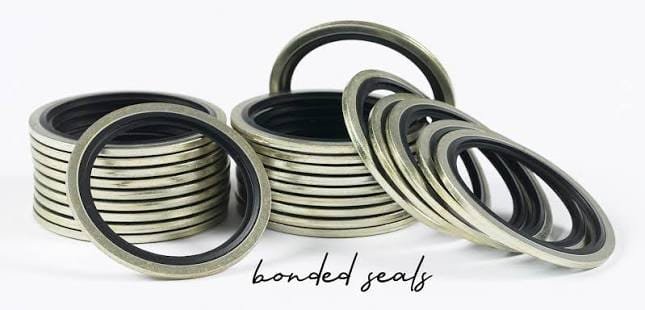
Hydraulic systems are one of the most recognizable applications for bonded washers. Pumps, valves, manifolds, cylinders, motors, hose connections, test ports, and other components may use bonded sealing elements around threaded connections.
The attraction is practical: the washer can provide a sealing interface without requiring the mating component to contain a complicated O-ring groove in every situation.
For maintenance teams, the one-piece construction can also simplify assembly because the elastomer remains attached to the metal support instead of being handled as two separate components.
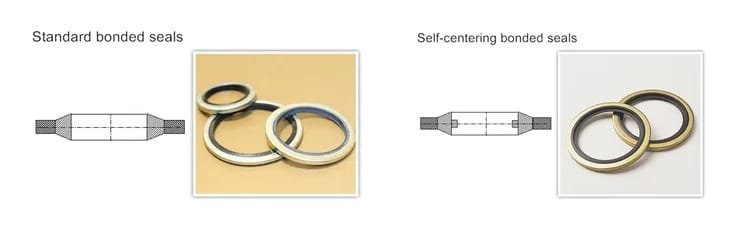
Self-centering designs can further assist installation by locating the seal around the fastener or port. This is especially useful where visual access is limited.
Bonded Washers in Automotive Applications
Automotive systems contain numerous threaded connections that may need to retain oil, fuel, coolant, refrigerant-related fluids, or hydraulic media.
Potential applications include engine components, transmission housings, hydraulic systems, fuel-related assemblies, braking components, cooling systems, and other fluid-handling connections.
The exact seal material is critical. For example, an elastomer suitable for petroleum oil should not automatically be assumed suitable for glycol-based coolant, refrigerant/oil mixtures, or aggressive cleaning chemicals.
Modern vehicle thermal-management systems can impose additional requirements. Parker documentation, for example, describes specialized composite sealing washers for automotive air-conditioning and cooling applications, including material solutions for R134a and R1234yf systems with PAG or POE oils.
Bonded Washers for Outdoor and Weatherproof Applications
Not every bonded washer is designed for high-pressure hydraulics. Another major category is the weatherproof sealing washer used with screws and fasteners on outdoor structures.
These washers can be used on roofing panels, siding, HVAC housings, solar installations, electrical enclosures, sheet-metal assemblies, and outdoor equipment where water intrusion must be controlled.
EPDM is often attractive for these applications because of its resistance to water, ozone, and weather exposure. Metal selection is also important because the washer may remain outdoors for many years.
Why Bonded Washers Are Useful in Vibration-Prone Equipment
Mechanical vibration can contribute to fastener loosening, leakage, and progressive damage. The elastomeric element in a bonded washer can provide some compliance between the fastener and mating surface.
This does not mean a bonded washer is a substitute for a properly engineered locking system. If a joint is exposed to severe cyclic loading, the engineer must evaluate fastener preload, joint stiffness, fatigue, vibration, and locking strategy separately.
The bonded washer can contribute to sealing and some degree of cushioning, but its primary purpose remains sealing.
Bonded Washers vs. O-Rings
Bonded washers and O-rings are both elastomeric sealing solutions, but they are designed for different geometries.
| Feature | Bonded Washer | O-Ring |
|---|---|---|
| Typical sealing mode | Static face/fastener sealing | Static or dynamic sealing |
| Metal support | Integrated | Normally none |
| Groove requirement | Usually simple flat sealing face | Usually requires a suitable gland |
| Installation | Generally simple | Requires correct gland and squeeze |
| Typical fastener use | Excellent | Possible only with suitable geometry |
Bonded Washers vs. Copper Crush Washers
Copper crush washers are widely used in automotive and mechanical applications. They create a seal by plastic deformation of the metal washer.
A bonded washer instead uses an elastomeric sealing element supported by a metal ring. This allows it to conform differently to surface irregularities and often reduces the need for very high deformation of the entire washer.
The choice depends on application requirements, pressure, temperature, fluid compatibility, available space, sealing surface, reusability requirements, and manufacturer specifications.
Bonded Washer Dimensions and Fit
Correct dimensions are essential. Engineers should normally verify the inner diameter, outer diameter, overall thickness, sealing profile, metal-ring thickness, and fastener compatibility.
For threaded connections, the bonded washer’s internal opening must accommodate the bolt or fitting without creating interference. At the same time, the sealing element must land on the intended sealing surface.
Choosing a washer merely because it “fits the bolt” is not enough. The sealing diameter and available face area must also be considered.
Installation of Bonded Washers
Step 1: Clean the Mating Surfaces
Remove oil sludge, dirt, metal particles, old gasket material, corrosion products, and other contamination.
Step 2: Inspect the Sealing Face
Look for scratches, burrs, corrosion pits, machining damage, dents, or distortion. A bonded washer can compensate for small imperfections, but it should not be expected to repair severe surface damage.
Step 3: Confirm Washer Orientation
Follow the manufacturer’s installation instructions. Some designs have a specific profile or self-centering feature that determines the correct orientation.
Step 4: Install Without Damaging the Elastomer
Avoid cutting, twisting, stretching, or scraping the sealing element. If the washer is installed over threads or sharp edges, protect the elastomer from mechanical damage.
Step 5: Tighten to the Correct Torque
Torque should follow the fastener, fitting, and equipment manufacturer’s specification. Do not assume that maximum available torque produces better sealing.
⚠️ Important installation warning: Excessive torque can crush or distort the elastomer, damage the fastener, deform the mating component, or alter the intended sealing geometry. Insufficient torque can leave inadequate contact pressure and allow leakage.
Why Torque Matters
Fastener torque is related to preload, but torque is not a direct measurement of preload. A simplified engineering relationship sometimes used for preliminary estimation is:
T ≈ K × F × d
where T is tightening torque, K is an empirical nut-factor, F is desired preload, and d is nominal fastener diameter.
The relationship is highly sensitive to friction. Thread condition, lubrication, coatings, surface finish, and washer characteristics can all influence the torque-preload relationship.
For a real bonded-washer application, the equipment or fastener manufacturer’s torque specification should take precedence over a generic formula.
Case Example: Hydraulic Port Leakage
Case Example — Illustrative Engineering Scenario: This example is based on common engineering failure mechanisms. It is not a report of a real customer, factory, or proprietary test result.
Consider a hydraulic manifold that repeatedly develops a small oil leak around a threaded port. A technician replaces the bonded washer, but leakage returns after several operating cycles.
A superficial diagnosis might conclude that the replacement washer is defective. A more systematic investigation would inspect:
Port sealing-face condition
Washer dimensions
Elastomer material
Fastener or plug dimensions
Thread condition
Installation torque
Hydraulic pressure and pressure cycling
Temperature
Suppose the investigation finds that the sealing face contains a deep radial scratch. Replacing the washer repeatedly may not resolve the problem because the scratch remains a potential leakage path.
The appropriate engineering response could involve correcting the sealing surface or replacing the damaged component, subject to the equipment manufacturer’s repair requirements.
Lesson: A bonded washer is a sealing component, not a substitute for a properly prepared sealing surface.
Laboratory Test Example
Laboratory Test Example: The following is an illustrative engineering test plan. It does not represent real customer data, certified production results, or a guaranteed service-life curve.
Suppose an engineering team needs to compare two bonded-washer elastomer compounds for a hydraulic application.
The team could expose representative specimens to the intended hydraulic fluid at a controlled elevated temperature and evaluate changes in:
Mass
Volume
Tensile strength
Elongation
Compression set
Surface appearance
ASTM D471 is commonly used to evaluate the effect of liquids on rubber, while ASTM D2240 can be used for hardness and ASTM D395 for compression set.
If Compound A shows excessive swelling and significant hardness loss while Compound B maintains substantially more stable properties, Compound B may be the stronger candidate. However, engineers would still need to verify actual seal geometry, pressure, compression, temperature, dynamic behavior, and production consistency before approving the material.
Failure Mode Analysis of Bonded Washers
| Failure Mode | Typical Appearance | Potential Cause | Recommended Investigation |
|---|---|---|---|
| Elastomer extrusion | Rubber pushed from sealing area | Excessive pressure or inadequate support | Pressure, clearance and seal profile |
| Chemical swelling | Soft or oversized elastomer | Fluid incompatibility | Fluid/material compatibility testing |
| Thermal cracking | Cracks or hardened rubber | Excessive temperature or aging | Temperature history and material analysis |
| Cutting | Sharp cut or nick | Threads, burrs or installation damage | Inspect installation path and hardware |
| Compression damage | Flattened or severely distorted rubber | Incorrect torque or geometry | Torque and dimensional inspection |
| Bond failure | Elastomer separates from metal | Manufacturing or chemical degradation | Bond-interface inspection |
| Corrosion | Rust or surface attack | Moisture, salt or incompatible environment | Metal grade and environmental exposure |
What Causes Bonded Washer Leakage?
Leakage can originate from several mechanisms. The most common are not necessarily material failures.
Potential causes include incorrect dimensions, damaged sealing surfaces, inadequate compression, excessive compression, incorrect torque, incompatible elastomer, excessive pressure, temperature beyond the material limit, contamination, damaged threads, assembly damage, corrosion, and incorrect installation orientation.
A good failure investigation should therefore begin with the complete joint rather than automatically replacing the washer.
How Surface Roughness Affects Sealing
No engineering surface is perfectly smooth. Even a machined metal face contains microscopic peaks and valleys.
The elastomeric element of a bonded washer is designed to conform to these irregularities. However, if the surface contains deep scratches, machining defects, corrosion pits, or radial channels, the available sealing capability may be exceeded.
Surface finish requirements depend on the specific bonded-seal design. Engineers should therefore follow the manufacturer’s sealing-face specifications instead of relying on a universal roughness value.
Corrosion Resistance
The metal portion of a bonded washer can be exposed to water, salt, humidity, chemicals, and atmospheric contaminants. Corrosion can reduce mechanical integrity and create rough surfaces that damage the elastomer.
Stainless steel can provide improved corrosion resistance compared with untreated carbon steel, although the exact stainless grade must be selected according to the environment.
Galvanic corrosion should also be considered when dissimilar metals are joined in the presence of an electrolyte such as water or saltwater.
🛠 Expert tip: If a bonded washer will be installed outdoors or in a salt-exposed environment, specify the metal and elastomer separately. “Stainless steel bonded washer” is not a complete material specification unless the exact grade and elastomer are identified.
Thermal Conductivity and Heat Transfer
Elastomers generally have low thermal conductivity compared with metals. Representative rubber compounds can have thermal conductivity roughly in the range of 0.1–0.3 W/m·K, although actual values vary with formulation and temperature.
The metal portion of the bonded washer provides a much more conductive path than the elastomer. This matters when a seal is exposed to elevated temperatures because heat can be transferred through the fastener, mating component, metal washer, and surrounding assembly.
Temperature should therefore be evaluated at the sealing interface rather than simply using the ambient temperature.
Standards and Test Methods
There is no single universal standard that determines whether every bonded washer is suitable for every application. Instead, engineers typically use dimensional, material, fastener, elastomer, and application-specific standards together.
ASTM D2240 is commonly used for elastomer hardness. ASTM D395 addresses compression set. ASTM D412 covers tensile properties of vulcanized rubber and thermoplastic elastomers, ASTM D471 evaluates the effect of liquids on rubber, and ASTM D573 addresses accelerated aging in air.
These standards describe test methods. They do not automatically establish a universal acceptance criterion for a particular bonded washer.
Depending on the application, designers may also encounter DIN-based sealing and fastener specifications, manufacturer-specific bonded-seal standards, hydraulic-port standards, and customer engineering specifications.
How to Select the Right Bonded Washer
Identify the fastener or port size. Confirm the nominal thread size and actual sealing diameter.
Measure the sealing face. Make sure enough flat surface exists for the elastomer to contact properly.
Identify the fluid. Oil, water, fuel, coolant, refrigerant, hydraulic fluid and chemicals require different material considerations.
Determine operating temperature. Consider continuous temperature and transient peaks.
Determine pressure. Include both steady-state and pressure spikes.
Evaluate vibration. Consider whether the joint experiences cyclic loading.
Choose the elastomer. NBR, HNBR, FKM and EPDM have different strengths.
Choose the metal. Consider carbon steel, stainless steel, plating, corrosion and galvanic compatibility.
Verify dimensions. Confirm inner diameter, outer diameter, thickness and profile.
Confirm torque. Use the equipment manufacturer’s specification whenever available.
How to Specify a Bonded Washer for Purchasing
A good purchasing specification should contain enough information to distinguish the required component from visually similar alternatives.
| Specification | Example Information |
|---|---|
| Seal type | Standard or self-centering bonded seal |
| Size | Metric or imperial nominal size |
| Elastomer | NBR, HNBR, FKM, EPDM or specified compound |
| Elastomer hardness | Specified Shore A value or allowable range |
| Metal | Carbon steel, stainless steel and exact grade where required |
| Fluid | Exact operating medium |
| Temperature | Continuous and maximum temperature |
| Pressure | Operating and peak pressure |
For buyers looking for a broader range of sealing components, bonded washers can be evaluated by material, size, sealing profile, and application requirements rather than by appearance alone.
Advantages of Bonded Washers
Integrated construction: The metal ring and elastomer are supplied as one component.
Reliable static sealing: The elastomer creates the sealing barrier.
Mechanical support: The metal ring distributes load and controls compression.
Simple assembly: One component is easier to handle than separate washer and elastomer components.
Wide material selection: Different elastomers and metals can be matched to different environments.
Compact design: Useful where space around a threaded connection is limited.
Self-centering options: Certain profiles simplify alignment during assembly.
Limitations of Bonded Washers
Bonded washers are not universal replacements for every gasket or O-ring.
They are primarily static sealing components. If the sealing interface itself must accommodate continuous rotary or reciprocating motion, another seal design may be more appropriate.
They also have limitations related to pressure, temperature, chemical compatibility, surface condition, compression, and available sealing area.
For extreme applications, engineers may need specialized metal seals, graphite gaskets, PTFE-based seals, O-rings, lip seals, or engineered face seals.
When Should You Use a Self-Centering Bonded Washer?
Self-centering bonded washers incorporate additional elastomeric geometry that helps locate the washer relative to the fastener or port.
This can be particularly useful where installation access is restricted or where alignment is difficult. The self-centering feature can reduce the likelihood that the washer is installed off-center.
However, self-centering geometry should not be assumed to improve every performance characteristic. It remains necessary to verify pressure, compression, material, and dimensional compatibility.
Bonded Washer Storage
Elastomeric sealing products should generally be stored away from direct sunlight, excessive heat, ozone-generating equipment, contamination, and unnecessary mechanical deformation.
Long-term storage can influence elastomer properties, especially when seals are exposed to unfavorable environmental conditions.
Keeping bonded washers in their original packaging until use is a sensible practice when possible.
Quality Inspection of Bonded Washers
A professional incoming inspection may include dimensional checks, visual inspection, material verification, hardness testing, bond inspection, and packaging verification depending on application criticality.
Visual inspection should look for:
Cracks
Cuts
Voids
Delamination
Surface contamination
Metal corrosion
Incorrect dimensions
Damaged sealing edges
For safety-critical or high-pressure applications, quality control should be based on documented specifications and validated inspection procedures rather than visual appearance alone.
Expert Tips for Better Bonded Washer Performance
🔧 Tip 1: Never choose the elastomer solely by temperature. Fluid compatibility is equally important.
🔧 Tip 2: Always inspect the mating surface when investigating repeated leakage.
🔧 Tip 3: Do not assume a higher torque value produces a better seal.
🔧 Tip 4: Specify the exact metal grade when corrosion is important.
🔧 Tip 5: Confirm the actual pressure rating for the exact washer design instead of using a generic bonded-washer pressure number.
🔧 Tip 6: Treat the washer, fastener, mating surface, fluid, temperature, and pressure as one sealing system.
Are Bonded Washers Reusable?
In most maintenance situations, a bonded washer should be replaced rather than automatically reused after removal. Compression can permanently alter the elastomer’s geometry, and the sealing surfaces may have experienced wear or contamination.
Some specific designs or industrial procedures may permit reuse under controlled conditions, but this should be based on the manufacturer’s documented recommendation rather than a general assumption.
Why Do Bonded Washers Fail Prematurely?
Premature failure usually has an identifiable cause. Common mechanisms include incorrect material, excessive temperature, chemical incompatibility, over-compression, insufficient compression, damaged sealing surfaces, excessive pressure, installation damage, corrosion, and incorrect dimensions.
In engineering troubleshooting, the removed washer should be treated as evidence. Its appearance can provide clues about the failure mechanism.
A hardened, cracked elastomer suggests a very different problem from a cleanly cut sealing lip. A swollen rubber ring suggests a different problem again. A corroded metal support points toward environmental or material-selection issues.
A Practical Failure-Diagnosis Checklist
| Question | Why It Matters |
|---|---|
| Was the correct size installed? | Incorrect geometry can prevent proper compression. |
| Was the correct elastomer used? | Chemical incompatibility can cause swelling or degradation. |
| Was torque correct? | Too little or too much compression can cause leakage. |
| Was the surface damaged? | Scratches and corrosion can create leak paths. |
| Was the washer contaminated? | Particles can prevent uniform sealing. |
| Was temperature within specification? | Excessive heat accelerates elastomer aging. |
| Was pressure within specification? | Excessive pressure can promote extrusion or leakage. |
The Most Important Engineering Principle
The most important point about bonded washers is that their performance comes from the interaction between two very different materials.
The metal provides strength and dimensional control. The elastomer provides flexibility and conformity. The fastener provides compression. The mating surface provides the sealing interface. The fluid determines chemical compatibility. Temperature determines much of the material’s long-term behavior. Pressure determines the mechanical demand.
Changing any one of these variables can change the performance of the entire joint.
In other words: a bonded washer is not simply a washer with rubber attached. It is a compact composite sealing system engineered to manage mechanical load and fluid leakage simultaneously.
Final Selection Guide
When choosing a bonded washer, start with the actual operating conditions rather than the product name.
First determine the fastener or port dimensions. Then establish the fluid, pressure, temperature, vibration, environmental exposure, and sealing-face condition. Select the elastomer according to chemical and thermal compatibility, then select the metal according to mechanical and corrosion requirements.
Finally, verify the exact dimensions, installation orientation, torque requirement, and product-specific pressure rating.
For engineers and purchasing teams, the most reliable approach is to request a technical datasheet or specification that identifies the material, dimensions, hardness, operating limits, and applicable test requirements.
Frequently Asked Questions About Bonded Washers
FAQ 1: What are bonded washers used for?
Bonded washers are primarily used to create static seals around bolts, screws, plugs, threaded fittings, and other fasteners. They are commonly used to prevent oil, hydraulic fluid, fuel, water, coolant, air, and other fluids or gases from leaking through a fastener connection.
FAQ 2: What is the difference between a bonded washer and a normal washer?
A normal metal washer mainly distributes fastener load. A bonded washer combines a metal support ring with a permanently bonded elastomeric sealing element, allowing it to distribute load while also providing a fluid or gas seal.
FAQ 3: Which rubber is best for a bonded washer?
There is no universal best material. NBR is commonly suitable for many oil and hydraulic applications, HNBR offers improved heat and aging resistance, FKM is useful for demanding high-temperature and chemical environments, and EPDM is particularly strong for water, weather, and ozone exposure. The exact fluid and temperature should determine the selection.
FAQ 4: Can bonded washers be used for high pressure?
Yes, specially designed bonded seals can be used in high-pressure hydraulic and pneumatic applications. However, pressure capability is product-specific. The exact washer size, profile, elastomer, compression, mating surface, temperature, and manufacturer rating must be considered. Some specialized products are rated for several hundred bar, but such ratings cannot be generalized to all bonded washers.
FAQ 5: Should a bonded washer be reused?
In general maintenance practice, replacement is preferred after removal because the elastomer may have been permanently compressed or damaged and the original sealing condition may no longer be reproducible. Reuse should only be considered when the specific manufacturer or equipment procedure explicitly permits it.