
D-Rings
D-Rings Overview
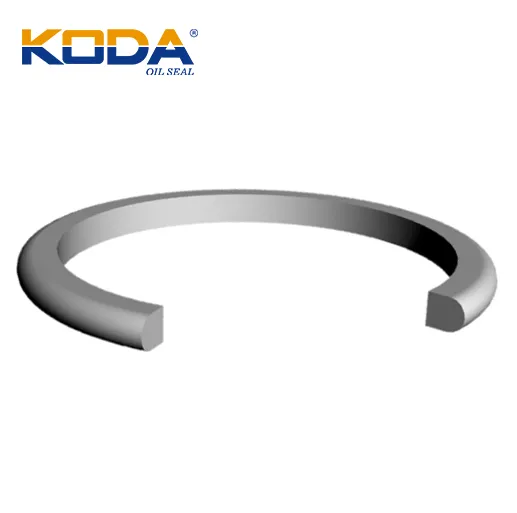
D-Rings are elastomer seals featuring a D-shaped cross-section, with one flat sealing surface and one curved sealing surface. This unique profile combines the installation simplicity of an O-ring with improved stability in dynamic applications. Compared with conventional O-rings, D-rings are less likely to twist or roll inside the gland, making them an effective solution for hydraulic cylinders, pneumatic actuators, rotary shafts, and reciprocating equipment.
Why Choose D-Rings?
When standard O-rings experience seal rolling, extrusion, or inconsistent performance, D-rings often provide a more reliable alternative.
Excellent Anti-Roll Performance
The flat base keeps the seal firmly positioned inside the groove, significantly reducing seal twisting during installation and operation. This helps maintain consistent sealing pressure throughout the service life.
Lower Dynamic Friction
The optimized sealing geometry minimizes unnecessary contact with the mating surface, reducing running friction while maintaining reliable sealing performance. Lower friction also helps reduce heat generation in continuously moving systems.
Improved Pressure Stability
Because the flat surface provides greater positional stability, D-rings perform well under medium to high pressure where standard O-rings may experience rolling or extrusion.
Compatible with Existing O-Ring Grooves
Many D-rings are manufactured in standard O-ring sizes, allowing engineers to upgrade sealing performance without redesigning existing hardware.
Available Materials
Selecting the correct elastomer is essential for sealing reliability.
| Material | Advantages | Typical Applications |
|---|---|---|
| NBR (Buna-N) | Excellent oil resistance and abrasion resistance | Hydraulic systems, industrial machinery |
| FKM (Viton®) | Outstanding chemical and high-temperature resistance | Automotive, chemical processing |
| EPDM | Excellent resistance to water, steam, and ozone | Water treatment, food equipment |
| HNBR | High strength and wear resistance | Heavy-duty hydraulic cylinders |
| PTFE | Extremely low friction and chemical compatibility | High-speed and aggressive media applications |
D-rings and O-ring grooves
One of the core advantages of D-rings lies in their excellent compatibility with the standard grooves of O-rings. D-rings can be directly installed into the existing grooves of O-rings, achieving a seamless upgrade and replacement from O-rings to D-rings.
This compatibility avoids large-scale structural modifications or process adjustments to equipment, significantly reducing upgrade costs. See the table below for various specifications of D-rings and their corresponding AS568 standard dimensions.
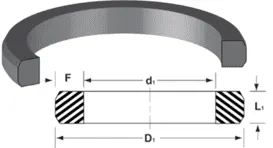
| D-Ring | d1 (in) | D1 (in) | L1 (in) | F (in) | Flange Size - in | d1 (mm) | D1 (mm) | L1 (mm) | F (mm) | DASH # |
|---|---|---|---|---|---|---|---|---|---|---|
| 1P-3709 | 2.497 | 2.75 | 0.195 | 0.134 | 2.25 | 63.9 | 69.85 | 5 | 3.4 | 230 |
| 1P-3708 | 2.247 | 2.5 | 0.195 | 0.134 | 2 | 57.4 | 63.5 | 5 | 3.4 | 228 |
| 1P-3707 | 2.134 | 2.4 | 0.195 | 0.134 | 1.875 | 54.2 | 60.96 | 5 | 3.4 | 227 |
| 1P-3706 | 1.997 | 2.25 | 0.195 | 0.134 | 1.75 | 51.1 | 57.15 | 5 | 3.4 | 226 |
| 1P-3705 | 1.747 | 2 | 0.195 | 0.134 | 1.5 | 44.7 | 50.8 | 5 | 3.4 | 224 |
| 1P-3704 | 1.494 | 1.75 | 0.195 | 0.134 | 1.25 | 38.2 | 44.45 | 5 | 3.4 | 222 |
| 1P-3703 | 1.244 | 1.5 | 0.195 | 0.134 | 1 | 31.9 | 38.1 | 5 | 3.4 | 218 |
| 1P-3702 | 0.994 | 1.25 | 0.195 | 0.134 | 0.75 | 25.4 | 31.75 | 5 | 3.4 | 214 |
| 1P-3700 | 0.744 | 1 | 0.195 | 0.134 | 0.5 | 19 | 25.4 | 5 | 3.4 | 210 |
How to Select the Right D-Ring
Selecting the correct D-ring involves evaluating both the application and operating environment.
Consider the Type of Motion
D-rings perform best in:
- Reciprocating motion
- Rotary motion
- Medium- to high-pressure hydraulic sealing
- Pneumatic dynamic sealing
For purely static applications, a standard O-ring or square ring may be a more cost-effective choice.
Match the Material to the Working Media
Before selecting a compound, verify compatibility with:
- Hydraulic oil
- Lubricating grease
- Fuel
- Water
- Steam
- Industrial chemicals
Using an incompatible elastomer can lead to swelling, hardening, or premature seal failure.
Verify Groove Dimensions
Many D-rings are designed to retrofit standard O-ring glands, but groove dimensions, squeeze, and clearance should always be checked to ensure proper sealing and avoid excessive compression.
Common Sealing Problems D-Rings Can Solve
A properly selected D-ring helps eliminate many common sealing issues, including:
- O-ring twisting during assembly
- Seal rolling during reciprocating motion
- Premature seal wear
- Leakage caused by unstable seal positioning
- High friction in hydraulic cylinders
- Frequent maintenance caused by seal failure
For OEM equipment and maintenance upgrades, D-rings often improve sealing reliability without requiring major design changes.
Improve Dynamic Sealing Performance with D-Rings
For hydraulic and pneumatic systems operating under continuous movement, seal stability is just as important as material selection. D-rings offer a practical solution by reducing seal rotation, lowering friction, and improving sealing consistency. With proper material selection and gland design, they help extend equipment service life, reduce maintenance costs, and improve long-term operational reliability.