
BS 4518 Metric O-Rings
BS 4518 Metric O-Rings
BS 4518 metric O-rings are standardized metric sealing rings developed around the British Standard system for toroidal elastomeric seals. Unlike generic metric O-rings that may simply be manufactured to a nominal diameter, BS 4518 provides defined O-ring dimensions together with associated housing-groove requirements.The current British Standards Institution listing identifies BS 4518:1982+A2:2014 as the specification for metric dimensions of toroidal sealing rings (“O-rings”) and their housings. The standard covers O-rings used for preventing fluid ingress or egress under both static and dynamic sealing conditions and also defines associated housing configurations.
For engineers, maintenance teams, and purchasing departments, this distinction is important. A BS 4518 O-ring should not be selected from inside diameter alone. The reference code, cross-section, groove geometry, working medium, temperature, pressure, and installation conditions all influence whether the finished seal will perform reliably.
For a complete listing of all metric o-ring sizes, visit our Metric O-Ring Cross Reference Table.
BS 4518 Size Chart
| Global Part # | Reference | C/S (MM) | I.D.(MM) | C/S (Inch) | I.D.(Inch) |
|---|
BS 4518 O-Ring Dimensions: ID Is Only One Part of the Specification
When replacing an existing seal, technicians often measure the inside diameter and assume the replacement is correct if the ID is close.
This approach can create problems.
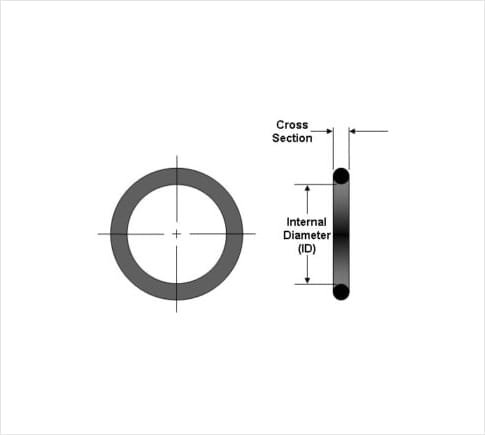
An O-ring has three primary dimensional characteristics:
- Inside diameter (ID)
- Cross-section (CS)
- Outside diameter (OD)
The relationship is:
OD ≈ ID + 2 × cross-section
For example, a 10.1 mm ID O-ring with a 1.6 mm cross-section has an approximate free-state OD of:
10.1 + (2 × 1.6) = 13.3 mm
This corresponds to the dimensional relationship shown in BS 4518 reference data.
However, the free-state dimensions should not be confused with the installed dimensions. Once the O-ring is placed into its groove, the elastomer is intentionally compressed or stretched depending on the sealing configuration.
Why Cross-Section Matters
Changing only the cross-section can significantly change sealing behavior.
A thicker O-ring can provide:
- Greater radial sealing contact
- Greater resistance to certain installation imperfections
- More available material for deformation
But a larger cross-section also requires a different groove design. Simply placing a thicker O-ring into an existing shallow groove can cause excessive squeeze, high friction, difficult assembly, or premature extrusion.
Conversely, installing an undersized cross-section may result in insufficient squeeze and leakage.
The replacement O-ring should therefore match the original dimensional standard and housing design rather than being selected solely by approximate diameter.
BS 4518 O-Ring Groove Design
One of the most important differences between a professional BS 4518 application and a simple “metric O-ring replacement” is the housing.
BS 4518 does not only define the elastomeric ring. It also addresses the dimensions and configurations of associated housing grooves. BSI states that the standard specifies five types of housing grooves and is intended for pressure conditions normally not exceeding 100 bar.
This matters because an O-ring does not seal by itself.
The sealing system consists of:
O-ring + groove + mating surface + fluid + pressure + temperature
A correctly manufactured O-ring installed in an incorrectly designed groove can still leak.
Radial or Diametral Sealing
In a radial sealing arrangement, the O-ring is compressed between an internal and external component.
Typical applications include:
- Hydraulic cylinders
- Valve spools
- Piston assemblies
- Pipe connections
- Hydraulic cartridges
- Pneumatic components
The amount of squeeze must be controlled carefully.
Too little squeeze can cause leakage, particularly during pressure fluctuations or thermal cycling.
Too much squeeze can produce:
- Excessive assembly force
- High friction
- Accelerated wear
- Increased heat generation in dynamic applications
- O-ring damage during installation
Static Face Sealing
BS 4518 also provides dimensions for static face-sealing arrangements. In this configuration, the O-ring is compressed axially between mating faces.
This is commonly encountered in:
- Flanged connections
- Valve covers
- End caps
- Hydraulic manifolds
- Machine housings
For static face sealing, groove depth, groove width, corner radius, and compression are all important.
BS 4518 Pressure Considerations
A common mistake is to assume that a standardized O-ring automatically has a universal pressure rating.
It does not.
Pressure capability depends on the complete sealing design, including:
- O-ring material
- O-ring hardness
- Groove clearance
- Pressure direction
- Temperature
- Extrusion gap
- Dynamic or static operation
- Surface finish
- Backup-ring design
BSI describes the BS 4518 housing configurations for pressures normally not exceeding 100 bar. It also notes that when pressure exceeds 100 bar, or when diametral clearance is greater than specified, an anti-extrusion backup ring is recommended.
Therefore, a purchasing specification such as:
“BS 4518 O-ring, 100 bar”
is incomplete.
The engineer should evaluate the actual operating pressure and extrusion clearance before approving the seal.
BS 4518 vs. Generic Metric O-Rings
One of the most common purchasing problems is the assumption that all metric O-rings with the same nominal dimensions are interchangeable.
In practice, a generic metric O-ring may not have been manufactured or documented according to the same dimensional system.
BS 4518 provides a defined reference system for O-ring dimensions and associated housings.
Why Standardization Helps
A standardized part number makes it easier to:
- Identify replacement seals
- Maintain engineering drawings
- Control spare-parts inventory
- Communicate requirements to suppliers
- Reduce dimensional ambiguity
- Reproduce an existing sealing design
For production equipment, this can be more important than the small difference in purchase price between two visually similar O-rings.
BS 4518 vs. ISO 3601 Metric O-Rings
BS 4518 and ISO 3601 should not automatically be treated as identical standards.
Both provide standardized metric O-ring dimensions, but their designation systems and dimensional requirements can differ.
When replacing an O-ring originally specified as BS 4518, the safest approach is to verify:
- Original standard
- Reference number
- ID
- Cross-section
- Groove dimensions
- Material
- Hardness
- Operating conditions
A cross-reference chart can help identify potentially equivalent sizes, but dimensional equivalence does not automatically establish application equivalence.
The replacement still needs to satisfy the sealing design and material requirements.
How to Measure an Existing BS 4518 O-Ring
When the original part number is unavailable, measurement becomes important.
Step 1: Measure the Cross-Section
Use a calibrated caliper or preferably an O-ring measurement gauge.
Measure the elastomer away from areas that have been flattened or damaged.
Step 2: Measure the Inside Diameter
Measure the inside diameter without stretching the O-ring excessively.
If the O-ring has been permanently stretched, the measured value may not represent its original free-state dimension.
Step 3: Inspect the Cross-Section
Look for:
- Flattening
- Swelling
- Cuts
- Compression set
- Surface cracks
- Spiral marks
- Extrusion damage
A damaged O-ring can provide misleading dimensional measurements.
Step 4: Identify the Groove
If possible, measure the original groove:
- Groove diameter
- Groove width
- Groove depth
- Corner radius
- Clearance gap
The groove often provides more reliable information than a damaged seal.
Final Engineering Takeaway
BS 4518 metric O-rings provide a practical standardized system for identifying and designing metric sealing components. Their four-digit-plus-two-digit reference format makes dimensional identification relatively straightforward, while the associated housing specifications help engineers develop repeatable sealing designs.
However, matching the BS 4518 size alone is not enough to guarantee sealing performance.
A reliable replacement should match:
Dimensional standard + ID + cross-section + material + hardness + groove + pressure + temperature + working fluid + installation conditions.
For low-risk applications, this approach prevents common sizing mistakes. For hydraulic, pneumatic, chemical, automotive, or other demanding systems, it provides the foundation for a much more reliable engineering review.
The most effective way to specify a BS 4518 O-ring is therefore not simply to ask for a “metric O-ring.” Specify the BS 4518 reference number together with the elastomer compound and application requirements. That small improvement in purchasing information can eliminate a large number of avoidable sealing failures.