Oil Seal DB - Rotary Shaft Seal
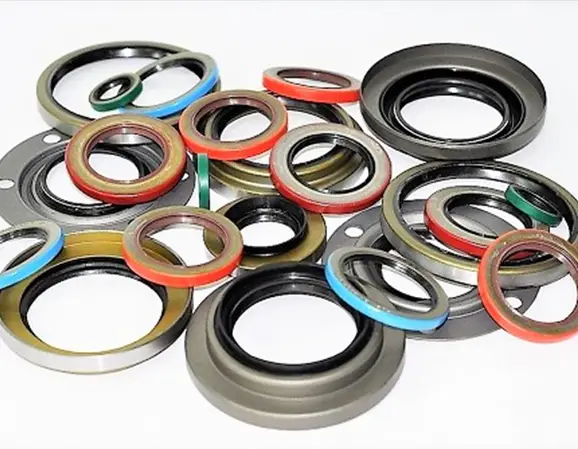
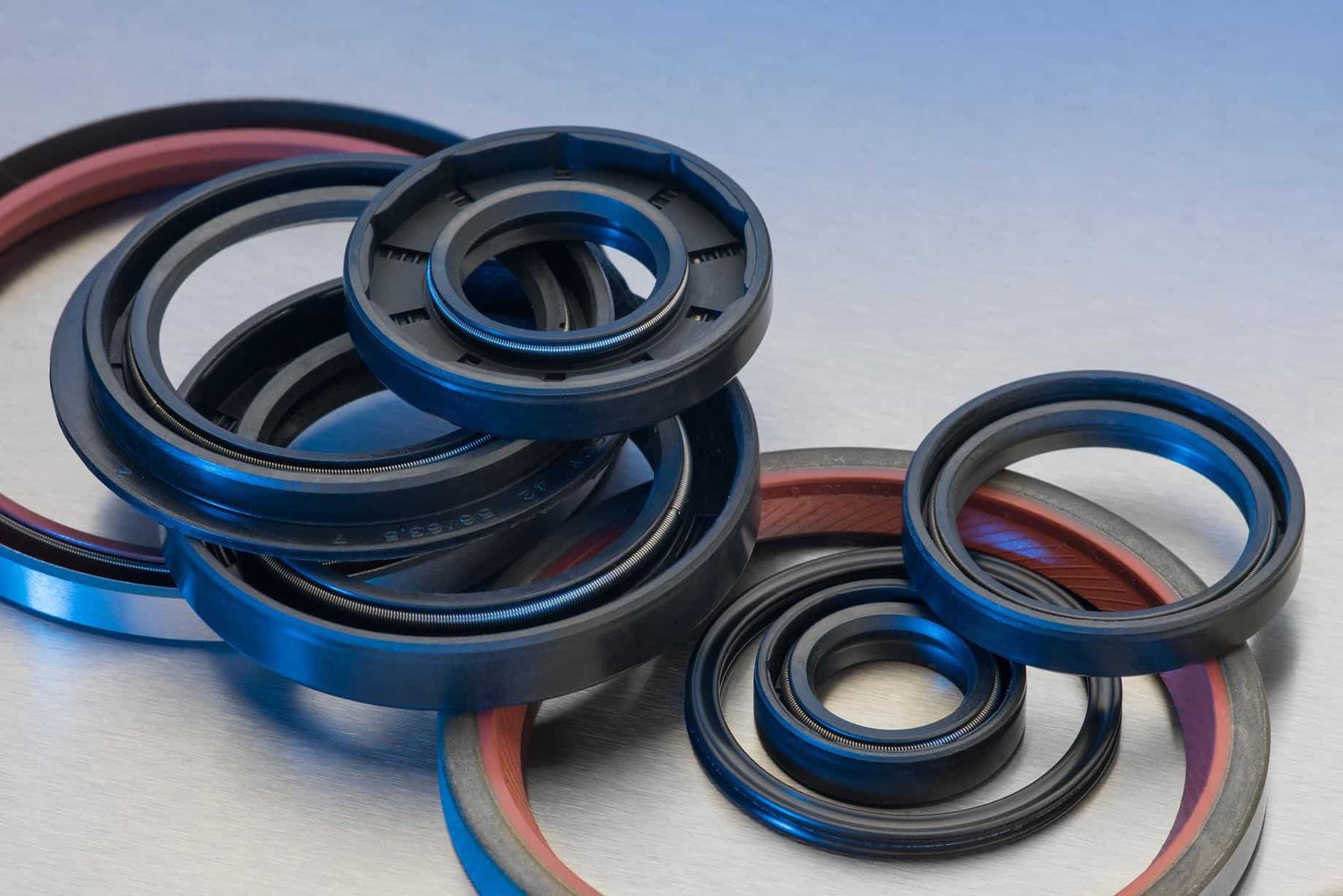
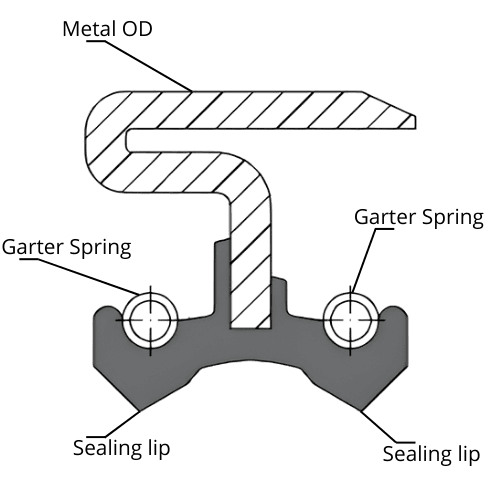
The DB oil seal is specifically engineered for rotating equipment where two different fluids or lubricants must remain completely separated. Unlike conventional rotary shaft seals that are primarily designed to retain lubricant and prevent the ingress of contaminants, the DB profile serves as a barrier between two independent media within the same assembly.
This sealing configuration is commonly used in machinery featuring multiple lubrication chambers, process fluids, or separate oil circuits where fluid migration could lead to contamination, reduced efficiency, or component damage. By maintaining a reliable separation zone, the DB oil seal helps ensure stable operation and protects system integrity.
To meet a wide range of operating conditions, DB rotary shaft seals are available in several elastomer compounds, including NBR, FKM (Viton®), ACM, Silicone (VMQ), CR, HNBR, and EPDM. Each material offers different levels of resistance to temperature, chemicals, wear, and environmental influences, allowing the seal to be matched to specific application requirements.
Depending on the manufacturer, industry standard, or catalog system, the DB oil seal may also be identified under alternative reference codes such as WBD, OS-D15, BD, M-DUO, B1 DUO, 822D, DFD, BK, and KB-DUO. Although the naming may vary, these designations generally refer to the same dual-media rotary shaft seal concept designed for effective fluid separation.
Applications and Why This Type Is Suitable
DB oil seals are commonly employed in rotating equipment where two separate fluids or lubrication systems must be kept completely isolated from one another. They are frequently found in industrial gear units with independent lubrication chambers, transmission assemblies where bearing grease and gearbox oil must remain separated, and pumping systems that handle different media on opposite sides of the shaft.
Additional applications include speed reducers, mixing equipment, processing machinery, and other industrial installations where preventing the migration of lubricants or process fluids is essential for maintaining system efficiency and product integrity. In these environments, even minor cross-contamination can negatively impact performance, making reliable fluid separation a critical design requirement.
One of the key advantages of the DB oil seal is its unique dual-sealing configuration. Unlike conventional arrangements that require two individual oil seals installed in opposite directions, the DB profile integrates two fully functional sealing lips into a single component. Both lips operate independently and provide active sealing performance, allowing the seal to create an effective barrier between two media within a compact installation space.
This integrated design offers several practical benefits, including reduced component count, simplified assembly procedures, and more efficient use of available housing space. In addition, using a single DB seal can help minimize alignment issues, installation tolerances, and assembly errors that may occur when multiple seals are used to achieve the same sealing function.
As a result, DB oil seals provide an efficient and reliable solution for applications requiring medium separation, long-term sealing performance, and optimized equipment design.
Material Options
The performance and service life of a DB oil seal are closely linked to the elastomer material selected for the application. Choosing the correct compound requires evaluating factors such as operating temperature, lubricant composition, environmental exposure, and expected mechanical stresses.
NBR (Nitrile Rubber) is the most commonly specified material for DB oil seals due to its excellent compatibility with mineral oils and greases. It provides a practical combination of durability, flexibility, and cost-effectiveness, making it suitable for a wide range of industrial sealing applications.
When operating conditions involve elevated temperatures or exposure to aggressive chemicals and synthetic lubricants, FKM (Viton®) is often recommended. This material offers outstanding resistance to heat, oxidation, and chemical attack, making it well suited for demanding environments where standard elastomers may not provide sufficient durability.
For applications involving modern lubricant formulations with performance-enhancing additives, ACM (Polyacrylate Rubber) can provide improved resistance to oil degradation. HNBR (Hydrogenated Nitrile Rubber) is frequently selected when increased wear resistance, higher mechanical strength, and extended operating life are required.
Other specialized materials are available for unique operating conditions. Silicone (VMQ) is commonly chosen for extreme temperature applications, CR (Chloroprene Rubber) offers good resistance to weathering and ozone, while EPDM is typically used in systems exposed to water-based media or outdoor environmental conditions. Because these compounds have specific compatibility characteristics, material selection should always be verified against the operating fluid and service conditions.
For installations exposed to moisture, chemicals, or corrosive atmospheres, additional protection can be achieved by specifying stainless steel garter springs and stainless steel reinforcing components, helping to improve corrosion resistance and extend seal reliability.
Material Table
Material | Temperature Range | Key Properties |
NBR | –40 °C to +100 °C | Good resistance to mineral oils and greases, good wear resistance, flexible, cost-effective |
FKM | –20 °C to +150 °C | High temperature resistance, excellent chemical resistance, suitable for aggressive lubricants, lower flexibility at low temperatures |
HNBR | –30 °C to +140 °C | Improved mechanical strength, better heat and aging resistance than NBR, good oil resistance |
ACM | –20 °C to +150 °C | Resistant to oils with additives, good thermal stability, limited low-temperature flexibility |
VMQ | –60 °C to +180 °C | Excellent low-temperature flexibility, good heat resistance, poor wear and oil resistance |
CR | –30 °C to +100 °C | Moderate oil resistance, good weather and ozone resistance, general-purpose elastomer |
EPDM | –40 °C to +120 °C | Excellent resistance to water, steam, and brake fluids, not suitable for mineral oils |
Comparable Oil Seal Types
Among the various rotary shaft seal profiles available, the DB oil seal serves a highly specialized function. Rather than focusing solely on lubricant retention or contamination exclusion, its primary purpose is to maintain a reliable barrier between two separate fluids or lubrication zones within the same shaft arrangement.
This operating principle clearly distinguishes the DB profile from more common designs such as SC and TC oil seals. An SC oil seal is typically used to retain a single lubricant in clean operating environments, while a TC oil seal incorporates an auxiliary dust lip to help prevent external contaminants from entering the system. In contrast, the DB configuration features two spring-loaded sealing lips that both function as active sealing elements, enabling effective separation of different media on opposite sides of the seal.
Another defining characteristic of the DB oil seal is its rigid metal outer case. The metal outer diameter provides precise positioning within the housing and delivers excellent dimensional stability during operation. This construction is particularly beneficial in applications where alignment accuracy, structural rigidity, and long-term stability are important considerations.
However, because the outer surface is metallic rather than elastomer-coated, the seal relies more heavily on housing accuracy and surface quality. Installation conditions must therefore be carefully controlled to ensure optimal sealing performance. While rubber-covered oil seals can accommodate minor housing imperfections, the DB design is intended for applications where machining tolerances can be maintained within specified limits.
For this reason, the DB oil seal is best viewed as a purpose-built sealing solution rather than a general-purpose alternative. It is specifically selected for equipment where reliable medium separation, dimensional precision, and long-term sealing integrity are critical requirements.
Selection Criteria: Dimensions, Tolerances, and Boundary Conditions
Choosing the correct DB oil seal begins with verifying the shaft and housing dimensions to ensure optimal sealing performance. The shaft should comply with ISO h11 tolerances and provide a hardened running surface with a minimum hardness of 45 HRC. To minimize friction, lip wear, and the risk of leakage, the shaft surface should be free from lead or torsional machining marks and meet the recommended finish specifications of Ra 0.2–0.8 μm, Rz 1–5 μm, and Rmax ≤ 6.3 μm.
Housing quality is equally important, particularly because the DB oil seal utilizes a metal outer diameter. The housing bore should be manufactured according to ISO H8 tolerance standards and provide a uniform seating surface capable of supporting a secure interference fit. Recommended bore surface characteristics include Ra 0.8–3.2 μm, Rz 6.3–16 μm, and Rmax ≤ 16 μm. Maintaining these specifications helps ensure proper seal retention, accurate positioning, and reliable static sealing between the metal case and housing.
In addition to dimensional requirements, application conditions must be carefully evaluated when selecting a DB oil seal. Important considerations include operating temperature, fluid type, shaft speed, and system pressure. Under normal operating conditions, standard material configurations are generally suitable for temperatures ranging from –40°C to +100°C, although continuous operation below +80°C is typically recommended to maximize seal life.
DB oil seals are intended for non-pressurized or very low-pressure systems, with a typical pressure capability of approximately 0.02 MPa. Maximum permissible shaft surface speed is generally around 5 m/s, although actual performance may vary depending on lubrication conditions, shaft finish, and seal material selection.
When using synthetic lubricants, specialty oils, or process fluids outside standard operating parameters, compatibility between the sealing material and the medium should always be confirmed before installation. Proper material selection can significantly improve sealing reliability and extend service life.
Oil Seal Cross-Reference Information
Oil seals are manufactured by numerous suppliers worldwide, and each manufacturer may use its own product coding system or designation for similar seal profiles. As a result, identical or equivalent oil seal designs can often be found under different reference numbers depending on the brand or catalog.
To simplify product identification and sourcing, the cross-reference table below provides an overview of equivalent designations used by various oil seal manufacturers and suppliers, helping users locate interchangeable alternatives across different product ranges.
Cross Reference
Manufacturer | DB Oil Seal Designation |
Dichtomatik | WBD |
Anyseals | OS-D15 |
Elring | BD |
Eriks | M-DUO |
FST | B1 DUO |
Goetze | 822 D |
Kaco | DFD |
Stefa | BK |
NOK / Taiwan NOK | DB |
Kimman | KB-DUO |
If you would like more information about this oil-seal or you don’t know what size or material you should have, please feel free to contact us.