
Category: VC oil seal
Oil Seal VC - Rotary Shaft Seal
The VC oil seal is a single-lip rotary shaft sealing profile designed for applications that require dependable lubricant retention with minimal sealing resistance. Unlike spring-energized seal designs, the VC configuration operates without a garter spring, relying instead on its precisely molded sealing lip to maintain contact with the shaft surface. This construction helps reduce friction, limit heat buildup, and promote efficient operation in light- to medium-duty applications.
Manufactured entirely from elastomeric materials, the VC seal offers excellent flexibility and adaptability during installation. Its resilient outer surface allows the seal to accommodate standard housing tolerances while providing reliable static sealing performance. The absence of a spring also contributes to lower radial load on the shaft, which can be advantageous in applications where reduced wear and smooth running characteristics are important.
VC rotary shaft seals are available in a variety of elastomer compounds, including NBR, FKM, ACM, EPDM, and VMQ, enabling compatibility with different operating temperatures, lubricants, and environmental conditions. This broad material selection makes the profile suitable for a wide range of industrial equipment, electric motors, pumps, gear drives, and other rotating machinery.
The design is particularly well suited for auxiliary or secondary sealing functions, such as retaining grease within bearing assemblies or protecting lightly loaded lubrication systems. In these situations, the seal provides consistent performance while maintaining a lower contact force than conventional spring-loaded alternatives.
Depending on the manufacturer or regional standard, the VC profile may be referenced under different product names or designation systems. Common equivalent codes include WAO, OS-B12, TR-K, A OF, RZV, GSM, BA OF, SA, 827 NO, DE, CD, IO, R26, LSM, and KAOW. These cross-reference identifiers can assist in locating compatible replacements across various brands and catalog systems.
| Picture | KODA NO. | OEM | Name | Product Highlights | Size | Style | Shaft diameter | Bore diameter | Seal height | Material | Inquiry |
|---|
Technical description
The VC rotary shaft seal features a precision-molded sealing lip that maintains effective contact with the rotating shaft without the assistance of a garter spring. This spring-free design minimizes radial loading and friction, making the seal particularly suitable for applications where low heat generation and smooth operation are important. The sealing lip effectively retains lubricants such as oil or grease, while the elastomer-covered outer diameter creates a dependable static seal between the seal and the housing bore.
Thanks to its flexible elastomer construction, the VC profile can accommodate minor imperfections in the housing surface and adapt to slight dimensional changes caused by temperature variations. This capability helps maintain sealing performance even in installations where bore surface conditions are not perfectly uniform.
The fully rubber-bodied design also simplifies installation. The seal can be fitted easily into the housing, while the elastomer material helps absorb vibration and compensate for small assembly irregularities. As a result, VC oil seals are often selected for compact equipment, cost-sensitive applications, and systems where the additional complexity of a spring-loaded sealing lip is unnecessary.
Performance characteristics such as temperature resistance, chemical compatibility, and service life are determined by the selected elastomer compound. Available material options allow the VC seal to be optimized for a variety of operating environments, ranging from standard industrial machinery to applications involving fluctuating temperatures or specialized media.
Because the sealing lip operates without spring assistance, contact forces on both the shaft and the lip remain relatively low. This reduced mechanical load can help minimize wear, extend component life, and support reliable long-term performance in light-duty and moderate-duty sealing applications.
Construction information
The VC rotary shaft seal is designed with a single sealing lip and a fully elastomeric outer body. Sealing performance is achieved through the inherent elasticity of the rubber material, allowing the lip to maintain continuous contact with the rotating shaft without the use of a garter spring. This design provides effective lubricant retention while reducing friction and simplifying the overall seal structure.
The elastomer-coated outer diameter creates a secure fit within the housing bore and helps prevent leakage along the outside of the seal. Its flexible construction also allows the seal to accommodate minor variations in housing dimensions and surface conditions, contributing to reliable static sealing performance.
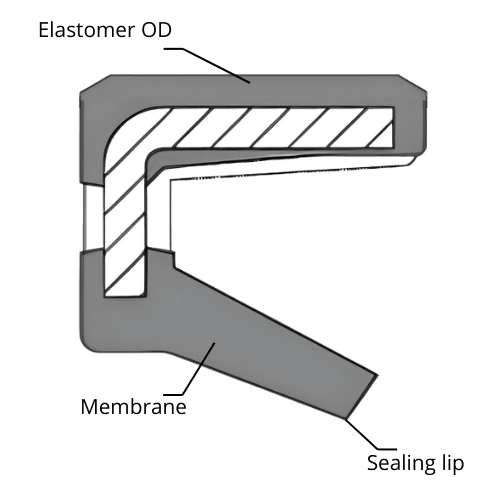
Compared with reinforced or metal-cased sealing profiles such as SA oil seals, the VC design is intended for applications with moderate operating demands where flexibility, ease of installation, and cost efficiency are important considerations. Its lightweight construction makes it well suited for standard industrial equipment, maintenance replacements, and retrofit projects involving conventional rotating shaft arrangements.
Where additional housing retention is required, particularly in bores affected by vibration, thermal cycling, or minor dimensional inconsistencies, ribbed outer diameter designs such as the G12 profile may offer improved grip and installation stability while retaining the same fundamental sealing concept as the VC type.
Material options
Material | Key Properties | Indicative Temperature Range | Typical Use Cases |
NBR (Nitrile Rubber) | Excellent oil and grease resistance, good wear resistance, economical | -30 °C to +100 °C | General machinery, gearboxes, pumps, light transmissions |
FKM (Viton®/Fluoroelastomer) | High heat resistance, excellent chemical resistance | -20 °C to +200 °C | Automotive, drive systems, chemical media, synthetic lubricants |
ACM (Polyacrylate) | Good heat and oxidation resistance | -20 °C to +150 °C | Automotive applications, higher oil temperatures |
EPDM | Excellent resistance to water, steam, coolants; not compatible with oil | -40 °C to +140 °C | HVAC, steam systems, coolant applications |
VMQ (Silicone) | Outstanding low-temperature flexibility, broad temperature range | -60 °C to +200 °C | Extreme cold or heat, low mechanical load applications |
Functional performance and operating parameters
The VC oil seal is primarily intended for low-pressure rotary applications where moderate operating speeds and efficient sealing performance are required. Since the design does not incorporate a garter spring, the sealing lip exerts a lower contact force on the shaft compared with spring-energized seal profiles. This reduced contact pressure helps minimize friction, decrease heat generation, and limit wear on both the sealing lip and the shaft surface during operation.
As a result, the VC profile is particularly well suited for light- to medium-duty service conditions where low running resistance and extended component life are important considerations. Depending on the seal dimensions, operating conditions, and elastomer compound selected, shaft speeds of up to approximately 6 m/s can typically be achieved in accordance with standard rotary shaft seal performance guidelines.
Material selection remains an important factor in determining overall performance. Operating temperature limits, fluid compatibility, and environmental resistance will vary according to the elastomer used. NBR is commonly selected for applications involving mineral oil-based lubricants and standard operating temperatures, while FKM is often preferred in systems exposed to elevated temperatures, synthetic lubricants, or chemically demanding environments requiring enhanced heat and chemical resistance.
Installation and design requirements
Reliable sealing performance depends not only on the seal itself but also on the condition and accuracy of the mating components. Before installation, the shaft surface should be carefully inspected to ensure it is free from burrs, sharp edges, and other defects that could damage the sealing lip during assembly. A suitable surface finish is equally important to promote stable sealing contact and reduce wear throughout the service life of the seal.
To minimize friction during initial operation, the sealing lip should be lightly coated with a compatible lubricant prior to installation. The shaft should also provide adequate wear resistance, with a recommended minimum hardness of 45 HRC to help prevent scoring or groove formation in the sealing track over time.
During assembly, the VC oil seal should be installed evenly and squarely into the housing bore to avoid distortion or uneven lip loading. The use of dedicated installation tools is strongly recommended, as they help ensure correct positioning while reducing the risk of damaging the elastomer body or sealing edge.
One advantage of the VC profile is its fully elastomeric construction, which allows it to accommodate minor variations in housing geometry more effectively than some rigid metal-cased alternatives. Nevertheless, proper alignment, clean mounting surfaces, and accurate installation practices remain critical factors in achieving maximum sealing efficiency and long-term operational reliability.
Specifications
Type oil seal: VC rotary shaft seal
Design: Fully elastomer with a single non-spring-loaded sealing lip
Materials: ACM, EPDM, FKM, NBR, VMQ
Pressure capability: Low pressure, depressurised application
Rotating speed: Low to medium
Temperature range: Depends on chosen material
Function: Keeps lubricants inside and keeps light contamination outside
Use Cases
The VC rotary shaft seal is widely applied across numerous industrial and commercial sectors where reliable lubricant retention and economical sealing performance are required. Typical applications include general machinery, workshop equipment, ventilation and HVAC systems, electric motors, fans, pumps, conveyors, and various light-duty power transmission assemblies. Its versatile design allows it to perform effectively in a range of operating environments, from dry conditions to applications involving grease lubrication or moderate levels of humidity.
The availability of multiple elastomer compounds further expands the range of suitable applications, enabling the seal to be matched to specific temperature requirements, media compatibility demands, and environmental conditions.
As different manufacturers often use their own product designation systems, the VC profile may be identified under various trade names, reference numbers, or legacy part codes. The cross-reference table below provides an overview of commonly used equivalent designations from different brands and suppliers, helping users identify compatible replacements and compare products across multiple sourcing options.
| Brand / Supplier | Cross-Reference Code |
|---|---|
| Dichtomatik | WAO |
| Anyseals | OS-A12 |
| B+S | TR-K |
| Elring | A OF |
| Eriks | RZV |
| FP Paris | GSM |
| FST | BA OF |
| Gaco | SA |
| Goetze | 827 NO |
| Kaco | DE |
| Kramp | CD |
| Paulstra | IO |
| Pioneer W | R26 |
| Rolf | LSM |
| Stefa | CD |
| Taiwan / NOK | VC |
| Vota | BA OF |
| Ebele | RZV |
| Kimman | KAOW |
When do I choose an oil seal VC?
When the VC Oil Seal Is a Suitable Choice
The VC profile is often selected for applications that prioritize simplicity, efficiency, and economical operation. It is particularly well suited when:
A straightforward sealing solution is sufficient for the application.
Low running friction and reduced heat generation are important.
Equipment operates under light to moderate service conditions.
Available installation space is limited.
Cost-effective sealing performance is preferred without unnecessary design complexity.
When an Alternative Seal Design May Be More Appropriate
The VC oil seal may not be the ideal option in more demanding operating environments. Alternative sealing profiles should be considered when:
Equipment is exposed to significant levels of dust, dirt, mud, slurry, or other abrasive contaminants.
High radial or axial loads place increased stress on the sealing interface.
Internal pressure conditions exceed the capabilities of a standard non-spring-loaded seal.
Enhanced contamination exclusion or increased sealing force is required.
For applications involving external contaminants, profiles equipped with an auxiliary dust lip, such as KC seals, can provide additional protection. Where greater lip contact force and improved sealing stability are needed, SC oil seals with a spring-energized sealing lip may be a more suitable solution. In particularly demanding environments, TC oil seals offer the benefits of both a garter spring and a secondary dust lip, providing enhanced lubricant retention together with improved resistance against dirt, moisture, and other external contaminants.
Property comparison: VC vs. SC vs. KC
Property | VC | SC | KC |
Number of lips | 1 (single main lip) | 1 (single spring-loaded lip) | 2 (main sealing lip + additional dust lip) |
Garter spring | No (non-spring-loaded lip) | Yes (spring-loaded elastomer lip) | No (non-spring-loaded main lip) |
Outer diameter | Elastomer-coated metal case | Elastomer-coated metal case | Elastomer-coated metal case |
Sealing force | Low–medium (secondary, low-friction sealing) | Medium–high (spring-loaded primary sealing) | Low–medium (secondary sealing with dust exclusion) |
Contamination resistance | Light (no dust lip, secondary grease sealing) | Light–medium (clean, enclosed systems, no dust lip) | Medium–high (extra dust lip for external contaminants) |
Typical use | Compact secondary seal for grease retention in confined assemblies | Primary shaft seal in clean, enclosed systems (motors, pumps, gearboxes) | Compact secondary seal with dust lip for grease retention in slightly contaminated environments |
Installation robustness | High (tolerant of rougher/expanding housings) | Medium–high (standard elastomer OD, spring-sensitive lip) | High (like VC; compact, elastomer-coated OD) |
If you would like more information about this oil-seal or you don’t know what size or material you should have, please feel free to contact us.
FAQ
What is a VC oil seal?
VC oil seal is a common type of rotary shaft lip seal, mainly used to prevent lubricant leakage and block dust, water and impurities from entering mechanical equipment.
What are the main application scenarios of VC oil seals?
It is widely used in motors, gearboxes, pumps, agricultural machinery, automotive parts and general industrial transmission equipment.
What material is VC oil seal usually made of?
The mainstream materials are NBR (nitrile rubber), FKM (fluorine rubber) and CR (chloroprene rubber) for different working conditions.
What is the difference between VC oil seal and TC oil seal?
VC has a single lip and simple structure for general low-speed working conditions; TC adopts double lips with better dustproof performance for harsh environments.
What working temperature can a standard NBR VC oil seal withstand?
The normal operating temperature range is -30℃ to 120℃.
How to choose the right size of VC oil seal?
Measure the shaft diameter, housing bore diameter and seal width strictly, and select the corresponding standard size.
Why does the VC oil seal leak oil after installation?
Common reasons include improper installation, shaft surface wear, seal aging, or mismatch between material and lubricant.
Does VC oil seal need additional spring?
Yes, most VC oil seals are equipped with a garter spring to keep the lip tightly attached to the shaft.