Manufacturing a reliable oil seal involves much more than placing rubber into a mold. A rotary shaft oil seal must retain lubricant, prevent external contaminants from entering the equipment, maintain stable contact with a rotating shaft, and withstand changes in temperature, speed, and operating pressure. Achieving these functions consistently requires a controlled sequence of material preparation, metal-component processing, molding, vulcanization, finishing, assembly, and inspection.
For OEM purchasing teams, engineers, and industrial distributors, understanding the oil seal manufacturing process is useful when evaluating suppliers, comparing quotations, investigating leakage problems, or developing a custom sealing component. The number of operations is not fixed for every product. A standard rubber-covered oil seal, a metal-cased seal with a garter spring, and a PTFE rotary seal require different production routes.
Key manufacturing principle: Oil seal quality is created by controlling every critical process—not simply by using advanced molding equipment. Compound consistency, metal-to-rubber bonding, lip geometry, curing conditions, dimensional accuracy, and final inspection all influence sealing performance.
How Many Processes Are Needed to Manufacture an Oil Seal?
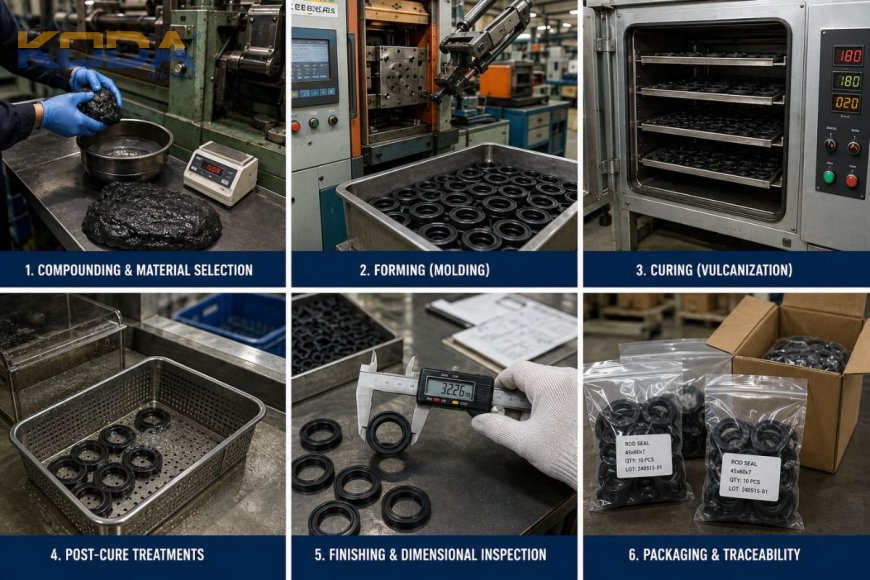
There is no universal process count for all oil seals. A typical bonded rubber-to-metal rotary shaft seal may pass through several major production stages, with each stage containing multiple individual operations. A practical manufacturing route often includes:
- Raw material inspection and preparation – verify rubber compounds, metal inserts, springs, and other components.
- Rubber compounding and mixing – blend the elastomer with the required curing agents, fillers, and additives.
- Rubber preforming – prepare accurately weighed blanks or preforms for molding.
- Metal case stamping and forming – produce the supporting metal shell or insert.
- Metal surface preparation – clean and treat the metal to support corrosion protection and rubber bonding.
- Mold preparation and loading – position the metal insert and rubber charge correctly in the mold.
- Rubber molding and vulcanization – form the seal profile and cure the elastomer under controlled conditions.
- Deflashing and finishing – remove excess material and refine critical edges and surfaces.
- Spring manufacture and installation – manufacture, join, and fit the garter spring when the design requires one.
- Dimensional and visual inspection – check critical dimensions, lip condition, concentricity, and workmanship.
- Functional or qualification testing – conduct application-specific tests where required.
- Cleaning, packaging, and traceability – protect the finished seal and maintain batch identification.
Some manufacturers combine several operations, automate them, or outsource selected processes. Others add post-curing, coating, special grinding, spring-load verification, or 100% inspection for demanding applications. Therefore, buyers should evaluate the actual process flow and control plan rather than judging a factory by a claimed number of production steps.
Raw Material Selection and Incoming Inspection
The manufacturing process begins with material selection. An oil seal normally contains an elastomeric sealing element and may also include a metal case, garter spring, bonding system, and surface treatment. The material combination must match the working fluid, temperature range, shaft speed, pressure, and environmental conditions.
Selecting the Rubber Compound
Common elastomer families used in oil seals include NBR, HNBR, FKM, and silicone rubber. Each has different mechanical, thermal, and chemical characteristics. The correct choice depends on the actual service environment rather than on the material name alone.
| Material | Typical Application Strength | Important Consideration |
|---|---|---|
| NBR | Widely used with many mineral-oil lubricants and general industrial applications | Check temperature limits, ozone exposure, and compatibility with additives |
| HNBR | Improved heat, aging, and mechanical properties compared with many standard NBR grades | Confirm compatibility with the specific lubricant and operating conditions |
| FKM | Selected higher-temperature and chemically demanding applications | Low-temperature flexibility and chemical compatibility vary by compound |
| VMQ Silicone | Applications requiring flexibility over a broad temperature range | Mechanical strength, abrasion resistance, and fluid compatibility need careful review |
Incoming rubber inspection may include compound identification, hardness, visual condition, batch documentation, and relevant material-property checks. For critical projects, buyers should agree on the compound specification and acceptance criteria before production begins.
Metal Case and Spring Materials
The metal case supports the seal structure and helps maintain its fit in the housing. Depending on the design and environment, manufacturers may use carbon steel, stainless steel, or other specified metal grades. The garter spring, where fitted, provides radial loading at the sealing lip and is commonly made from corrosion-resistant spring wire selected for the operating environment.
Incoming metal inspection should verify material grade, thickness, surface condition, dimensional suitability, and corrosion-related requirements. Spring wire should also be checked for dimensional consistency and suitable mechanical properties.
Rubber Compounding and Mixing
Rubber compounding is one of the most influential stages in oil seal production. Raw elastomer is blended with carefully selected ingredients to achieve the required hardness, elasticity, tensile properties, wear behavior, heat resistance, and fluid compatibility.
Depending on the compound and production scale, mixing may be performed using an internal mixer, a two-roll mill, or a combination of equipment. The process must distribute ingredients evenly without causing excessive heat or unwanted material degradation.
Critical mixing parameters
- Mixing sequence: Ingredients must be added in the correct order to support dispersion and processing stability.
- Batch temperature: Excessive heat can cause premature curing or damage heat-sensitive ingredients.
- Mixing time and energy: Insufficient mixing may leave uneven filler or additive distribution, while excessive mixing can affect compound properties.
- Batch identification: Each compound batch should be traceable to its material records and production orders.
- Storage conditions: Mixed compounds should be stored and used within defined handling and shelf-life requirements.
Inconsistent mixing can lead to variations in hardness, curing behavior, elasticity, and wear resistance. These variations may later appear as unstable lip dimensions, poor sealing contact, or inconsistent service life.
Practical quality check: Ask the supplier whether rubber compounds are controlled by batch number and whether critical properties are verified before molding. A material certificate without batch-level identification may not provide sufficient traceability for a demanding OEM program.
Rubber Preforming: Preparing the Correct Molding Charge
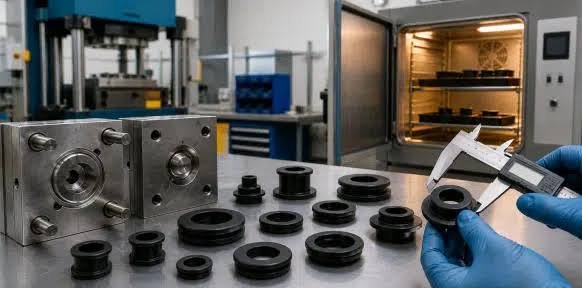
After mixing, the rubber compound is prepared into semi-finished blanks or preforms. These pieces are weighed and shaped to suit the seal design and molding method.
Preforming can involve cutting strips, weighing individual charges, extrusion, or using a precision preforming machine. The purpose is to provide a repeatable amount of compound in a controlled shape so that the mold fills consistently.
Incorrect preform weight can cause several problems:
- Insufficient material may result in incomplete filling or short shots.
- Excessive material may increase flash and trimming work.
- Uneven preform geometry may cause inconsistent flow or localized defects.
- Variation between cavities may affect dimensional consistency in multi-cavity molds.
For high-volume production, automated weighing and preforming can improve repeatability and reduce operator-dependent variation. However, the preform design must still be developed for the specific compound, mold, and seal geometry.
Metal Case Stamping and Surface Treatment
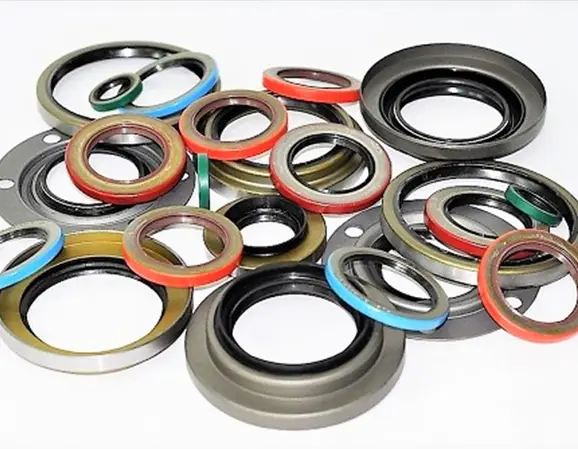
Many radial shaft oil seals use a metal case or reinforcing insert. This component is typically manufactured by stamping or press forming sheet metal into the required geometry. The shape must support the elastomer and provide the dimensional stability needed for installation in the housing.
Stamping and Forming
Metal stamping tools form the blank into the required shell profile. The operation may include blanking, drawing, trimming, and other forming stages, depending on the design. Critical dimensions include outside diameter, width, concentricity, and the geometry of the rubber-bonding region.
Metal parts should be checked for burrs, cracks, deformation, and dimensional variation. Sharp edges can damage the elastomer during molding or assembly, while inconsistent case geometry may affect seal fit and concentricity.
Cleaning and Bonding Preparation
Before rubber-to-metal bonding, the insert surface must be prepared. A typical preparation route may include degreasing, cleaning, controlled surface treatment, drying, and application of a compatible bonding agent. The exact treatment depends on the metal, elastomer compound, adhesive system, and manufacturer’s process specification.
Contamination such as oil, dust, oxidation, or handling residues can weaken adhesion. Incorrect drying or adhesive application may also result in incomplete bonding or inconsistent bond strength.
Important: Rubber-to-metal bonding is a functional requirement, not merely a cosmetic feature. A seal with a poorly bonded insert may separate under thermal cycling, mechanical stress, or service exposure.
Mold Design, Loading, and Vulcanization
Molding creates the final rubber profile, including the sealing lip, dust lip where specified, outer rubber surface, and bonding interface. The mold must be designed around the seal drawing, compound shrinkage, parting-line position, cavity layout, and required production volume.
Compression and Injection Molding
Compression molding uses a prepared rubber charge placed into a heated mold. The mold closes under pressure, allowing the compound to flow into the cavity and form the required profile.
Injection molding feeds prepared rubber compound into a closed mold through a controlled injection system. It can support automated and high-volume production when the compound, tooling, and process are properly matched.
Neither method is universally superior. Selection depends on part geometry, material behavior, annual volume, tooling cost, required consistency, and the manufacturer’s production capabilities.
Vulcanization and Cure Control
Vulcanization is the chemical curing process that transforms the uncured rubber compound into an elastic material with its required mechanical properties. Heat and time are applied under controlled molding conditions. The correct cure cycle depends on the compound formulation, seal thickness, mold design, and production method.
Under-curing can leave the rubber with inadequate mechanical properties, while over-curing or excessive thermal exposure can damage the compound. Inconsistent temperature distribution or pressure may also produce variation between cavities or across the same component.
Manufacturers should establish and monitor process parameters such as:
- Mold temperature and temperature uniformity.
- Cure time and the validated cure window.
- Closing pressure and molding conditions.
- Compound batch and material identification.
- Part placement and metal-insert positioning.
- Process records and reaction plans for out-of-control conditions.
Why cure control matters: A seal can look acceptable while still having unsuitable material properties. Visual inspection alone cannot confirm that the rubber has been properly vulcanized. Compound verification and appropriate physical-property testing are needed to support process control.
Deflashing, Lip Finishing, and Post-Processing
After molding and curing, excess rubber may remain around the parting line or other mold features. This excess material is known as flash. It must be removed without damaging the functional sealing surfaces.
Depending on the seal design and production requirements, manufacturers may use manual trimming, mechanical cutting, cryogenic deflashing, or dedicated finishing equipment. The chosen method must preserve the lip geometry and avoid cuts, nicks, or rough edges.
Critical areas to inspect during finishing
- Primary sealing lip: Check for cuts, tears, deformation, and irregular edges.
- Dust lip: Confirm that the lip profile is complete and free from damage where applicable.
- Parting line: Ensure flash does not interfere with assembly or sealing function.
- Outer diameter: Check for damage or material irregularities that may affect housing fit.
- Bonding region: Inspect for visible separation or other signs of incomplete bonding.
Some compounds or applications may require additional post-curing or surface treatment. These operations should be specified by the material and product design rather than applied automatically to every oil seal.
Garter Spring Manufacturing and Installation
Many conventional radial shaft oil seals use a garter spring to maintain radial force at the primary sealing lip. The spring helps compensate for certain changes in lip dimensions and material behavior during service.
Spring production generally involves winding spring wire to the required diameter and geometry, followed by joining the ends to form a continuous loop. The finished spring is then installed into the designed groove around the sealing lip.
Important spring-related checks may include:
- Wire diameter and material identification.
- Spring dimensions and circularity.
- Joint integrity and surface condition.
- Correct seating in the lip groove.
- Spring displacement or deformation after assembly.
- Specified load or tension characteristics where required.
Not all oil seals use a garter spring. Some designs rely on lip geometry, elastomer properties, or other structural features. The production route must follow the approved product drawing.
Oil Seal Quality Inspection and Testing
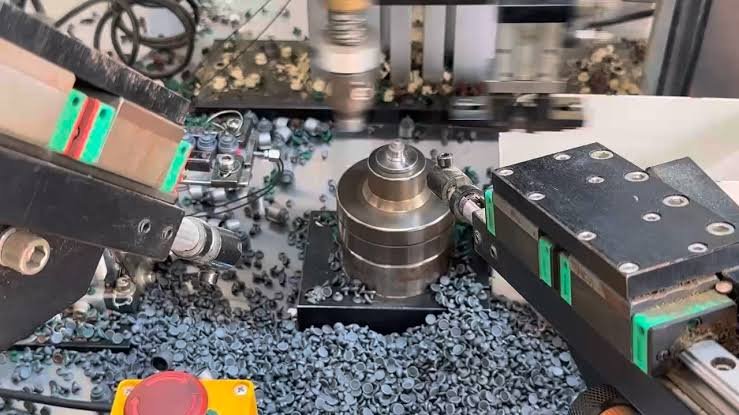
Quality inspection should take place throughout production, not only after the seal is completed. A final visual check cannot reliably detect every material, bonding, dimensional, or performance problem.
In-Process Inspection
In-process checks help detect defects before they move to the next operation. Typical control points include incoming material verification, compound batch inspection, preform weight, metal insert dimensions, surface treatment, mold condition, cure records, and finishing quality.
Dimensional Inspection
Depending on the seal type and drawing, critical dimensions may include shaft diameter, housing diameter, seal width, lip geometry, spring position, and other functional features. Measurement methods should be appropriate for the component’s geometry and specified tolerances.
For rotary shaft seals, dimensional conformity should be considered together with the shaft and housing requirements. A seal that meets its own dimensions may still perform poorly if the mating hardware is outside specification.
Material and Physical-Property Testing
Relevant rubber tests may include hardness, tensile strength, elongation, compression set, heat aging, and fluid resistance. The required tests and acceptance limits should be defined by the material specification, product standard, and application requirements.
Functional and Performance Testing
For critical applications, performance validation may include leakage testing, rotary running tests, friction or torque evaluation, temperature monitoring, and durability testing under representative operating conditions.
A useful test plan should reflect the real equipment environment. A seal intended for high-speed rotation in a particular lubricant should not be qualified solely through a static dimensional inspection.
| Inspection Stage | Typical Check | Problem It Helps Prevent |
|---|---|---|
| Incoming materials | Material identity, batch, condition, and certificates | Wrong or inconsistent raw materials |
| Compounding | Batch records and specified compound properties | Variation in hardness and curing behavior |
| Metal preparation | Dimensions, cleanliness, and bonding preparation | Poor fit or rubber-to-metal separation |
| Molding and curing | Process parameters, cavity condition, and cure records | Incomplete filling or inconsistent material properties |
| Finishing | Lip condition, flash removal, and surface defects | Lip damage and assembly interference |
| Final inspection | Dimensions, appearance, and specified functional tests | Nonconforming products reaching customers |
Common Oil Seal Manufacturing Defects and Their Causes
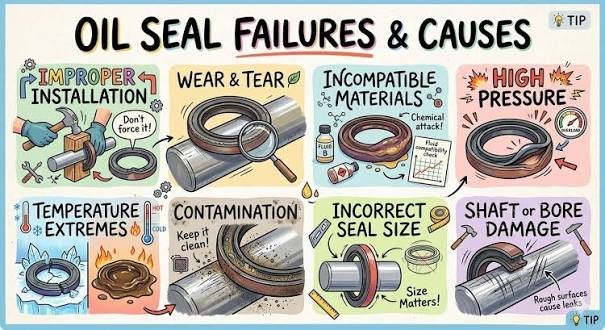
Understanding manufacturing defects helps buyers assess supplier capability and helps production teams identify where corrective action is needed.
| Defect | Possible Process Cause | Recommended Control |
|---|---|---|
| Incomplete molding | Insufficient charge, poor material flow, or unsuitable molding conditions | Review preform weight, mold vents, compound behavior, and process settings |
| Excessive flash | Excess material, mold wear, or poor mold closure | Control charge weight and inspect mold condition and closing accuracy |
| Poor rubber-to-metal bonding | Contamination, incorrect adhesive application, or unsuitable curing conditions | Control cleaning, surface treatment, adhesive handling, and bond validation |
| Lip deformation | Mold damage, uneven material flow, or improper handling | Inspect tooling, preform placement, demolding, and handling methods |
| Hardness variation | Compound inconsistency or uncontrolled curing | Strengthen batch control and verify cure conditions |
| Spring displacement | Incorrect assembly, groove variation, or handling damage | Check spring dimensions, installation equipment, and final assembly inspection |
| Corrosion on metal case | Unsuitable material, surface treatment, or storage conditions | Verify metal grade, protective treatment, packaging, and storage environment |
How Manufacturing Processes Affect Oil Seal Service Life
Oil seal performance is determined by the interaction between design, materials, manufacturing quality, and installation conditions. A defect introduced during production may not cause an immediate problem, but it can reduce the seal’s ability to maintain a stable contact zone during operation.
Rubber formulation and curing
Incorrect compound properties or inconsistent vulcanization can affect elasticity, hardness, compression set, and resistance to heat or fluids. These changes may lead to premature lip wear, hardening, cracking, or loss of sealing force.
Lip geometry and finishing
The primary lip controls the contact interface with the shaft. Variations in lip angle, edge condition, or concentricity can influence friction, lubricant retention, and leakage behavior. Finishing operations must therefore protect the functional lip rather than simply improve appearance.
Metal case accuracy and bonding
The metal insert helps maintain structural stability and housing fit. Poor forming accuracy or weak bonding can affect installation and long-term integrity, particularly when the seal experiences vibration or temperature cycling.
Spring consistency
For spring-loaded designs, incorrect spring dimensions, poor joining, or displacement during assembly can alter the radial force applied to the lip. Excessive or insufficient force may affect friction, wear, and leakage control.
How to Evaluate an Oil Seal Manufacturer for OEM Supply
For global B2B buyers, choosing a supplier should involve both production capability and process transparency. A manufacturer may have modern equipment, but buyers still need evidence that critical operations are controlled and repeatable.
When evaluating an oil seal factory, consider the following questions:
- Material control: Can the supplier identify rubber compounds by grade and batch and provide relevant material test records?
- Mixing capability: Are compound mixing conditions, batch identification, and storage procedures documented?
- Tooling capability: Can the factory develop or modify molds for custom dimensions and lip profiles?
- Bonding process: Are metal cleaning, surface treatment, adhesive application, and bonding conditions controlled?
- Curing consistency: Are molding parameters monitored and linked to production batches?
- Inspection system: Are critical dimensions and visual characteristics checked using defined methods and acceptance criteria?
- Testing capability: Can the supplier arrange material, fluid-resistance, dimensional, and application-specific performance tests?
- Traceability: Can a finished seal be traced back to its material batch and manufacturing records?
- Change management: Will the supplier notify the buyer before changing material, tooling, process conditions, or subcontracted operations?
For a new OEM project, a sensible qualification route is to review the drawing and application data, approve the material and prototype, evaluate samples under representative conditions, and then validate the production process before mass production. The exact validation plan should be agreed between the buyer and manufacturer.
Buyer tip: Request a process flow chart, control plan, inspection report, and sample traceability record. These documents provide more useful evidence of manufacturing discipline than a machine list or a general statement that the factory follows strict quality control.
Standards and Technical References for Oil Seal Production
Relevant standards help define terminology, dimensions, inspection methods, and performance testing. The applicable standard depends on the seal type and intended use. Buyers should confirm the current edition and the specific requirements included in their purchase specification.
- ISO 6194 series: Covers rotary shaft lip-type seals, including terminology, dimensions, performance-related requirements, and associated guidance across the series.
- DIN 3760: A widely referenced standard for radial shaft sealing rings and related design dimensions.
- ISO 3601 series: Covers O-rings, including dimensions, housing requirements, quality acceptance, and material-related specifications. It is relevant when O-rings are used in associated sealing assemblies, but it is not a substitute for rotary shaft seal requirements.
- ISO 188: Provides methods for evaluating accelerated ageing and heat resistance of vulcanized or thermoplastic rubber.
- ISO 815: Specifies methods for determining compression set of rubber under defined conditions.
Standards do not replace application testing. A seal may conform to dimensional requirements and still be unsuitable for a particular shaft speed, lubricant, temperature, or installation condition. The buyer and manufacturer should agree on the relevant drawings, test methods, acceptance limits, and documentation before production approval.
Frequently Asked Questions About Oil Seal Manufacturing
FAQ 1: How many steps are involved in manufacturing an oil seal?
The number varies according to the design and production method. A typical bonded rubber-to-metal oil seal may involve material preparation, rubber mixing, preforming, metal stamping, surface treatment, molding, vulcanization, finishing, spring installation, inspection, testing, and packaging. Some operations may be combined or automated, while specialized seals may require additional processes.
FAQ 2: What is the most important process in oil seal production?
No single operation determines quality by itself. Rubber compounding and vulcanization are especially important because they establish the elastomer’s physical properties. However, metal preparation, bonding, lip molding, finishing, and inspection are also essential. A defect in any critical stage can affect the finished seal.
FAQ 3: Why is vulcanization important for oil seals?
Vulcanization converts the uncured rubber compound into an elastic material with the required mechanical properties. Incorrect cure conditions can result in unsuitable hardness, elasticity, compression set, or aging behavior. Manufacturers should establish validated curing conditions for each compound and product design.
FAQ 4: How can buyers check the quality of an oil seal manufacturer?
Buyers should review the supplier’s material control, mixing and curing records, metal-to-rubber bonding process, tooling capability, dimensional inspection, functional testing, and batch traceability. For important applications, request a process flow chart, control plan, sample inspection report, and application-specific validation results.
FAQ 5: Does every oil seal need a garter spring?
No. Many conventional radial shaft oil seals use a garter spring to maintain radial loading at the primary lip, but some designs use other lip geometries or structural arrangements. Whether a spring is required depends on the seal profile, operating conditions, and manufacturer’s design specification.
Conclusion: Consistent Oil Seal Quality Starts with Process Control
Oil seal manufacturing is a connected engineering process in which every operation contributes to the performance of the finished component. Rubber formulation, preforming, metal case preparation, bonding, molding, vulcanization, finishing, spring assembly, and inspection must work together to produce a seal with consistent dimensions and reliable material properties.
For engineers, the practical lesson is to specify the operating conditions and functional requirements clearly. For purchasing teams and distributors, the priority is to evaluate whether the supplier can demonstrate repeatable production, documented inspection, and traceability. A well-controlled process helps reduce manufacturing variation, prevent avoidable defects, and improve confidence in the finished oil seal.
Looking for a Reliable Oil Seal Manufacturing Partner?
Whether you need standard rotary shaft oil seals, custom rubber-to-metal bonded seals, or OEM production for industrial and automotive applications, the right manufacturing solution starts with a clear understanding of your technical requirements.
Share your drawings, material requirements, working conditions, and estimated order volume with our team. We can help review the seal design, discuss suitable material options, and identify the manufacturing and inspection requirements for your project.
Contact us to discuss your oil seal requirements and request a technical quotation.
Authoritative Technical Resources
- NOK – Oil Seal Manufacturing Process: manufacturing flow for rubber, metal case, and garter spring components, including vulcanization, finishing, inspection, and traceability.
- ISO – Search for the ISO 6194 Series: international standards covering rotary shaft lip-type seals.
- ISO – Search for the ISO 3601 Series: O-ring dimensional, quality, and material-related standards.
- Parker Hannifin: engineering resources and technical information on fluid power sealing systems.
- Trelleborg Sealing Solutions: sealing technology, material selection, and application engineering resources.
- NOK Corporation: manufacturer information and sealing technology resources.