Rotary Sealing Solutions
Rotary Sealing Products
KODA offers a complete range of rotary seals, designed to meet the dynamic sealing needs of various industries, effectively ensuring the operational performance and service life of machinery.
Upholding a relentless pursuit of quality and innovation, we provide diversified sealing solutions, covering a full range of products including oil seals, fabric-reinforced seals, V-rings, gamma seals, end caps, and shaft repair sleeves. Each seal undergoes precise design and rigorous testing, ensuring stable and reliable sealing performance even under extreme operating conditions.
Rotary sealing function principle
Rotary seals play an irreplaceable and crucial role in the functionality and operational efficiency of modern mechanical equipment. The core design objective of these seals is to seal the fluid medium within rotating parts of the equipment, eliminating the risk of leakage and preventing external contaminants from entering the equipment. The key criterion for evaluating their sealing performance lies in their ability to maintain stable and reliable sealing performance under complex operating conditions such as pressure fluctuations, temperature changes, and speed adjustments.
1. Sealing Mechanism: The core function of rotary seals is fluid sealing and contamination protection. Their working principle is achieved through the organic combination of a physical barrier structure and material compatibility: on the one hand, a precise structure forms a sealing barrier; on the other hand, the material’s own deformation and conformation capabilities adapt to the contour and movement of the sealed component.
2. Material Selection: Material selection is a core factor determining product performance. Materials must meet three key requirements: chemical compatibility with the sealing medium, resistance to operating temperature and pressure, and wear resistance. These factors collectively determine the operational stability and service life of the seal.
3. Friction and Wear: Controlling friction is one of the core aspects of rotary sealing technology. An excessively high coefficient of friction directly accelerates seal wear, generates excessive heat, and ultimately leads to seal failure. Therefore, a precise balance between sealing efficiency and friction level must be achieved through reasonable material selection and structural design to ensure long-term stable operation of the equipment.
Oil seal

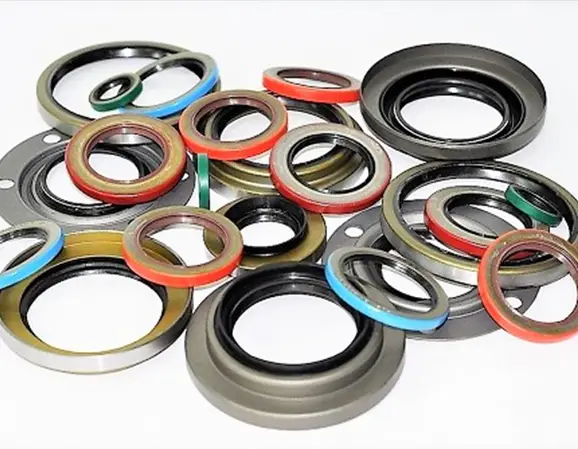
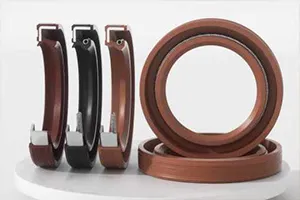
Oil seals, also known as rotary shaft seals or grease seals, are indispensable key components in mechanical systems, especially suitable for applications involving rotating shafts such as gearboxes and hydraulic cylinders. KODA offers a wide range of oil seal products, using a variety of high-performance elastomers including nitrile rubber, Viton® (fluororubber), silicone rubber, and EPDM rubber. Each material is precisely selected based on its unique temperature resistance, wear resistance, and chemical corrosion resistance to match different operating conditions.
Our oil seals feature diverse lip structures and shell designs, making them adaptable to various application environments. They effectively seal the lubricant within the system while reliably preventing the intrusion of external contaminants, ensuring stable equipment operation. For more detailed product information, please visit our dedicated oil seal product page.
V-Rings

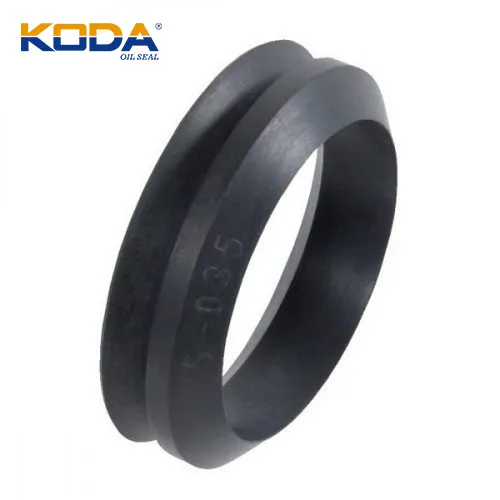
KODA V-type seals are specialized rubber seals designed for shaft applications. They effectively prevent dust, moisture, and other external contaminants from entering equipment, while ensuring lubricant retention within the system to prevent leakage and loss.This series of seals features a unique structural design, offering significant advantages in ease of installation. Assembly requires minimal pre-installation work, making it an ideal sealing solution that balances economy and versatility. Its performance is stable and reliable, maintaining excellent sealing performance in both dry environments and high-speed operating conditions, suitable for both rotary and reciprocating shaft applications.
This product series includes three main lines: VA, VC, and VS. Materials available include nitrile rubber or fluororubber (Viton®), and various sizes are offered to meet different operational requirements. For more product details, please visit the V-type seal product page.
Hydraulic Seals

Hydraulic seals are core components of hydraulic systems, primarily used to seal the hydraulic oil and fluids inside hydraulic equipment, while also preventing the intrusion of external contaminants such as dust, moisture, and impurities. This ensures the sealing performance, stability, and efficient operation of the hydraulic system under high-pressure, high-frequency reciprocating or rotary motion conditions. Their sealing performance directly determines the working efficiency, service life, and safety and reliability of the hydraulic system, making them a crucial barrier to ensure the normal operation of hydraulic equipment.
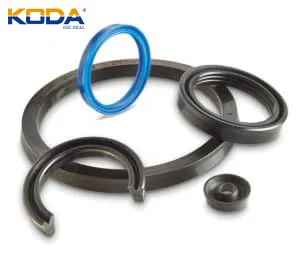
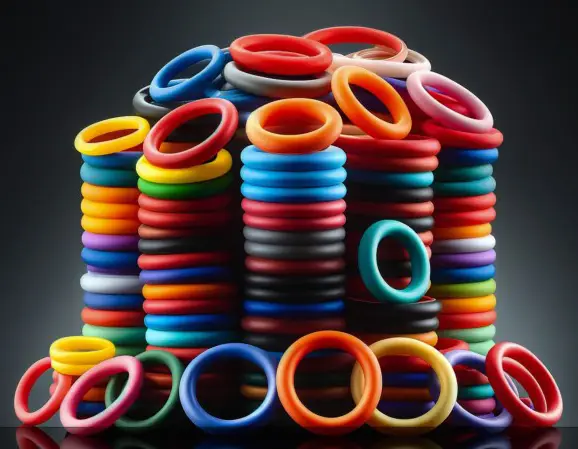
KODA supplies a full range of high-quality Hydraulic Seals, covering all types and material options mentioned above, and precisely matching various standard sizes such as AS568 and metric. Manufactured using precision molding processes, the products strictly control material compatibility and sealing performance, adapting to various hydraulic conditions from conventional low pressure to ultra-high pressure, and from normal temperature to extreme temperatures. All products comply with relevant industry standards such as FDA and NBR, and are widely used in engineering machinery, industrial manufacturing, energy extraction, and other fields, providing reliable sealing guarantees for the stable and efficient operation of hydraulic systems. For detailed information on our hydraulic seals, please visit our hydraulic seals product page.
U-Cup Seals

U-Cup Seals, or U-shaped seals, are a type of lip seal. They are named for their U-shaped cross-section and are core components of reciprocating motion seals. They are widely used in piston and piston rod sealing applications in hydraulic and pneumatic systems. Compared to O-rings, they offer higher pressure resistance and sealing stability.The cross-section of the U-shaped sealing ring consists of a top lip, two side lips, and a bottom cavity. Some models are designed with a spring-loaded structure (built-in helical spring) to compensate for wear and insufficient sealing force under low pressure.The medium pressure acts on the inner side of the U-shaped cavity, causing the lips on both sides to fit tightly against the sealing surface (cylinder inner wall/piston rod surface), forming a sealing contact zone. The higher the pressure, the tighter the lip fit and the stronger the sealing effect; under low-pressure or no-pressure conditions, the spring-loaded type can maintain the sealing performance through spring tension.
Groove design: Groove dimensions must be designed strictly according to standards (such as ISO 6072, GB/T 10708.1) to avoid excessive interference causing lip deformation or excessive gap causing extrusion. For more detailed information about our end caps, please visit our U-Cup Seals product page.
Combination gasket

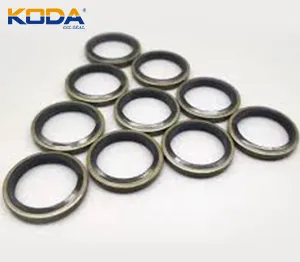
KODA's Combination Gasket is a composite sealing element that integrates the advantages of multiple materials. It is usually composed of a metal skeleton and a non-metallic sealing layer. It is mainly used in static sealing scenarios, and is especially suitable for flange connections, pipe joints and other working conditions with high temperature, high pressure and strong corrosion. Its sealing reliability is far higher than that of gaskets made of single materials.Metal skeleton: Serving as the supporting structure, commonly used materials include carbon steel, stainless steel (304/316), copper, and aluminum, which determine the gasket's pressure resistance and heat resistance. Some models feature corrugated or serrated structures to enhance resilience.Non-metallic sealing layer: Attached to both sides or one side of the metal skeleton, commonly used materials include rubber (NBR, FKM), flexible graphite, PTFE, and asbestos (gradually phased out). The elasticity of non-metallic materials fills the microscopic gaps in the sealing surface, achieving a seal.
Selection and matching are based on the temperature, pressure, and medium of the operating conditions, choosing the appropriate metal frame and sealing layer materials; for example, for highly corrosive media, a combination of 316 stainless steel and PTFE is preferred. Flange requirements: The flange sealing surface must be flat, free of severe burrs and cracks; bolt preload must be uniform to avoid localized overtightening that could damage the gasket. For more detailed information about our end caps, please visit our Combination gasket product page.
Your trusted partner for rotary seal solutions
With deep expertise in rotary seals, KODA is ready to provide you with precise and suitable solutions. Leveraging extensive technical sales experience and a comprehensive portfolio of high-quality products, we are your ideal choice for one-stop seal procurement. Whether you need standard models or customized engineering sealing solutions, our professional team will provide you with comprehensive technical guidance and attentive support. For detailed specifications and to discuss customization needs, please feel free to contact us. You can call +86 18730921709, fill out the product inquiry form on this page, or browse our comprehensive product page for more details.