
BS 1806 Metric Sizes
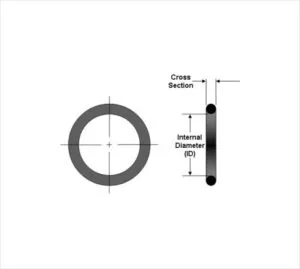
BS 1806 Metric Size Chart
The BS 1806 O-ring standard is a British standard historically used to identify imperial-size O-rings and their dimensional series.Although BS 1806 has been superseded by BS ISO 3601, it has not disappeared from industrial documentation. Existing machinery, replacement-parts catalogs, engineering drawings, maintenance manuals, and legacy equipment may still specify O-rings using BS 1806 references. The BS 1806 size system contains the five principal cross-section groups associated with AS568 and also includes several dimensions positioned between AS568 sizes. This makes BS 1806 particularly useful when dealing with older British or international equipment.
For a complete listing of all metric o-ring sizes, visit our Metric O-Ring Cross Reference Table.
BS 1806 Size Chart
| Global Part # | Reference | C/S (MM) | I.D.(MM) | C/S (Inch) | I.D.(Inch) |
|---|
These examples illustrate an important characteristic of the BS 1806 system: the reference number identifies a defined dimensional size rather than simply representing a nominal metric diameter.
For complete purchasing or engineering work, the actual standard table and applicable tolerances should be consulted rather than relying on rounded dimensions.
Why BS 1806 O-Rings Still Matter
From a purely standards perspective, BS 1806 is an older system.
From a maintenance perspective, however, old standards can remain relevant for decades.
Industrial equipment frequently has a much longer service life than the standards under which its original components were specified.
You may therefore encounter BS 1806 references in:
- Hydraulic equipment
- Pneumatic machinery
- Industrial pumps
- Valves
- Gearboxes
- British-manufactured machinery
- Legacy automotive equipment
- Industrial maintenance documentation
- Replacement-part catalogs
- OEM drawings
- Older hydraulic and pneumatic systems
The Important Point for Maintenance Teams
A standard being superseded does not mean that every existing component using that standard should automatically be replaced with a different size system.
If an existing machine was designed around a BS 1806 O-ring, the safest replacement process is:
Original reference → dimensional verification → cross-reference → material verification → application validation
That process is much safer than assuming that a similarly numbered AS568 part is automatically identical.
Can a BS 1806 O-Ring Be Replaced by an AS568 O-Ring?
Sometimes.
But the answer should never be based solely on the part number.
A replacement can be considered when the candidate O-ring provides sufficiently equivalent:
- Cross-section
- Inside diameter
- Outside diameter
- Tolerances
- Groove squeeze
- Groove fill
- Material properties
- Hardness
- Operating temperature
- Pressure capability
KODA O-Ring’s international cross-reference resource explicitly notes that cross-reference charts do not take tolerances or materials into consideration.
This is an important distinction for engineers.
Dimensional Match ≠ Functional Match
Suppose two O-rings have nearly identical ID and cross-section.
If one is:
NBR 70 Shore A
and the other is:
EPDM 70 Shore A
they may be dimensionally interchangeable but chemically incompatible with the same working fluid.
Likewise, replacing a 70 Shore A seal with a much harder compound can change extrusion resistance and squeeze behavior.
Therefore, dimensional cross-reference should always be followed by material and application verification.
How to Identify a BS 1806 O-Ring Without the Original Part Number
When the original packaging or drawing is unavailable, use a structured identification process.
Step 1: Measure the Cross-Section
Measure the rubber thickness using a suitable O-ring gauge or calibrated measuring equipment.
Avoid measuring a heavily compressed or damaged section.
Step 2: Measure the Inside Diameter
Measure the internal diameter carefully.
If the seal has been stretched during service, the measured value may differ from its original free-state dimensions.
Step 3: Calculate the Approximate Outside Diameter
Use:
OD ≈ ID + 2 × CS
This provides a quick dimensional check.
Step 4: Compare With BS 1806 Tables
Search the measured dimensions against the standard reference table.
Step 5: Check Other Standards
If no exact BS 1806 match exists, compare against:
- AS568
- ISO 3601
- Generic imperial sizes
- Other international standards
KODA O-Ring provides an international cross-reference table covering BS 1806 alongside AS568, ISO 3601, BS 4518, DIN 3771, JIS B 2401, ISO 6149, and other systems.
Step 6: Verify the Application
Before ordering, identify:
- Working fluid
- Temperature
- Pressure
- Motion
- Required hardness
- Installation conditions
Only then should the replacement be approved.
How to Specify a BS 1806 O-Ring in an RFQ
Instead of sending:
“Please quote BS 1806 -012.”
provide as much application information as possible.
Recommended RFQ Format
Standard: BS 1806
Reference: -012
Material: NBR
Hardness: 70 Shore A
Fluid: Hydraulic oil
Operating temperature: −20°C to +100°C
Pressure: 150 bar
Application: Static hydraulic manifold
Quantity: 500 pcs
Certification: As required
This allows the supplier to verify whether the selected material and hardness are appropriate rather than treating the reference number as a complete specification.
Final Engineering Takeaway
The most useful way to understand BS 1806 O-rings is not simply as an old British size chart.
They are a legacy dimensional reference that still matters whenever existing equipment, drawings, or replacement parts depend on the standard.
BS 1806 contains the five main cross-section groups associated with AS568 and also includes several intermediate sizes, which is one reason the standard continues to appear in international O-ring cross-reference work.
However, the most important lesson for engineers and maintenance professionals is:
A dimensional cross-reference is not the same thing as an approved seal replacement.
When replacing a BS 1806 O-ring, verify:
Reference → ID → Cross-section → Tolerance → Groove → Material → Hardness → Fluid → Temperature → Pressure → Installation
Only after these factors have been considered can an alternative AS568, ISO 3601, or other O-ring size be treated as a technically appropriate replacement.
For legacy equipment, the safest strategy is therefore to preserve the original dimensional specification whenever possible while documenting the material and application requirements alongside the BS 1806 reference.
That approach reduces incorrect substitutions, prevents repeat leakage, improves spare-parts inventory control, and gives purchasing teams a much clearer specification to send to an O-ring manufacturer or sealing supplier.
When a BS 1806 number appears on an old drawing, don’t treat it as obsolete information. Treat it as the starting point for identifying the correct sealing system.