
Teflon® Encapsulated O-Rings
What Is a Teflon® Encapsulated O-Ring?
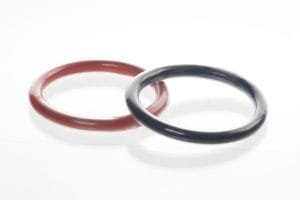
A Teflon® encapsulated O-ring is a composite sealing element designed for applications where a conventional elastomer cannot provide sufficient chemical resistance, while a solid PTFE seal cannot provide enough elastic recovery.The construction is relatively simple but highly effective: a flexible elastomeric core is completely surrounded by a fluoropolymer jacket. The jacket provides the chemical and environmental resistance, while the core supplies the elastic force needed to maintain contact with the sealing surfaces.
This combination solves a fundamental engineering trade-off in sealing technology. Conventional rubber O-rings provide excellent resilience and recovery but may swell, harden, or deteriorate when exposed to aggressive chemicals. Solid PTFE has exceptional chemical resistance but lacks the elastic memory required for many O-ring sealing applications.
Encapsulated O-rings combine these two characteristics into one component. The result is a seal suitable for aggressive chemical environments, elevated temperatures, vacuum service, food and pharmaceutical equipment, process machinery, and other applications where conventional elastomers may have a short service life.
How Does an Encapsulated O-Ring Work?
A conventional elastomeric O-ring seals because the rubber is compressed inside a gland and continuously pushes against the mating surfaces.
An encapsulated O-ring works according to the same basic principle, but its two materials perform different jobs.
| Component | Primary Function |
|---|---|
| FEP/PFA jacket | Chemical resistance, low friction, environmental protection |
| Elastomeric core | Elastic recovery and sealing force |
| Groove | Controls squeeze and prevents excessive movement |
| Mating surface | Provides the opposing sealing interface |
This distinction is important when troubleshooting.
If an encapsulated O-ring fails because of chemical exposure, the jacket should be investigated first. If it fails to maintain sufficient contact pressure, the core material, hardness, cross-section, compression, and temperature should also be examined.
The seal should therefore be specified as a complete construction rather than simply as a PTFE O-ring.
Why Choose an Encapsulated O-Ring Instead of a Standard Rubber O-Ring?
A standard NBR, EPDM, silicone, or FKM O-ring exposes its elastomer directly to the working fluid. Chemical compatibility therefore depends heavily on the specific rubber compound.
An encapsulated O-ring places a fluoropolymer barrier between the process fluid and the elastomeric core.
This can be particularly valuable when the sealing environment contains:
- Aggressive acids
- Caustic chemicals
- Solvents
- Aromatic compounds
- Fuels
- Petroleum-based fluids
- Cleaning chemicals
- High-purity process fluids
- Food-processing chemicals
- Pharmaceutical process media
The FEP/PFA jacket also provides a low-friction surface and very low moisture absorption, while offering strong resistance to weathering and many environmental exposures.
The Practical Engineering Advantage
Instead of asking:
“Which rubber can survive this chemical?”
the engineer can often approach the problem differently:
“Can the jacket isolate the elastomeric core from the chemical, while the core supplies the required sealing force at the operating temperature?”
That is a much more useful way to evaluate an encapsulated O-ring.
Solid-Core vs. Hollow-Core Encapsulated O-Rings
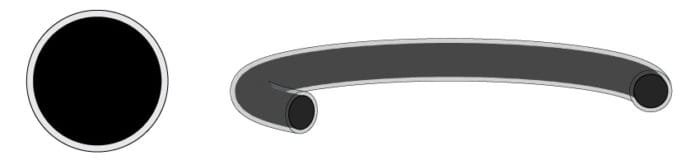
Viton® Solid-Core
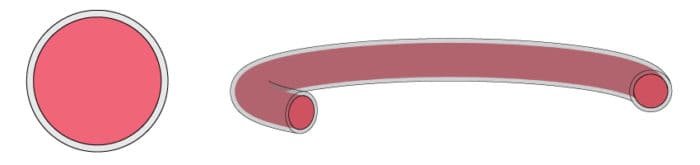
Silicone Solid-Core
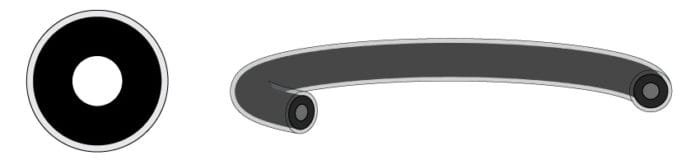
Viton® Hollow-Core
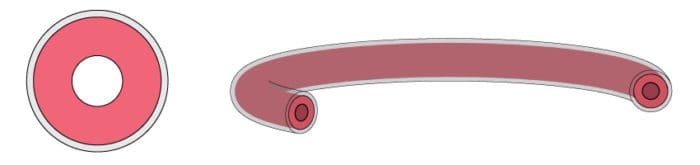
Silicone Hollow-Core
Another important selection parameter is the construction of the internal elastomer.
Solid-Core Encapsulated O-Rings
A solid core contains elastomer throughout the interior of the O-ring.
Advantages include:
- Higher resistance to compression set
- Stronger recovery force
- More robust sealing under demanding conditions
- Better suitability when reliable energizing force is required
For general industrial sealing, the solid-core design is usually the safer starting point when groove dimensions and assembly force permit it. KODA O-Ring’s product information identifies solid-core construction as its standard configuration and emphasizes its compression-set resistance and recovery characteristics.
Hollow-Core Encapsulated O-Rings
A hollow-core construction contains a circular void within the elastomeric energizer.
This reduces the force required to compress the O-ring.
That characteristic can be valuable when:
- The mating components are relatively fragile
- Assembly force must be minimized
- The gland provides limited compression
- A more compliant seal is required
The trade-off is that a hollow core does not provide exactly the same energizing behavior as a solid core.
If the application has significant pressure, large thermal cycling, or demanding recovery requirements, the solid-core design should normally be evaluated first.
The Most Common Installation Problem: Damaging the Jacket
This is where encapsulated O-rings differ significantly from ordinary rubber O-rings.
The FEP/PFA jacket is much less flexible than a bare elastomer.
A conventional rubber O-ring can tolerate a certain amount of stretching and deformation during installation because the elastomer itself is highly flexible.
An encapsulated O-ring has a relatively rigid outer fluoropolymer layer.
Excessive stretching can therefore cause:
- Jacket deformation
- Surface cracking
- Permanent distortion
- Localized thinning
- Installation cuts
- Leakage after assembly
KODA O-Ring specifically recommends heating encapsulated O-rings before installation and removing sharp edges from installation surfaces.
Recommended Installation Procedure
Step 1: Inspect the O-Ring
Before installation, examine the jacket for:
- Cuts
- Scratches
- Cracks
- Wrinkles
- Flattened areas
- Surface defects
Do not install a seal with visible jacket damage.
Step 2: Inspect the Groove
Clean the groove thoroughly.
Remove:
- Metal chips
- Dirt
- Old seal fragments
- Corrosion products
- Hardened lubricant
The groove must not contain sharp edges that could cut the jacket.
Step 3: Check Assembly Edges
Pay particular attention to:
- Threads
- Keyways
- Ports
- Splines
- Cross holes
- Sharp shoulders
Use an appropriate lead-in chamfer where possible.
Step 4: Warm the O-Ring
Heating increases flexibility and makes installation easier.
One published installation procedure recommends heating the O-rings in water at approximately 100°C / 212°F for at least three minutes, removing them immediately before installation. An oven method using approximately 100°C for at least 15 minutes is also described.
The exact procedure should be adapted to the specific seal construction and manufacturer instructions.
Step 5: Install Without Excessive Stretch
Do not force the O-ring over a sharp edge.
Avoid twisting the ring.
Do not use screwdrivers or other sharp tools to push the seal into position.
Step 6: Allow the Seal to Recover
After installation, verify that the O-ring is correctly seated in the groove before assembling the mating component.
A distorted encapsulated O-ring can create a leakage path even when the dimensional specification is correct.
How to Select the Correct Encapsulated O-Ring
A reliable selection process should follow the application rather than the product catalog.
1. Identify the Fluid
Record:
- Fluid name
- Concentration
- Additives
- Cleaning chemicals
- Contaminants
2. Determine the Temperature
Record both:
- Continuous operating temperature
- Maximum transient temperature
3. Determine Pressure
Include:
- Normal pressure
- Maximum pressure
- Pressure spikes
- Pressure cycling
4. Determine Movement
Is the seal:
- Static
- Reciprocating
- Oscillating
- Rotary
Encapsulated O-rings are most naturally suited to static and carefully engineered dynamic applications. High-speed dynamic applications require additional evaluation because the fluoropolymer jacket has different friction and mechanical behavior from ordinary elastomers.
5. Select the Jacket
Choose between:
FEP → general high chemical resistance
PFA → higher thermal/mechanical demands
6. Select the Core
Consider:
FKM → stronger mechanical recovery and resilience
Silicone → wider low-temperature flexibility and softer sealing behavior
7. Select Solid or Hollow Core
Use:
Solid core → maximum recovery and compression-set resistance
Hollow core → lower compression force and greater compliance
8. Confirm the Standard Size
Common encapsulated O-rings are available in standardized dimensions such as AS568 inch sizes, while metric and custom sizes are also available depending on the manufacturer.
What Information Should Be Included in an RFQ?
Avoid sending a supplier only:
“Need a Teflon O-ring, size 214.”
A technically useful RFQ should specify:
Construction: FEP encapsulated
Core: FKM
Size: AS568-214
Core hardness: Application-dependent / specified requirement
Temperature: ___ °C
Pressure: ___ bar
Media: ___
Static/Dynamic: ___
Quantity: ___
Certification: FDA / USP Class VI / other, if required
This allows the manufacturer to determine whether the requested construction is actually suitable rather than simply supplying a dimensionally correct component.
Important Limitations You Should Know Before Ordering
Encapsulated O-rings are highly capable, but they are not a universal replacement for every elastomeric seal.
Higher Cost
The additional manufacturing process and fluoropolymer material make encapsulated O-rings more expensive than standard NBR or FKM O-rings.
More Difficult Installation
The jacket is less flexible and more vulnerable to installation damage.
Limited Elasticity of the Jacket
The fluoropolymer layer itself does not behave like rubber. The core must provide most of the recovery force.
Core Still Matters
Although the working fluid contacts the jacket rather than the core, core temperature capability, mechanical properties, and compression behavior still determine the overall seal performance.
Groove Design Still Matters
An expensive encapsulated O-ring will not compensate for:
- Excessive extrusion clearance
- Incorrect squeeze
- Poor surface finish
- Sharp gland edges
- Incorrect dimensions
The sealing system must be designed as a whole.
Final Engineering Takeaway
A Teflon® encapsulated O-ring should not be viewed simply as a more expensive version of a conventional O-ring.
It is a two-material sealing system engineered around a specific failure problem.
The fluoropolymer jacket addresses chemical exposure and provides a low-friction, highly resistant sealing surface. The elastomeric core provides the resilience that a solid PTFE seal cannot easily provide. FEP is a strong general choice for aggressive chemical environments, while PFA becomes more attractive as temperature and mechanical demands increase. FKM and silicone cores then allow the engineer to tune the sealing force, resilience, and temperature behavior.
The most important selection principle is therefore:
Do not choose an encapsulated O-ring by size alone. Match the jacket, core, hardness, temperature, pressure, chemical environment, groove geometry, and installation method to the actual operating conditions.
When those variables are correctly matched, FEP- and PFA-encapsulated O-rings can provide a highly reliable solution for chemical processing, pharmaceutical equipment, food machinery, fuel systems, valves, pumps, and other applications where ordinary elastomeric O-rings cannot deliver the required service life.