
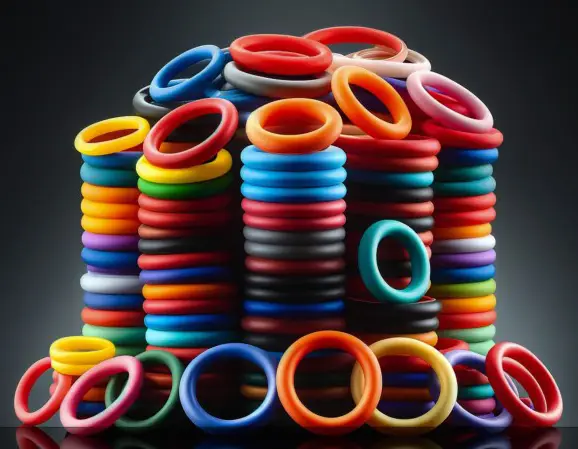
The AS568 standard is the most widely recognized sizing specification for O-rings in North America and many international industries. Whether used in hydraulic systems, pneumatic equipment, automotive assemblies, aerospace applications, or industrial machinery, AS568 O-rings provide a standardized approach to sizing that ensures compatibility, interchangeability, and reliable sealing performance.
Understanding AS568 standards goes far beyond selecting a size number. Engineers, procurement specialists, and maintenance professionals must also consider quality requirements, material compatibility, environmental conditions, and performance expectations. A properly selected AS568 O-ring can significantly improve equipment reliability, reduce maintenance costs, and prevent costly leakage failures.
📏 Key Insight: AS568 establishes standardized O-ring dimensions, enabling consistent compatibility across manufacturers, industries, and applications worldwide.
What Is AS568?
AS568 is an aerospace standard originally developed in the United States to define O-ring dimensions. The standard specifies the inside diameter (ID), cross-sectional diameter (CS), and corresponding dash numbers used to identify O-ring sizes.
Today, AS568 sizing has become the industry benchmark for countless sealing applications. Because the dimensions are standardized, engineers can replace O-rings from one supplier with equivalent products from another without redesigning equipment.
The standardized dimensions found in the AS568 O-Ring size chart help simplify sourcing and maintenance operations.
Why AS568 Standards Matter
Without dimensional standards, manufacturers would produce O-rings using proprietary sizing systems, creating compatibility challenges across industries.
AS568 provides consistency by ensuring:
- Interchangeability between suppliers
- Simplified inventory management
- Improved maintenance efficiency
- Reliable groove compatibility
- Reduced engineering complexity
- Global sourcing flexibility
🌎 Industry Benefit: Standardized AS568 sizing reduces procurement risks and allows equipment manufacturers to support global maintenance networks.
Understanding AS568 Dash Numbers
Each AS568 O-ring is identified by a dash number that corresponds to a specific inside diameter and cross-sectional size.
Examples include:
- AS568-010
- AS568-214
- AS568-325
- AS568-445
The dash number acts as a universal reference that allows engineers to specify exact dimensions regardless of manufacturer.
When selecting an AS568 O-Ring, always verify both the dash number and the material compound to ensure proper fit and performance.
🔍 Selection Tip: A correct dash number ensures dimensional compatibility, but material selection determines actual sealing performance.
AS568 Size Series Overview
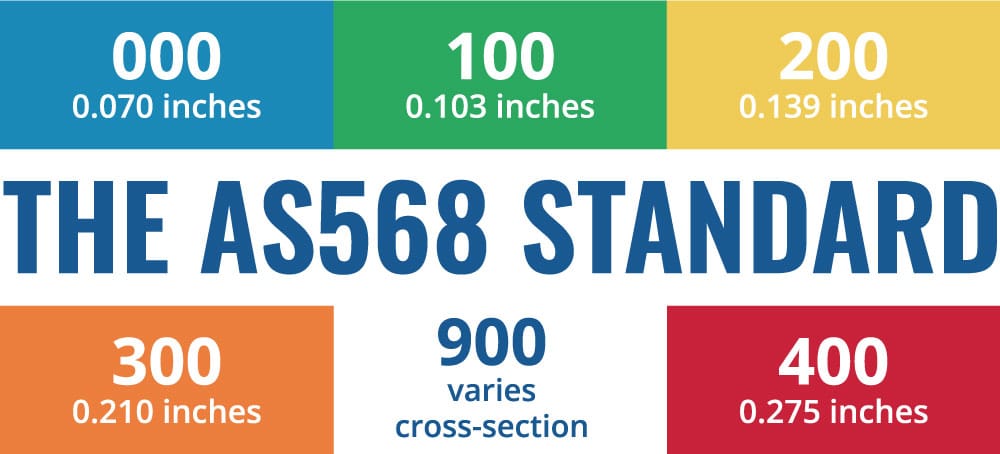
The AS568 standard organizes O-rings into several series based on cross-sectional diameter.
0XX Series
Used for miniature and compact sealing applications where space is limited.
1XX Series
Suitable for many standard industrial sealing applications.
2XX Series
Frequently used in hydraulic and pneumatic systems.
3XX Series
Designed for larger sealing diameters and higher-duty applications.
4XX Series
Applied in large industrial equipment and specialized sealing systems.
📊 Engineering Note: Selecting the proper cross-sectional series helps achieve the correct squeeze and sealing force.
Quality Requirements for AS568 O-Rings
Dimensional compliance alone does not guarantee sealing reliability. Quality manufacturing is equally important.
High-quality AS568 O-rings should exhibit:
- Consistent dimensions
- Uniform hardness
- Smooth surface finish
- Minimal flash
- Excellent elasticity
- Controlled compression set properties
Manufacturers should implement strict quality-control procedures throughout production.
✅ Quality Insight: Even when dimensions are correct, poor compound quality can lead to leakage and premature seal failure.
Material Compatibility Considerations
One of the most important aspects of O-ring selection is ensuring compatibility between the elastomer and the operating environment.
NBR (Nitrile)
Excellent resistance to petroleum-based oils and hydraulic fluids.
FKM (Viton®)
Provides superior chemical and high-temperature resistance.
EPDM
Ideal for water, steam, and outdoor environments.
Silicone
Offers exceptional flexibility across wide temperature ranges.
FFKM
Provides near-universal chemical compatibility for extreme applications.
Selecting the correct AS568 O-Ring material is often more important than selecting the size itself.
Temperature Performance and Reliability
Temperature exposure significantly affects O-ring performance.
- Low temperatures may cause hardening and loss of elasticity.
- High temperatures accelerate aging and compression set.
- Rapid thermal cycling increases material stress.
- Improper material selection shortens seal life.
Understanding operating temperatures is essential for long-term sealing reliability.
🌡️ Performance Insight: The best O-ring size cannot compensate for a material that is unsuitable for the application’s temperature range.
AS568 Compatibility with Groove Design
AS568 dimensions are intended to work with properly designed grooves that provide appropriate squeeze and gland fill percentages.
Key groove design considerations include:
- Compression percentage
- Stretch limits
- Volume fill calculations
- Pressure resistance
- Dynamic versus static applications
Using an AS568 O-Ring with a properly engineered gland significantly improves sealing performance.
Industries That Depend on AS568 O-Rings
The AS568 standard is utilized across numerous industries due to its proven compatibility and availability.
- Hydraulic equipment
- Pneumatic systems
- Automotive manufacturing
- Aerospace engineering
- Food processing equipment
- Medical devices
- Chemical processing plants
- Oil and gas operations
- Industrial automation
- Agricultural machinery
🏭 Industry Fact: AS568 sizing has become one of the most universally accepted O-ring dimensional standards in modern engineering.
Common Mistakes When Selecting AS568 O-Rings
- Choosing based only on size
- Ignoring chemical compatibility
- Overlooking temperature requirements
- Using incorrect hardness levels
- Installing damaged O-rings
- Purchasing low-quality compounds
- Ignoring pressure conditions
Avoiding these common mistakes helps maximize service life and reduce maintenance costs.
⚠️ Warning: Most O-ring failures are caused by improper material selection, installation errors, or environmental incompatibility rather than dimensional issues.
Best Practices for AS568 O-Ring Selection
- Confirm dash number requirements.
- Review operating pressure conditions.
- Verify temperature ranges.
- Check chemical compatibility.
- Evaluate dynamic or static movement.
- Select trusted manufacturers.
- Inspect incoming quality documentation.
Using the correct AS568 O-Ring improves system reliability while minimizing maintenance and downtime.
✔️ Best Practice: Always evaluate size, material, pressure, temperature, and media compatibility together when selecting an O-ring.
Conclusion

AS568 remains the industry’s most trusted O-ring sizing standard because it provides dimensional consistency, compatibility, and interchangeability across manufacturers and industries. However, true sealing performance depends on more than dimensions alone. Material selection, operating conditions, groove design, and manufacturing quality all play critical roles in achieving reliable sealing results.
By understanding AS568 sizing, quality requirements, and compatibility factors, engineers can confidently select O-rings that deliver long service life, reduced maintenance costs, and dependable performance in even the most demanding applications.
Frequently Asked Questions
1. What does AS568 mean for O-rings?
AS568 is a standardized sizing system that defines O-ring inside diameters, cross-sections, and dash numbers for consistent compatibility.
2. Are all AS568 O-rings interchangeable?
Dimensionally they are interchangeable if they share the same dash number, but material compatibility must also be considered.
3. Why is material selection important for AS568 O-rings?
Different elastomers offer varying resistance to temperature, chemicals, pressure, and environmental conditions.
4. Which industries commonly use AS568 O-rings?
Hydraulic, pneumatic, automotive, aerospace, industrial manufacturing, chemical processing, and oil and gas industries all widely use AS568 O-rings.
5. How can I find the correct AS568 size?
Measure the inside diameter and cross-sectional diameter of the O-ring and compare them with the official AS568 size chart.