When engineers specify an O-ring for a new machine, the decision is rarely as simple as choosing the correct size. The application may require a particular elastomer, hardness, temperature range, pressure capability, chemical resistance, compression set performance, and regulatory status. One question becomes especially important when equipment is intended for electrical, industrial, fluid-handling, appliance, enclosure, or safety-related applications: Should the design use a standard O-ring, or does it require a UL Listed or UL Recognized O-ring material?
The distinction matters because a conventional O-ring that performs well mechanically is not automatically certified for a particular safety application. Conversely, selecting a UL-recognized sealing material when no certification requirement exists can add cost, documentation, sourcing restrictions, and qualification work without necessarily improving the functional sealing performance.
This article explains the engineering difference between standard and UL-qualified O-rings, how UL 157 relates to gaskets and seals, how elastomer properties affect sealing reliability, how to evaluate temperature and chemical exposure, and when each type should be specified. The objective is not simply to answer which O-ring is “better,” but to explain which qualification is appropriate for a specific end-use environment.
Key Engineering Point: A UL qualification is not a universal statement that an O-ring is superior to every standard O-ring. UL evaluation is tied to defined material properties, construction, environmental exposure, and end-use conditions. The correct choice depends on the complete sealing system and the applicable product safety requirements.
What Is a Standard O-Ring?
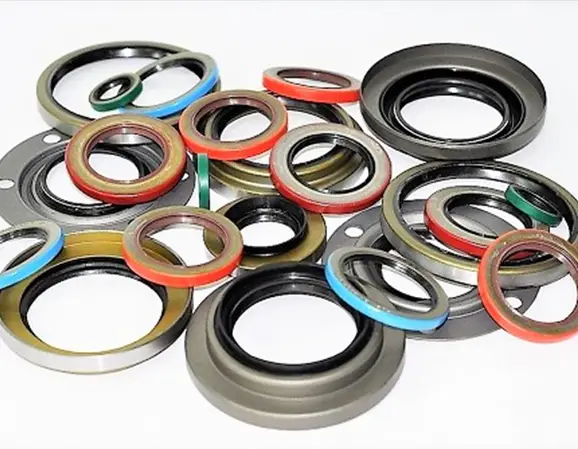
A standard O-ring is a toroidal elastomeric sealing element designed to prevent leakage between two mating surfaces. It is normally manufactured from materials such as NBR, EPDM, FKM, silicone, HNBR, neoprene, or specialized fluorinated compounds. The O-ring works by being compressed inside a gland so that the elastomer maintains contact pressure against the sealing surfaces.
The basic design principle is straightforward. The O-ring cross-section is intentionally larger than the available gland gap, creating radial or axial squeeze. When the system is pressurized, the fluid pressure can also energize the elastomer and increase contact against the low-pressure side of the gland.
Standard O-rings may be manufactured according to recognized dimensional and quality systems. For example, ISO 3601 establishes dimensional systems and quality acceptance criteria for O-rings used in fluid systems. ISO 3601-3 addresses surface imperfections and maximum acceptable limits for those imperfections.
For many industrial applications, the engineering specification is therefore based on several independent requirements: O-ring size, material, hardness, temperature, fluid compatibility, pressure, gland geometry, surface finish, manufacturing quality, and inspection requirements.
Manufacturers and engineers may also use O-Rings selected according to AS568, ISO 3601, metric dimensions, or application-specific drawings. A dimensional standard tells you how the O-ring is sized or controlled; it does not by itself mean that the material has been evaluated for a specific safety certification.
What Does UL Mean for an O-Ring?
UL certification introduces another level of evaluation. UL Solutions describes ANSI/UL 157 as the Standard for Gaskets and Seals. Its gasket and seal testing program covers elastomeric and composite sealing materials and includes O-rings, shaft seals, flexible cellular gaskets, sheet materials, special forms, and other sealing components. Evaluation can include tensile strength, elongation, compression set, tensile set, hardness, low-temperature performance, accelerated aging, and exposure to specified environments.
This is important because sealing performance cannot be reduced to hardness or tensile strength alone. A seal may have excellent initial properties and still lose sealing force after long-term heat exposure, chemical exposure, compression, or aging.
UL’s published certification information also demonstrates why engineers should inspect the exact certification rather than simply accepting a supplier statement that a material is “UL approved.” Published UL records can identify the material, hardness range, tensile strength, elongation, compression set, service temperature, and specific end-use applications.
Do not confuse “UL Listed” and “UL Recognized Component.” UL explains that Recognized Components are intended for use as components of complete equipment and may have restrictions on construction or performance. Final acceptance can depend on how the component is installed and used in the complete equipment.
Standard O-Rings vs. UL-Qualified O-Rings
| Factor | Standard O-Ring | UL-Qualified O-Ring / Seal Material |
|---|---|---|
| Primary purpose | General sealing performance | Sealing plus defined safety/certification requirements |
| Material selection | Based mainly on chemical, thermal and mechanical requirements | Based on application requirements and applicable UL evaluation |
| Hardness | Commonly specified by Shore A range | Specific certified material range may be documented |
| Compression set | Specified according to engineering requirement | May be evaluated as part of UL material qualification |
| Traceability | Depends on supplier quality system | Certification and follow-up requirements may provide additional traceability |
| Typical cost | Usually lower | Potentially higher because of qualification and controlled material requirements |
| Best use | General industrial sealing | Products where applicable safety or regulatory requirements call for UL-qualified sealing materials |
Why O-Ring Material Matters More Than the Color
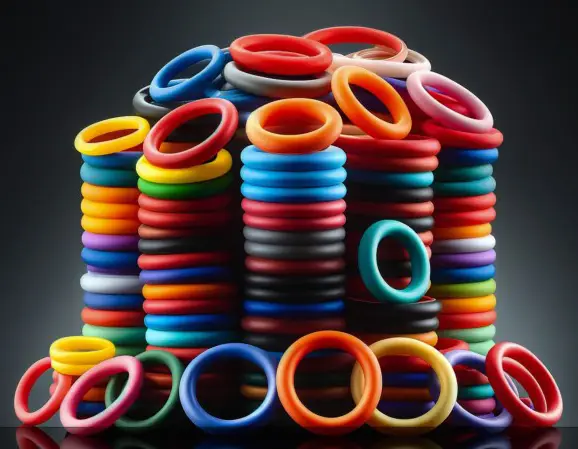
O-rings are often identified visually by color, but color is not a reliable substitute for a material specification. Two black O-rings may have completely different chemical resistance and temperature behavior. Likewise, two red O-rings may be made from different elastomers.
The engineering specification should identify the elastomer family or compound designation, hardness, dimensional standard, operating temperature, fluid exposure, compression requirements, and applicable certifications.
ASTM D2000 is a useful example of a material classification approach. ASTM explains that D2000 classifies vulcanized rubber materials using material types associated with heat-aging resistance and classes associated with resistance to swelling in oil, together with additional property requirements. The current ASTM listing identifies ASTM D2000-18(2024)e1 as an active version.
This distinction is critical. A rubber compound can be dimensionally correct and mechanically strong while still being chemically unsuitable for the service fluid.
Common O-Ring Elastomers and Their Engineering Characteristics
| Material | Typical Strengths | Typical Limitations | Common Applications |
|---|---|---|---|
| NBR | Good mineral-oil and fuel resistance; economical | Limited ozone/weathering resistance compared with some alternatives | Hydraulic systems, pneumatic equipment, petroleum oils |
| EPDM | Excellent weathering, ozone and many water-based fluid applications | Generally unsuitable for petroleum oils | Water systems, outdoor equipment, cooling systems |
| FKM | High-temperature and broad chemical resistance | Can have limitations with hot water/steam and certain chemicals | Automotive, chemical, aerospace and high-temperature applications |
| Silicone | Wide temperature capability and flexibility | Lower mechanical strength and abrasion resistance than many engineering elastomers | Appliances, electronics, medical and temperature-sensitive applications |
| HNBR | Improved heat, ozone and mechanical resistance compared with conventional NBR | Higher cost than basic NBR | Automotive, oilfield, high-performance sealing |
These material descriptions are general engineering guidance rather than a substitute for compound-specific compatibility testing. The actual formulation can significantly change performance.
What Does Hardness Have to Do With O-Ring Selection?
O-ring hardness is commonly expressed as Shore A hardness. Typical engineering selections include approximately 70 Shore A for general-purpose sealing, although softer and harder compounds are widely used depending on the application.
A softer O-ring can conform more easily to surface irregularities and may provide good low-pressure sealing. However, excessive softness can increase the risk of extrusion, nibbling, installation damage, or dimensional instability under pressure.
A harder O-ring generally provides better resistance to extrusion and may be advantageous at higher pressure, but it can require greater installation force and may not seal effectively against rough or imperfect surfaces at low pressure.
Expert Tip: Never select hardness independently of gland geometry. A 90 Shore A O-ring is not automatically a better high-pressure seal than a 70 Shore A O-ring. Clearance gap, pressure, temperature, extrusion risk, compound properties, and gland design must be considered together.
Compression Set: One of the Most Important Long-Term Properties
Compression set describes the tendency of an elastomer to retain permanent deformation after being compressed for a defined time and temperature. For a static O-ring, low compression set is generally desirable because the seal needs to maintain contact pressure over its service life.
Consider a simplified example. Suppose an O-ring is compressed 25% during installation. If long-term thermal aging causes significant permanent deformation, the O-ring may no longer recover sufficiently when the system cools or experiences pressure fluctuations.
The result can be a gradual loss of sealing force, especially in applications where pressure is low or where thermal cycling repeatedly changes the dimensions of the mating components.
UL’s gasket and seal evaluation specifically identifies compression set as one of the properties that can be investigated during qualification.
Temperature Is Not Just a Maximum Number
O-ring temperature selection should consider both continuous temperature and transient temperature. A seal that survives a short exposure to a high temperature does not necessarily have the same life at that temperature continuously.
Thermal aging can change hardness, tensile strength, elongation, compression set, and flexibility. Low temperatures can produce the opposite problem: the elastomer may become significantly stiffer and lose its ability to follow dimensional changes or surface irregularities.
UL gasket and seal certification information can contain defined maximum and minimum service temperatures. For example, UL Product iQ records show certified gasket and seal materials with specified temperature limits and corresponding hardness and mechanical-property ranges.
Therefore, an engineer should ask: What is the continuous temperature? What is the peak temperature? How many cycles occur? How long does the peak last? Is the O-ring compressed throughout the exposure? Is the fluid itself changing at elevated temperature?
Thermal Conductivity and Heat Transfer
Elastomers generally have much lower thermal conductivity than metals. This means an O-ring can act as a local thermal barrier within a metal assembly. The actual temperature of the elastomer may therefore differ from the measured temperature of a nearby metal housing.
For engineering calculations, the approximate conductive heat-transfer relationship is:
Q = k × A × ΔT / L
where Q is heat-transfer rate, k is thermal conductivity, A is effective heat-transfer area, ΔT is temperature difference, and L is the conduction distance.
For a seal designer, the important point is not simply the numerical value of thermal conductivity. It is the interaction between the seal, housing, fluid, pressure, friction, and heat generation. A dynamic seal can generate frictional heat, while a static seal may primarily follow the temperature of the surrounding components.
Pressure, Extrusion and Clearance Gap
Pressure is one of the most common reasons a conventional O-ring fails even when the compound itself is chemically compatible.
Under pressure, the elastomer can be forced into the clearance gap between mating components. This phenomenon is commonly described as extrusion. If the pressure is sufficiently high, repeated pressure cycling can produce small pieces of elastomer being removed from the seal.
Typical engineering controls include reducing clearance, increasing hardness, selecting a more extrusion-resistant compound, improving gland geometry, or using backup rings where appropriate.
A simple conceptual pressure relationship is:
Force = Pressure × Effective Area
As pressure rises, the force attempting to deform the elastomer can increase substantially. This is why a sealing design that works at 2 MPa may require additional extrusion protection at a substantially higher pressure.
When Should You Choose a Standard O-Ring?
A standard O-ring is often the most appropriate choice when the equipment does not require a specific UL certification and the application can be fully qualified using conventional engineering requirements.
Typical examples include general industrial hydraulic equipment, pneumatic systems, machinery, gearboxes, pumps, agricultural equipment, automotive repair components, laboratory fixtures, and many custom mechanical assemblies.
The design engineer should still establish a complete specification rather than simply writing “70 Shore O-ring.” A useful specification can include:
- O-ring size and dimensional standard.
- Elastomer family and compound designation.
- Hardness range.
- Operating temperature range.
- Fluid or chemical exposure.
- Static or dynamic sealing mode.
- Operating pressure.
- Maximum extrusion gap.
- Surface finish and gland dimensions.
- Compression or stretch requirements.
- Quality acceptance criteria.
- Special regulatory or customer requirements.
When Should You Consider UL-Qualified O-Rings?

UL-qualified sealing materials should be considered when the end-product standard, certification program, customer specification, or regulatory pathway requires a gasket or seal material evaluated under applicable UL requirements.
UL Solutions states that its gasket and seal program can certify products as UL Recognized Components and publish them in the Product iQ database. UL also explains that many certified gasket and seal materials are intended for factory installation in complete equipment, with traceability and application conditions forming part of the certification framework.
Examples may include electrical enclosures, appliances, equipment exposed to specified flammable or combustible fluids, safety-related assemblies, and products whose end-product standard references UL 157.
However, the exact requirement must be confirmed from the end-product standard. It is not good engineering practice to assume that every O-ring installed in an electrical product must automatically be UL certified.
UL Listed vs. UL Recognized: Why the Difference Matters
The terms “Listed” and “Recognized” should not be used interchangeably.
A UL Listed product is generally evaluated as a complete product for its intended use, while a UL Recognized Component is evaluated for use as a component within an end product. UL explains that Recognized Components can have incomplete constructional features or restricted performance capabilities, and final acceptance depends on how they are incorporated into the complete equipment.
Practical Purchasing Rule: Do not tell a supplier simply, “We need a UL O-ring.” Ask for the applicable UL standard, certification category, material designation, hardness range, temperature range, end-use conditions, and current certification record.
How to Read a UL Seal Certification Record
A certification record should be treated as an engineering document rather than a marketing label.
Important information may include the manufacturer, material, hardness range, tensile strength, elongation, compression set, tensile set, maximum and minimum service temperatures, and approved end-use applications.
For example, a UL Product iQ record for a silicone gasket material identifies a service-temperature range, hardness range, tensile strength, elongation, compression set, and specific enclosure applications. Another record for an EPDM material identifies a different temperature range and different chemical/end-use applications.
This illustrates a fundamental engineering principle: certification belongs to a defined material and application, not simply to the word “rubber.”
Chemical Resistance: Standard vs. UL Is Not the Main Question
Chemical compatibility should be evaluated separately from certification.
Suppose a standard FKM O-ring has excellent resistance to a particular hydrocarbon fluid. That does not automatically make it UL qualified for an end product. Conversely, a UL-qualified material should not automatically be assumed compatible with every fluid simply because it carries a UL-related qualification.
Engineers should consider swelling, shrinkage, hardness change, tensile-property retention, volume change, surface cracking, softening, embrittlement, and compression-set behavior after chemical exposure.
A simplified volumetric swelling calculation can be expressed as:
Volume Change (%) = [(Vafter − Vbefore) / Vbefore] × 100
As an illustrative laboratory example, if a test specimen has an initial volume of 10.00 cm³ and a post-exposure volume of 10.80 cm³, the calculated volume increase is 8%. That result alone does not determine suitability, but it provides a measurable basis for comparing compounds.
Case Example: Choosing a Seal for an Electrical Enclosure
Case Example — Engineering Scenario, Not a Claim of a Real Customer Project: Consider an outdoor electrical enclosure that uses a circular elastomeric gasket around a removable cover. The equipment manufacturer wants protection against water ingress and also needs to comply with a product safety certification pathway.
A purchasing team initially proposes a conventional EPDM O-ring because EPDM offers strong weathering and ozone resistance. From a pure material-compatibility perspective, that may be reasonable.
However, the engineering team discovers that the end-product certification requirements reference UL requirements for gaskets and seals. The problem is therefore no longer simply “Which rubber seals water best?” The question becomes “Which specific material and construction satisfy the required end-product conditions while maintaining the necessary sealing performance?”
The team evaluates:
- Weather and UV exposure.
- Minimum winter temperature.
- Maximum enclosure temperature.
- Compression set after aging.
- Water resistance.
- Hardness and installation force.
- Gland geometry.
- Applicable UL certification requirements.
The final decision is based on both sealing engineering and certification requirements. This is the correct workflow: first identify the product requirement, then identify the material and certification path.
Laboratory Test Example
Laboratory Test Example — Illustrative Engineering Method: A manufacturer wants to compare a conventional standard compound with a candidate UL-qualified compound for a static sealing application.
Rather than claiming that one material is universally better, the laboratory establishes controlled tests.
| Test | Purpose | Typical Measurement |
|---|---|---|
| Hardness | Confirm compound consistency | Shore A |
| Tensile test | Evaluate mechanical strength | Tensile strength and elongation |
| Compression set | Assess permanent deformation | Percent compression set |
| Fluid immersion | Assess chemical compatibility | Mass, volume and hardness change |
| Thermal aging | Assess property retention | Change in mechanical properties |
| Leak test | Verify actual sealing function | Leak rate or pass/fail criterion |
Important: The test program above is an illustrative engineering example. It is not presented as a real customer test, factory test report, certified UL test result, or product life curve.
Failure Mode Analysis: Why a Standard O-Ring Can Fail
Failure analysis should distinguish between material failure, design failure, installation failure, and certification failure.
Failure Mode 1: Compression Set
The O-ring remains permanently flattened after prolonged compression. Contact pressure decreases and leakage may occur during thermal cycling or low-pressure operation.
Failure Mode 2: Extrusion
The O-ring is forced into a clearance gap by pressure. Small pieces may be removed during pressure cycling, eventually creating a leak path.
Failure Mode 3: Chemical Swelling
The elastomer absorbs the working fluid and increases in volume. Excessive swelling can create installation problems, friction, dimensional instability, or premature damage.
Failure Mode 4: Chemical Shrinkage or Embrittlement
Some chemicals extract components from an elastomer or attack the polymer network, resulting in shrinkage, hardness change, cracking, or loss of elasticity.
Failure Mode 5: Thermal Aging
Long-term heat exposure can alter the polymer structure and change hardness, tensile properties, elongation, and compression recovery.
Failure Mode 6: Installation Damage
Cutting, twisting, pinching, over-stretching, contamination, or sharp gland edges can create a defect before the machine even begins operation.
Failure Mode 7: Certification Mismatch
The material may seal successfully but fail to satisfy the applicable end-product certification requirement. This is not necessarily a mechanical sealing failure; it is a compliance and product-qualification failure.
Installation Guidelines for Standard and UL-Qualified O-Rings

Correct installation is essential regardless of certification status.
Before installation, inspect the groove for burrs, scratches, machining marks, contamination, and sharp edges. Clean the gland and mating surface according to the application’s cleanliness requirements.
Do not roll an O-ring into a groove with excessive twisting. A twisted O-ring can create localized stress and a spiral-shaped leakage path.
When stretching an O-ring over a shaft, control the installation stretch. Excessive stretch reduces cross-sectional diameter and can change the intended squeeze.
Use an application-compatible lubricant where permitted. Lubricant compatibility must be confirmed with both the elastomer and the working fluid.
Installation Rule: A certified material cannot compensate for a damaged groove, excessive clearance, incorrect squeeze, contamination, or installation damage.
Gland Design and O-Ring Squeeze
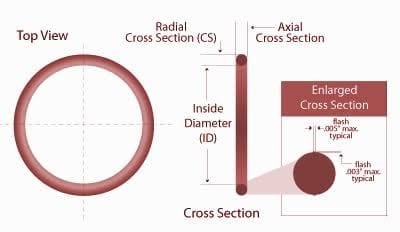
O-ring squeeze is the percentage by which the installed cross-section is compressed relative to its original cross-section.
Squeeze (%) = [(Original Cross-Section − Installed Height) / Original Cross-Section] × 100
For example, if an O-ring has a nominal cross-section of 3.00 mm and the installed gland height is 2.40 mm:
Squeeze = [(3.00 − 2.40) / 3.00] × 100 = 20%
This calculation is intentionally simplified. Actual gland design must also account for tolerances, thermal expansion, groove fill, stretch, pressure, dynamic motion, elastomer swell, and manufacturing variation.
Surface Finish and Leakage
An O-ring does not create a perfect seal simply because it is soft. The elastomer must deform sufficiently to fill microscopic surface irregularities while maintaining stable contact pressure.
Surface finish requirements depend strongly on whether the seal is static or dynamic. A rotating or reciprocating application can require tighter control of surface texture because excessive roughness can act like a series of leakage channels and accelerate wear.
Static sealing surfaces can generally tolerate different surface conditions from dynamic sealing surfaces, but sharp scratches, burrs, dents, corrosion pits, and machining defects remain significant risks.
How ASTM and ISO Standards Fit Into the Decision
Different standards answer different questions.
| Standard / System | Primary Engineering Role |
|---|---|
| ISO 3601 | O-ring dimensions and quality requirements for applicable fluid-system applications |
| ASTM D2000 | Classification of vulcanized rubber materials according to defined property requirements |
| ANSI/UL 157 | Evaluation framework for gaskets and seals, including O-rings and other elastomeric sealing components |
| End-product standard | Defines the safety requirements that the finished equipment must satisfy |
ISO 3601-3 specifically defines quality acceptance criteria for O-rings and addresses surface imperfections. ASTM D2000, meanwhile, establishes a classification framework for rubber material properties rather than serving as a substitute for end-product safety certification.
A Better O-Ring Selection Workflow
Professional seal selection should follow a logical sequence instead of beginning with price or color.
- Define the application. Determine whether the seal is static, reciprocating, oscillating, or rotary.
- Define the fluid. Identify the exact chemical, concentration, additives, and contamination.
- Define temperature. Record continuous, minimum, maximum, and transient temperatures.
- Define pressure. Record normal, maximum, pressure spikes, and pressure cycling.
- Define dimensions. Select the correct cross-section, inside diameter, gland dimensions, and tolerances.
- Select elastomer. Compare chemical resistance, thermal resistance, compression set, hardness, and mechanical strength.
- Check extrusion risk. Evaluate pressure, hardness, clearance, and backup-ring requirements.
- Check certification. Determine whether UL, NSF, FDA, WRAS, automotive, aerospace, or another requirement applies.
- Verify documentation. Request compound data, inspection requirements, certificate information, and traceability where necessary.
- Validate the assembly. Perform functional testing under realistic environmental conditions.
When UL Certification Adds Real Value
UL qualification becomes especially valuable when the sealing material is part of a product certification pathway. In such situations, the documentation and controlled material characteristics can reduce uncertainty during end-product evaluation.
UL Solutions states that its gasket and seal certification process is intended to help manufacturers demonstrate compliance of sealing materials with relevant requirements and that certified materials can be published in Product iQ.
This can be important for OEM production because changing an elastomer compound without reviewing the certification can potentially affect the certified construction.
When UL Certification May Be Unnecessary
If the equipment has no applicable UL requirement and the customer specification does not call for UL-qualified materials, selecting a UL-qualified compound solely because the label sounds more premium may not provide a meaningful engineering benefit.
For a simple hydraulic machine, for example, the more important questions may be whether the compound is compatible with the hydraulic fluid, whether the operating temperature is within range, whether the hardness is suitable, whether the gland is correctly designed, and whether the material has adequate compression-set resistance.
In this situation, spending more on certification that is not required may increase procurement cost without solving the actual engineering problem.
Total Cost of Ownership
The lowest purchase price is not always the lowest total cost.
Suppose a standard O-ring costs $0.20 per piece and a qualified alternative costs $0.60. At first glance, the standard O-ring appears three times cheaper. However, if the application requires certification and the standard material causes redesign, additional laboratory testing, documentation delays, or failed certification review, the apparent savings can disappear quickly.
Conversely, using a more expensive certified component where no certification is needed may unnecessarily increase production cost.
Better purchasing equation:
Total Cost of Ownership = Purchase Cost + Assembly Cost + Qualification Cost + Failure Cost + Maintenance Cost + Compliance Cost
Supplier Questions Engineers Should Ask
Before purchasing a standard O-ring, ask for the compound designation, hardness tolerance, dimensional standard, batch inspection requirements, temperature range, chemical compatibility information, and applicable quality certificates.
For a UL-qualified O-ring or seal material, ask additional questions:
- What is the UL certification or recognition number?
- Is the material currently active in the certification database?
- Is the material UL Listed or UL Recognized?
- What is the exact material designation?
- What hardness range is covered?
- What temperature range is covered?
- What end-use applications are covered?
- Are there restrictions on thickness, geometry, color, or processing?
- Does the certification apply to the finished O-ring or to the raw material?
- Is factory installation required?
These questions help prevent a common purchasing mistake: receiving a certificate for a material family and assuming that every size, formulation, geometry, or application is automatically covered.
Expert Comparison: What Should Drive the Decision?
| Question | If Yes | Engineering Action |
|---|---|---|
| Does the end-product standard require UL? | Yes | Evaluate applicable UL-qualified material and end-use conditions |
| Is the application purely mechanical with no certification requirement? | Yes | Select the best material based on engineering performance and cost |
| Is chemical exposure severe? | Yes | Prioritize compound compatibility testing |
| Is pressure high? | Yes | Evaluate extrusion clearance, hardness and backup-ring requirements |
| Is temperature highly variable? | Yes | Evaluate thermal cycling and compression-set behavior |
Common Mistakes to Avoid
Mistake 1: Assuming UL means chemically compatible. Certification does not replace fluid compatibility analysis.
Mistake 2: Assuming all UL seals are interchangeable. Different certified materials can have different temperature, chemical and end-use limitations.
Mistake 3: Treating hardness as the only material specification. Hardness does not tell the complete story of compression set, chemical resistance, tensile strength, elongation, low-temperature flexibility, or aging behavior.
Mistake 4: Ignoring gland geometry. Even an excellent compound can fail if squeeze and clearance are wrong.
Mistake 5: Assuming a certificate automatically covers the finished assembly. UL explains that component recognition can depend on incorporation into the complete equipment.
Mistake 6: Selecting by color. Color is not a sufficient material identification method.
Mistake 7: Changing compounds without engineering review. A seemingly minor elastomer change can affect compression set, friction, chemical compatibility, dimensions, and certification status.
How to Build a High-Quality O-Ring Specification
A professional drawing or purchasing specification should be sufficiently detailed that two qualified suppliers can understand the same requirement.
A practical specification might state the O-ring size standard, dimensional code, elastomer family, compound designation, hardness, hardness tolerance, color if needed for identification, temperature range, fluid compatibility, inspection requirements, packaging requirements, and certification requirements.
Where applicable, the specification should explicitly state that a UL-qualified material is required and identify the applicable UL standard or certification category rather than simply writing “UL material.”
This approach improves purchasing consistency and reduces the risk of an apparently equivalent replacement being introduced without engineering approval.
Why Documentation Is Part of Seal Reliability
In a simple machine, documentation may seem secondary to physical performance. In regulated or certified products, documentation can become part of the engineering control system.
A controlled material designation allows engineering and quality teams to determine whether the same compound is being used over time. Batch traceability can also make failure investigations more effective.
For certified products, maintaining the approved material and processing conditions can be especially important. UL Product iQ provides published certification information that can be used to verify certified materials and their characteristics.
Final Selection Guide
Choose a standard O-ring when:
- No UL certification requirement applies.
- The application can be qualified through normal engineering testing.
- The compound has adequate chemical and thermal resistance.
- The gland design is appropriate for the pressure and motion.
- The supplier can provide sufficient quality documentation.
“`
Choose a UL-qualified O-ring or seal material when:
- The applicable end-product standard requires UL evaluation.
- The certification pathway specifically references UL 157 or another applicable requirement.
- The equipment manufacturer needs documented certified sealing materials.
- The application requires defined environmental and safety performance.
- Material traceability and certification status are important parts of the product qualification process.
“`
Conclusion: Standard vs. UL Listed O-Rings
The difference between standard and UL-qualified O-rings is fundamentally a difference in application requirements, qualification, documentation and intended end use rather than a simple difference between “cheap” and “premium” rubber.
A properly selected standard O-ring can provide excellent sealing performance when the material, hardness, dimensions, gland design, pressure, temperature and chemical environment are correctly matched.
A UL-qualified sealing material becomes important when the finished product must satisfy applicable safety requirements or certification pathways. UL’s gasket and seal program evaluates relevant physical properties and environmental conditions, while published certification records identify specific material characteristics and application information.
Engineers should therefore avoid asking only, “Is this O-ring UL?” The better questions are: What standard applies? What exact material is certified? What conditions are covered? Is the component Listed or Recognized? Does the certification cover this application? And does the seal still meet the mechanical and chemical requirements of the actual system?
For general industrial sealing, the priority should be correct material and design. For certified products, the priority should be correct material, correct design, and correct certification pathway. In both cases, engineering validation remains essential.
Frequently Asked Questions
FAQ 1: Is a UL O-ring always better than a standard O-ring?
No. UL qualification does not mean an O-ring is universally superior for every application. UL evaluation addresses defined properties and end-use conditions. A conventional O-ring made from a highly suitable compound may be the better engineering choice for a non-regulated application. The correct question is whether the material satisfies the complete application requirement.
FAQ 2: Does every O-ring used in an electrical product need to be UL certified?
No. The requirement depends on the applicable end-product standard, certification pathway, construction, function of the seal, and specific product requirements. Some applications may require UL-qualified gasket or seal materials, while others may not. The applicable product standard should be reviewed before specifying certification.
FAQ 3: What is the difference between UL Listed and UL Recognized O-rings?
UL Listed products are evaluated as products for defined intended uses, while UL Recognized Components are evaluated for incorporation into complete equipment. UL specifically notes that Recognized Components can have restrictions and that final acceptance depends on how the component is installed and used in the complete equipment.
FAQ 4: Can ASTM D2000 replace UL certification?
No. ASTM D2000 is a rubber-material classification system that establishes property classifications and requirements for vulcanized rubber materials. It does not serve as a substitute for an applicable UL certification or end-product safety evaluation.
FAQ 5: What should I provide when asking a supplier for the correct O-ring?
Provide the O-ring size, dimensional standard, elastomer requirement, hardness, operating temperature, pressure, working fluid, static or dynamic operating condition, gland information, expected service environment, and any required certification. If UL qualification is required, specify the applicable UL requirement and request the exact certification information rather than relying on a general statement such as “UL approved.”