Understanding How Tensile Strength Affects O-Ring Performance
When engineers evaluate an O-ring, tensile strength is often discussed alongside hardness, elongation, compression set, chemical resistance, and temperature capability. However, tensile strength is one of the most important mechanical properties because it determines how well an elastomer can resist stretching, installation stress, pressure-induced deformation, handling damage, and mechanical loading before rupture. A properly selected O-ring must maintain its sealing function while repeatedly experiencing deformation and environmental stress.
✔ Engineering Insight: High tensile strength does not automatically mean that an O-ring is the best seal for every application. The correct design requires a balance between tensile strength, elongation, hardness, compression set, chemical compatibility, temperature resistance, and operating conditions.
What Is Tensile Strength in an O-Ring?
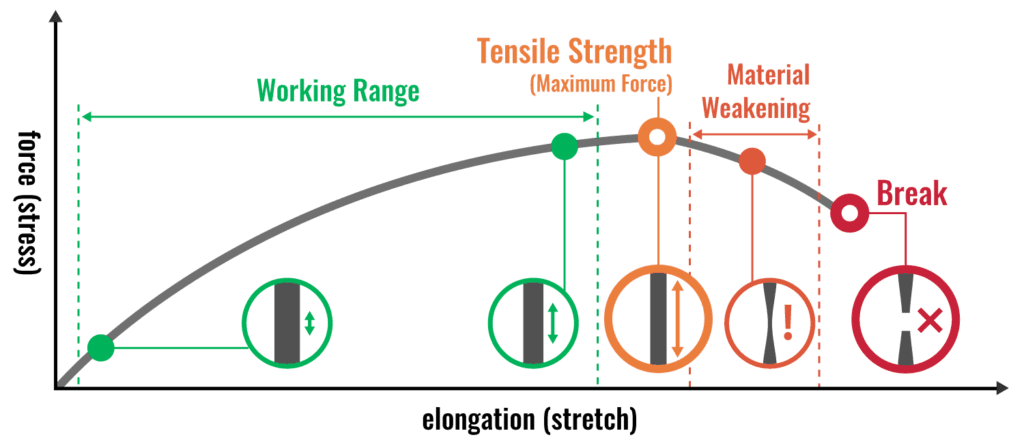
Tensile strength is the maximum tensile stress that an elastomer can withstand before it breaks. It is commonly expressed in MPa, psi, or sometimes N/mm². In practical terms, tensile strength describes how much pulling force a rubber material can resist relative to its original cross-sectional area.
The basic engineering relationship is:
Tensile Stress = Force ÷ Original Cross-Sectional Area
σ = F / A₀
For an elastomer, the tensile strength value is normally measured using a standardized dumbbell-shaped test specimen rather than a complete O-ring. The measured value provides a material-performance reference that helps engineers compare different rubber compounds.
Why Tensile Strength Matters to O-Ring Performance
An O-ring is not a rigid component. It is designed to deform. During installation, the seal may be stretched over a shaft, compressed inside a groove, exposed to pressure, or subjected to dynamic movement. These conditions create tensile and shear stresses within the elastomer.
Insufficient tensile strength can contribute to:
- ⚠ Tearing during installation
- ⚠ Damage caused by sharp groove edges
- ⚠ Rupture during excessive stretching
- ⚠ Crack propagation under repeated movement
- ⚠ Reduced resistance to extrusion damage
- ⚠ Premature failure in dynamic applications
On the other hand, tensile strength should never be considered in isolation. A compound with high tensile strength but poor compression set may still lose sealing force after long-term compression.
Tensile Strength and O-Ring Stretch During Installation
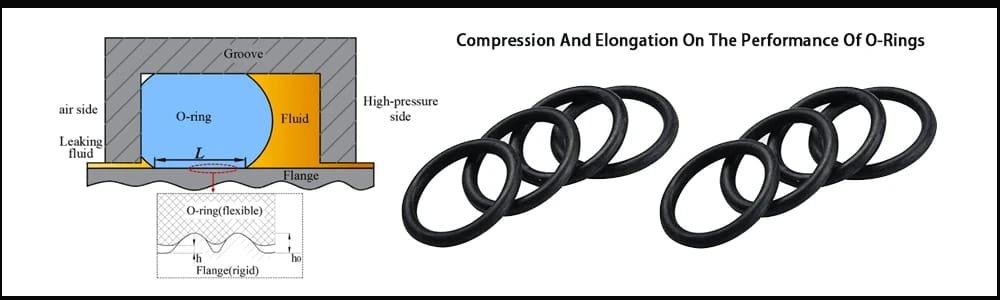
Installation stretch is one of the most direct situations in which tensile strength becomes important. When an O-ring is stretched over a shaft or installed into a groove, its diameter increases and the cross-sectional diameter may decrease slightly.
For a simple diameter calculation:
Stretch Ratio (%) = (Installed Diameter − Original Diameter) ÷ Original Diameter × 100
For example, if an O-ring with an original inside diameter of 50 mm is stretched to 52 mm:
Stretch = (52 − 50) ÷ 50 × 100 = 4%
A 4% stretch may be acceptable for many static applications, but the actual allowable value depends on the O-ring design, groove geometry, cross-section, elastomer compound, and application standard. Excessive stretching can reduce cross-sectional diameter and alter the intended compression ratio.
Relationship Between Tensile Strength and Elongation
Tensile strength and elongation at break are closely related but describe different properties.
| Property | What It Measures | Importance |
|---|---|---|
| Tensile Strength | Maximum stress before rupture | Resistance to breaking |
| Elongation at Break | Percentage of stretching before rupture | Flexibility and deformation capacity |
| Modulus | Stress required at a defined elongation | Resistance to deformation |
A material may have high tensile strength but relatively low elongation. Another compound may stretch significantly but have lower ultimate tensile strength. The best material depends on the application.
Typical Tensile Strength of Common O-Ring Materials
Actual values vary significantly according to formulation, curing system, filler package, test method, temperature, and manufacturer. The following values are general engineering ranges rather than guaranteed specifications for every compound.
| Elastomer | Typical Tensile Strength | Typical Application |
|---|---|---|
| NBR | Approximately 10–25 MPa | Oil and hydraulic systems |
| FKM | Approximately 10–20 MPa | Fuel and high-temperature service |
| EPDM | Approximately 10–25 MPa | Water and steam |
| Silicone | Approximately 5–12 MPa | Medical and temperature-sensitive applications |
| Polyurethane | Approximately 20–50 MPa | High-wear hydraulic applications |
These ranges are provided for engineering orientation only. The exact value should always be taken from the compound-specific technical data sheet and verified using the applicable test method.
Hardness, Tensile Strength, and Sealing Performance
Hardness is commonly measured using Shore A methods such as ASTM D2240 or ISO 48-related procedures. A typical industrial O-ring may have a hardness of 70 Shore A, although softer and harder compounds are also widely used.
Hardness and tensile strength are not interchangeable. Increasing hardness may improve resistance to extrusion, but it can also increase installation force and reduce the ability of the seal to conform to surface irregularities.
Expert Tip: A 90 Shore A O-ring is not automatically stronger or more reliable than a 70 Shore A O-ring. The compound formulation and application environment determine actual performance.
Relevant ASTM and ISO Standards
Engineers commonly use standardized test methods to evaluate elastomer performance.
- ASTM D412: Tensile properties of vulcanized rubber and thermoplastic elastomers.
- ASTM D2240: Durometer hardness testing.
- ASTM D395: Compression set of rubber materials.
- ASTM D471: Effect of liquids on rubber properties.
- ASTM D1414: Rubber O-ring testing procedures.
- ASTM D2000: Classification system for rubber products used in automotive applications.
- ISO 3601: O-ring dimensions, tolerances, and related requirements.
- ISO 48: Hardness testing of vulcanized or thermoplastic rubber.
Standards are essential because tensile strength results can vary depending on specimen geometry, test speed, conditioning, temperature, and measurement procedure.
How Temperature Changes Tensile Strength
Elastomers are viscoelastic materials, meaning their mechanical properties change with temperature and time.
At elevated temperatures, many elastomers experience reduced tensile strength and modulus. Long-term exposure may also accelerate oxidation, chain scission, plasticizer loss, or other chemical changes.
At low temperatures, rubber may become harder and less flexible. Even when the material retains significant tensile strength, reduced flexibility can increase the risk of cracking during installation or movement.
| Temperature Condition | Potential Effect |
|---|---|
| Low temperature | Reduced flexibility and increased stiffness |
| Normal temperature | Nominal mechanical performance |
| High temperature | Potential loss of strength and accelerated aging |
Tensile Strength and Chemical Resistance
Chemical exposure can significantly reduce the original tensile strength of an elastomer. Absorption, swelling, extraction of additives, and chemical degradation may alter the polymer network.
For example, NBR generally performs well with many petroleum-based oils but may not be suitable for every solvent. EPDM typically offers excellent resistance to hot water and many polar fluids but is generally unsuitable for petroleum-based oils. FKM often provides excellent resistance to fuels, oils, and elevated temperatures, while silicone provides excellent temperature flexibility but may have limitations in certain mechanical applications.
ASTM D471 immersion testing is commonly used to evaluate changes in volume, hardness, tensile strength, and elongation after exposure to selected liquids.
Tensile Strength and Compression Set
Compression set describes the permanent deformation remaining after an elastomer has been compressed for a specified period under controlled conditions. It is commonly evaluated using ASTM D395.
An O-ring can have excellent tensile strength but poor compression set performance. In that situation, the seal may resist installation damage but gradually lose its ability to maintain contact pressure after prolonged compression.
The key engineering principle: Tensile strength helps prevent rupture, while compression set resistance helps maintain sealing force over time. Both properties are important, but they solve different failure mechanisms.
Tensile Strength and Thermal Conductivity
Most elastomeric materials have relatively low thermal conductivity, commonly in the approximate range of 0.13–0.30 W/m·K depending on formulation and filler content. This means that heat generated by friction or transferred from a hot fluid may not dissipate as quickly as it would through metals.
Temperature rise can reduce tensile strength and accelerate aging. Therefore, engineers evaluating high-speed dynamic sealing applications should consider frictional heat generation together with tensile strength retention.
Typical Applications Where Tensile Strength Is Critical

- Hydraulic cylinders
- Pneumatic actuators
- Automotive fuel systems
- Engine sealing systems
- Industrial pumps
- Rotary shafts
- Medical equipment
- Oil and gas equipment
- Water treatment systems
- High-temperature processing machinery
Dynamic applications typically create more complex stress conditions than static applications because the O-ring may experience repeated compression, sliding, rolling, twisting, and shear.
Installation Methods That Protect Tensile Integrity
Even a high-quality O-ring can fail if installation procedures create excessive mechanical damage.
- ✔ Clean the groove and mating surfaces.
- ✔ Remove sharp edges and burrs.
- ✔ Avoid using sharp tools to stretch the seal.
- ✔ Apply a compatible lubricant when appropriate.
- ✔ Avoid twisting the O-ring during assembly.
- ✔ Control installation stretch.
- ✔ Verify groove dimensions and surface finish.
Stretching the O-ring beyond the design range can create localized stress concentrations. A small nick created during installation may then become the starting point for crack growth.
Failure Mode Analysis
Failure Mode Analysis — Illustrative Industry Example
An O-ring used in a repeatedly serviced hydraulic assembly developed a circumferential tear during maintenance. Inspection found that the seal had been stretched over a sharp metallic edge using an unapproved tool. Although the compound had adequate tensile strength under standardized testing, the installation damage created a notch that concentrated stress. The resulting tear demonstrates that nominal tensile strength cannot compensate for poor installation practice.
This is an illustrative engineering example based on common industry failure mechanisms and is not presented as a documented customer case or proprietary factory test result.
Case Example: Selecting a Material for a Hydraulic System
Case Example — Industry Experience Scenario
Consider a hydraulic actuator operating with petroleum-based hydraulic fluid at moderate-to-high pressure. The design team compares NBR and polyurethane materials. NBR may provide a balanced combination of oil resistance, flexibility, and cost. Polyurethane may offer significantly higher tensile strength and wear resistance, making it attractive for applications involving abrasion and dynamic movement.
The final decision should not be based on tensile strength alone. Pressure, temperature, fluid compatibility, extrusion clearance, hardness, compression set, and expected movement must also be evaluated.
This scenario is an engineering example for educational purposes and does not represent a specific customer, factory, or guaranteed service-life result.
Laboratory Test Example
Laboratory Test Example — Demonstration Only
A laboratory comparison may evaluate three elastomer compounds using ASTM D412 tensile testing. Test specimens can be conditioned at a defined temperature and humidity before measuring tensile strength, elongation at break, and modulus. Additional ASTM D471 immersion testing may then evaluate how exposure to a selected fluid changes tensile properties.
For example, engineers may compare the percentage retention of tensile strength after fluid exposure:
Strength Retention (%) = Tensile Strength After Exposure ÷ Original Tensile Strength × 100
If a compound originally measures 18 MPa and measures 14.4 MPa after exposure, the calculated retention is 80%.
This calculation is a laboratory methodology example. The numerical values are illustrative and must not be interpreted as actual customer data, factory test results, or a service-life prediction.
How to Choose the Right O-Ring Based on Tensile Strength
| Question | Engineering Consideration |
|---|---|
| Will the seal be stretched during installation? | Check installation stretch and tear resistance. |
| Is the application dynamic? | Evaluate tensile strength, wear, friction, and fatigue resistance. |
| Will chemicals contact the seal? | Verify compound compatibility and post-exposure strength retention. |
| Is temperature elevated? | Review tensile strength retention and aging resistance. |
| Is extrusion possible? | Consider hardness, clearance, pressure, and backup-ring design. |
Common Tensile-Related Failure Modes
Tearing During Installation
This may result from excessive stretch, sharp edges, damaged tools, or insufficient lubrication.
Cracking After Chemical Exposure
Chemical attack may reduce tensile strength and elongation, making the seal more vulnerable to cracking.
Fatigue Failure
Repeated deformation may eventually initiate and propagate cracks, particularly when the material is exposed to heat, ozone, chemicals, or excessive mechanical stress.
Extrusion and Nibbling
High pressure combined with excessive clearance may force the O-ring into the gap. Once damaged, tensile stress can accelerate tearing and material loss.
Expert Tips for Improving O-Ring Performance
- ✔ Always review the complete compound data sheet.
- ✔ Do not compare tensile strength values without checking the test standard.
- ✔ Consider tensile strength retention after chemical exposure.
- ✔ Evaluate hardness and compression set together with tensile properties.
- ✔ Match the elastomer to the operating temperature range.
- ✔ Inspect installation surfaces for burrs and sharp edges.
- ✔ Use application-specific validation testing for critical sealing systems.
Final Engineering Perspective
Tensile strength has a direct influence on O-ring reliability because it determines how effectively the elastomer resists rupture under mechanical stress. However, the best sealing performance comes from a balanced material system rather than a single maximum property.
A reliable design considers tensile strength together with elongation, hardness, compression set, modulus, thermal stability, chemical resistance, wear behavior, friction, groove geometry, pressure, and installation conditions.
For engineers and purchasing teams, the most effective approach is to define the operating environment first, select a compatible elastomer compound, confirm relevant ASTM or ISO test data, and then validate the finished sealing system under representative conditions. When these factors are considered together, the correct O-ring can provide reliable sealing performance across demanding industrial applications.
Frequently Asked Questions
1. What does tensile strength mean for an O-ring?
Tensile strength is the maximum tensile stress an elastomer can withstand before breaking. It helps indicate resistance to tearing and rupture during installation, deformation, and mechanical loading.
2. Is a higher tensile strength always better for an O-ring?
No. Higher tensile strength can improve resistance to rupture, but the complete material system must also provide suitable elongation, compression set resistance, hardness, chemical compatibility, temperature resistance, and wear performance.
3. Which ASTM standard is commonly used to measure rubber tensile strength?
ASTM D412 is widely used to measure tensile properties of vulcanized rubber and thermoplastic elastomers. The exact test conditions should be reviewed when comparing technical data.
4. How does chemical exposure affect O-ring tensile strength?
Chemical exposure may cause swelling, extraction, hardening, softening, cracking, or polymer degradation. These changes can reduce tensile strength and elongation, which is why fluid compatibility testing is important.
5. What other properties should be considered besides tensile strength?
Important properties include elongation at break, hardness, compression set, modulus, temperature resistance, chemical resistance, wear resistance, friction behavior, and resistance to extrusion. The correct combination depends on the specific application.