Understanding Seal Surface Coating Solutions for O-Rings
Seal surface coating solutions play a critical role in improving the reliability, durability, and installation performance of modern sealing systems. While selecting the correct elastomer is essential, the surface treatment applied to an o-ring can significantly influence friction, wear resistance, chemical compatibility, assembly efficiency, and long-term sealing stability. In industries ranging from automotive and aerospace to medical devices and semiconductor manufacturing, advanced coating technologies have become an important engineering solution for demanding applications.
✔ Engineering Insight: Surface coatings do not replace proper material selection. Instead, they complement the elastomer by enhancing installation performance, reducing friction, minimizing stick-slip behavior, and extending service reliability under challenging operating conditions.
Why Surface Coatings Matter
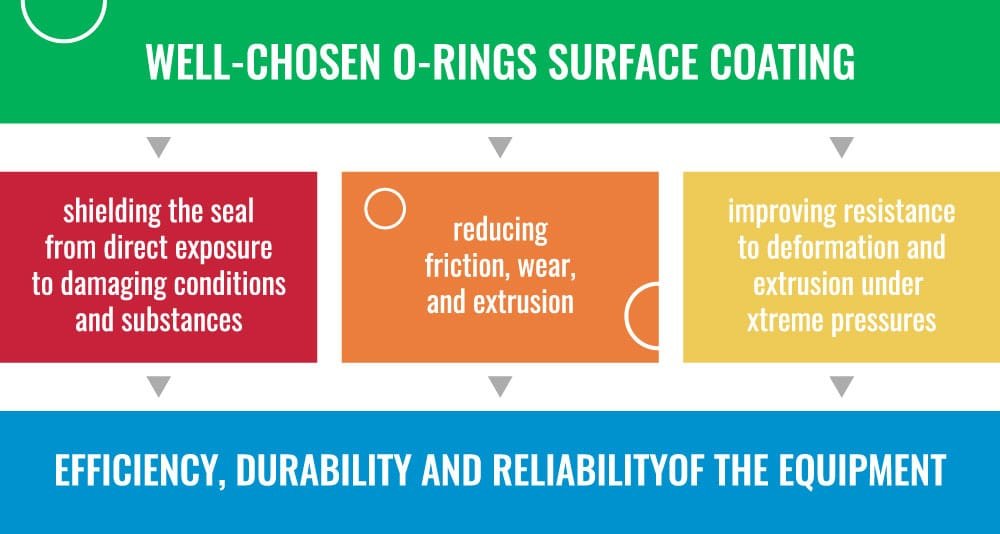
An uncoated elastomer naturally exhibits relatively high friction against metal, plastic, and composite surfaces. During installation or repeated movement, this friction may cause twisting, abrasion, extrusion damage, or premature wear. Proper coating technology reduces these risks while improving assembly consistency.
Typical engineering objectives include:
- ✔ Lower installation force
- ✔ Reduced assembly damage
- ✔ Improved wear resistance
- ✔ Better chemical protection
- ✔ Reduced stick-slip motion
- ✔ Increased service life
- ✔ Cleaner automated assembly
- ✔ Enhanced appearance and identification
How Seal Surface Coatings Work
Unlike changing the elastomer formulation itself, surface coatings modify only the outer layer of the sealing element. Depending on coating technology, the thickness typically ranges from less than 1 μm up to approximately 30 μm.
Coating mechanisms include:
- Lubrication layer formation
- Low surface energy modification
- Dry-film lubrication
- Polymer barrier protection
- Plasma surface activation
- Chemical conversion treatment
Common Types of O-Ring Surface Coatings
PTFE Coating

Polytetrafluoroethylene (PTFE) is among the most widely used low-friction coatings.
| Property | Typical Value |
|---|---|
| Coefficient of friction | 0.04–0.10 |
| Chemical resistance | Excellent |
| Temperature | Up to approximately 260°C |
| Wear resistance | Very good |
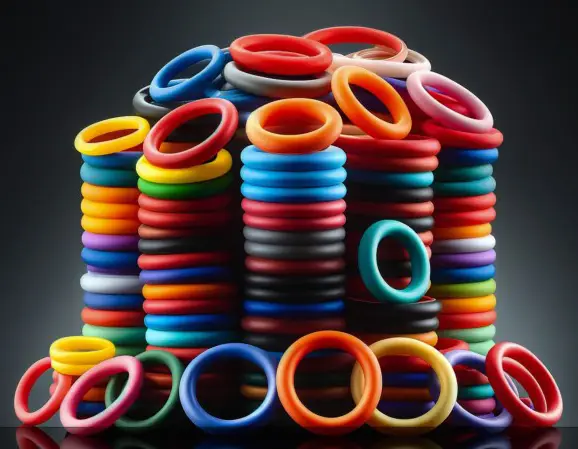
PTFE-coated o-ring products are commonly used in hydraulic systems, chemical processing equipment, food machinery, and semiconductor applications.
Silicone-Based Coatings
Silicone coatings primarily reduce installation friction while maintaining elastomer flexibility.
- Easy assembly
- Excellent flexibility
- Cost-effective
- Suitable for static seals
Molybdenum Disulfide (MoS₂)
MoS₂ coatings provide excellent dry lubrication for dynamic sealing systems operating under high loads.
Graphite Coatings
Graphite offers stable lubrication at elevated temperatures and is commonly applied where conventional lubricants cannot survive.
Parylene Coatings
Parylene is deposited through vapor deposition technology, forming an extremely uniform protective barrier with excellent dielectric and chemical properties.
Selecting the Right Elastomer Before Coating
The coating should always be selected after choosing the correct base elastomer.
| Material | Typical Hardness | Temperature | Applications |
|---|---|---|---|
| NBR | 70 Shore A | -40°C to 120°C | Hydraulic oil |
| FKM | 75 Shore A | -20°C to 200°C | Fuel systems |
| EPDM | 70 Shore A | -50°C to 150°C | Water systems |
| Silicone | 60-70 Shore A | -60°C to 200°C | Medical devices |
Engineering Standards Frequently Referenced
Several internationally recognized standards guide material selection, testing, and quality verification.
- ISO 3601 — O-ring dimensions and tolerances
- ISO 48 — Rubber hardness measurement
- ASTM D2240 — Shore hardness testing
- ASTM D2000 — Rubber material classification
- ASTM D471 — Fluid immersion testing
- ASTM D412 — Tensile properties
- ASTM D395 — Compression set testing
- ASTM D1414 — O-ring testing procedures
Coefficient of Friction Comparison
| Surface | Typical Friction |
|---|---|
| Uncoated Rubber | 0.8–1.3 |
| Silicone Coating | 0.3–0.6 |
| PTFE Coating | 0.04–0.10 |
| Parylene | 0.20–0.35 |
Thermal Conductivity Considerations
Most elastomers exhibit relatively low thermal conductivity, typically between 0.13 and 0.30 W/m·K. Surface coatings generally do not significantly improve heat transfer; instead, they primarily enhance frictional behavior and environmental resistance.
Chemical Resistance Overview
Proper coating selection should consider chemical compatibility with both the process media and cleaning agents.
Examples:
- PTFE performs exceptionally well against acids and solvents.
- Parylene provides excellent moisture protection.
- Silicone coatings are suitable for many general industrial applications.
- MoS₂ coatings are preferred for dry mechanical motion.
Installation Best Practices
- Inspect groove dimensions according to ISO 3601.
- Remove burrs and sharp edges.
- Avoid twisting during installation.
- Maintain recommended stretch ratios.
- Ensure proper compression.
- Use compatible lubricants when required.
For high-volume automated assembly, coated o-ring products frequently improve production consistency while reducing insertion force.
Selection Guide
| Application | Recommended Coating |
|---|---|
| Chemical processing | PTFE |
| Medical equipment | Parylene |
| Dynamic hydraulic seals | MoS₂ |
| General industrial assembly | Silicone |
Failure Mode Analysis (Industry Example)
Example for educational purposes only.
An industrial pneumatic actuator experienced recurring leakage after approximately six months of operation. Inspection revealed severe abrasion on the sealing surface caused by repeated dry sliding against anodized aluminum. Replacing the original uncoated seal with a PTFE-coated version reduced installation friction and minimized wear during subsequent maintenance cycles. This illustrates a common engineering approach rather than a documented customer case.
Case Example (Industry Experience)
Illustrative engineering example.
In an automated assembly line producing hydraulic valves, insertion forces varied significantly due to friction between rubber seals and aluminum bores. Engineers evaluated coated sealing solutions and selected a low-friction PTFE surface treatment. Assembly force became more consistent, reducing rejected components during production. This scenario reflects common industry practice and is presented as an illustrative example rather than actual production data.
Laboratory Test Example
Demonstration example only.
Laboratory evaluations often compare coated and uncoated specimens using ASTM D471 immersion tests, ASTM D395 compression set measurements, friction testing, and repeated insertion cycles. Such testing helps engineers understand relative performance under controlled conditions. Numerical results depend on material formulation, coating thickness, operating temperature, and testing methodology.
Expert Tips for Engineers
- ✔ Select elastomer first, coating second.
- ✔ Verify compatibility with cleaning chemicals.
- ✔ Avoid assuming all PTFE coatings perform identically.
- ✔ Review compression set alongside friction properties.
- ✔ Validate performance through application-specific testing.
- ✔ Consider operating temperature, pressure, and media simultaneously.
Future Trends in Seal Surface Technology
Emerging coating technologies include nano-structured polymer films, plasma-enhanced surface modification, environmentally friendly fluorine-free coatings, and hybrid ceramic-polymer systems. These developments aim to reduce friction further while improving environmental compliance and extending maintenance intervals.
Manufacturers are also integrating digital quality inspection, automated coating thickness measurement, and AI-assisted process monitoring to improve coating consistency across high-volume production.
Choosing the right o-ring with an optimized surface coating requires balancing material properties, operating conditions, regulatory requirements, and manufacturing efficiency. By understanding coating technologies, engineering standards, installation practices, and potential failure mechanisms, designers can significantly improve sealing reliability while reducing maintenance costs throughout the product lifecycle.
Frequently Asked Questions
1. Why are O-ring surface coatings used?
Surface coatings reduce friction, improve installation, increase wear resistance, minimize stick-slip behavior, and enhance sealing reliability without changing the base elastomer.
2. Which coating provides the lowest friction?
PTFE coatings generally offer the lowest coefficient of friction and are widely used in demanding industrial sealing applications.
3. Can a coating improve chemical resistance?
Some coatings provide additional protection against chemicals and moisture, but overall compatibility still depends primarily on the underlying elastomer material.
4. Which standards are commonly referenced for O-rings?
Frequently referenced standards include ISO 3601, ASTM D2000, ASTM D2240, ASTM D471, ASTM D395, ASTM D412, and ASTM D1414.
5. How should engineers choose the right coating?
Evaluate operating temperature, pressure, motion type, chemical exposure, installation requirements, friction targets, and the selected elastomer before determining the most appropriate surface coating solution.