Why Are O-Rings Important in Industrial Use?
O-rings are among the simplest and most widely used sealing components in modern engineering. Their circular cross-section, compact geometry, relatively low manufacturing cost, and ability to seal both static and dynamic interfaces make them essential across industrial equipment, hydraulic systems, pneumatic machinery, pumps, valves, engines, chemical processing equipment, semiconductor tools, medical devices, and many other applications.
Despite their simple appearance, an O-ring is a precision-engineered component. Its performance depends on material formulation, hardness, cross-sectional geometry, groove design, compression, temperature, pressure, fluid compatibility, surface finish, installation quality, and long-term aging behavior.
For engineers, maintenance professionals, and equipment designers, understanding the importance of O-Rings means understanding more than simply choosing a rubber ring that fits a groove. A reliable O-ring must be correctly matched to the application and installed under controlled conditions.
✔ Key Engineering Principle: An O-ring seals because the elastomer is compressed against mating surfaces and generates contact stress. Reliable sealing occurs when the available sealing force remains sufficient to resist the pressure and leakage paths created by the operating environment.
What Is an O-Ring?
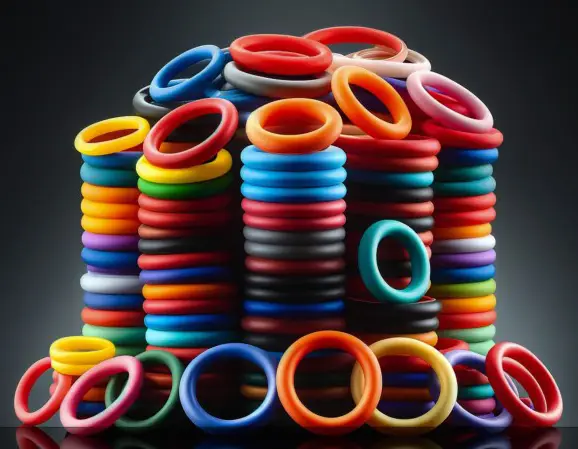
An O-ring is a toroidal elastomeric sealing element with a circular cross-section. It is installed in a machined groove, commonly called a gland, and compressed between two mating surfaces.
Depending on the design, an O-ring may provide:
- 🔒 Static sealing between stationary components
- ⚙ Dynamic sealing in reciprocating applications
- 🔄 Dynamic sealing in rotary applications
- 💧 Fluid containment
- 🌬 Gas sealing
- 🛡 Protection against dust and contamination
- ⚡ Electrical and environmental isolation in specialized applications
The importance of the O-ring comes from its ability to perform these functions with a small amount of material and relatively simple installation requirements.
Why O-Rings Are So Important in Industrial Applications
Industrial equipment must often operate under pressure, temperature variation, vibration, chemical exposure, and repeated mechanical movement. A small sealing failure can cause lubricant loss, pressure loss, contamination, downtime, environmental release, or even equipment damage.
O-rings are important because they provide an efficient barrier between two surfaces without requiring complex mechanical structures.
Their major advantages include:
| Advantage | Industrial Value |
|---|---|
| Compact design | Requires relatively little installation space |
| Low manufacturing complexity | Suitable for high-volume production |
| Wide material selection | Can be matched to oils, fuels, water, chemicals, and gases |
| Reusable design principle | Standard sizes can simplify maintenance and inventory |
| Static and dynamic capability | Useful in many types of industrial equipment |
How Does an O-Ring Create a Seal?
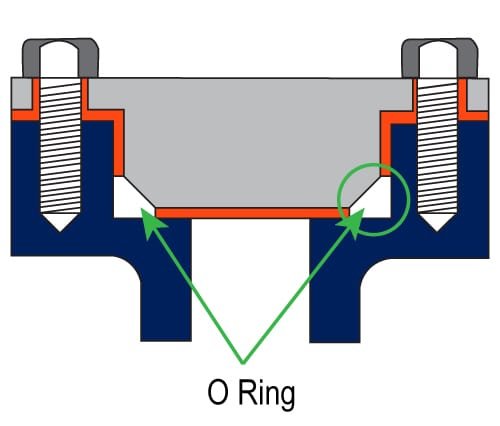
When an O-ring is installed into a gland, it is compressed against the mating surface. This deformation creates contact pressure between the elastomer and the sealing surfaces.
In a simplified concept, the sealing system must generate sufficient contact stress to resist the pressure attempting to force fluid through the interface.
Simplified Sealing Concept:
Available sealing contact stress > pressure-driven leakage force
Actual O-ring design is more complex and depends on groove geometry, elastomer behavior, pressure, temperature, surface finish, extrusion clearance, and dynamic movement.
When pressure is applied, the O-ring can be energized further against the low-pressure side of the gland. This is one reason O-rings can perform effectively in many pressure-sealing applications.
The Importance of O-Ring Material Selection
The elastomer is one of the most important factors affecting O-ring performance. Different materials have different resistance to temperature, chemicals, oils, fuels, water, steam, ozone, and atmospheric aging.
| Material | Typical Strengths | Typical Limitations |
|---|---|---|
| NBR | Mineral oils, fuels, good general mechanical performance | Limited ozone and weathering resistance compared with some alternatives |
| FKM | High-temperature performance and many oils and fuels | Compatibility limitations with certain chemicals and low-temperature conditions |
| EPDM | Water, weathering, ozone, and many aqueous fluids | Generally unsuitable for many petroleum-based oils |
| VMQ Silicone | Wide temperature range and flexibility | Lower tear and abrasion resistance in some applications |
| FFKM | Very broad chemical resistance and high-temperature capability | High material cost |
These are general engineering comparisons. The exact performance of an O-ring depends on the compound formulation, curing system, temperature, pressure, fluid chemistry, and exposure time.
O-Ring Hardness and Its Importance
O-ring hardness is commonly specified using the Shore A hardness scale. Common industrial hardness levels include approximately 70 Shore A, although softer and harder compounds are also available.
Hardness affects several performance characteristics:
- Resistance to extrusion
- Ease of installation
- Compression behavior
- Resistance to deformation
- Friction and breakaway force
- Ability to conform to surface irregularities
A softer O-ring may conform well to irregular surfaces but can be more vulnerable to extrusion under high pressure. A harder compound may provide improved extrusion resistance but can require greater installation force and may be less tolerant of surface imperfections.
ASTM D2240 is commonly associated with durometer hardness testing of rubber and elastomers. ISO 48 series standards are also widely associated with hardness measurement of vulcanized or thermoplastic rubber.
O-Ring Compression: A Critical Design Variable
Compression is the amount by which the O-ring cross-section is reduced during installation.
A simplified compression calculation is:
Compression (%) = (Original Cross-Section − Installed Height) ÷ Original Cross-Section × 100%
For example, if an O-ring has an original cross-sectional diameter of 3.00 mm and the installed height is 2.40 mm:
Compression = (3.00 − 2.40) ÷ 3.00 × 100% = 20%
This is a mathematical example only. The correct compression depends on whether the application is static, reciprocating, rotary, vacuum, low pressure, or high pressure.
Too little compression may cause leakage. Excessive compression may increase friction, accelerate wear, and create excessive stress in the elastomer.
Static O-Ring Sealing
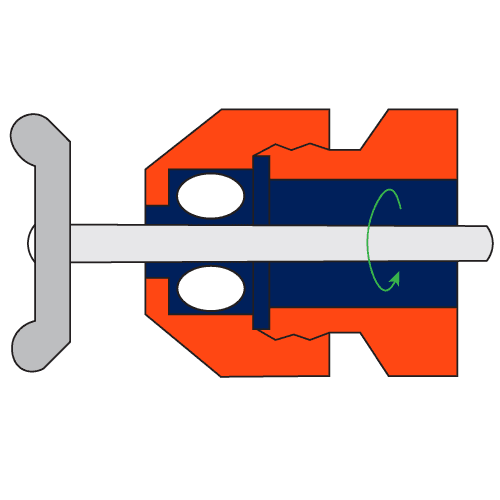
Static applications are those in which the mating surfaces do not move relative to each other.
Examples include:
- Flange connections
- Valve bodies
- Hydraulic manifolds
- Pipe fittings
- Pressure vessels
- Machine covers
- End caps
Static O-ring seals are generally easier to design than dynamic seals because there is no continuous sliding or rotating contact.
However, static sealing still requires correct groove design, compression, surface finish, material selection, and installation.
Dynamic O-Ring Sealing
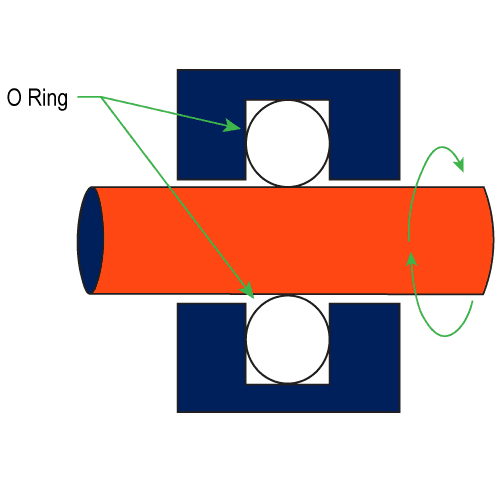
Dynamic applications involve relative movement between the O-ring and a mating surface.
Typical movements include:
- Reciprocating movement
- Rotary movement
- Oscillating movement
Dynamic applications are more demanding because friction, heat generation, wear, lubrication, surface finish, and motion speed must be considered.
A compound that performs well in a static application may not be the best choice for a high-speed dynamic application.
Pressure Resistance and Extrusion
High pressure can force an elastomer into the clearance gap between mating components. This phenomenon is known as extrusion.
Extrusion can cause:
- ⚠ Surface damage
- ⚠ Material nibbling
- ⚠ Leakage
- ⚠ Premature failure
Resistance to extrusion depends on pressure, hardness, temperature, clearance gap, material modulus, groove design, and the use of backup rings.
In high-pressure systems, an O-ring may be combined with one or more backup rings to reduce the available extrusion gap.
Temperature Effects on O-Ring Performance
Temperature strongly affects elastomer behavior.
At elevated temperatures, an elastomer may experience:
- Accelerated aging
- Hardening
- Softening
- Compression set
- Reduced strength
- Increased chemical degradation
At low temperatures, many elastomers become stiffer and less flexible. If the material cannot maintain sufficient elastic recovery, sealing contact may be reduced.
Temperature limits must always be evaluated together with the fluid and pressure environment.
Thermal Conductivity and Heat Transfer
Elastomers generally have relatively low thermal conductivity compared with metals. Heat generated at a dynamic sealing interface may therefore depend heavily on the surrounding shaft, housing, lubricant, and cooling system.
Heat generation can be influenced by:
- Friction
- Rotational speed
- Radial sealing force
- Lubrication
- Surface finish
- Material hardness
- Operating temperature
Excessive heat can accelerate elastomer aging and increase the risk of premature failure.
Chemical Compatibility and Corrosion Considerations
An O-ring must be compatible with the fluid it contacts. Chemical compatibility depends on the elastomer chemistry, fluid composition, temperature, concentration, pressure, and exposure time.
Potential chemical damage may include:
- Swelling
- Shrinkage
- Softening
- Hardening
- Cracking
- Loss of tensile strength
- Loss of elasticity
The metal components surrounding an O-ring may also corrode. Corrosion products can damage the sealing surfaces or change the dimensions of the sealing assembly.
For this reason, fluid compatibility should be evaluated for both the elastomer and the surrounding materials.
Common Standards Used in O-Ring Engineering
O-ring design and testing may involve different standards depending on the application and industry.
- ASTM D2000: Classification system for rubber products used in automotive applications.
- ASTM D2240: Durometer hardness testing of rubber and elastomers.
- ASTM D395: Compression set testing of rubber.
- ASTM D412: Tensile properties of vulcanized rubber and thermoplastic elastomers.
- ASTM D471: Effect of liquids on rubber properties.
- ISO 3601: O-rings and related dimensions, tolerances, and quality requirements.
- ISO 48: Hardness measurement of rubber materials.
- ISO 815: Compression set testing of vulcanized or thermoplastic rubber.
The applicable standard should be selected according to the actual product specification and application.
O-Ring Installation: Why It Matters
Even a high-quality O-ring can fail if it is installed incorrectly.
Recommended installation practices include:
- Clean the groove and mating surfaces.
- Remove sharp edges and burrs.
- Inspect the O-ring for cuts, cracks, and contamination.
- Use a compatible lubricant when permitted.
- Avoid twisting during installation.
- Use suitable installation tools.
- Do not stretch the O-ring excessively.
- Protect the O-ring from sharp threads and keyways.
Installation Warning: Twisting can create a spiral failure pattern known as spiral or helical failure. This is especially important in dynamic applications or where the O-ring is subjected to movement.
O-Ring Surface Finish and Sealing Reliability
Surface finish is an important part of the sealing system.
A surface that is too rough may damage the elastomer or create leakage channels. A surface that is extremely smooth may also create lubrication and friction behavior that differs from the intended design.
The correct surface finish depends on whether the sealing interface is static or dynamic, the elastomer material, the pressure, the lubricant, and the application requirements.
Surface defects such as scratches, pits, burrs, and machining marks should be evaluated carefully.
O-Ring Applications in Industrial Equipment

O-rings are used throughout industrial equipment.
| Industry | Typical Applications |
|---|---|
| Hydraulics | Cylinders, valves, manifolds, fittings |
| Pneumatics | Actuators, valves, air systems |
| Automotive | Engines, transmissions, fuel systems, cooling systems |
| Chemical processing | Pumps, valves, chemical equipment |
| Food and pharmaceutical | Processing equipment and hygienic systems |
| Energy | Power systems, pumps, valves, equipment interfaces |

Case Example: Industrial Hydraulic O-Ring Selection
Case Example — Illustrative Industry Experience
Consider a hydraulic manifold operating with a petroleum-based hydraulic fluid at elevated pressure and moderate temperature.
A practical engineering evaluation may include the fluid type, operating temperature, pressure, groove dimensions, extrusion clearance, O-ring hardness, backup-ring requirements, surface finish, and installation method.
A general-purpose elastomer may appear suitable based only on temperature, but chemical compatibility and pressure resistance must also be evaluated.
If leakage occurs, the investigation should inspect the O-ring for extrusion, cuts, compression set, swelling, installation damage, and chemical degradation.
This example is based on common engineering practice and is illustrative only. It does not represent a real customer, factory test, or guaranteed service-life result.
Laboratory Test Example
Laboratory Test Example — Demonstration Only
A laboratory evaluation of an O-ring compound may include hardness testing, tensile testing, elongation measurement, compression set testing, fluid immersion, dimensional inspection, and visual examination.
A simplified volume change calculation after fluid immersion may be expressed as:
Volume Change (%) = (Final Volume − Initial Volume) ÷ Initial Volume × 100%
For example, if an illustrative specimen changes from 10.0 cm³ to 10.8 cm³:
(10.8 − 10.0) ÷ 10.0 × 100% = 8%
This calculation demonstrates the method only. Actual acceptance criteria depend on the material specification, test standard, fluid, temperature, and exposure time.
This laboratory example is not a real customer test or fabricated product-performance result.
Failure Mode Analysis: Why O-Rings Fail
Failure Mode Analysis — Illustrative Engineering Example
Extrusion: May indicate excessive pressure, excessive clearance, insufficient hardness, or inadequate backup support.
Compression set: May indicate long-term compression, excessive temperature, material aging, or unsuitable compound selection.
Swelling: May indicate chemical incompatibility with the operating fluid.
Cracking: May be associated with ozone, oxidation, thermal aging, chemical attack, or mechanical damage.
Spiral failure: May indicate twisting or rotational movement in an unsuitable installation or design condition.
Cutting: May indicate sharp edges, burrs, damaged tools, or improper installation.
Root-cause analysis should combine visual inspection with dimensional, material, and operating-environment evidence.
This analysis is an illustrative industry example and does not represent a real customer failure investigation.
Common O-Ring Failure Modes
1. Compression Set
Compression set is the permanent deformation remaining after an elastomer has been compressed and exposed to defined conditions.
A high compression set can reduce elastic recovery and eventually reduce sealing contact.
2. Extrusion and Nibbling
High pressure can force the O-ring into a clearance gap. Repeated movement can then damage the material.
3. Chemical Swelling
Absorption of incompatible fluids can cause dimensional changes and changes in mechanical properties.
4. Thermal Aging
Long-term exposure to excessive temperature can cause hardening, cracking, loss of elasticity, or other degradation.
5. Installation Damage
Cuts, scratches, twists, and contamination introduced during installation are common causes of early leakage.
O-Ring Selection Guide
| Selection Question | Engineering Reason |
|---|---|
| What fluid will contact the O-ring? | Determines chemical compatibility. |
| What is the temperature range? | Determines thermal aging and flexibility requirements. |
| What is the pressure? | Determines extrusion risk and backup-ring requirements. |
| Is the application static or dynamic? | Determines friction, wear, and movement requirements. |
| What is the shaft or bore surface condition? | Affects leakage, wear, and installation damage. |
| Is ozone or outdoor exposure expected? | May require an elastomer with improved weathering resistance. |
O-Ring Quality Control
Quality control may include dimensional inspection, visual inspection, hardness measurement, material verification, and functional testing.
Important quality characteristics may include:
- Cross-sectional diameter
- Inside diameter
- Surface condition
- Flash and parting-line condition
- Hardness
- Material identification
- Dimensional stability
- Compression behavior
For critical applications, traceability and controlled material specifications may also be important.
Expert Tips for Reliable O-Ring Performance
Expert Tip 1: Never select an O-ring based only on size. Fluid, temperature, pressure, movement, and material compatibility are equally important.
Expert Tip 2: If an O-ring fails prematurely, inspect the failure pattern before replacing it with the same part.
Expert Tip 3: Excessive compression does not automatically produce a better seal. It may increase friction, heat, and material stress.
Expert Tip 4: Installation cleanliness is critical. Small particles or burrs can create leakage paths or damage the elastomer.
Expert Tip 5: Standardized O-ring sizes can simplify maintenance, but the material compound must still be selected for the actual operating environment.
The Long-Term Importance of O-Rings in Industry
O-rings may be small components, but their influence on industrial reliability is significant. A properly selected and installed O-ring can help prevent fluid leakage, maintain hydraulic pressure, protect lubricants, prevent contamination, and support reliable machine operation.
Because O-rings are used in such a wide range of environments, no single compound or design is ideal for every application.
Successful engineering requires a complete evaluation of material, geometry, compression, pressure, temperature, chemical compatibility, surface finish, installation, and maintenance conditions.
When these factors are properly controlled, O-rings provide one of the most efficient and versatile sealing solutions available to modern industry.
Frequently Asked Questions
1. Why are O-rings important in industrial applications?
O-rings are important because they provide compact, reliable sealing for fluids and gases in many types of equipment. They can be used in static and dynamic applications and are available in many elastomer materials for different temperature, pressure, and chemical environments.
2. What is the most important factor when selecting an O-ring?
There is no single factor that is always most important. The O-ring material must be compatible with the fluid, temperature, pressure, movement, and installation environment. Correct size and groove design are also essential.
3. Why do O-rings leak?
Common causes include incorrect material selection, insufficient or excessive compression, extrusion, compression set, chemical swelling, thermal aging, damaged surfaces, incorrect groove design, and installation damage.
4. Are O-rings suitable for high-pressure applications?
Yes. O-rings can be used in high-pressure systems when the material, hardness, groove design, clearance gap, pressure direction, and backup-ring requirements are properly engineered. High pressure can increase the risk of extrusion if the design is inadequate.
5. How can O-ring service life be improved?
Service life can often be improved by selecting a compatible material, controlling temperature and pressure, using correct compression, maintaining suitable surface finish, preventing contamination, using proper installation procedures, and analyzing failure patterns before selecting replacement components.