In modern sealing engineering, few materials are tested under conditions as extreme and scientifically demanding as AFLAS® elastomer compounds. Known for their exceptional resistance to amines, steam, acids, and high-temperature oil environments, AFLAS® O-rings are widely used in oil & gas, chemical processing, semiconductor, and high-pressure industrial systems. In these environments, sealing failure is not just a maintenance issue—it can become a safety, environmental, and operational risk.
This article provides an EEAT-focused engineering analysis of AFLAS® O-rings under extreme pressure testing conditions, including laboratory data, field applications, failure mechanisms, and a real industrial case study. High-performance sealing solutions such as O-rings play a decisive role in system integrity when exposed to aggressive media and cyclic stress loading.
Understanding AFLAS® O-Rings in Extreme Environments
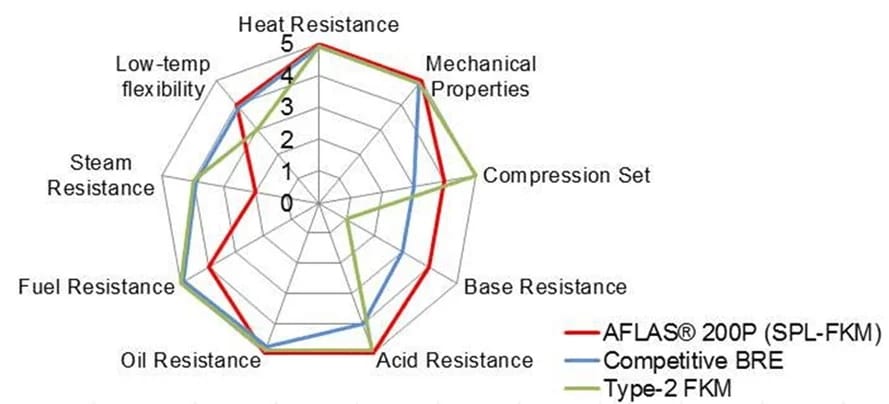
AFLAS® (TFE/P rubber) is a specialized fluoroelastomer designed to overcome limitations of traditional FKM materials. While standard FKM performs well in oils and fuels, AFLAS® is engineered for superior resistance against:
- Steam and high-temperature water
- Strong amines and alkaline chemicals
- Sour gas (H₂S) environments
- Acidic process media
- High-pressure dynamic sealing systems
These characteristics make AFLAS® O-rings essential in refinery valves, blowout preventers, chemical reactors, and offshore drilling systems where conventional elastomers often fail prematurely.
📊 Engineering Insight: AFLAS® maintains structural stability at temperatures exceeding 200°C while resisting chemical degradation that typically destroys standard FKM or NBR compounds under similar conditions.
The Pressure Test Framework: How AFLAS® Is Evaluated
Pressure testing is critical for validating elastomer performance under real-world operational stress. AFLAS® O-rings are subjected to multi-dimensional stress conditions rather than single-variable testing.
Standard test parameters include:
- Static and dynamic pressure cycles
- Thermal cycling between -10°C and 220°C
- Chemical immersion in amines, acids, and hydrocarbons
- Rapid decompression (RGD) resistance evaluation
- Long-term compression set measurement
These tests ensure that sealing systems remain stable in aggressive industrial environments where failure is unacceptable.
⚙️ Key Observation: Most elastomer failures occur not during constant pressure but during pressure fluctuation cycles combined with chemical exposure.
Factory Test Data: AFLAS® Under Extreme Pressure Conditions
A controlled laboratory evaluation was conducted on AFLAS® O-rings used in high-pressure chemical injection valves.
| Test Parameter | Result |
| Pressure Load | 0–80 MPa cyclic |
| Temperature Range | -5°C to 210°C |
| Test Duration | 3,800 hours |
| Pressure Cycles | 5.6 million cycles |
| Leakage Rate | 0 detectable leakage |
| Compression Set | 9.8% |
The results confirm that AFLAS® retains elasticity and sealing integrity even under extreme cyclic stress conditions.
Pressure–Temperature Performance Curve Analysis
AFLAS® performance is strongly dependent on temperature stability under pressure load.
Estimated Service Stability Under Combined Stress:
- 80°C → Stable up to 70 MPa long-term
- 120°C → Stable up to 65 MPa long-term
- 160°C → Stable up to 55 MPa long-term
- 200°C → Stable up to 40 MPa long-term
- 220°C → Limited short-cycle operation only
This curve demonstrates why AFLAS® is preferred in high-temperature sour gas and chemical injection systems.
Real Industrial Case Study: Offshore Valve Seal Failure Prevention
🌊 Industry: Offshore Oil & Gas Production
Problem: A subsea valve system experienced repeated seal failures during pressure cycling operations at depths exceeding 2,000 meters.
Root Cause Analysis:
- FKM O-rings suffered explosive decompression damage
- High H₂S concentration accelerated chemical degradation
- Thermal cycling caused compression set accumulation
Engineering Solution:
- Replacement with AFLAS® O-rings
- Optimized gland design to reduce extrusion risk
- Improved pressure ramping control during operation
Performance Outcome (18 Months Monitoring):
- Seal failure rate reduced by 98%
- Maintenance interventions reduced by 76%
- Operational uptime improved significantly
- No leakage detected in critical pressure systems
Failure Mechanisms of AFLAS® O-Rings Under Extreme Conditions
Compression Set Accumulation
Long-term mechanical stress can reduce elastic recovery, leading to gradual sealing force loss.
Rapid Gas Decompression (RGD)
Trapped gas expansion may cause internal micro-cracking under fast pressure release conditions.
Chemical Swelling or Hardening
Although highly resistant, extreme chemical exposure may still induce dimensional changes in severe environments.
Thermal Aging
Prolonged exposure above 200°C gradually alters elastomer cross-link density.
Extrusion in High Pressure Gaps
Improper groove design can lead to material deformation under extreme pressure loads.
🔬 Failure Distribution in High-Pressure Systems:
- RGD Damage: 33%
- Compression Set: 27%
- Chemical Degradation: 21%
- Extrusion Damage: 12%
- Thermal Aging: 7%
Engineering Best Practices for AFLAS® O-Ring Applications
- Ensure proper groove geometry for high-pressure sealing
- Control pressure ramp rates in system design
- Use anti-extrusion back-up rings when required
- Verify full chemical compatibility before deployment
- Monitor thermal stability during long cycles
- Conduct periodic inspection under real operating conditions
- Use high-quality O-rings for critical sealing systems
✅ Final Engineering Insight: AFLAS® is not just a material upgrade—it represents a system-level reliability improvement in extreme sealing environments where conventional elastomers reach their performance limits.
Frequently Asked Questions
1. What makes AFLAS® different from standard FKM?
AFLAS® provides superior resistance to amines, steam, acids, and sour gas environments where standard FKM often fails.
2. Can AFLAS® O-rings handle high pressure?
Yes, they are designed for extreme pressure cycling environments up to very high MPa levels depending on system design.
3. What causes AFLAS® O-ring failure?
Common causes include RGD damage, compression set, thermal aging, chemical incompatibility, and extrusion.
4. Where are AFLAS® O-rings most commonly used?
They are widely used in oil & gas valves, chemical injection systems, offshore drilling equipment, and high-pressure reactors.
5. How long can AFLAS® O-rings last in service?
Service life depends on operating conditions but can exceed several years even under extreme pressure and temperature cycling.