
Oil seals play a critical role in protecting rotating machinery by retaining lubricants, limiting fluid leakage, and preventing dust, moisture, and other contaminants from entering mechanical assemblies. Although an oil seal may appear to be a relatively small component, its material selection directly influences sealing reliability, friction, wear resistance, and maintenance costs.
Choosing the right oil seal material requires more than comparing temperature ratings or selecting the least expensive option. Engineers and maintenance professionals must consider the lubricant, shaft speed, pressure differential, environmental exposure, shaft surface finish, and expected service life. A material that performs well in an automotive gearbox may be unsuitable for a water-exposed pump, a high-temperature engine, or equipment operating in a chemically aggressive environment.
Key engineering principle
The best oil seal material is the one that meets the complete application requirements, not necessarily the material with the highest advertised temperature rating. Always verify compatibility against the specific compound manufacturer’s technical data and the equipment’s operating conditions.
Understanding Oil Seal Materials and Their Functions
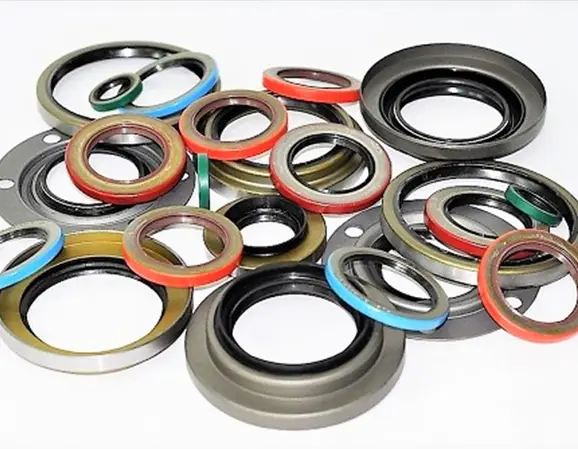
An oil seal, also called a rotary shaft seal or radial shaft seal, is installed between a stationary housing and a rotating or reciprocating component, depending on the seal design. Its primary purpose is to control the movement of lubricant and contaminants at the sealing interface.
Many conventional oil seals contain three principal components: a flexible sealing element, a reinforcing case, and, where required, a garter spring. The sealing lip creates the contact interface with the shaft. The case provides structural support and helps retain the seal in its housing. The spring maintains radial loading on the primary lip in designs that require it.
The material used for the sealing lip is especially important because it must retain its mechanical properties while exposed to lubricant, heat, motion, and environmental conditions. Material degradation can lead to hardening, softening, swelling, cracking, excessive wear, or loss of sealing force.
What determines oil seal performance?
✓ Fluid and chemical compatibility
✓ Continuous and intermittent operating temperatures
✓ Shaft surface speed and frictional heat
✓ Abrasion resistance and resistance to mechanical wear
✓ Compression set and long-term elasticity
✓ Shaft finish, runout, alignment, and housing fit
✓ Exposure to water, dust, ozone, sunlight, and cleaning chemicals
Common Types of Oil Seal Materials
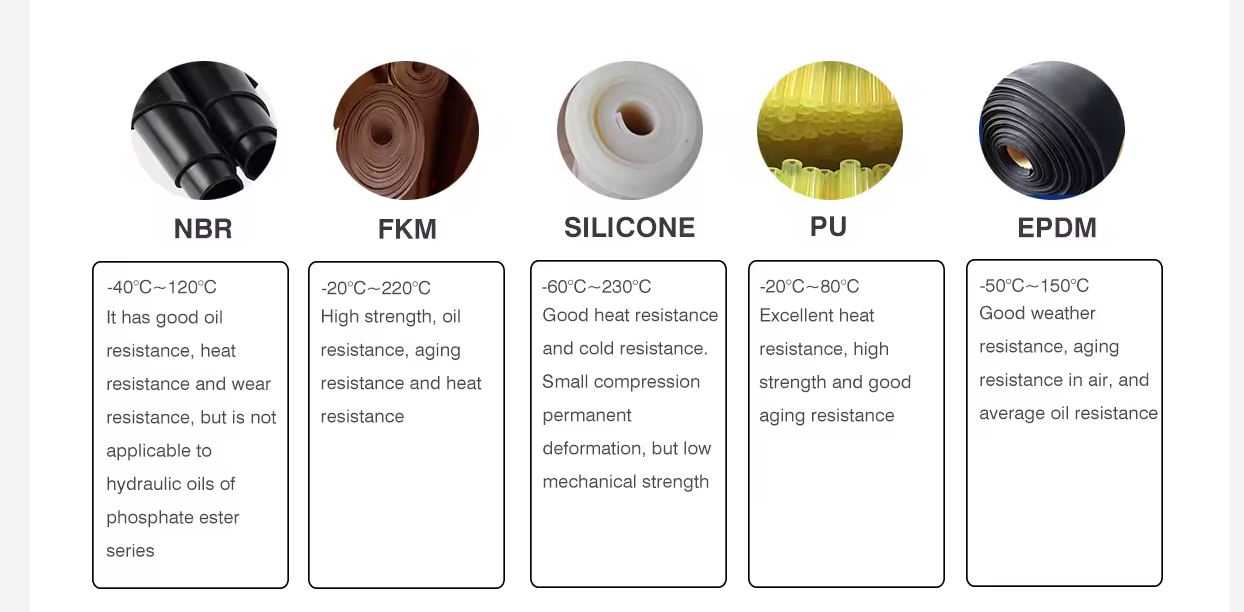
Different elastomers and engineering polymers provide different combinations of heat resistance, flexibility, chemical compatibility, friction, and cost. The following materials are frequently considered when selecting seals for automotive, industrial, hydraulic, agricultural, and heavy-duty equipment.
1. Nitrile Rubber (NBR): A Versatile General-Purpose Material
Nitrile butadiene rubber, commonly abbreviated as NBR, is one of the most widely used materials for conventional oil seals. It offers a practical balance of oil resistance, abrasion resistance, flexibility, and manufacturing cost, making it suitable for many standard lubrication applications.
NBR is commonly considered for sealing mineral oils, lubricating greases, and selected hydraulic fluids. Its resistance to fuels and other chemicals depends on the fluid composition and the specific compound formulation. Not every NBR grade is compatible with every fuel, additive package, or synthetic lubricant.
Typical advantages
- Good resistance to many petroleum-based oils and greases.
- Useful abrasion resistance for conventional rotary shaft applications.
- Good flexibility and practical sealing performance in suitable temperature ranges.
- Generally economical and widely available in standard seal designs.
Potential limitations
- Temperature capability is generally lower than that of many high-temperature FKM compounds.
- Resistance to ozone, sunlight, and outdoor weathering is often limited unless the formulation is specifically designed for those conditions.
- Compatibility with aggressive chemicals and some specialized fluids may be inadequate.
- Long-term exposure to excessive heat can accelerate hardening and reduce sealing effectiveness.
Many conventional NBR compounds have published service ranges around -30°C to 100°C, while certain formulations can support different limits. These figures are general guidance only; the exact compound specification takes precedence.
Best suited for: General-purpose automotive oil seals, compatible gearbox applications, industrial machinery, and equipment using lubricants that fall within the selected NBR compound’s limits.
2. Fluoroelastomer (FKM): For Demanding Heat and Chemical Conditions
FKM is a family of fluorocarbon elastomers widely used where higher temperatures or more demanding chemical exposure make conventional rubber unsuitable. Viton™ is a well-known trademark associated with certain FKM products, but not every FKM compound has identical performance characteristics.
Compared with many standard NBR grades, suitable FKM compounds can provide improved resistance to heat, oxidation, and a broad range of oils, fuels, and chemicals. They are often considered for engine sealing, high-temperature gearboxes, and industrial equipment operating under demanding conditions.
Typical advantages
- Good high-temperature performance in appropriately specified compounds.
- Resistance to many mineral oils, lubricants, fuels, and chemical media.
- Good resistance to thermal ageing and oxidation under suitable conditions.
- Useful long-term sealing performance when the compound matches the application.
Potential limitations
- Generally more expensive than standard NBR materials.
- Low-temperature flexibility varies by compound and may be insufficient for some cold-start conditions.
- Compatibility with certain ketones, amines, hot-water systems, steam, and other media must be checked carefully.
- FKM is not a universal solution for dry-running contact, abrasive service, or every aggressive chemical environment.
Some FKM compounds are specified for continuous service around 200°C, while specialized grades may support higher temperatures or different low-temperature performance. These values are not interchangeable across all products.
Best suited for: Selected engine seals, high-temperature rotating equipment, and applications requiring verified resistance to oils, fuels, or chemicals under demanding conditions.
3. Silicone Rubber (VMQ): Broad Temperature Flexibility
Silicone rubber, commonly identified as VMQ, is valued for its flexibility across a broad temperature range. It can remain flexible at low temperatures and withstand elevated temperatures in suitable formulations. Silicone also offers good resistance to ozone and weathering, which can be useful in exposed environments.
However, a broad temperature range does not automatically make silicone the best choice for a rotary oil seal. Some silicone compounds have comparatively low tear strength and limited abrasion resistance. These characteristics can become important when the sealing lip continuously contacts a rotating shaft.
Typical advantages
- Good flexibility in many low-temperature applications.
- Useful high-temperature capability in appropriate grades.
- Good resistance to ozone and weathering.
- Available in formulations designed for specific industrial, automotive, and specialized applications.
Potential limitations
- Wear and tear resistance may be inadequate for some high-speed rotary sealing applications.
- Compatibility with lubricants depends on the silicone formulation and fluid chemistry.
- Some compounds are unsuitable for certain aggressive additives, hydrolysis conditions, or highly demanding contact surfaces.
Silicone compounds can support a wide temperature range, but the actual limits must be taken from the selected compound’s technical data. A seal designed for static service should not automatically be used in a demanding rotary application.
Best suited for: Selected low-temperature or high-temperature sealing applications where flexibility and environmental resistance are important and the mechanical wear requirements are compatible with the compound.
4. Polyacrylate Rubber (ACM): For Selected Automotive Lubrication Systems
Polyacrylate rubber, abbreviated as ACM, is used in certain automotive sealing applications because it can offer useful resistance to hot lubricating oils and thermal ageing. It is often considered where the operating conditions exceed the practical capabilities of a standard NBR compound but do not require a more specialized material.
ACM may be suitable for selected transmission, engine, and rotary shaft sealing applications. However, its low-temperature flexibility and compatibility with water, coolants, and certain fluids can be limiting factors.
Typical advantages
- Good resistance to hot oils in compatible applications.
- Useful resistance to oxidation and thermal ageing.
- Can provide a practical balance of performance and cost in selected automotive applications.
Potential limitations
- Cold-weather flexibility may be less suitable than that of specialized low-temperature compounds.
- Water, coolant, and other fluid compatibility must be confirmed.
- Not appropriate for every fuel, hydraulic fluid, or chemical exposure.
Best suited for: Selected automotive transmissions, hot-oil environments, and shaft seals where the specified ACM compound meets the temperature and fluid requirements.
5. Hydrogenated Nitrile Rubber (HNBR): Enhanced Mechanical and Thermal Performance
Hydrogenated nitrile butadiene rubber, or HNBR, is produced by hydrogenating the polymer structure of NBR. This modification can improve resistance to heat, oxidation, and certain forms of mechanical degradation while preserving useful resistance to many petroleum-based lubricants.
HNBR is used in selected automotive, industrial, oilfield, and heavy-duty sealing applications. It may be appropriate when standard NBR does not provide sufficient durability under the combined effects of temperature, abrasion, and fluid exposure.
Typical advantages
- Improved heat and ageing resistance compared with many conventional NBR grades.
- Good mechanical strength and abrasion resistance in suitable formulations.
- Useful resistance to many oils and selected industrial fluids.
- Available in grades designed for demanding operating environments.
Potential limitations
- Usually costs more than conventional NBR.
- Low-temperature properties vary by formulation.
- Compatibility with particular chemicals, fuels, and additives requires verification.
Best suited for: Applications requiring more demanding thermal and mechanical performance than a standard NBR compound can reliably provide.
6. Ethylene Propylene Diene Rubber (EPDM): For Water and Weather-Exposed Applications
EPDM is valued for its resistance to weathering, ozone, water, and many polar chemicals. It is widely used in water-related sealing systems, cooling systems, and outdoor applications where environmental exposure is important.
Its main limitation in oil sealing is compatibility with petroleum-based oils and fuels. EPDM is generally unsuitable for conventional petroleum lubricating oils unless a specific fluid and compound combination has been explicitly approved.
Typical advantages
- Good resistance to weathering, ozone, and many outdoor conditions.
- Useful performance in water and selected water-glycol applications.
- Good resistance to many polar chemicals and cleaning solutions.
Potential limitations
- Generally poor compatibility with petroleum-based oils, fuels, and many hydrocarbon fluids.
- Performance varies with formulation, temperature, and the exact chemical mixture.
- Should not be substituted for NBR or FKM in an oil-filled assembly without technical confirmation.
Best suited for: Compatible water, coolant, weather-exposed, and selected chemical sealing applications rather than conventional petroleum-oil rotary seals.
7. Polytetrafluoroethylene (PTFE): A Specialized Low-Friction Sealing Material
PTFE is an engineering polymer rather than a conventional elastomer. It is used in specialized seals where low friction, chemical resistance, and thermal performance are important. Certain PTFE seal designs can operate under conditions that are challenging for conventional rubber sealing lips.
PTFE seals are not all constructed or installed in the same way. Some designs require particular shaft surface finishes, controlled installation procedures, or special consideration during initial operation. Filled PTFE compounds may also have different mechanical and wear properties from unfilled PTFE.
Typical advantages
- Low-friction characteristics in suitable designs.
- Broad chemical resistance to many industrial fluids.
- Useful thermal capability in appropriately engineered seals.
- Available in specialized profiles and filled formulations for demanding applications.
Potential limitations
- Installation can require more precise procedures than conventional elastomer seals.
- PTFE is not elastic in the same manner as rubber, so seal geometry and installation design are critical.
- Wear performance depends on the compound, shaft finish, lubrication, speed, and load.
Best suited for: Specialized rotary shaft applications where the PTFE design is approved for the operating conditions and the installation requirements can be followed correctly.
8. Chloroprene Rubber (CR): For Selected Weather- and Oil-Exposed Applications
Chloroprene rubber, also known as CR or neoprene, can offer a useful balance of weathering resistance, mechanical properties, and resistance to selected oils and chemicals. Its suitability depends on the specific compound and the sealing environment.
CR may be considered for certain industrial seals and applications involving outdoor exposure. It should not be assumed to outperform NBR or FKM in petroleum oil resistance or high-temperature service.
Best suited for: Applications where the compound’s verified resistance to the working fluid, weather, and temperature matches the design requirements.
9. Perfluoroelastomer (FFKM): For Highly Demanding Chemical Environments
FFKM is a specialized class of fluoroelastomer used in selected high-temperature and chemically aggressive environments. Certain compounds offer exceptional chemical resistance and thermal performance, making them useful in demanding industrial processing, semiconductor manufacturing, and other specialized applications.
FFKM is generally substantially more expensive than standard oil seal materials. It should be selected only when the operating requirements justify its use and the exact compound is compatible with the process media.
Best suited for: Highly demanding applications where a validated FFKM compound is required to meet chemical, temperature, and service-life requirements that other materials cannot adequately satisfy.
Oil Seal Material Comparison Table
The following table provides a preliminary comparison of commonly used materials. The ratings are qualitative and should be used for initial screening rather than final engineering approval.
| Material | Oil resistance | Temperature capability | Key consideration | Relative cost |
|---|---|---|---|---|
| NBR | Good for many petroleum oils | Moderate | General-purpose performance and value | Low |
| FKM | Good to excellent for compatible fluids | High for suitable grades | Verify low-temperature and chemical limitations | High |
| VMQ silicone | Application-dependent | Broad for suitable grades | Abrasion and tear resistance can limit rotary use | Medium to high |
| ACM | Good for selected hot oils | Moderate to high | Check water and low-temperature compatibility | Medium |
| HNBR | Good for many compatible oils | Moderate to high | Improved ageing and mechanical performance in suitable grades | Medium to high |
| EPDM | Generally poor for petroleum oils | Grade-dependent | Strong candidate for compatible water and weather applications | Low to medium |
| PTFE | Broad chemical resistance | High for suitable designs | Specialized design and installation requirements | Medium to high |
| FFKM | Compound-dependent, often excellent | Very high for selected grades | High cost; confirm actual process compatibility | Very high |
Important: No material ranking can replace a fluid compatibility chart or a compound-specific technical data sheet. Temperature limits, chemical resistance, and wear performance can vary significantly between formulations within the same material family.
How to Select an Oil Seal Material for Your Application
Effective material selection starts with the operating environment and the failure risks that matter
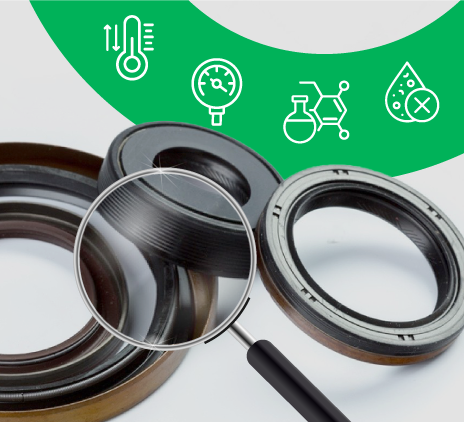
most. The following process helps narrow the choices before a seal is specified, purchased, or installed.
Step 1: Identify the Exact Fluid
Record the lubricant or process medium, including the product type, viscosity grade where relevant, additive package, and any cleaning chemicals that may contact the seal. Mineral oil, synthetic oil, transmission fluid, coolant, fuel, and industrial process fluids can affect elastomers differently.
If a machine uses a newly introduced lubricant or a different additive formulation, do not assume that the existing seal compound will remain compatible. Check the fluid manufacturer’s information and the seal material supplier’s compatibility guidance.
Step 2: Establish the Real Temperature Range
Determine both the normal operating temperature and the highest or lowest temperatures experienced during startup, shutdown, cleaning, and abnormal operating conditions. Friction at the sealing lip can create localized temperatures that differ from the bulk lubricant temperature.
A material that survives a short temperature peak may not provide the same service life under continuous exposure. Select a compound whose published operating limits cover the actual duty cycle, with an appropriate engineering margin.
Step 3: Evaluate Shaft Speed and Surface Condition
Rotational speed, shaft diameter, surface finish, runout, and alignment all influence the performance of a dynamic seal. Higher surface speed can increase frictional heating, while excessive shaft runout can cause uneven lip loading and accelerated wear.
Do not select a material based only on chemical resistance when the primary failure mechanism may be mechanical. Confirm that the seal design and compound are suitable for the required speed and contact conditions.
Step 4: Assess Pressure and Contamination
Conventional radial shaft oil seals are often designed for low-pressure applications. If the assembly experiences a significant pressure differential, verify the seal’s rated pressure capability, shaft movement, and the need for a pressure-rated design.
External dust, water, mud, abrasive particles, and cleaning agents may also affect service life. Depending on the assembly, an auxiliary dust lip, protective cover, or different seal configuration may be needed in addition to the correct material.
Step 5: Balance Initial Cost Against Service Life
The lowest purchase price does not always result in the lowest total cost. A standard NBR seal may provide excellent value in a compatible application, whereas a more expensive compound may be justified if it prevents repeated maintenance, equipment downtime, or costly contamination.
Consider the cost of the seal, installation labour, equipment accessibility, failure consequences, expected service interval, and the availability of replacement parts. The best choice is the material and design that meet the required reliability at a reasonable lifecycle cost.
Practical selection checklist
Before confirming an oil seal specification, document the fluid, temperature range, shaft speed, pressure conditions, shaft dimensions, surface finish, contamination exposure, and expected service life. Verify all critical limits with the seal supplier before releasing the design or purchase order.
Common Oil Seal Material Selection Mistakes
Choosing Only by Maximum Temperature
A seal material with a high temperature rating may still be incompatible with the lubricant or unsuitable for the shaft speed. Heat resistance is only one part of the selection process; chemical compatibility, wear, friction, and low-temperature behaviour must also be assessed.
Assuming All FKM or NBR Compounds Are Identical
Material abbreviations identify broad polymer families rather than a single universal formulation. Different compounds may contain different fillers, curing systems, plasticizers, and performance modifiers. Always request the actual grade or technical data sheet when the application is critical.
Replacing a Damaged Seal Without Inspecting the Shaft
A new seal cannot reliably compensate for a badly worn shaft, damaged housing bore, excessive runout, or incorrect installation depth. If a replacement fails repeatedly, inspect the complete sealing system before changing materials or ordering another part.
Using EPDM in Petroleum-Oil Applications Without Verification
EPDM offers excellent resistance to many weathering and water-related conditions, but it is generally not compatible with conventional petroleum oils. Using it in the wrong environment can lead to swelling, deterioration, and leakage. Verify compatibility before substituting one elastomer for another.
Ignoring Installation Requirements for PTFE Seals
PTFE seals may require a specific installation direction, surface finish, or fitting procedure. Applying the same installation method used for a conventional rubber seal may damage the sealing element or compromise initial performance. Follow the exact manufacturer’s instructions.
Quality Control and Verification Before Installation
Material selection is only one part of achieving dependable sealing performance. Product quality, dimensional accuracy, manufacturing consistency, and correct installation are also important. For industrial purchasing, the following checks can help reduce uncertainty.
- Material identification: Request the material designation and supporting technical information when the application has critical temperature or chemical requirements.
- Dimensional inspection: Verify the inner diameter, outer diameter, width, and any critical profile dimensions against the drawing.
- Visual inspection: Look for cuts, cracks, deformation, damaged lips, contamination, and other visible defects.
- Application verification: Confirm the part number, seal profile, shaft dimensions, and housing arrangement.
- Traceability: For critical applications, retain supplier documentation, batch information, and inspection records where available.
- Installation control: Use appropriate tools and follow the specified procedures to prevent damage during assembly.
- Performance monitoring: Record leakage, operating temperature, and service history to support future material selection and maintenance decisions.
Where failure could create safety, environmental, or significant operational risks, material substitution should be reviewed by a qualified engineer. A small sample test may help assess compatibility, but it does not replace validation under representative operating conditions.
Frequently Asked Questions About Oil Seal Materials
1. Which material is best for a standard oil seal?
NBR is a common choice for standard oil seals because it offers good resistance to many petroleum-based lubricants, useful abrasion resistance, and an economical price. However, it is not suitable for every temperature, fluid, or environmental condition. Verify the exact NBR compound against the application requirements.
2. Is FKM better than NBR for oil seals?
FKM generally offers improved high-temperature and chemical resistance in suitable grades, while NBR is often more economical for conventional oil-sealing applications. FKM may be preferable in demanding environments, but low-temperature flexibility, chemical compatibility, shaft speed, and cost should still be evaluated before choosing.
3. Can EPDM oil seals be used with engine oil?
EPDM is generally unsuitable for conventional petroleum-based engine oils because compatibility is poor. It is more commonly used in compatible water, coolant, weather-exposed, and selected chemical applications. Always confirm the actual fluid and compound compatibility before use.
4. What information is needed to select the correct oil seal material?
Provide the working fluid, continuous and intermittent temperature range, shaft speed, pressure differential, shaft dimensions, surface condition, environmental exposure, and expected service life. The original part number and material specification are also valuable when replacing an existing seal.
5. How can I prevent premature oil seal failure?
Select a compatible compound and seal design, verify the shaft and housing dimensions, inspect the contact surface, and follow the correct installation procedure. If leakage returns after replacement, investigate shaft wear, runout, pressure, lubrication, and contamination rather than assuming that a different material alone will solve the problem.
Need Help Selecting an Oil Seal Material?
Provide your application details, working fluid, operating temperature, shaft speed, dimensions, and original part number. These details help identify suitable material options and reduce the risk of premature seal failure.
Explore oil seal products: China KODA Oil Seals
For critical applications, confirm the selected material and seal design against the manufacturer’s technical data before ordering or installation.
Effective oil seal material selection is a practical engineering decision that combines fluid compatibility, temperature capability, mechanical wear, installation conditions, and lifecycle cost. By evaluating these factors together and verifying the actual compound specification, equipment owners and purchasing teams can improve sealing reliability, reduce maintenance interruptions, and make more informed replacement decisions.