Understanding Teflon® Encapsulated O-Rings for Reliable Sealing
Selecting the right sealing material is rarely as simple as choosing an elastomer with the highest temperature rating or the broadest chemical-resistance chart. In demanding industrial equipment, the seal must often withstand aggressive chemicals, elevated temperatures, pressure cycling, vacuum, cleaning agents, process fluids, and dimensional changes while maintaining sufficient sealing force. This is where Teflon® encapsulated O-rings can provide a valuable engineering solution.
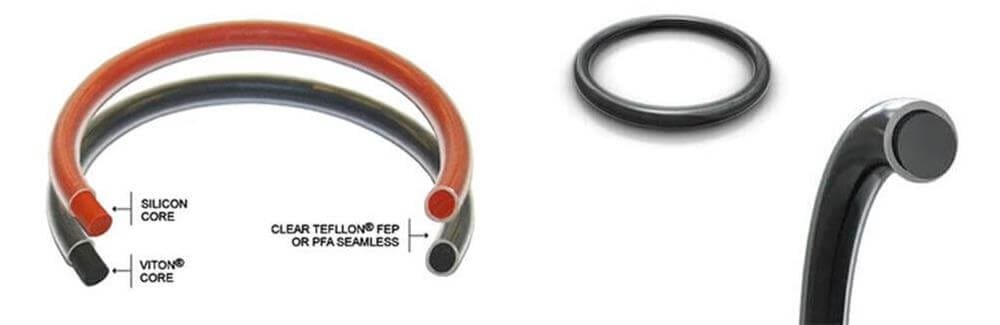
The term Teflon® is a registered trademark associated with Chemours and is commonly used in industry to describe certain fluoropolymer products. In sealing applications, the phrase “Teflon® encapsulated O-ring” generally refers to an elastomeric O-ring core surrounded by a thin, seamless fluoropolymer jacket, commonly based on FEP or PFA. The exact polymer, formulation, construction, and regulatory status should always be confirmed from the supplier’s technical documentation.
The basic design combines two different material characteristics. The elastomeric core provides the resilience required to energize the seal, while the fluoropolymer encapsulation provides exceptional chemical resistance and a low-friction protective barrier.
◆ Engineering principle: An encapsulated O-ring is not simply a “better O-ring.” It is a composite sealing design. The jacket, core material, temperature, pressure, groove geometry, installation method, and process fluid must all be considered together.
What Is a Teflon® Encapsulated O-Ring?
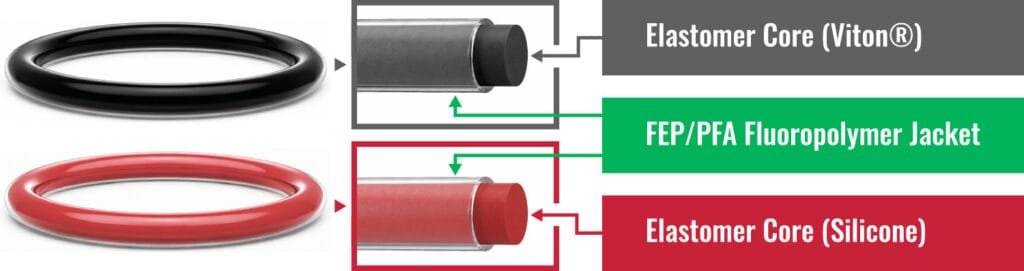
A Teflon® encapsulated O-ring consists of an elastomeric inner core surrounded by a fluoropolymer jacket. The core supplies elastic recovery and sealing force, while the outer jacket provides resistance to chemicals, solvents, many corrosive media, and a wide range of process fluids.
Common core materials include silicone, FKM, and other elastomers selected according to the temperature and mechanical requirements of the application. The encapsulation may use FEP or PFA depending on the required temperature capability, chemical environment, flexibility, and application design.
The construction can be understood as a two-material system:
| Component | Primary Function | Typical Engineering Benefit |
|---|---|---|
| Elastomeric core | Provides elastic recovery and sealing force | Helps compensate for small dimensional irregularities and maintain contact pressure |
| Fluoropolymer jacket | Protects the core from the process environment | Excellent chemical resistance and low friction |
| Interface | Transfers deformation between materials | Determines much of the practical behavior of the composite seal |
This construction makes encapsulated O-rings particularly useful when a conventional elastomer has adequate elasticity but insufficient chemical resistance.
For engineers evaluating available constructions and dimensions, Teflon® Encapsulated O-Rings can be considered where chemical resistance and reliable elastic sealing must coexist.
Why Use an Encapsulated O-Ring Instead of a Conventional O-Ring?
Conventional elastomers such as NBR, EPDM, FKM, and silicone each offer useful combinations of temperature resistance, flexibility, mechanical strength, and chemical compatibility. However, no elastomer is universally resistant to every process fluid.
For example, a conventional elastomer may perform very well in an oil environment but exhibit unacceptable swelling in a particular solvent. Another material may resist water and steam but perform poorly in petroleum-based fluids. A high-performance fluorocarbon elastomer may provide excellent chemical resistance but still be unsuitable for a particular aggressive chemical at a specific concentration and temperature.
The fluoropolymer jacket changes this balance. Fluoropolymers such as PTFE, FEP, and PFA are known for broad chemical resistance and low surface energy.
However, fluoropolymers also have a major limitation as standalone O-ring materials: they are much less elastic than conventional elastomers. A solid PTFE O-ring, for example, does not behave like a conventional rubber O-ring.
The encapsulated design addresses this limitation by using an elastomeric core underneath the fluoropolymer jacket.
The design logic is simple: the core supplies elasticity; the jacket supplies chemical protection.
FEP Versus PFA Encapsulation
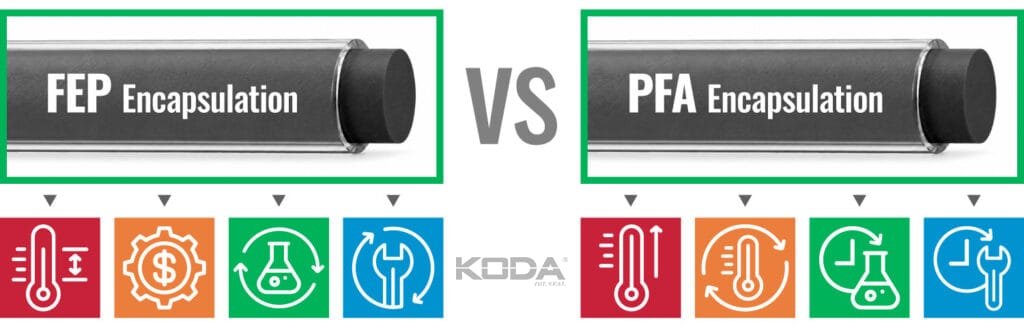
FEP and PFA are both fluoropolymers, but they are not identical materials. Their thermal behavior, mechanical properties, processing characteristics, and practical application ranges can differ.
| Property | FEP | PFA |
|---|---|---|
| Chemical resistance | Excellent for many aggressive chemicals | Excellent and often preferred for severe chemical environments |
| Temperature capability | Very high for a thermoplastic fluoropolymer | Generally capable of higher continuous-temperature service in many designs |
| Flexibility | Generally favorable for encapsulated sealing applications | Excellent chemical performance with application-dependent mechanical behavior |
| Permeation | Low compared with many elastomers | Very low permeability for many gases and chemicals |
| Typical use | Chemical processing, pumps, valves, general aggressive-fluid sealing | More demanding chemical and thermal applications |
Exact temperature limits should never be selected from a generic FEP or PFA material chart alone. The maximum service temperature of the complete encapsulated O-ring is influenced by the core material, jacket construction, pressure, compression, chemical exposure, and installation conditions.
The Importance of the Elastomeric Core
One of the most common mistakes in selecting encapsulated O-rings is focusing entirely on the fluoropolymer jacket. The core remains a critical component because it provides the force that keeps the sealing interface energized.
At low temperatures, the core must retain sufficient flexibility to maintain sealing force. At elevated temperatures, it must resist excessive permanent deformation and degradation. Under pressure, it must remain mechanically stable enough to prevent excessive extrusion or damage.
Typical core options include silicone and FKM, although the exact selection depends on the supplier’s construction and the application.
| Core Material | General Strengths | Important Considerations |
|---|---|---|
| Silicone | Excellent flexibility and broad temperature capability | Lower tear and abrasion resistance than some engineering elastomers |
| FKM | High-temperature and chemical resistance in many applications | Low-temperature flexibility and chemical compatibility must be evaluated |
The core should therefore be specified with the same care as the jacket. A chemically resistant jacket cannot compensate for an elastomeric core that loses its sealing capability under the actual operating conditions.
Temperature Resistance and Thermal Design
Fluoropolymers are well known for high-temperature resistance, but “high temperature” must be interpreted carefully when selecting an encapsulated O-ring.
Consider a system operating at 200°C. The fluoropolymer jacket may tolerate this temperature, but the elastomeric core may have a lower practical limit depending on its composition. Consequently, the complete O-ring may not be suitable simply because the jacket material itself has a high melting or continuous-use temperature.
Thermal expansion must also be considered. Different materials have different coefficients of thermal expansion. The fluoropolymer jacket and elastomeric core do not respond identically to temperature changes.
Repeated heating and cooling can therefore create dimensional and mechanical changes within the composite seal.
Expert tip: When evaluating an encapsulated O-ring for thermal cycling, specify the actual temperature profile rather than only the maximum temperature. The number of cycles, dwell time, heating rate, cooling rate, pressure, and process chemicals can be just as important.
Chemical Resistance
Chemical resistance is one of the primary reasons engineers choose fluoropolymer-encapsulated O-rings.
Fluoropolymers generally resist a broad range of acids, bases, solvents, fuels, oils, and other aggressive chemicals. Their low surface energy also reduces adhesion and can provide useful release characteristics.
Nevertheless, “chemically inert” should never be interpreted as “compatible with every chemical under every condition.” Strong bases, high-temperature fluorine-containing compounds, molten alkali metals, and other specialized environments may require separate evaluation.
Chemical compatibility is a function of concentration, temperature, exposure time, pressure, mechanical stress, and the exact polymer grade.
A useful engineering compatibility evaluation should therefore include:
- Chemical identity.
- Chemical concentration.
- Operating temperature.
- Exposure duration.
- Pressure.
- Static or dynamic service.
- Cleaning and sterilization chemicals.
- Expected number of cycles.
Hardness and Mechanical Behavior
Hardness is commonly expressed using Shore A for elastomeric O-ring cores. Common O-ring compounds may be supplied in the approximate range of 60 to 90 Shore A, depending on the design.
However, hardness is not a direct measure of chemical resistance. Nor does a harder encapsulated O-ring automatically provide a better seal.
Hardness affects insertion force, deformation, extrusion resistance, compression behavior, and contact pressure. The correct value depends on gland geometry and operating conditions.
The fluoropolymer jacket also affects the apparent installation behavior. Because fluoropolymer surfaces have low friction, the seal may slide more easily during assembly, which can be beneficial but can also make certain installation errors less obvious.
Compression and Sealing Force
An O-ring seals by being compressed between mating surfaces. The deformation creates contact pressure that helps block the leakage path.
For a simplified static-seal analysis, radial or axial squeeze can be represented as:
Squeeze (%) = [(Original Cross-Section − Compressed Cross-Section) ÷ Original Cross-Section] × 100
For example, if an O-ring has a nominal cross-section of 3.53 mm and the installed gland compresses the effective section to 3.00 mm, the simplified squeeze calculation is:
[(3.53 − 3.00) ÷ 3.53] × 100 ≈ 15.0%
This is only an illustrative calculation. Actual gland design must account for groove dimensions, tolerances, thermal expansion, pressure, material behavior, and applicable O-ring design standards or manufacturer recommendations.
Encapsulated O-rings should not automatically use the same squeeze values as conventional rubber O-rings because the fluoropolymer jacket changes friction, deformation, and mechanical response.
Compression Set and Long-Term Reliability
Compression set is especially important for static sealing. If the elastomeric core permanently loses too much of its original shape after long-term compression, sealing force can decrease.
The fluoropolymer jacket itself does not provide the same elastic recovery as an elastomer. Therefore, the core’s resilience remains important even when the jacket has excellent chemical resistance.
For long-term service, engineers should consider temperature-dependent compression set, thermal aging, chemical exposure, and the duration of compression.
ASTM D395 is commonly associated with compression set testing of rubber and elastomeric materials. The specific test method and conditions should be selected according to the application and material type.
Relevant ASTM and ISO Standards
Reliable O-ring engineering depends on standardized dimensional, material, and test methods. Standards should be treated as tools for defining requirements rather than as automatic guarantees of performance.
| Standard / Series | General Relevance |
|---|---|
| ISO 3601 | International standard series covering O-rings, including dimensions, tolerances, and quality-related requirements |
| AS568 | Widely used U.S. aerospace and industrial O-ring sizing system |
| ASTM D1414 | Testing of rubber O-rings and related physical properties |
| ASTM D395 | Compression set of rubber and elastomeric materials |
| ASTM D2240 | Durometer hardness measurement for rubber and elastomeric materials |
| ASTM D471 | Effect of liquids on rubber properties |
The exact applicability of each standard depends on whether the requirement concerns the elastomeric core, finished O-ring, dimensions, material qualification, or test procedure. Engineers should always confirm the current edition and scope of the standard before placing it into a purchasing specification.
Dimensional Standards and O-Ring Sizing
Choosing the correct cross-section and inside diameter is essential. A chemically perfect material can still leak if the dimensions or gland geometry are incorrect.
ISO 3601 is widely used internationally for O-ring dimensions and tolerances, while AS568 is extensively used for inch-series O-ring sizing.
Metric applications should consider nominal inside diameter, cross-section, dimensional tolerances, groove dimensions, and thermal expansion.
For a metric sealing application, engineers can also review encapsulated O-ring selection information together with the supplier’s dimensional tables and application recommendations.
Thermal Expansion and Clearance Calculations
Thermal expansion becomes important when a seal operates across a wide temperature range. A simple linear thermal-expansion relationship can be written as:
ΔL = α × L₀ × ΔT
where ΔL is the dimensional change, α is the coefficient of thermal expansion, L₀ is the original dimension, and ΔT is the temperature change.
Consider an illustrative component dimension of 50 mm and a temperature increase of 100°C. If a hypothetical material has a coefficient of thermal expansion of 100 × 10-6/°C, the estimated linear expansion would be:
ΔL = 100 × 10-6 × 50 × 100 = 0.50 mm
This is an illustrative calculation, not a recommended design value. Actual O-ring and gland behavior is more complicated because elastomers and fluoropolymers have different coefficients of expansion and nonlinear mechanical properties.
Thermal Conductivity and Heat Transfer
Thermal conductivity is sometimes overlooked when evaluating sealing materials. Fluoropolymers generally have relatively low thermal conductivity compared with metals, which means an encapsulated O-ring can behave as a thermally insulating element at the sealing interface.
For many sealing applications, this is not a limiting factor. However, when a seal is exposed to rapid temperature changes, localized heating, or high-temperature process equipment, engineers should consider the thermal response of the entire assembly.
The temperature at the seal may differ from the temperature measured in the bulk process fluid. Metal housing, shaft, valve body, insulation, fluid flow, and heat-transfer conditions can all influence the actual O-ring temperature.
Do not select an O-ring solely from the fluid temperature. Determine the temperature at the seal location whenever the application is thermally demanding.
Permeation and Gas Service
Fluoropolymer jackets can provide much lower permeability to many gases and chemicals than conventional elastomers. This can be valuable in vacuum equipment, chemical processing, instrumentation, and gas-handling applications.
However, permeability is not the same as leakage through an incorrectly designed seal.
A system can experience leakage because of poor compression, extrusion, surface damage, contamination, incorrect dimensions, or assembly defects even when the seal material itself has low permeability.
For vacuum applications, the engineer should also evaluate outgassing, permeation, compression set, thermal cycling, surface condition, and cleanliness requirements.
Static Versus Dynamic Applications
Encapsulated O-rings are generally most straightforward in static sealing applications. Dynamic applications introduce additional challenges because the fluoropolymer jacket must withstand repeated sliding, rolling, or oscillating contact.
Friction can be reduced because fluoropolymer surfaces generally have low coefficients of friction. However, low friction does not guarantee good wear life.
Dynamic sealing depends on shaft speed, pressure, surface finish, lubrication, temperature, eccentricity, stroke, contact pressure, and seal geometry.
A seal designed for a static flange should therefore not automatically be installed on a reciprocating shaft.
Installation of Encapsulated O-Rings
Installation quality has a direct influence on seal reliability. Encapsulated O-rings are particularly sensitive to sharp edges and excessive deformation because the fluoropolymer jacket can be damaged during assembly.
1. Inspect all sealing surfaces. Remove burrs, machining marks, chips, corrosion, and contamination.
2. Verify dimensions. Confirm the O-ring size and groove dimensions before installation.
3. Avoid sharp tools. Do not puncture or scratch the jacket with screwdrivers, knives, or improvised tools.
4. Use compatible lubricant. The lubricant must not attack either the jacket or core and must be suitable for the process.
5. Avoid twisting. Twisting creates localized stress and can compromise sealing.
6. Control stretching. Excessive stretch can alter cross-section and sealing behavior.
7. Verify seating. Ensure that the O-ring is properly located in the gland before closing the assembly.
8. Confirm pressure direction. Make sure the gland and clearance are suitable for the actual pressure conditions.
Common Installation Errors
| Error | Likely Consequence | Preventive Action |
|---|---|---|
| Sharp groove edge | Jacket cut or scraped | Deburr and inspect lead-in geometry |
| Twisted seal | Localized stress and leakage | Use controlled installation technique |
| Excessive stretching | Reduced effective cross-section | Select correct size and follow supplier limits |
| Dry assembly | High installation friction | Use compatible installation lubricant where appropriate |
| Wrong groove dimensions | Insufficient sealing or excessive deformation | Verify engineering drawing and tolerance stack |
Failure Mode Analysis
Failure Mode 1 — Jacket damage: The fluoropolymer layer is cut or punctured during installation. This can expose the core and create a potential leakage path or chemical-attack location.
Failure Mode 2 — Core degradation: The elastomer loses elasticity because of excessive temperature, chemical exposure, aging, or compression set.
Failure Mode 3 — Spiral or torsional damage: The O-ring twists during installation or dynamic movement and develops localized deformation.
Failure Mode 4 — Extrusion: Pressure forces the seal into the clearance gap, potentially producing jacket or core damage.
Failure Mode 5 — Thermal cycling: Repeated temperature changes produce differential dimensional changes between the core, jacket, and metal gland.
Failure Mode 6 — Chemical permeation or attack: The selected fluoropolymer may be resistant to the bulk chemical, but the specific service conditions or core material may still be unsuitable.
Failure Mode 7 — Incorrect dimensions: The O-ring may be dimensionally correct in nominal terms but unsuitable for the actual groove tolerances and thermal conditions.
Case Example: Chemical Processing Valve
The following is an illustrative engineering case example based on common sealing-design considerations. It is not a disclosed customer case, certified field report, or actual factory performance record.
Consider a chemical-processing valve operating with an aggressive solvent at elevated temperature. A conventional elastomeric O-ring initially provides acceptable sealing, but after repeated operating cycles the maintenance team observes swelling and increased compression set.
The engineering team considers a fluoropolymer-encapsulated O-ring.
The first step is to characterize the actual chemical exposure rather than simply selecting the material with the highest published temperature rating. The team records solvent concentration, operating temperature, pressure, exposure duration, cleaning procedure, and valve cycle frequency.
The next step is to evaluate the existing gland. The groove dimensions are measured, surface condition is inspected, and pressure-induced extrusion risk is assessed.
An appropriate encapsulated construction is then selected with a compatible elastomeric core. Prototype seals are exposed to the process chemical under controlled conditions and inspected for swelling, dimensional changes, cracking, jacket damage, and changes in sealing behavior.
This example demonstrates an important principle: material substitution alone is not a complete seal-design solution. The gland, installation process, temperature, pressure, and chemical environment must also be validated.
Case lesson: When changing from a conventional elastomer to an encapsulated O-ring, recheck installation force, gland fill, squeeze, extrusion clearance, and thermal behavior instead of assuming the original design remains unchanged.
Laboratory Test Example
The following laboratory program is an illustrative example. It does not contain real customer data, factory test results, or a fabricated service-life curve.
Suppose an engineering team wants to compare a conventional FKM O-ring with an FEP-encapsulated FKM-core O-ring for an aggressive chemical service.
| Test | Purpose | Measurement |
|---|---|---|
| Hardness | Establish material consistency | Shore A for elastomeric core where applicable |
| Mass change | Identify absorption or extraction | Percentage change after conditioning |
| Volume change | Evaluate swelling | Percentage volume change |
| Compression set | Evaluate retained deformation | Residual deformation after defined conditioning |
| Tensile properties | Assess mechanical aging | Tensile strength and elongation |
| Visual inspection | Identify surface degradation | Cracks, blistering, jacket damage, deformation |
| Leak testing | Evaluate functional sealing | Leak rate under defined pressure and temperature |
ASTM D471 can be relevant when evaluating the effect of liquids on rubber properties, while ASTM D395 can be used for applicable compression-set evaluations. ASTM D2240 is commonly used for durometer hardness measurements. Actual testing should follow the applicable standard and the requirements of the specific material and application.
Laboratory Testing Does Not Equal Field Life
A controlled laboratory test can identify material trends, but it should not automatically be converted into a predicted field service life.
For example, a 168-hour immersion test can reveal swelling behavior under a defined chemical condition, but it does not prove that the O-ring will last a specific number of years in a production machine. Real equipment introduces pressure cycling, vibration, contamination, thermal gradients, assembly variation, cleaning cycles, and mechanical tolerances.
Laboratory results should therefore be used to support engineering decisions, not to manufacture unsupported lifetime claims.
Pressure and Extrusion Resistance
Pressure is one of the most important factors in O-ring design. As pressure rises, the elastomer can be forced toward the extrusion clearance between the mating components.
The risk of extrusion is influenced by:
- Pressure level.
- Pressure cycling.
- Temperature.
- Material hardness.
- Radial or axial clearance.
- Gland geometry.
- Seal deformation.
- Use of backup rings where appropriate.
A harder elastomeric core can sometimes improve extrusion resistance, but pressure capability should be established using an appropriate seal-design method rather than a simple hardness comparison.
Vacuum Applications
Encapsulated O-rings can be attractive in vacuum equipment because fluoropolymer jackets can offer low permeability and good chemical resistance.
However, vacuum sealing introduces requirements beyond ordinary static pressure sealing. Engineers may need to consider outgassing, permeation, surface cleanliness, compression set, thermal cycling, seal geometry, and leak-detection sensitivity.
The correct vacuum specification should therefore state the target pressure range and acceptable leak rate instead of simply describing the application as “vacuum compatible.”
Low-Friction Characteristics
Fluoropolymer surfaces are recognized for low surface energy and low friction relative to many elastomeric materials. This can reduce assembly friction and may be beneficial in certain dynamic sealing environments.
However, friction is influenced by many factors, including surface finish, pressure, temperature, lubrication, sliding speed, contact geometry, and material pair.
A low-friction jacket does not automatically make an encapsulated O-ring appropriate for high-speed dynamic motion.
Corrosion and Chemical Processing Applications
Fluoropolymer-encapsulated O-rings are commonly considered in chemical-processing equipment because the outer jacket can resist many aggressive chemicals that challenge ordinary elastomers.
Typical application areas may include chemical pumps, valves, dosing equipment, reactors, piping connections, analytical instruments, laboratory equipment, and fluid-handling systems.
The seal itself does not prevent corrosion of surrounding metal components. In fact, the compatibility of the complete assembly must be evaluated because a chemically resistant O-ring can remain intact while the metal gland or shaft corrodes.
Surface corrosion can produce roughness and sharp edges that eventually damage the seal. Therefore, corrosion-resistant sealing must be considered as an assembly-level engineering problem.
Food, Pharmaceutical, and Clean-Process Applications
Encapsulated O-rings may be useful in certain hygienic applications where chemical resistance, cleanability, and low extractability are important. Nevertheless, material selection must be based on the exact regulatory and process requirements.
Engineers should verify whether the specific finished seal meets the applicable food-contact or pharmaceutical requirements. A generic statement such as “FDA material” is not enough to establish compliance for every application.
For critical applications, request documentation covering the exact compound, manufacturing process, dimensions, and intended conditions of use.
Common Misconceptions
Misconception 1: FEP or PFA is chemically compatible with everything. No polymer is universally compatible with every chemical under every combination of temperature, concentration, pressure, and time.
Misconception 2: The highest temperature rating is always the best choice. The core material, pressure, thermal cycling, and actual seal temperature must be considered.
Misconception 3: Encapsulated O-rings never fail. They can be damaged by installation errors, extrusion, thermal cycling, chemical exposure, wear, and incorrect gland design.
Misconception 4: All encapsulated O-rings have identical performance. Jacket material, core material, manufacturing quality, dimensions, tolerances, and construction can vary significantly.
Misconception 5: A laboratory immersion test proves service life. Laboratory conditioning is useful for material comparison but does not automatically establish real-world lifetime.
How to Compare Encapsulated O-Rings With Other Seals
| Seal Type | Chemical Resistance | Elastic Recovery | Typical Strength |
|---|---|---|---|
| NBR O-ring | Good for many oils and fuels | Good | Cost-effective general sealing |
| EPDM O-ring | Excellent for many water-based environments | Good | Water, steam, weathering |
| FKM O-ring | Very good in many chemical and fuel applications | Good | High-temperature service |
| PTFE O-ring | Excellent | Very low compared with elastomers | Aggressive chemical environments |
| Encapsulated O-ring | Excellent in many aggressive environments | Provided primarily by the elastomeric core | Combines fluoropolymer protection with elastomeric resilience |
The table illustrates why encapsulated O-rings occupy a useful middle ground. They are intended to combine the environmental resistance of a fluoropolymer with the sealing elasticity of an elastomer.
Selection Checklist for Engineers and Purchasing Teams
Material: Identify the jacket polymer and elastomeric core.
Size: Confirm ISO 3601, AS568, or applicable metric dimensions.
Hardness: Specify the core hardness where relevant.
Temperature: Establish minimum, normal, maximum, and transient temperatures at the seal location.
Pressure: Determine operating and peak pressure as well as pressure cycling.
Chemical exposure: Identify the exact chemicals, concentration, temperature, and duration.
Motion: Specify static, reciprocating, oscillating, or rotary service.
Gland: Verify groove dimensions, clearance, surface finish, and squeeze.
Regulatory: Obtain appropriate declarations or compliance documentation for the intended application.
Quality: Confirm dimensional tolerances, material consistency, traceability, and inspection requirements.
Testing: Where risk justifies it, conduct application-specific chemical, thermal, pressure, and leak testing.
Expert Tips for Reliable Encapsulated O-Ring Selection
◆ Tip 1: Start with the process fluid, not the seal material. Define the environment before selecting the compound.
◆ Tip 2: Separate jacket performance from core performance. Both materials must survive the application.
◆ Tip 3: Do not ignore temperature cycling. A seal that survives a steady temperature may behave differently under repeated thermal transitions.
◆ Tip 4: Validate the gland. Changing seal construction can change installation force, friction, and deformation behavior.
◆ Tip 5: Use actual process conditions whenever possible. Generic material charts are starting points, not final engineering approval.
Frequently Asked Questions About Teflon® Encapsulated O-Rings
FAQ 1: What is a Teflon® encapsulated O-ring?
A Teflon® encapsulated O-ring generally refers to an elastomeric O-ring core surrounded by a fluoropolymer jacket, commonly FEP or PFA. The elastomeric core provides elastic sealing force while the fluoropolymer jacket provides broad chemical resistance and low-friction surface characteristics. The exact construction should be confirmed with the supplier.
FAQ 2: What is the difference between FEP and PFA encapsulated O-rings?
FEP and PFA are both fluoropolymers with excellent chemical resistance, but their temperature capabilities, mechanical characteristics, processing behavior, and application suitability can differ. PFA is often selected for particularly demanding thermal or chemical environments, while FEP is widely used in general encapsulated sealing applications. The final selection should be based on the complete seal construction and operating conditions.
FAQ 3: Are encapsulated O-rings better than FKM O-rings?
Not universally. An encapsulated O-ring may provide superior resistance to certain aggressive chemicals, but it may also have higher cost, different installation characteristics, and different limitations in dynamic applications. FKM may be the better engineering choice when its chemical and temperature capabilities are sufficient and mechanical elasticity is more important.
FAQ 4: Can encapsulated O-rings be used at high temperatures?
They can be used in many high-temperature applications, but the maximum temperature must be established for the complete construction. The fluoropolymer jacket and elastomeric core have different thermal properties, and pressure, chemical exposure, thermal cycling, and compression can affect the practical service limit.
FAQ 5: How do I choose the correct encapsulated O-ring?
Start by defining the seal dimensions, temperature, pressure, process fluid, chemical concentration, motion, cleaning conditions, gland geometry, regulatory requirements, and expected service conditions. Then select the jacket and core combination that satisfies those requirements and validate the finished seal under representative conditions.
Selecting Teflon® Encapsulated O-Rings for Reliable Sealing
Reliable sealing begins with understanding what the seal actually needs to do. Teflon® encapsulated O-rings are valuable because they combine two fundamentally different material technologies: an elastomeric core that supplies resilience and a fluoropolymer jacket that provides exceptional chemical resistance and a low-friction sealing surface.
This combination can make encapsulated O-rings particularly useful in chemical processing, pharmaceutical equipment, food-processing machinery, laboratory systems, vacuum equipment, pumps, valves, instrumentation, and other applications where conventional elastomers may be challenged by aggressive fluids.
However, reliable performance depends on more than the name of the polymer. Engineers must evaluate the exact FEP or PFA construction, core elastomer, hardness, O-ring size, groove dimensions, squeeze, pressure, temperature, thermal cycling, chemical concentration, surface finish, dynamic motion, and installation procedure.
Standards such as ISO 3601, AS568, ASTM D395, ASTM D471, ASTM D1414, and ASTM D2240 can provide useful frameworks for dimensional control and material testing, but standards should be applied according to their actual scope and the requirements of the specific application.
The most important engineering rule is simple: choose the seal as a complete system, not as an isolated material. A chemically resistant jacket cannot compensate for an unsuitable core. A high-temperature material cannot compensate for incorrect gland geometry. A perfect O-ring cannot compensate for a damaged sealing surface or poor installation.
When material compatibility, dimensional accuracy, gland design, thermal behavior, pressure, installation, and validation are considered together, encapsulated O-rings can provide a robust solution for demanding sealing environments.
For applications requiring broad chemical resistance combined with elastomeric sealing performance, engineers can further review Teflon® Encapsulated O-Rings and compare the available constructions against the actual requirements of the equipment and process.
The objective should never be to select the most expensive or highest-rated seal simply because it appears technically superior. The objective is to select the most appropriate sealing construction for the real operating environment, then verify that selection through sound engineering analysis, controlled testing, and proper installation.