
Why Metal Detectable O-Rings Matter for Modern Manufacturing Safety
Metal detectable O-rings are engineered sealing components designed to provide the normal sealing function of an elastomer while also improving the ability of a production line to identify fragments or particles that may enter a product stream after seal damage. They are particularly valuable in food processing, beverage production, pharmaceutical manufacturing, nutraceutical processing, cosmetics, and other industries where foreign-material control is a critical part of quality management.
The fundamental concept is straightforward: a conventional elastomeric O-ring can be difficult or impossible for a metal detector to identify if a small piece breaks away. A metal-detectable formulation incorporates a suitable detectable component into the elastomer so that, when the material passes through an appropriately configured detection system, the resulting signal can help trigger rejection or investigation.
However, “metal detectable” does not mean “automatically safe,” “automatically FDA compliant,” or “guaranteed detectable at every size and orientation.” Detection depends on the elastomer formulation, fragment mass and geometry, detector sensitivity, aperture size, product characteristics, line speed, moisture, temperature, signal processing, and the way the finished seal is installed and maintained.
◆ Key safety principle: A metal-detectable O-ring should be treated as one layer within a broader foreign-material prevention and detection program—not as a replacement for preventive maintenance, hygienic design, inspection, sanitation, and HACCP-based controls.
What Are Metal Detectable O-Rings?
A metal detectable O-ring is an elastomeric sealing ring formulated with a detectable additive or filler that allows compatible metal-detection equipment to recognize material that would otherwise have little or no detectable metallic response.
The O-ring still performs its primary engineering function: maintaining a seal between mating components. Depending on the application, the compound may need to resist water, steam, cleaning chemicals, oils, fats, acids, alkalis, temperature cycling, pressure, abrasion, compression set, and repeated assembly.
The detectable function is an additional safety characteristic. This distinction is important because the formulation has to balance two potentially competing requirements: elastomer performance and detection performance.
For example, adding conductive or magnetically responsive material can alter density, hardness, tensile properties, elongation, compression behavior, thermal characteristics, and chemical compatibility. Consequently, a detectable O-ring should always be evaluated as a complete engineered compound rather than as an ordinary O-ring with a marketing label.
For an overview of specialized Metal Detectable O-Rings, engineers should review the actual compound, dimensional specifications, detection claims, and application limitations rather than relying only on the phrase “metal detectable.”
Why Conventional O-Rings Can Create Foreign-Material Risks
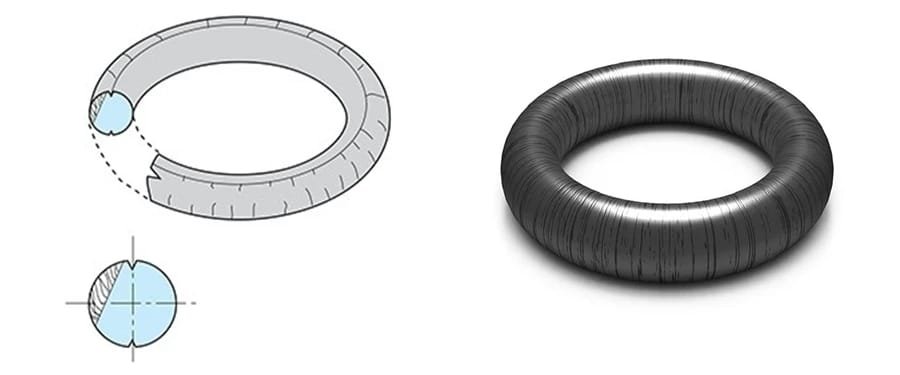
O-rings are often located in pumps, valves, pipe connections, dosing equipment, fillers, mixers, heat exchangers, filters, packaging machines, and processing equipment. They can experience repeated compression, pressure cycling, thermal cycling, chemical exposure, vibration, friction, and mechanical stress.
Over time, an O-ring can fail through several mechanisms. It may be cut during assembly, extruded by pressure, chemically swollen, thermally degraded, mechanically worn, compressed permanently, or torn during maintenance.
If a damaged seal releases a fragment into a product stream, the fragment may be difficult to identify visually, especially when the elastomer is similar in color to the product. This creates an important distinction between preventing seal failure and detecting the consequences of seal failure.
A metal-detectable formulation addresses the second problem by increasing the possibility that an escaped fragment can produce a detectable signal.
Metal Detectability Versus Magnetic Detectability
The terms “metal detectable” and “magnetically detectable” should not automatically be treated as identical. Metal detection systems and magnetic separation systems operate according to different physical principles.
A conventional metal detector typically generates an electromagnetic field and monitors changes in the signal caused by conductive or otherwise electromagnetically responsive material. Detection performance depends strongly on the equipment and operating frequency.
Magnetic systems, by contrast, depend on magnetic properties and are particularly effective for ferromagnetic contaminants. A compound designed to improve metal-detector response should therefore be validated with the actual detection equipment used on the production line.
| Characteristic | Metal Detection | Magnetic Separation |
|---|---|---|
| Primary principle | Electromagnetic response | Magnetic attraction |
| Typical target | Conductive and detectable metallic material | Magnetically responsive particles |
| Seal application | Detectable elastomer fragments in suitable systems | Usually a supplementary control |
| Critical variable | Detector sensitivity and product effect | Magnetic properties and separator geometry |
The practical lesson is simple: validate the detectable O-ring using the same type of detection technology and operating conditions used in production.
The Role of Material Formulation
The detectable response of an O-ring is closely related to its compound formulation. Elastomers such as NBR, EPDM, FKM, silicone, and other polymers can be formulated with different fillers and additives to achieve specific mechanical, thermal, and chemical properties.
A detectable compound may contain a carefully selected particulate component that changes the detector response while maintaining acceptable elastomer performance. The concentration and dispersion of the detectable component can influence the finished product’s density, hardness, tensile strength, elongation, compression set, and processing behavior.
The formulation must also be sufficiently homogeneous. Poor dispersion can produce local differences in detectability or mechanical behavior. From a quality-control perspective, this makes compound mixing, molding, curing, and batch traceability important considerations.
Expert tip: When comparing detectable O-rings from different suppliers, request compound-specific mechanical and chemical data together with documented detection-test information. A detectable claim without defined test conditions is difficult to use as an engineering specification.
Common Materials Used in Detectable O-Rings
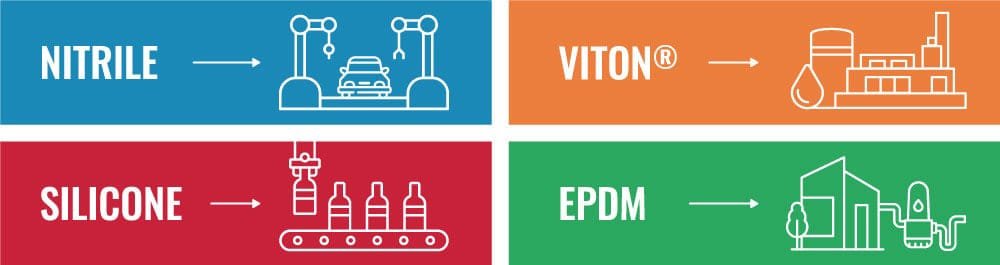
The correct polymer depends on the application. There is no universal elastomer that is optimal for every food, beverage, pharmaceutical, or processing environment.
| Material | Typical Advantages | Important Limitations |
|---|---|---|
| NBR | Good oil and grease resistance; economical; good mechanical properties | Ozone, weathering, and some chemical limitations |
| EPDM | Excellent resistance to water, many aqueous chemicals, ozone, and weathering | Generally unsuitable for many petroleum-oil applications |
| FKM | Strong high-temperature and chemical resistance in many formulations | Low-temperature and application-specific compatibility require evaluation |
| Silicone | Wide temperature capability and excellent flexibility | Tear and abrasion resistance may be lower than some engineering elastomers |
| HNBR | Good mechanical, heat, and ozone performance | Compound-specific food-contact and chemical requirements must be verified |
The detectable additive does not eliminate the normal material-selection process. Engineers must still identify the process fluid, cleaning chemistry, temperature, pressure, motion, surface finish, sterilization cycle, and expected service life.
Hardness and Metal Detectable O-Rings
Shore A hardness is one of the most commonly specified properties for elastomeric O-rings. Common grades may include approximately 60, 70, 80, and 90 Shore A, depending on the compound.
Hardness influences deformation, assembly force, extrusion resistance, friction, and conformity to surface irregularities. However, it does not determine detectability by itself.
Two O-rings can have the same nominal hardness and different detection performance because their formulations contain different detectable components or different concentrations and dispersion characteristics.
Likewise, a harder detectable O-ring is not automatically better than a softer one. The correct choice must balance mechanical sealing requirements with detector performance.
Understanding Detection Sensitivity
Detection sensitivity is often discussed in terms of the smallest reference contaminant that a metal detector can reliably identify under defined conditions. But the smallest detectable fragment of an elastomeric seal is not a universal number.
A detector’s performance can change according to aperture size, product conductivity, product temperature, moisture, salt concentration, packaging, orientation, line speed, detector frequency, and signal-processing settings.
For example, wet or salty food products can create a strong “product effect” that makes detecting small foreign materials more difficult. A detection threshold established using a dry, low-conductivity test product should therefore not automatically be applied to a wet food product.
◆ Critical distinction: A supplier’s statement that an O-ring is detectable is not equivalent to a guarantee that every fragment will be detected on every production line. The complete detector-product-seal system must be validated.
Why Fragment Shape Matters
A broken O-ring rarely produces a perfectly spherical particle. It may produce a curved segment, thin strip, irregular chip, flattened fragment, or small section of the original cross-section.
The detector response can vary with the fragment’s orientation and effective volume. A larger fragment may produce a stronger signal than a small fragment, but geometry and orientation can affect the result.
This is why a proper validation program should not test only one convenient piece of the seal. Representative fragments should be evaluated where the hazard analysis identifies a realistic minimum-size failure scenario.
Food Safety and Regulatory Considerations

Food-contact applications require a distinction between detectability and food-contact compliance. These are separate properties.
In the United States, 21 CFR §177.2600 addresses rubber articles intended for repeated use in producing, manufacturing, packing, processing, preparing, treating, packaging, transporting, or holding food. The regulation specifies permitted substances and conditions, as well as extraction requirements for certain food-contact uses.
Therefore, an O-ring should not be described as “FDA approved” simply because it is metal detectable. The relevant question is whether the exact finished rubber article and its formulation are suitable for the intended food-contact application under the applicable regulatory framework and conditions of use.
The same principle applies to other markets. Depending on the destination and application, manufacturers may need to consider applicable food-contact legislation, customer specifications, hygienic-design requirements, migration or extractables requirements, and documentation such as declarations of compliance.
Regulatory status should always be verified against the exact compound and intended use. A generic polymer name is not sufficient evidence of compliance.
Material Safety Versus Detection Performance
A successful detectable O-ring has to satisfy at least two different performance categories.
Category 1 — Sealing performance: The O-ring must remain chemically, thermally, mechanically, and dimensionally suitable for the application.
Category 2 — Detection performance: If a fragment enters the product stream, the fragment should generate a sufficiently distinguishable detector response under validated operating conditions.
The two requirements must be evaluated together. Increasing the amount of detectable filler might improve detector response but could also affect hardness, tensile strength, elongation, compression set, abrasion resistance, or chemical behavior.
Typical Applications
Metal detectable O-rings can be considered for applications where elastomeric seals are used near an open or potentially exposed product stream and where foreign-material detection is part of the site’s quality-control strategy.
- Food processing: pumps, valves, mixers, fillers, dosing systems, and processing equipment.
- Beverage production: filling, transfer, blending, carbonation, and fluid-handling equipment.
- Pharmaceutical processing: equipment where foreign-material control and material traceability are important.
- Nutraceutical production: powder and liquid processing equipment.
- Cosmetics: mixing, filling, and dosing equipment where elastomer fragments must be controlled.
- Packaging machinery: sealing components located close to product-contact areas.
The suitability of a detectable O-ring should always be confirmed for the actual application rather than inferred from the industry name alone.
Cleaning, Sanitation, and Chemical Resistance
Food and pharmaceutical equipment is frequently exposed to cleaning agents that can be more aggressive than the product itself. Hot water, alkaline detergents, acidic cleaners, oxidizing agents, sanitizers, and repeated thermal cycles can accelerate elastomer aging.
A seal that is chemically compatible with the food product may still fail prematurely because of the cleaning process.
For example, an elastomer may experience swelling after exposure to one chemical, hardening after thermal aging, or loss of tensile strength after repeated chemical cycles. Any detectable filler used in the formulation must also remain compatible with the overall compound system.
A robust qualification program should therefore evaluate both product exposure and cleaning exposure.
Temperature and Thermal Cycling
Temperature affects elastomer stiffness, compression behavior, chemical aging, and sealing performance. In food and beverage equipment, a seal may experience ambient storage, refrigerated product, hot product, hot-water cleaning, steam exposure, and rapid thermal transitions.
The temperature range should therefore be expressed as an actual application profile rather than a single maximum number.
A useful engineering analysis identifies:
- Minimum operating temperature.
- Normal operating temperature.
- Maximum operating temperature.
- Cleaning temperature.
- Duration of thermal exposure.
- Number of thermal cycles.
- Pressure during temperature transitions.
This information helps determine whether the compound can maintain its sealing force over the expected service interval.
Hardness, Compression Set, and Long-Term Sealing
An O-ring can remain visually intact while losing sealing performance because of compression set. Compression set describes the tendency of an elastomer to retain deformation after prolonged compression under specified test conditions.
Hardness does not directly determine compression set. Compound chemistry, curing system, temperature, time, compression level, and environmental exposure all influence the result.
For a static food-processing seal, it may be more important to maintain reliable sealing force after thousands of thermal and cleaning cycles than to maximize the nominal hardness value.
Pressure, Extrusion, and Detectable O-Ring Design
Many processing machines contain hydraulic or pneumatic sections where O-rings may experience significant pressure. Pressure can push an elastomer into the clearance between mating components, creating extrusion or nibbling damage.
The risk increases with pressure, clearance, temperature, material softness, and unfavorable gland geometry.
A harder compound may reduce deformation in some cases, but pressure capability should be established from the complete seal design. Backup rings, controlled extrusion gaps, suitable squeeze, proper groove dimensions, and appropriate material properties can be more important than hardness alone.
Installation Practices That Reduce O-Ring Failure
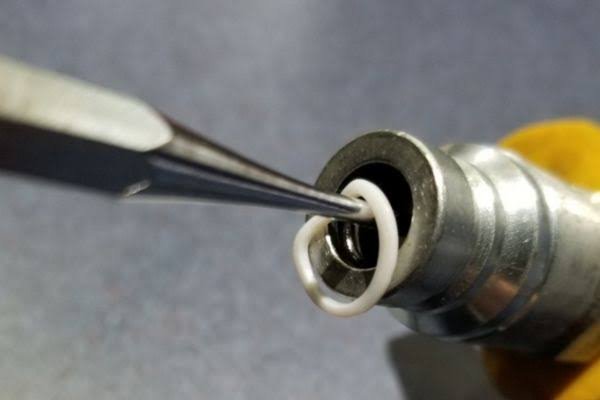
A metal-detectable O-ring cannot provide much safety value if poor installation causes premature seal damage. Installation should therefore be treated as part of the foreign-material prevention strategy.
1. Inspect the gland. Remove burrs, sharp edges, machining debris, and contamination.
2. Inspect the O-ring. Check for cuts, cracks, flattening, contamination, molding defects, or dimensional abnormalities.
3. Use compatible lubrication. The lubricant must be compatible with the elastomer and process environment.
4. Avoid twisting. Twisted O-rings can develop localized stress and premature failure.
5. Control stretching. Excessive stretching can alter the effective cross-section and sealing behavior.
6. Use suitable tooling. Avoid screwdrivers, knives, or sharp tools that can cut the seal.
7. Verify final assembly. Ensure that the O-ring is correctly seated and not pinched.
Laboratory Test Example
The following is an illustrative laboratory test example based on an engineering qualification concept. It is not actual customer data, factory production data, or a manufacturer’s certified test report.
Suppose an engineering team wants to qualify a detectable EPDM O-ring for a water-based processing system. The team could evaluate representative samples before and after controlled exposure to process water and cleaning chemistry.
| Illustrative Test | Purpose | Example Observation |
|---|---|---|
| Hardness | Confirm material consistency | Compare conditioned samples with specification |
| Mass change | Assess swelling or extraction | Record percentage change after exposure |
| Volume change | Evaluate dimensional stability | Compare pre- and post-exposure dimensions |
| Compression set | Evaluate retained deformation | Compare with application requirement |
| Metal detection | Assess detector response | Test representative fragments under production conditions |
| Visual inspection | Identify cracks, swelling, cuts, or degradation | Document changes photographically or through inspection records |
A robust study would also include relevant temperature, pressure, cleaning cycles, and mechanical loading. Detection tests should use realistic fragments rather than only intact O-rings.
Case Example: A Food Processing Valve
This is an illustrative engineering case example and does not represent a real disclosed customer or verified production incident.
Consider a processing valve that uses multiple elastomeric O-rings. Operators report occasional seal wear after extended production and cleaning cycles. The plant’s existing metal detector is effective at identifying conventional metallic contaminants but has limited ability to detect ordinary rubber fragments.
The engineering team considers replacing the conventional O-rings with metal-detectable versions.
The first step is not simply purchasing a detectable seal. The team identifies the valve’s operating temperature, product chemistry, cleaning chemistry, pressure, seal dimensions, compression, surface finish, installation method, and maintenance frequency.
A compatible detectable compound is then evaluated. Detection tests are performed using realistic fragment sizes and orientations through the production detector. Mechanical and chemical tests are conducted separately to ensure that the detectable compound remains suitable for service.
The resulting design provides two complementary controls: preventing premature seal failure through appropriate material and installation, and improving the probability of detecting a fragment if seal damage occurs.
Case lesson: Detectability is most valuable when it is integrated into a complete preventive-maintenance and foreign-material control system.
Failure Mode Analysis
Failure Mode 1 — Cutting during installation: A sharp gland edge or improper tool damages the O-ring. The seal may later release a fragment. Correct lead-in geometry, deburring, lubrication, and installation tooling reduce the risk.
Failure Mode 2 — Extrusion: High pressure forces the elastomer into a clearance gap. Repeated pressure cycling can produce nibbling and fragment formation.
Failure Mode 3 — Chemical swelling: An incompatible fluid increases seal volume and changes mechanical behavior. The resulting deformation can increase friction or cause mechanical damage.
Failure Mode 4 — Thermal aging: Repeated exposure to high temperatures can change hardness, elasticity, tensile strength, and compression behavior.
Failure Mode 5 — Abrasion: Dynamic motion, inadequate lubrication, excessive friction, or poor surface finish can wear the O-ring surface.
Failure Mode 6 — Detector mismatch: The seal is described as detectable, but the production detector is unable to reliably identify the smallest realistic fragment under actual product conditions.
Failure Mode 7 — False compliance assumption: A purchaser assumes that “food grade” or “metal detectable” automatically means compliance with every applicable food-contact requirement. Actual regulatory status must be established for the specific finished article and intended use.
Metal Detectable O-Rings and HACCP Thinking
A Hazard Analysis and Critical Control Point approach focuses on identifying hazards, establishing preventive controls, monitoring those controls, and defining corrective actions. Metal-detectable O-rings can support a foreign-material control strategy, but the O-ring itself should not automatically be classified as a critical control point.
The appropriate control structure depends on the individual process and hazard analysis. In one facility, detector verification may be a critical control. In another, the seal may be controlled through preventive maintenance, inspection, sanitation procedures, and detector monitoring.
The important point is that the detectable seal should be incorporated into the site’s documented food-safety system rather than treated as an isolated purchasing specification.
Traceability and Quality Documentation
For critical sealing applications, traceability can be just as important as material performance. A quality documentation package may include batch identification, material specification, dimensional requirements, hardness, applicable food-contact documentation, test records, and supplier certificates where appropriate.
Manufacturers should be able to establish which compound and production batch were used for a particular shipment. Customers may also benefit from defining acceptable changes in compound, detectable additive, curing system, or manufacturing process.
A significant formulation change should not be treated as equivalent to the original product merely because the O-ring has the same color, dimensions, and nominal hardness.
Color Coding and Visual Inspection
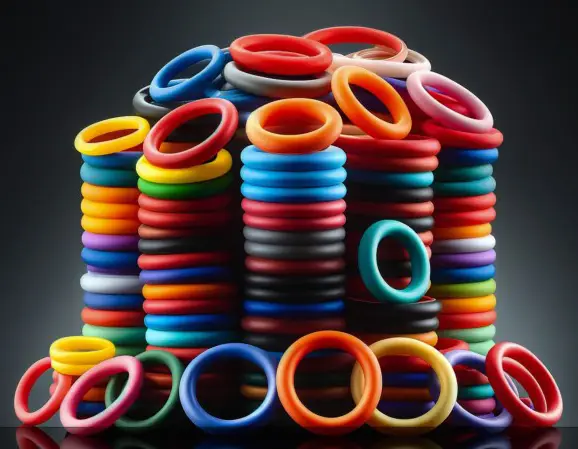
Some detectable O-rings are supplied in distinctive colors to make them easier to identify during maintenance and visual inspection. Color can help technicians quickly distinguish a designated sealing component from ordinary black elastomer products.
However, color should be considered a visual management aid rather than a detection mechanism. A brightly colored seal is not necessarily metal detectable, and a detectable seal does not become safer simply because it has a particular color.
Visual identification, detector response, and material documentation should therefore be treated as separate quality characteristics.
Surface Finish and Hygienic Equipment Design
The O-ring itself is only one component of the hygienic sealing interface. The mating surfaces should be appropriately finished and designed to minimize product traps, crevices, dead spaces, and contamination-retention areas.
An elastomer that is chemically compliant but installed in a poorly designed groove can still create sanitation problems.
Engineers should therefore consider gland geometry, compression, accessibility, cleanability, drainage, surface finish, temperature, and chemical exposure when evaluating a detectable sealing system.
How to Select a Metal Detectable O-Ring

Step 1 — Define the hazard. Determine why foreign-material detection is required and what fragment size represents a credible failure scenario.
Step 2 — Define the process. Record product composition, temperature, pressure, speed, and contact conditions.
Step 3 — Define cleaning conditions. Include detergent, sanitizer, temperature, concentration, exposure time, and cycle frequency.
Step 4 — Select the polymer. Choose NBR, EPDM, FKM, silicone, HNBR, or another suitable material according to actual chemical and thermal requirements.
Step 5 — Select hardness. Establish an appropriate Shore A range based on sealing geometry, pressure, friction, and deformation requirements.
Step 6 — Confirm regulatory suitability. Verify applicable food-contact requirements for the exact finished compound and intended use.
Step 7 — Validate detection. Test realistic fragments using the actual production detector and representative product conditions.
Step 8 — Establish inspection and replacement intervals. Detectability does not prevent mechanical degradation.
Step 9 — Maintain traceability. Record supplier, compound, batch, dimensions, and relevant qualification documentation.
Important Engineering Data to Request from a Supplier
| Data | Why It Matters |
|---|---|
| Polymer type | Determines broad chemical and thermal behavior |
| Compound designation | Identifies the actual formulation family |
| Shore hardness | Indicates indentation hardness under defined conditions |
| Temperature range | Defines expected thermal service limits |
| Chemical compatibility | Reduces swelling and degradation risks |
| Compression set | Helps assess long-term static sealing behavior |
| Tensile and elongation | Provides mechanical-property context |
| Food-contact documentation | Supports regulatory and customer compliance review |
| Detection test conditions | Allows comparison with the actual production detector |
| Batch traceability | Supports quality investigation and corrective action |
What Metal Detectable O-Rings Cannot Guarantee
It is important to establish realistic expectations. A detectable O-ring cannot guarantee that every possible fragment will be detected. Detector performance has physical limits, and the product being inspected can significantly affect sensitivity.
A detectable O-ring also cannot guarantee that the seal will never fail. It does not replace correct material selection, maintenance, installation, inspection, hygienic design, or appropriate operating conditions.
Nor does “metal detectable” alone establish food-contact compliance. As noted above, U.S. 21 CFR §177.2600 specifies requirements for certain rubber articles intended for repeated food contact, including formulation and extraction provisions.
◆ Best practice: Specify the complete requirement: material + compound + hardness + dimensions + operating environment + regulatory suitability + detection performance + validation conditions.
Five Practical Safety Principles
1. Prevent before detecting. Good design, installation, inspection, and maintenance should minimize the probability of seal failure.
2. Detect realistic fragments. Qualification should consider actual failure modes, fragment geometry, orientation, product effect, and detector settings.
3. Separate detectability from compliance. Metal-detectable performance and food-contact suitability are different requirements.
4. Test the complete system. The production detector, product, conveyor speed, aperture, and seal fragment must be considered together.
5. Maintain traceability. A controlled supplier and documented compound specification make failure investigation much more effective.
Frequently Asked Questions About Metal Detectable O-Rings
FAQ 1: What is a metal detectable O-ring?
A metal detectable O-ring is an elastomeric sealing ring formulated so that suitable metal-detection equipment can detect fragments of the material under defined conditions. It is designed to add a foreign-material detection benefit while retaining the sealing properties required by the application.
FAQ 2: Are metal detectable O-rings automatically FDA compliant?
No. Metal detectability and food-contact compliance are separate properties. In the United States, 21 CFR §177.2600 establishes requirements for certain rubber articles intended for repeated food contact, including provisions concerning formulation and extraction. The exact finished product and intended conditions of use must be evaluated.
FAQ 3: Can a metal detector detect every piece of a metal detectable O-ring?
Not necessarily. Detection depends on fragment size, geometry, orientation, detector aperture, product effect, line speed, detector settings, and other operating conditions. The correct approach is to validate the seal using realistic fragments and actual production conditions.
FAQ 4: Which elastomer is best for a metal detectable O-ring?
There is no universally best material. NBR may be appropriate for some oil-containing environments, EPDM for many water-based applications, FKM for certain high-temperature and chemical environments, and silicone for applications requiring particular flexibility and temperature performance. The exact detectable formulation must be evaluated for chemical, thermal, mechanical, regulatory, and detection requirements.
FAQ 5: How should metal detectable O-rings be tested?
Testing should include the complete production system. Evaluate representative O-ring fragments using the actual metal detector, product, aperture, line speed, and operating conditions. Separate tests should evaluate hardness, tensile properties, elongation, compression set, chemical resistance, thermal aging, dimensional stability, and any applicable food-contact requirements.
Final Engineering Perspective
Safety with metal detectable O-rings is ultimately about building multiple layers of control around a small but important component. The O-ring must first be mechanically reliable and chemically compatible. It must be installed correctly, maintained appropriately, and replaced before predictable degradation creates unacceptable risk.
The detectable formulation then adds another layer: if a fragment does escape, the production system has a better opportunity to identify it before contaminated product reaches the next stage of processing or the consumer.
The strongest engineering approach is therefore not to ask whether an O-ring is simply “metal detectable.” Instead, ask whether the specific compound, hardness, dimensions, detection characteristics, food-contact status, chemical resistance, temperature capability, gland design, and production detection system have been evaluated together.
When these factors are integrated into material selection, hygienic design, preventive maintenance, detector validation, and documented quality procedures, metal detectable O-rings can become a valuable component of a modern foreign-material control strategy.
For applications where seal integrity and foreign-material detection are both critical, detailed technical evaluation of Metal Detectable O-Rings should focus on the complete engineering specification rather than on detectability as a standalone marketing claim.