How long does a pinion shaft oil seal last? There is no single mileage or hour figure that applies to every vehicle, axle, differential, or operating environment. A pinion shaft oil seal can remain serviceable for many years when the shaft surface, lubricant, seal material, installation, temperature, alignment, and contamination are all properly controlled. Conversely, a seal can begin leaking soon after installation when the original problem is actually a worn pinion yoke, excessive shaft runout, damaged sealing surface, incorrect lubricant, overheating, or installation damage.
The most useful way to answer the question is therefore not to assign an arbitrary lifespan, but to understand the engineering factors that determine seal life. A pinion shaft seal is a dynamic rotary seal: its sealing lip continuously slides against a rotating shaft while retaining gear oil and excluding contaminants. The resulting friction, heat, lubrication film, shaft motion, and elastomer aging determine how long the sealing system remains effective.
🔧 Engineering takeaway: A pinion shaft oil seal should not be replaced based on mileage alone. If a new seal leaks prematurely, inspect the pinion yoke or flange, shaft sealing surface, bearing condition, runout, installation depth, lubricant level, and operating temperature before assuming that the replacement seal itself was defective.
What Is a Pinion Shaft Oil Seal?
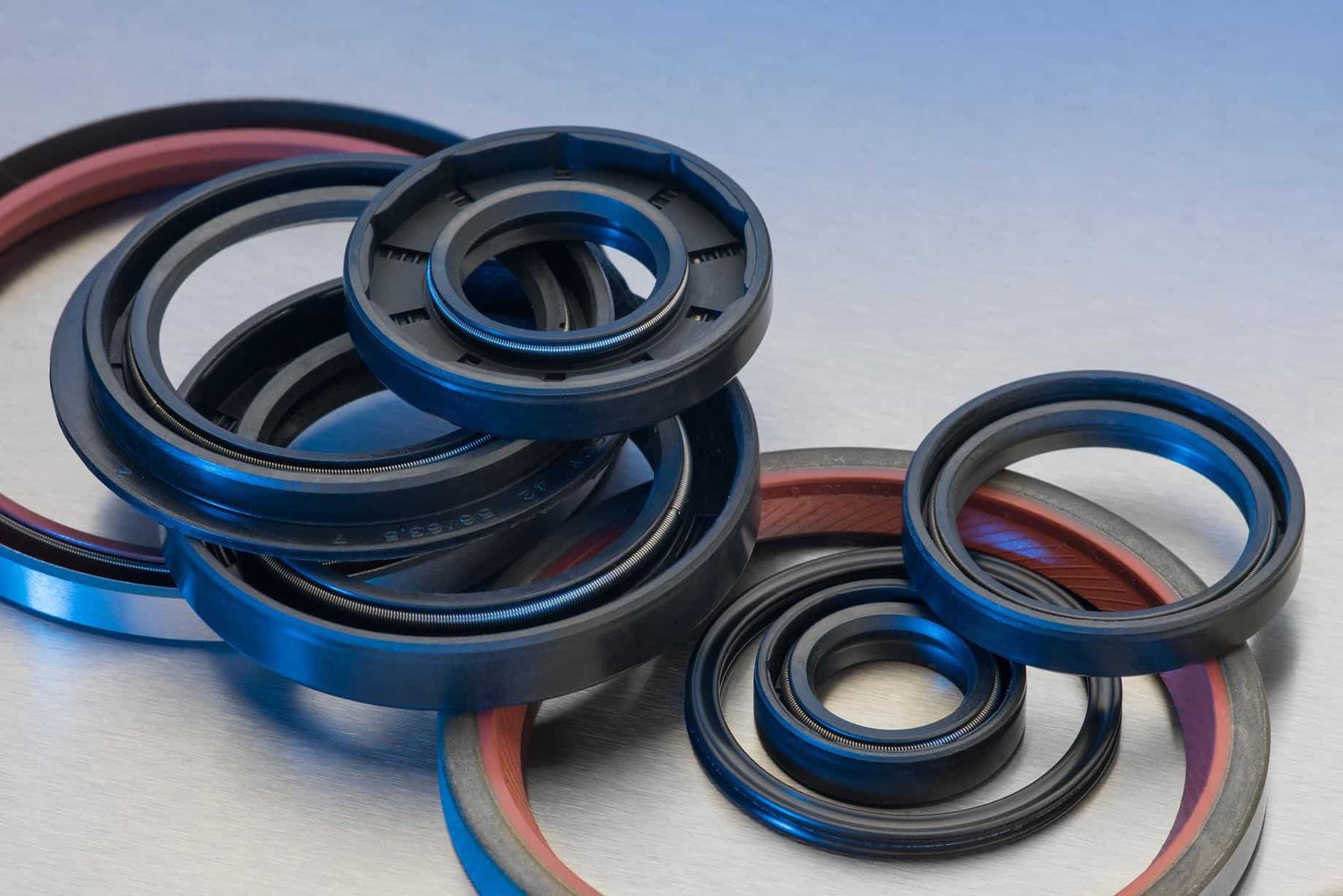
A pinion shaft oil seal is a radial shaft seal installed around the rotating pinion shaft at the differential or axle housing. Its primary purpose is to retain gear lubricant inside the differential while preventing water, dirt, dust, and other contaminants from entering around the rotating shaft.
The pinion shaft transfers torque from the driveshaft or propeller shaft into the differential gear set. Because the pinion shaft rotates at substantial speed, especially when the vehicle is moving at highway speed, the seal must maintain controlled contact with the rotating shaft without generating excessive frictional heat.
Unlike a static gasket, a pinion shaft oil seal operates continuously under dynamic conditions. The sealing lip must accommodate small shaft movements, changes in temperature, lubricant viscosity, surface irregularities, and manufacturing tolerances.
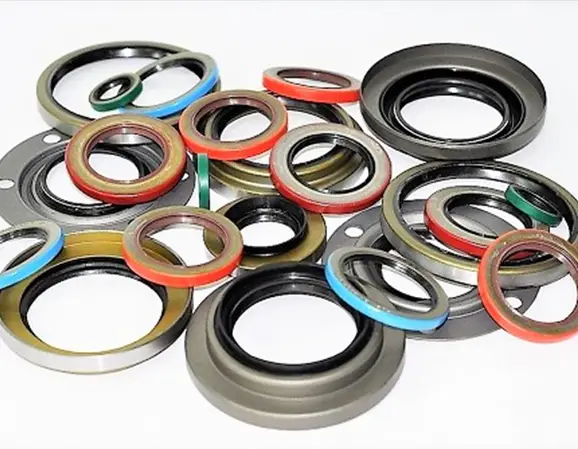
Modern radial shaft seals commonly use an elastomeric sealing element supported by a metal case. Depending on the design, the sealing lip may incorporate a garter spring that maintains radial force against the shaft. Some designs also include a secondary dust lip to provide additional environmental protection.
The international ISO 6194 series covers rotary shaft lip-type seals incorporating elastomeric sealing elements. ISO 6194-1 addresses nominal dimensions and tolerances, while ISO 6194-3 provides guidance concerning storage, handling, and installation. ISO 6194-4 specifies general performance test procedures.
For applications involving automotive and industrial driveline components, choosing correctly specified oil seals requires consideration of more than the outside diameter and inside diameter.
How Long Does a Pinion Shaft Oil Seal Normally Last?
There is no universal service-life specification for pinion shaft oil seals. In practical automotive service, an original-equipment seal may remain leak-free for many years and well over 100,000 miles in favorable conditions, while severe-duty vehicles may require earlier replacement. A seal that lasts 50,000 miles in one axle should not be assumed to have failed prematurely if another application lasts 150,000 miles.
The important distinction is between expected service life and guaranteed service life. Seal manufacturers generally evaluate products under controlled test conditions rather than promising a fixed number of miles for every field application.
A useful engineering classification is:
| Operating condition | Typical life expectation | Primary life risks |
|---|---|---|
| Normal passenger-vehicle use | Potentially many years / high mileage | Age, wear, lubricant degradation |
| Towing and heavy loads | Often reduced | Heat, pressure, lubricant stress |
| Off-highway operation | Highly variable | Mud, dust, water, shaft wear |
| Modified/high-speed driveline | Application dependent | Runout, speed, temperature |
| Poor installation or damaged shaft | May fail immediately | Lip damage, leakage path, excessive wear |
The practical conclusion is simple: mileage is only one variable. The condition of the complete seal system is much more important than a generic replacement interval.
The Main Factors That Determine Pinion Seal Life
1. Shaft Surface Condition
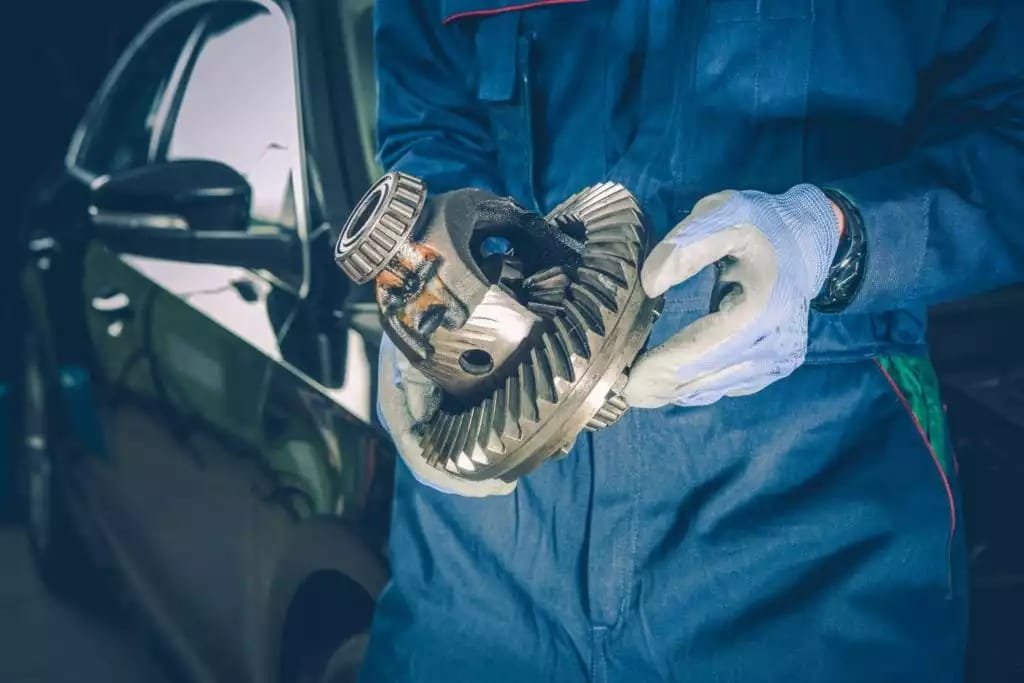
The seal lip does not seal against an abstract shaft diameter. It seals against a specific surface texture, hardness, geometry, and motion pattern. If the pinion yoke or flange develops a groove where the seal lip contacts it, installing a new seal may only provide temporary improvement.
A worn shaft surface can create a permanent leakage path. The sealing lip may repeatedly move into the same groove, reducing effective contact pressure and allowing lubricant to migrate along the interface.
SKF guidance for radial shaft seals identifies shaft surface finish, hardness, accuracy, and running condition as important factors in achieving reliable sealing. One SKF reference gives typical shaft recommendations including a hardened counterface and a surface roughness around Ra 0.2–0.8 μm for certain radial shaft seal applications. These values are application guidance rather than universal requirements for every automotive pinion seal.
2. Shaft Runout and Eccentricity
Dynamic runout occurs when the rotating shaft does not remain perfectly concentric with the seal. Eccentricity can repeatedly move the seal lip away from the intended contact position during each revolution.
This creates a difficult combination: one portion of the lip may experience excessive contact pressure while another portion experiences insufficient contact pressure. The result can be uneven wear, localized heating, and leakage.
For a simplified example, suppose a shaft rotates at 3,000 rpm. The shaft completes:
3,000 × 60 = 180,000 revolutions per hour.
At that speed, even a very small geometric error is repeated hundreds of thousands of times every hour.
This explains why apparently minor shaft runout can become a major seal-life problem.
3. Operating Temperature
Temperature is one of the most important variables in elastomer seal life. As temperature increases, elastomer properties, lubricant viscosity, oxidation rate, and frictional behavior can change.
Temperature at the seal lip is not necessarily equal to the ambient temperature or even the bulk differential-oil temperature. Friction at the lip can create localized heat. Poor lubrication, excessive shaft speed, excessive radial load, or inadequate heat dissipation can increase the temperature at the sealing interface.
SKF documentation specifically notes that inadequate lubrication can increase temperature at the sealing lip and contribute to hardening and cracking. It also notes that excessive counterface roughness can accelerate lip wear.
4. Lubricant Compatibility
The elastomer must be chemically compatible with the gear oil and additives used in the axle. A seal material that performs well in one lubricant may not have the same performance in another formulation.
NBR is widely used for oil seals because it provides good resistance to many mineral-oil-based lubricants and is economical. FKM can offer higher temperature capability and broader chemical resistance in many applications, but material selection must still be based on the actual fluid, temperature, speed, and seal design.
As one manufacturer reference illustrates, allowable continuous temperature ranges differ substantially among NBR, ACM, silicone, and FKM compounds, and resistance also changes depending on the particular fluid.
5. Contamination
Dust, mud, water, sand, and road debris can dramatically shorten the life of a rotating shaft seal. Contaminants can become trapped near the lip and act as abrasive particles.
Off-highway applications are particularly demanding. Published SAE research on off-highway pinion shaft oil seals identifies abrasive wear and heat-related seal degradation as important field failure mechanisms. The study investigated shaft runout, eccentricity, temperature, rotation, and reciprocal motion as part of accelerated testing.
Why Pinion Shaft Seals Fail Prematurely
A seal that leaks after a short period does not automatically indicate poor seal quality. Premature failure is frequently a system-level problem.
- Damaged pinion yoke: a groove or corrosion track can defeat a new seal.
- Excessive shaft runout: causes cyclic lip movement and uneven wear.
- Incorrect installation depth: may position the lip on a damaged portion of the shaft.
- Dry installation: can cause immediate lip damage during initial rotation.
- Wrong seal orientation: can cause the sealing lip to face the wrong side.
- Incorrect lubricant: can cause swelling, shrinkage, hardening, or loss of mechanical properties.
- Overfilled differential: can increase oil exposure and pressure-related leakage conditions.
- Blocked or damaged axle breather: can create pressure that drives lubricant toward the seal.
- Bearing problems: worn bearings can increase shaft movement and seal lip displacement.
- Excessive heat: accelerates elastomer aging and lubricant degradation.
Material Selection for Pinion Shaft Oil Seals
Seal material should be selected according to the actual operating environment rather than simply choosing the cheapest elastomer.
| Material | General characteristics | Potential automotive use |
|---|---|---|
| NBR | Good general oil resistance, economical, widely used | Many conventional axle and gearbox applications |
| ACM | Improved high-temperature performance for selected oils | Certain automotive drivetrain applications |
| FKM | High temperature and chemical resistance | Severe-temperature or chemically demanding applications |
| Silicone | Wide temperature capability but application-specific wear and fluid considerations | Selected applications rather than a universal choice |
The exact formulation matters. Two seals labeled NBR can have different hardness, low-temperature behavior, abrasion resistance, compression set, and compatibility because compound formulation and reinforcement differ.
Does Seal Hardness Affect Service Life?
Yes, but harder is not automatically better.
Elastomer hardness is often measured using Shore A methods. A harder seal can provide useful resistance to extrusion and deformation in some applications, while a softer seal can conform more readily to surface irregularities and may require less contact force.
For dynamic shaft sealing, the correct balance between hardness, modulus, lip geometry, spring force, temperature capability, and lubrication is more important than selecting the highest Shore A value.
A typical automotive seal compound may fall somewhere around the 70–90 Shore A range, but the correct value depends on the seal design and application. This range should be treated as an engineering example, not as a universal pinion-seal specification.
Heat Generation and the Pinion Seal
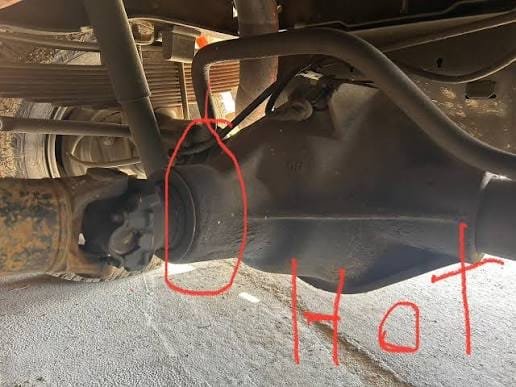
A useful conceptual relationship for frictional heat is:
Power loss ≈ friction force × sliding velocity
P ≈ F × v
For a rotating shaft, surface velocity can be estimated from:
v = πDN / 60
where D is shaft diameter in meters and N is rotational speed in revolutions per minute.
For example, assume a simplified pinion shaft diameter of 40 mm and rotational speed of 3,000 rpm:
v = π × 0.040 × 3,000 / 60 ≈ 6.28 m/s.
This is only an illustrative calculation. Real seal friction depends on lip geometry, contact pressure, lubricant film, elastomer properties, shaft finish, temperature, and other variables.
The example demonstrates why a seal that looks small can still experience significant sliding velocity and heat generation.
What Happens When the Pinion Seal Gets Too Hot?
Excessive heat can accelerate elastomer aging, change hardness, reduce elasticity, damage the lubricant film, and increase wear. If the lip becomes brittle, hardened, cracked, or permanently deformed, its ability to maintain a controlled sealing interface can deteriorate rapidly.
Heat can originate from several sources:
- High rotational speed
- Excessive lip friction
- Insufficient lubrication
- Incorrect lubricant viscosity
- High differential temperature
- Excessive bearing preload
- Incorrect gear setup
- High towing loads
- Insufficient heat dissipation
Therefore, replacing the seal without diagnosing excessive temperature can result in repeated failures.
The Role of Shaft Hardness and Surface Finish
The shaft counterface is part of the sealing system. It must be sufficiently hard and properly finished to resist the formation of wear grooves.
A rough surface can act like abrasive paper against the lip. However, an excessively smooth surface is not necessarily ideal in every seal design because the lubricant film behavior at the interface also matters.
SKF guidance emphasizes that the counterface should have appropriate roughness and that inadequate surface characteristics can either starve the sealing lip of lubricant or increase wear.
In one SKF application reference, a shaft hardness of approximately 45 HRC minimum and Ra 0.2–0.8 μm are presented as recommendations for certain radial shaft seal applications. Automotive manufacturers may specify different values based on their own shaft and seal designs.
Expert tip: When a pinion seal repeatedly fails at approximately the same mileage, inspect the shaft contact track before replacing the seal again. Repeated replacement without correcting the shaft surface can simply repeat the same failure mechanism.
Case Example: A New Pinion Seal Starts Leaking Quickly
Case Example — illustrative engineering scenario, not a report of a real customer:
Consider a hypothetical rear axle in which a new pinion seal begins leaking after several hundred miles. The technician initially suspects a defective seal because the seal is new.
During inspection, a visible circumferential wear groove is discovered on the pinion yoke at the previous seal contact location. The replacement seal was installed in approximately the same axial position, placing its lip directly over the existing groove.
The seal may initially hold lubricant because the elastomer conforms to the groove. As the shaft rotates, however, the groove provides a preferential leakage path. The lip also experiences localized movement and wear.
A better repair strategy would involve evaluating the yoke surface and selecting an appropriate repair or replacement method, rather than simply installing a third seal.
This example illustrates a central principle of rotary sealing: seal life depends on the counterface as much as the elastomer.
Laboratory Test Example
Laboratory Test Example — illustrative methodology, not fabricated customer data or a claimed product life curve:
A development laboratory evaluating a pinion shaft seal might establish a controlled test using a representative shaft diameter, specified gear oil, controlled temperature, shaft speed, shaft runout, and defined contamination conditions.
| Test variable | Example controlled condition |
|---|---|
| Shaft diameter | Representative production diameter |
| Shaft speed | Several defined operating points |
| Lubricant | Specified production gear lubricant |
| Temperature | Controlled and monitored |
| Runout | Defined nominal and elevated conditions |
| Evaluation | Leakage, lip wear, shaft track, temperature, torque |
ISO 6194-4 provides general performance test procedures for rotary shaft lip-type seals and can be used for qualification-oriented testing.
The purpose of such testing is not to claim that a seal will last exactly a particular number of miles in every vehicle. Instead, controlled testing helps engineers compare designs and identify sensitivity to temperature, speed, lubrication, runout, and other factors.
Failure Mode Analysis: Pinion Shaft Oil Seal
Failure Mode 1: Lip Wear
Normal dynamic sealing produces some wear over time. Excessive wear can result from poor lubrication, high shaft speed, rough shaft surfaces, contamination, excessive radial force, or unsuitable material.
Failure Mode 2: Heat Cracking
Heat-related degradation may produce hardening, cracking, or loss of elasticity at the sealing lip. The root cause should be investigated rather than treating the cracked lip as the primary problem.
Failure Mode 3: Abrasive Wear
Sand, dust, rust particles, or other contamination can enter the sealing region and wear the lip or shaft. Off-highway operation can be especially aggressive.
Failure Mode 4: Shaft Groove Formation
A repeated sealing contact pattern can eventually produce a groove. Once the groove becomes significant, simply installing another seal at the same position may not restore long-term sealing.
Failure Mode 5: Installation Damage
A lip can be cut, rolled, distorted, or displaced during installation. Damage may occur when the seal passes over splines, threads, sharp edges, or damaged shaft surfaces without an appropriate installation sleeve or protective method.
Failure Mode 6: Pressure-Related Leakage
A blocked axle breather can allow internal pressure to rise. The pressure can push lubricant toward the seal and increase the probability of leakage.
How to Install a Pinion Shaft Oil Seal Correctly
Correct installation is essential because even a high-quality seal can fail if it is damaged during installation.
- Clean the surrounding area. Prevent dirt from entering the differential during disassembly.
- Inspect the shaft or yoke. Look for grooves, corrosion, burrs, pitting, or abnormal wear.
- Confirm the correct seal. Verify dimensions, lip orientation, material, and application.
- Protect the sealing lip. Avoid contact with sharp splines, threads, or edges.
- Lubricate the sealing lip as specified. Do not assume a dry lip is acceptable.
- Use the correct installation tool. Drive the seal squarely into the housing.
- Follow the specified installation depth. Do not automatically copy the old seal position if the shaft contact area is worn.
- Check the breather. A restricted breather can contribute to repeated leakage.
- Use the specified lubricant. Fill the axle according to the manufacturer’s procedure.
- Inspect for leakage after operation. Confirm that the leak source is actually the pinion seal.
ISO 6194-3 specifically addresses storage, handling, and installation of rotary shaft lip seals, emphasizing careful handling and proper installation practices.
Why the Old Seal Should Not Always Be Used as the Installation Reference
It is common to remove an old seal and install the new seal at approximately the same depth. This may be acceptable in many repairs, but it can be problematic when the shaft has developed a wear track.
If the old seal ran on a damaged groove, placing the new lip in precisely the same location can reproduce the leakage mechanism.
Technicians should therefore evaluate both the old seal and its contact position before installation.
🔍 Diagnostic rule: The wear pattern on the removed seal is evidence. A narrow, polished contact area, uneven wear, heat discoloration, hardened elastomer, cuts, or contamination can help identify the actual failure mechanism.
How to Tell Whether a Pinion Seal Is Near the End of Its Life
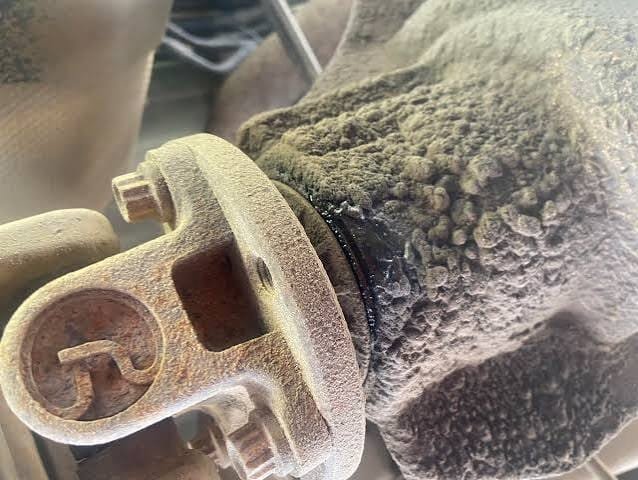
Several symptoms can indicate seal deterioration:
- Fresh gear-oil residue around the pinion flange
- Oil accumulation on the underside of the differential housing
- Oil thrown outward by a rotating flange or yoke
- Persistent wetness around the seal after cleaning
- Visible deterioration or cracking of the seal lip
- Oil contamination around nearby driveline components
However, oil near the pinion area does not automatically prove that the pinion seal is leaking. Differential covers, axle tubes, breather fittings, plugs, and nearby components can also leak and allow oil to migrate toward the pinion region.
Pinion Seal vs. Bearing Failure
A worn pinion bearing can create shaft movement that eventually damages the seal. In that situation, replacing only the seal may temporarily reduce leakage but will not correct the underlying mechanical problem.
Potential bearing-related indicators include abnormal driveline noise, changes in gear-mesh behavior, unusual vibration, excessive play, or abnormal wear patterns. Diagnosis should follow the vehicle manufacturer’s axle service procedure.
This is particularly important because seal lip displacement caused by shaft movement can be much greater than the movement expected in normal operation.
Does Driving Style Affect Pinion Seal Life?
Yes. Driving conditions influence axle temperature, shaft speed, lubricant temperature, vibration, and contamination exposure.
Heavy towing and sustained high loads can increase gear and lubricant temperatures. Off-road driving can expose the sealing area to mud, water, sand, and debris. Vehicles with modified driveline geometry may introduce operating conditions different from the original design.
Frequent high-speed operation also increases shaft surface velocity. Because seal friction and heat generation are influenced by sliding velocity, high-speed operation can increase the thermal demands placed on the seal.
How Contamination Shortens Seal Life
Contamination can cause both direct and indirect damage.
Directly, abrasive particles can wear the elastomer and shaft. Indirectly, water can contaminate lubricant, promote corrosion, and alter lubrication behavior. Mud can also damage the secondary dust lip or create an aggressive environment around the shaft.
A field study of off-highway rotary oil seals identified abrasive wear and thermal degradation as important failure mechanisms and used combinations of speed, temperature, eccentricity, runout, and reciprocal motion to reproduce field-related failure behavior.
A Practical Seal-Life Calculation Concept
There is no universal equation that converts shaft speed, temperature, and material into an exact number of miles. Nevertheless, engineers can build a useful risk model by considering the main stress factors.
| Factor | Low-risk condition | Higher-risk condition |
|---|---|---|
| Temperature | Controlled and within seal rating | High or fluctuating temperature |
| Shaft finish | Correct finish and hardness | Grooved, rough, corroded |
| Runout | Within design specification | Excessive eccentricity |
| Lubrication | Correct fluid and level | Incorrect, degraded, insufficient |
| Environment | Clean road use | Mud, sand, water, dust |
This approach is more scientifically defensible than claiming that every pinion seal should last exactly 60,000, 100,000, or 150,000 miles.
ASTM and ISO Standards Relevant to Seal Engineering
Engineers evaluating elastomeric seals may encounter multiple standards covering material properties, dimensional requirements, hardness, fluid resistance, aging, and seal performance.
ISO 6194-1: addresses rotary shaft lip-type seals with elastomeric sealing elements, including nominal dimensions and tolerances for seals, shafts, and housings.
ISO 6194-3: addresses storage, handling, and installation of rotary shaft lip seals.
ISO 6194-4: establishes general performance test requirements for rotary shaft lip-type seals and can support qualification testing.
ASTM methods are also widely used in elastomer characterization, including hardness, tensile properties, compression set, fluid immersion, aging, and other material-performance measurements. The exact ASTM method should be selected according to the property being evaluated and the applicable material specification.
Important: A standard test result should not automatically be interpreted as a prediction of field mileage. Laboratory conditions and vehicle operating conditions are different, and seal-system behavior depends on the complete application.
Choosing the Right Replacement Pinion Shaft Seal
When selecting a replacement seal, evaluate the following:
- Correct shaft diameter
- Correct housing bore diameter
- Correct seal width
- Correct sealing direction
- Correct elastomer material
- Compatible gear lubricant
- Required temperature range
- Rotational speed
- Environmental contamination
- Pressure conditions
- Dust-lip requirements
- Spring-loaded versus non-spring-loaded design
- Manufacturer installation requirements
Spring-loaded rotary seals are commonly used where reliable oil retention is required. SKF notes that spring-loaded designs are typically used for retaining oil or excluding dirt in higher-speed radial applications, while non-spring-loaded designs are generally associated with grease retention or slower applications.
What Is the Best Material for a Pinion Shaft Oil Seal?
There is no single “best” material for every pinion shaft.
NBR can be an excellent choice for conventional mineral-oil applications when temperature and speed are within its design range. ACM may be selected for certain automotive high-temperature oil applications. FKM may be advantageous where higher temperature or chemical resistance is required.
The correct question is not “Which material is strongest?” but rather “Which compound provides the required compatibility, temperature capability, wear resistance, flexibility, and sealing performance under the actual operating conditions?”
How Much Does a Damaged Shaft Affect Seal Life?
A damaged shaft can reduce seal life dramatically because the seal lip and shaft operate as a coupled tribological system.
If the shaft has a circumferential groove, the new lip may settle into the existing wear track. If the shaft has corrosion pits, the lip may experience repeated local deformation. If the shaft surface is excessively rough, abrasive wear may accelerate.
In severe cases, the shaft should be repaired or replaced before installing another seal.
Can a Speedi-Sleeve or Shaft Repair Sleeve Extend Seal Life?
A properly selected shaft repair sleeve can restore a damaged sealing surface without necessarily replacing the complete shaft or yoke. The sleeve provides a new running surface for the seal lip.
The suitability of a repair sleeve depends on available space, shaft geometry, sleeve dimensions, surface requirements, seal lip position, and manufacturer instructions. It is not a universal solution for every pinion application.
How to Diagnose a Repeated Pinion Seal Leak
If a pinion seal has been replaced more than once and leakage returns, use a systematic diagnostic process.
- Clean the entire differential and surrounding area.
- Confirm the actual source of the lubricant.
- Inspect the pinion yoke or flange sealing track.
- Measure or verify shaft runout according to the service procedure.
- Check for bearing looseness or abnormal movement.
- Inspect the axle breather.
- Confirm lubricant type and level.
- Review the seal material and dimensions.
- Inspect the removed seal for a wear pattern.
- Review installation depth and orientation.
This process prevents a common repair mistake: repeatedly replacing the visible component without correcting the underlying cause.
Expert Tips for Maximizing Pinion Seal Life
💡 Tip 1: Never judge a replacement seal only by its appearance. Material, lip geometry, spring design, dimensional accuracy, and compatibility all matter.
💡 Tip 2: Always inspect the shaft contact surface before installing a new seal.
💡 Tip 3: Keep the sealing lip lubricated during initial installation when required by the seal manufacturer.
💡 Tip 4: A clean, functional breather is an important part of the sealing system.
💡 Tip 5: Do not use a generic seal-temperature limit without confirming the actual compound and lubricant combination.
💡 Tip 6: If the same seal position repeatedly leaks, investigate shaft wear, runout, bearing movement, and temperature.
Pinion Shaft Oil Seal Maintenance Checklist
| Inspection item | What to look for |
|---|---|
| Seal area | Fresh oil, wetness, dirt accumulation |
| Pinion yoke/flange | Grooves, rust, pitting, wear |
| Breather | Blockage or restricted ventilation |
| Lubricant | Correct type, level, contamination |
| Driveline | Vibration, abnormal noise, bearing movement |
Why a Universal Mileage Recommendation Can Be Misleading
Suppose two vehicles use apparently similar pinion seals. Vehicle A operates primarily on clean highways with moderate loads. Vehicle B regularly tows heavy trailers, travels on gravel roads, experiences high axle temperatures, and operates in dusty conditions.
Even if both vehicles accumulate the same 80,000 miles, the seal systems have experienced very different amounts of thermal cycling, shaft rotation, contamination, lubricant stress, and mechanical load.
In other words, miles are an imperfect proxy for seal duty. Operating hours, revolutions, temperature, contamination, and mechanical condition may provide more useful engineering information.
A More Useful Way to Think About Seal Life
Instead of asking only “How many miles does a pinion seal last?”, ask five questions:
- What is the shaft speed and surface velocity?
- What temperature does the sealing lip actually experience?
- Is the shaft counterface smooth, hard, concentric, and free of grooves?
- Is the lubricant compatible and properly maintained?
- Is the seal protected from contamination and installed correctly?
If the answers are favorable, long service life is much more achievable. If several answers are unfavorable, even a premium seal can experience premature leakage.
How Long Should a Pinion Shaft Oil Seal Last?
A pinion shaft oil seal can last for many years and substantial mileage, but there is no scientifically responsible universal mileage figure that applies to every vehicle. Seal life is controlled by the interaction between the elastomer, shaft surface, lubricant, temperature, rotational speed, runout, bearing condition, contamination, pressure, and installation quality.
For normal service, a properly selected and correctly installed seal can provide long-term service. When a seal fails early, the most valuable diagnostic step is not automatically buying another seal. Instead, inspect the entire sealing system.
Pay particular attention to the pinion yoke or shaft sealing track, because a worn counterface can cause repeated failures. Also inspect the axle breather, lubricant condition, bearing movement, shaft runout, temperature, and environmental contamination.
ISO 6194 provides an important engineering framework for rotary shaft lip seals, including dimensional requirements, installation guidance, and performance testing. These standards reinforce the principle that reliable sealing depends on the complete seal-and-counterface system rather than the elastomer alone.
Final expert point: If a pinion seal leaks repeatedly, do not treat the seal as an isolated component. Investigate the shaft, bearing, breather, lubricant, temperature, alignment, runout, contamination, and installation procedure. Correcting the root cause is usually more valuable than simply installing another replacement seal.
Frequently Asked Questions About Pinion Shaft Oil Seal Life
FAQ 1: How many miles does a pinion shaft oil seal last?
There is no universal mileage rating. Under favorable conditions, an original seal can remain functional for many years and high mileage, while severe-duty applications may experience earlier wear. Shaft condition, temperature, lubricant, runout, contamination, and installation quality are often more important than mileage alone.
FAQ 2: Why does my new pinion seal keep leaking?
Possible causes include a worn pinion yoke, shaft groove, excessive runout, bearing movement, blocked breather, incorrect lubricant, incorrect installation depth, damaged sealing lip, incorrect seal orientation, or excessive operating temperature. Replacing the seal without investigating these factors may result in another premature leak.
FAQ 3: Should I replace the pinion yoke when replacing the seal?
Not automatically. Inspect the yoke sealing surface first. If it has a significant wear groove, corrosion, pitting, or other damage, repair or replacement may be appropriate. A shaft repair sleeve can also be considered when compatible with the application and installation requirements.
FAQ 4: Does a blocked differential breather cause a pinion seal leak?
It can contribute to leakage. A restricted breather can increase internal pressure as the axle heats during operation, increasing the tendency for lubricant to escape through seals and other interfaces. The breather should therefore be included in the diagnostic process when repeated seal leakage occurs.
FAQ 5: What is the best way to extend pinion shaft oil seal life?
Use the correct seal material and dimensions, maintain the specified lubricant, keep the breather functional, protect the sealing area from contamination, inspect the shaft counterface, control runout and bearing condition, and install the seal using the manufacturer’s recommended procedure. The most important principle is to treat the seal, shaft, lubricant, and surrounding mechanical components as one sealing system.