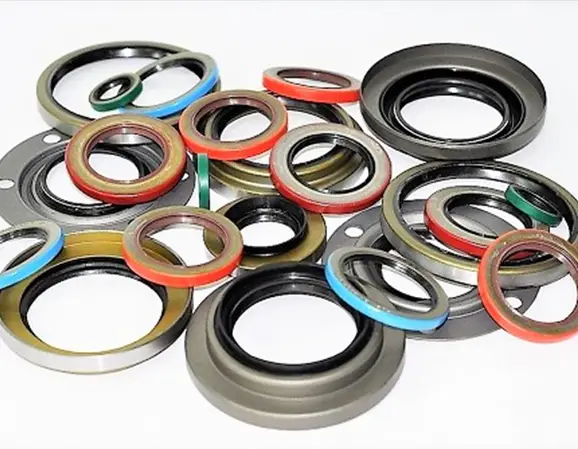
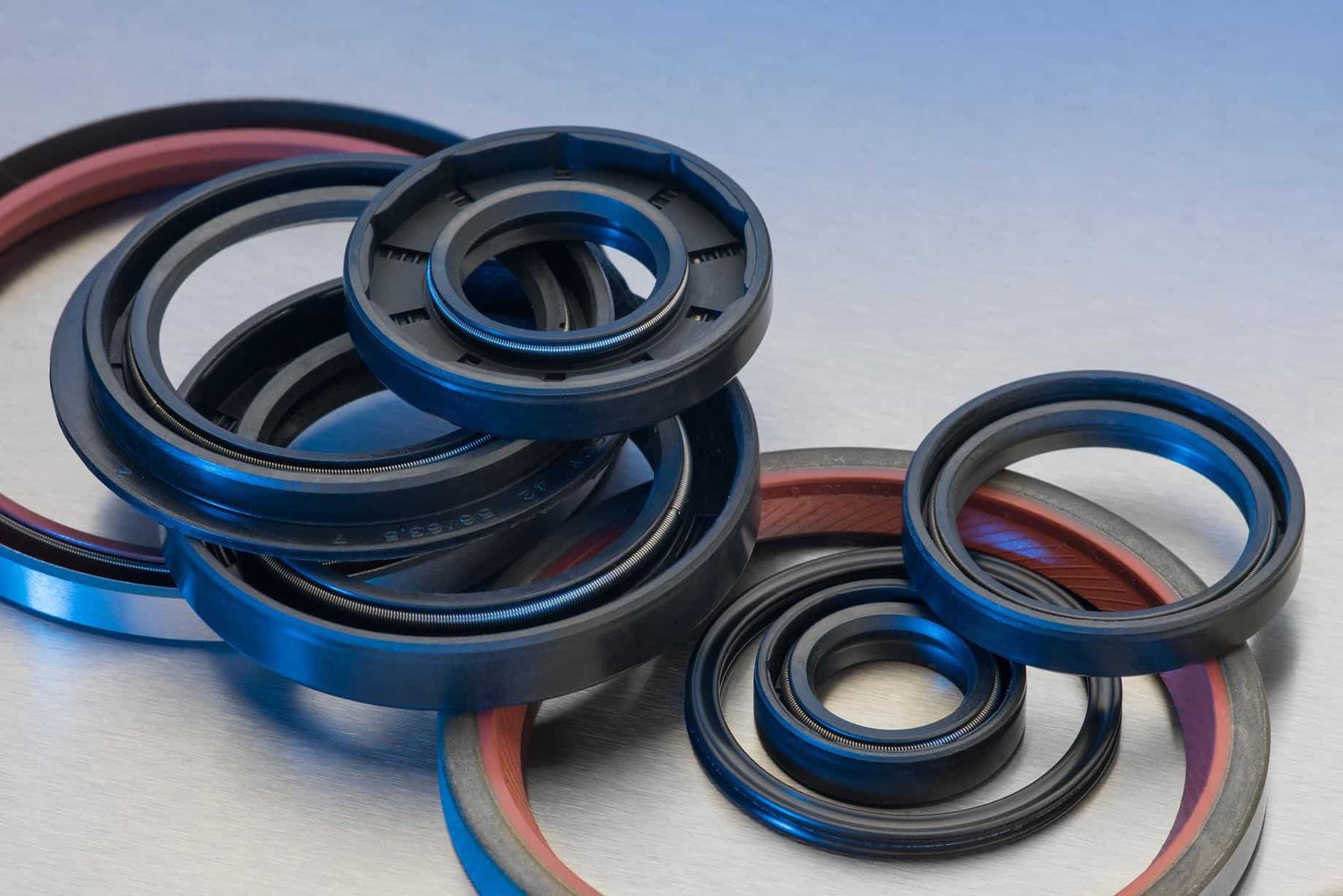
Food processing, beverage production, pharmaceutical manufacturing, and sanitary equipment industries rely on sealing systems that can perform under strict hygiene requirements. The concept of Seal Dynamics in Food Safety focuses on how sealing components behave when exposed to temperature changes, cleaning chemicals, pressure cycles, mechanical movement, and demanding sanitation procedures.
In food and beverage applications, a seal is not simply a component used to prevent leakage. It is a critical barrier that protects products from contamination, prevents lubricant migration, maintains system pressure, and supports compliance with food safety regulations. Poor seal selection can result in microbial growth risks, production downtime, product recalls, and unexpected maintenance costs.
Modern sanitary sealing solutions require a combination of material science, precision manufacturing, and application engineering. Engineers must evaluate elastomer compatibility, compression behavior, temperature resistance, chemical stability, and regulatory requirements before selecting the correct sealing material.
🔎 Engineering Insight:
A food-grade seal must satisfy two different requirements simultaneously: high sealing reliability and strict hygienic performance. A material that seals well mechanically may still fail if it absorbs chemicals, develops surface cracks, or cannot withstand sanitation cycles.
Understanding Seal Dynamics in Food Safety Applications
Seal dynamics describe the interaction between a sealing material, the equipment design, operating environment, and process conditions. In food processing systems, these interactions are more complex than in many industrial applications because equipment must frequently withstand cleaning procedures such as Clean-In-Place (CIP) and Sterilization-In-Place (SIP).
A sealing system must maintain performance while exposed to:
✓ Hot water and steam sterilization
✓ Acidic and alkaline cleaning agents
✓ Vegetable oils, fats, and food ingredients
✓ Pressure fluctuations and vibration
✓ Frequent assembly and disassembly cycles
Unlike static industrial systems, food equipment often experiences repeated thermal expansion and contraction. The seal must maintain contact pressure without excessive deformation, extrusion, or permanent compression set.
Why Seal Selection Directly Influences Food Safety
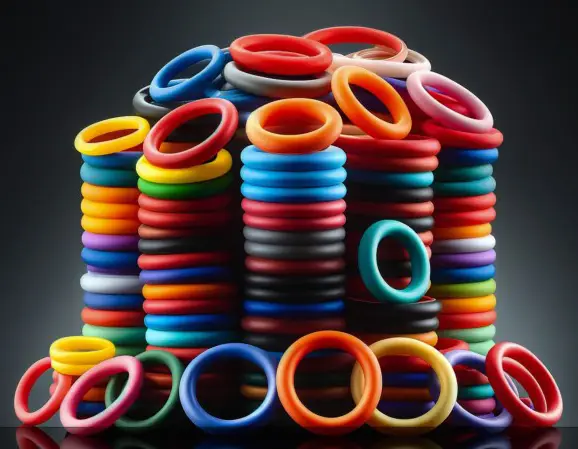
A sealing failure can create several food safety hazards. For example, a damaged O-ring in a filling machine may allow external contaminants to enter the product zone. A chemically degraded gasket may release particles or lose elasticity, creating hidden leakage paths.
The primary food safety functions of seals include:
🛡 Contamination Prevention
Seals create a controlled barrier between processed products and external environments.
⚙ Process Reliability
Proper sealing prevents pressure loss, fluid leakage, and unexpected equipment shutdown.
🧼 Hygienic Design Support
Food-grade seals help equipment maintain smooth, cleanable surfaces with reduced bacterial retention areas.
Food-Grade Seal Materials and Performance Characteristics
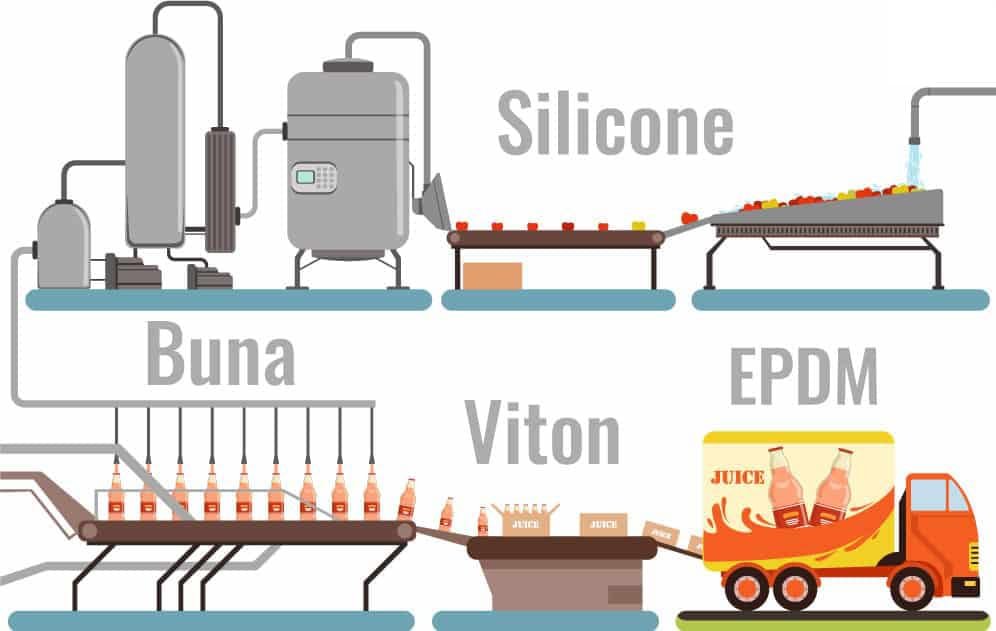
The selection of elastomer materials determines how a seal performs in food processing environments. Common materials include EPDM, Silicone (VMQ), Fluorocarbon (FKM), Nitrile (NBR), and advanced FDA-compliant compounds.
EPDM Seals for Steam and Cleaning Applications
Ethylene Propylene Diene Monomer (EPDM) is widely used in food and beverage equipment because of its excellent resistance to hot water, steam, and many cleaning chemicals.
Typical properties:
Temperature range: approximately -50°C to +150°C depending on compound formulation.
Hardness range: commonly 60-90 Shore A.
Chemical resistance: excellent against water, steam, acids, and alkalis.
EPDM is often selected for dairy systems, beverage filling machines, pumps, and CIP cleaning environments.
Silicone Seals for Temperature Stability
Silicone rubber provides excellent flexibility over a wide temperature range and maintains elasticity during repeated thermal cycling.
Typical characteristics:
Temperature capability: approximately -60°C to +200°C.
Low compression deformation: suitable for repeated heating and cooling cycles.
Food compatibility: available in FDA-compliant formulations.
Silicone seals are commonly found in bakery equipment, beverage dispensers, coffee machines, and pharmaceutical processing systems.
FKM Seals for Chemical Resistance
Fluorocarbon elastomers provide excellent resistance to oils, fuels, and aggressive chemicals. In food applications, specially formulated FKM compounds may be used where chemical exposure exceeds EPDM capability.
| Material | Temperature Range | Main Advantage |
| EPDM | -50°C to +150°C | Steam and chemical resistance |
| Silicone | -60°C to +200°C | Temperature flexibility |
| FKM | -20°C to +200°C | Chemical resistance |
| NBR | -30°C to +100°C | Oil and grease resistance |
Important Food Safety Standards for Sealing Materials
Food processing seals must comply with recognized regulatory requirements to ensure that materials are suitable for contact with food products.
Common standards include:
FDA 21 CFR 177.2600
Defines requirements for rubber articles intended for repeated food contact use.
3-A Sanitary Standards
Used widely in dairy and hygienic processing equipment to promote sanitary equipment design.
ISO 3601
Defines dimensions and tolerances for O-rings used in industrial sealing applications.
ASTM D2000
Provides a classification system for rubber materials based on temperature, fluid resistance, and mechanical properties.
Compliance with standards does not automatically guarantee sealing success. Engineers must still evaluate actual operating conditions, including pressure, temperature, chemical concentration, and cleaning frequency.
Seal Installation Practices for Hygienic Equipment

Correct installation is essential because even the highest-quality food-grade seal can fail when installed incorrectly.
Surface Finish Requirements
Seal contact surfaces should be properly machined and finished. Excessively rough surfaces can damage elastomers, while extremely smooth surfaces may reduce lubrication retention.
Typical stainless steel sealing surfaces often require controlled roughness values depending on application design. Many hygienic systems target surface finishes around Ra 0.8 μm or smoother.
Lubrication Considerations
Food-grade lubricants should be selected when lubrication is required. Lubricants should comply with recognized food machinery requirements such as NSF H1 classification where incidental food contact is possible.
Incorrect lubricants may cause swelling, softening, or chemical degradation of elastomer seals.
Failure Mode Analysis of Food Processing Seals
Understanding failure mechanisms helps engineers improve reliability and reduce maintenance frequency.
Failure Mode 1: Compression Set
Compression set occurs when an elastomer loses its ability to return to its original shape after long-term compression.
Common causes:
• Excessive operating temperature
• Incorrect material selection
• Long storage periods before installation
Failure Mode 2: Chemical Swelling
Chemical exposure may cause volume increase, hardness changes, and loss of mechanical strength.
Example:
Case Example (Industry Experience Example):
A beverage processing valve using an unsuitable elastomer may experience seal expansion after repeated exposure to cleaning chemicals. The result can be increased friction, difficult valve operation, and leakage. This example represents common industry observations and is not a specific customer failure report.
Failure Mode 3: Mechanical Damage
Cuts, scratches, twisting, and improper installation can create leakage channels. O-rings should be installed without twisting and should be inspected for surface defects before assembly.
Laboratory Testing Example for Seal Evaluation
The following represents a typical engineering evaluation approach rather than actual customer test data.
A laboratory may evaluate a food-grade elastomer by performing:
1. Compression Set Test: Measures permanent deformation after controlled temperature exposure.
2. Immersion Test: Evaluates swelling or hardness changes after chemical exposure.
3. Tensile Test: Measures changes in mechanical strength.
4. Hardness Test: Determines Shore A hardness variation before and after aging.
How to Choose the Right Food Safety Seal
A practical selection process should consider:
Step 1: Identify media contact conditions.
Step 2: Confirm temperature range.
Step 3: Evaluate cleaning chemical exposure.
Step 4: Select certified food-compatible materials.
Step 5: Verify mechanical dimensions and installation requirements.
For professional sealing solutions and additional engineering references, explore more information about Seal technologies and industrial sealing applications.
Food processing equipment manufacturers often rely on advanced Seal designs to improve hygiene performance, reduce downtime, and maintain consistent production quality.
Selecting the correct Seal requires balancing material compatibility, mechanical performance, regulatory compliance, and long-term reliability.
Conclusion
Seal dynamics play a fundamental role in food safety because sealing components directly influence contamination prevention, equipment reliability, and production efficiency. Engineers must consider material properties, operating conditions, cleaning procedures, and regulatory requirements when selecting food-grade sealing solutions.
A properly designed sealing system combines the right elastomer, correct installation practices, suitable surface finishes, and continuous performance monitoring. Through scientific material selection and engineering analysis, food manufacturers can achieve safer operations and longer equipment service life.
Frequently Asked Questions
1. What is the most common material used for food-grade seals?
EPDM and silicone are among the most commonly used materials because they provide excellent resistance to water, steam, and food processing conditions.
2. Are all FDA-approved seals suitable for every food application?
No. FDA compliance only indicates material suitability for food contact. Engineers must still verify temperature, chemical exposure, pressure, and mechanical requirements.
3. Why do food processing seals fail during cleaning cycles?
Repeated exposure to high temperatures and cleaning chemicals can cause swelling, hardness changes, or compression set if the wrong elastomer is selected.
4. How often should food equipment seals be replaced?
Replacement intervals depend on operating conditions, sanitation frequency, material selection, and maintenance practices. Regular inspection is recommended.
5. What factors should engineers consider when selecting a food safety seal?
Important factors include food-contact certification, temperature range, chemical resistance, hardness, compression behavior, equipment design, and installation conditions.