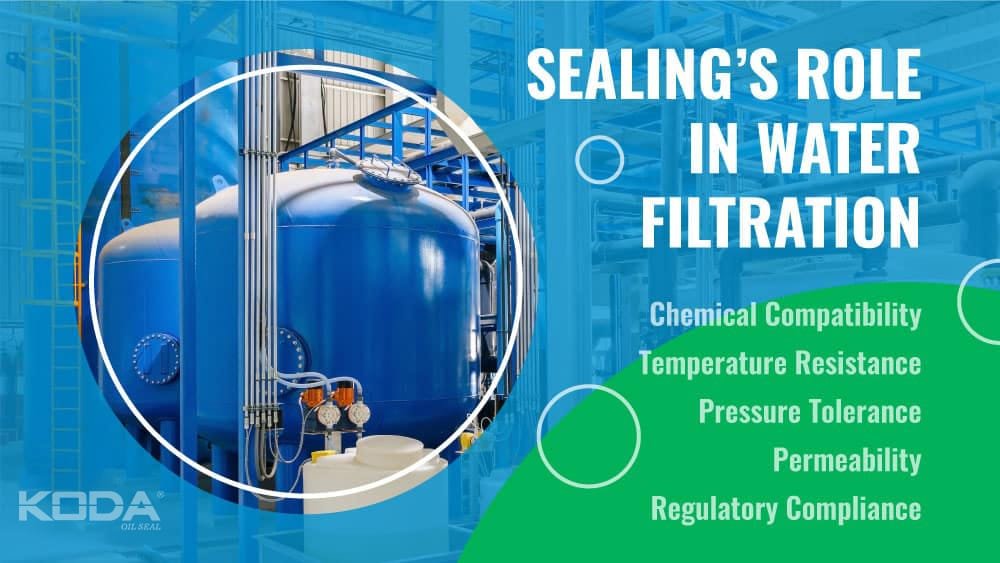
The Critical Sealing Role in Water Filtration Systems
Water filtration systems are designed to remove contaminants, improve water quality, and provide reliable fluid control across residential, commercial, and industrial applications. Although filtration media, membranes, pumps, and control systems receive most engineering attention, the performance of the entire system often depends on a smaller but equally important component: Sealing technology.
A filtration system without effective sealing cannot maintain pressure stability, prevent leakage, or protect filtered water from external contamination. Whether used in reverse osmosis equipment, industrial water treatment plants, cartridge filter housings, UV purification systems, or wastewater processing equipment, sealing components provide the essential barrier between fluids and the external environment.
Modern water filtration equipment faces increasingly complex challenges. Systems must withstand continuous pressure cycles, chemical exposure from disinfectants, temperature variations, mineral deposits, and long operating periods with minimal maintenance. Selecting the correct sealing material and design is therefore a critical engineering decision rather than a simple replacement task.
💧 Engineering Insight:
In water filtration applications, sealing performance directly affects system efficiency, hygiene protection, operating pressure, and maintenance frequency. A properly designed seal prevents leakage while maintaining long-term material stability.
Why Sealing Is Essential in Water Filtration Equipment
Water filtration equipment operates by controlling the movement of liquids through different pressure zones. Any unwanted leakage path can reduce filtration efficiency and introduce risks such as contamination, pressure loss, or equipment damage.
Common sealing locations in filtration systems include:
- ✔ Filter cartridge housings
- ✔ Reverse osmosis membrane vessels
- ✔ Pump connections
- ✔ Valve assemblies
- ✔ Pipe joints and fittings
- ✔ Water purification equipment
- ✔ Industrial filtration skids
- ✔ Chemical dosing systems
The primary purpose of sealing is not only to stop leakage. A well-designed seal maintains pressure balance, prevents external particles from entering the system, reduces energy loss, and protects sensitive filtration components.
How Sealing Works in Water Filtration Systems
Sealing components work by creating controlled contact pressure between two mating surfaces. When installed correctly, the elastomer or sealing material deforms slightly and fills microscopic surface irregularities, blocking fluid migration.
Basic Sealing Mechanism
| Factor | Function |
|---|---|
| Compression | Creates initial sealing force |
| Elastic Recovery | Maintains contact after pressure changes |
| Material Compatibility | Prevents chemical degradation |
| Surface Finish | Reduces leakage pathways |
| Temperature Resistance | Maintains mechanical properties |
Common Sealing Materials Used in Water Filtration
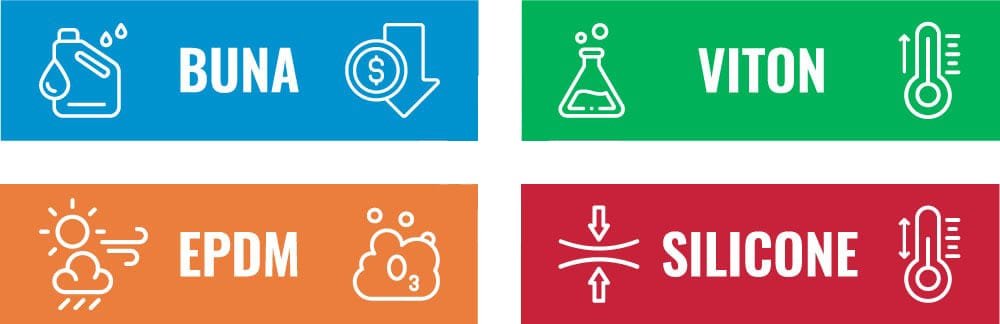
The selection of sealing materials depends on water chemistry, pressure conditions, temperature range, regulatory requirements, and equipment design. Different elastomers provide different resistance characteristics.
| Material | Temperature Range | Hardness Range | Main Advantages | Applications |
|---|---|---|---|---|
| EPDM | -50°C to +150°C | 60-90 Shore A | Excellent water and steam resistance | Drinking water systems, pumps |
| NBR | -40°C to +120°C | 60-90 Shore A | Good mechanical strength | Industrial water equipment |
| FKM | -20°C to +200°C | 70-90 Shore A | Chemical and temperature resistance | Chemical filtration systems |
| Silicone | -60°C to +230°C | 40-80 Shore A | Excellent flexibility and hygiene properties | Food and medical water systems |
| PTFE | -200°C to +260°C | Hard material | Outstanding chemical resistance | Aggressive chemical filtration |
Material Performance Factors Engineers Must Evaluate
Hardness Selection
Hardness is one of the most important parameters when selecting sealing materials. It is commonly measured using the Shore A scale for elastomers.
| Hardness | Performance Characteristics |
|---|---|
| 50-60 Shore A | Excellent flexibility and surface adaptation |
| 70 Shore A | General industrial sealing standard |
| 80-90 Shore A | Higher pressure and extrusion resistance |
Compression Set Resistance
Compression set describes the permanent deformation of a sealing material after being compressed for a specific period. Lower compression set values indicate better long-term sealing ability.
In water filtration systems, seals often remain compressed for months or years. Poor compression resistance may lead to reduced contact pressure and gradual leakage.
Water and Chemical Resistance Considerations
Although water appears harmless, filtration systems may expose seals to various chemicals, including chlorine, ozone, cleaning agents, acids, and alkaline solutions.
| Environment | Recommended Material |
|---|---|
| Drinking Water | EPDM / Silicone |
| Chlorinated Water | EPDM / FKM |
| High Temperature Water | EPDM / Silicone |
| Chemical Cleaning Process | FKM / PTFE |
| Industrial Wastewater | NBR / FKM / EPDM |
Pressure Management and Seal Design
Pressure is a major factor affecting sealing performance. Filtration equipment may operate from low-pressure household systems to high-pressure reverse osmosis systems exceeding several MPa.
| Pressure Condition | Main Sealing Challenge |
|---|---|
| Low Pressure | Maintaining contact and preventing contamination |
| Medium Pressure | Compression control and extrusion prevention |
| High Pressure | Material deformation and extrusion resistance |
For high-pressure filtration equipment, engineers may use backup rings, reinforced sealing designs, or higher hardness materials to prevent extrusion failure.
ASTM and ISO Standards Related to Sealing Materials
Professional sealing manufacturers commonly reference international standards to evaluate material quality, mechanical properties, and dimensional consistency.
| Standard | Purpose |
|---|---|
| ASTM D2000 | Rubber material classification |
| ASTM D2240 | Hardness testing |
| ASTM D395 | Compression set evaluation |
| ASTM D412 | Tensile strength measurement |
| ISO 3601 | O-ring dimensional requirements |
| ISO 9001 | Quality management systems |
Thermal Performance and Heat Transfer
Water filtration systems usually operate at moderate temperatures, but industrial applications may involve hot water, sterilization cycles, or chemical cleaning processes.
Most elastomer sealing materials have relatively low thermal conductivity, typically around 0.15-0.40 W/m·K. This means temperature resistance depends mainly on polymer stability rather than heat transfer capability.
Installation Guidelines for Reliable Sealing
Proper installation is essential for achieving long-term sealing performance. Many field failures are not caused by material defects but by installation errors.
- ✔ Clean sealing surfaces before assembly
- ✔ Remove sharp edges and machining debris
- ✔ Use compatible installation lubrication
- ✔ Avoid twisting elastomer seals
- ✔ Confirm correct compression level
- ✔ Inspect seals before installation
🔍 Expert Tip:
A perfectly selected sealing material can still fail if installation damage occurs. Cuts, twists, contamination, and excessive compression are among the most common causes of early leakage.
Typical Sealing Failure Modes in Water Filtration
| Failure Mode | Cause | Solution |
|---|---|---|
| Leakage | Incorrect material or installation | Review design and assembly process |
| Swelling | Chemical incompatibility | Select resistant material |
| Cracking | Aging or ozone exposure | Improve material selection |
| Compression Set | Long-term deformation | Choose low compression materials |
| Extrusion | High pressure gap | Improve groove design |
Case Example (Industry Engineering Experience)
Example Only – Not Actual Customer Data
An industrial water filtration system experienced repeated leakage around a filter housing connection. Engineers reviewed several possible causes, including seal material compatibility, installation compression, and surface condition. After evaluating operating temperature, chemical exposure, and pressure conditions, a more suitable elastomer selection and improved installation method were considered. This example represents common engineering problem-solving practices and does not represent a verified customer case or guaranteed performance result.
Laboratory Test Example
Illustrative Laboratory Evaluation
A sealing material evaluation may include hardness testing, tensile testing, compression set measurement, water immersion testing, chemical resistance testing, and thermal aging analysis. ASTM test methods such as ASTM D2240, ASTM D395, and ASTM D412 are commonly referenced. Actual results depend on material formulation, test conditions, and equipment design.
How to Select the Right Sealing Solution
Engineers should consider the following factors before selecting a sealing component:
- ✔ Water chemistry
- ✔ Operating temperature
- ✔ Pressure range
- ✔ Required service life
- ✔ Regulatory requirements
- ✔ Maintenance conditions
- ✔ Installation environment
Professional Sealing solutions help filtration equipment achieve better reliability, reduced maintenance costs, and improved system efficiency.
Frequently Asked Questions
1: Why is sealing important in water filtration systems?
Sealing prevents leakage, maintains pressure stability, protects filtered water quality, and ensures reliable operation of filtration equipment.
2: Which sealing material is best for water applications?
EPDM is commonly preferred for water systems because of its excellent water and ozone resistance, while FKM and PTFE are used for more aggressive environments.
3: What causes sealing failure in filtration equipment?
Common causes include incorrect material selection, improper installation, chemical attack, excessive pressure, and compression set.
4: How can sealing life be improved?
Seal life can be improved through correct material selection, proper groove design, clean installation, and regular maintenance inspection.
5: Are all sealing materials suitable for drinking water systems?
No. Drinking water applications often require specially selected materials that meet relevant safety and regulatory requirements.