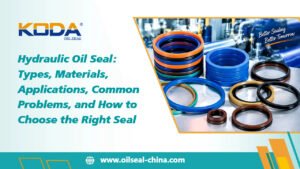
Hydraulic oil seals are critical components in fluid power systems. They help control hydraulic fluid leakage, maintain the pressure conditions required for machine operation, and prevent external contaminants from entering moving assemblies. From excavators and agricultural machinery to hydraulic presses, industrial equipment, pumps, and mobile power units, the performance of a sealing system directly affects equipment reliability, maintenance intervals, and operating costs.
However, selecting a hydraulic oil seal is not simply a matter of matching its dimensions. Seal profile, elastomer or polymer compound, pressure, temperature, movement speed, surface finish, extrusion clearance, and installation conditions must all be considered together. A seal that performs well in one hydraulic cylinder may fail prematurely in another application if the operating conditions are different.
This guide explains the main types of hydraulic seals, material characteristics, common failure mechanisms, and a practical selection process. It is intended to help equipment manufacturers, maintenance engineers, hydraulic repair specialists, distributors, and international B2B buyers specify sealing products with greater confidence.
What Is a Hydraulic Oil Seal?
A hydraulic oil seal is a sealing element designed to control the movement of hydraulic fluid between components in a hydraulic system. Depending on its position and construction, it may prevent fluid from escaping along a moving piston rod, stop internal leakage across a piston, exclude dust from a cylinder, or retain lubricant around a rotating shaft.
Hydraulic sealing systems commonly combine several components rather than relying on one seal to perform every function. A typical hydraulic cylinder may contain rod seals, piston seals, wiper seals, guide rings, and static O-rings. Each component addresses a different leakage, contamination, friction, or guidance requirement.
Engineering principle: A reliable hydraulic sealing system depends on the compatibility of the seal, housing, mating surface, fluid, and operating conditions. Replacing a leaking seal without checking these factors may only provide a temporary repair.
How Hydraulic Seals Work
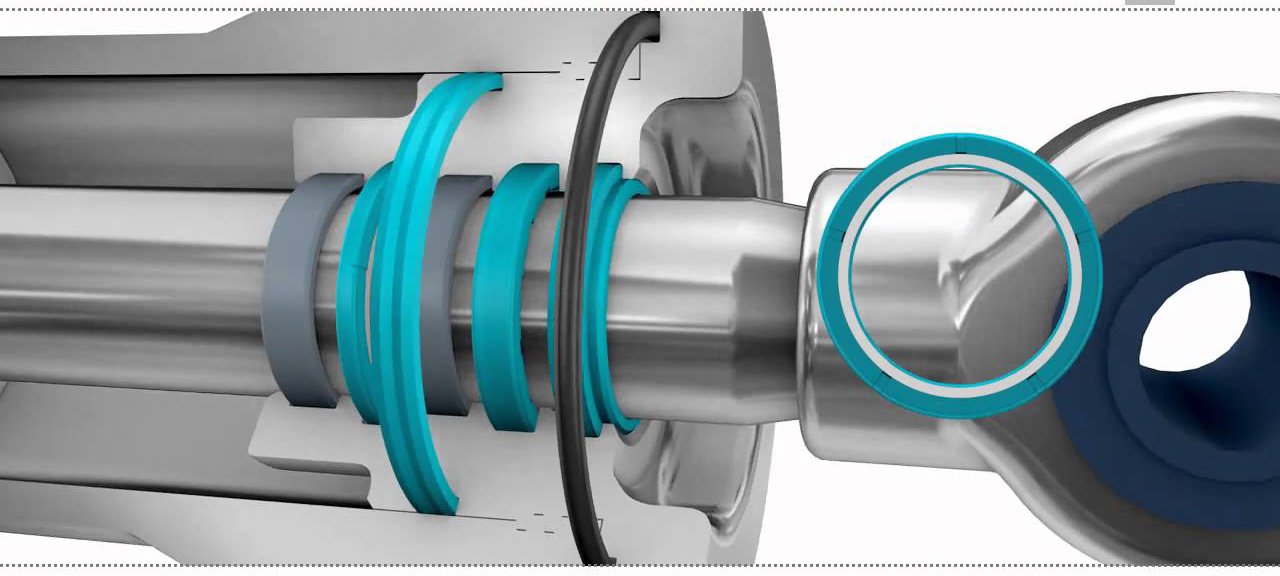
Hydraulic seals create a controlled contact interface between stationary and moving components. In a reciprocating cylinder, the sealing lip or profile maintains contact with the rod or cylinder bore as the piston moves. Hydraulic pressure can help energize certain seal designs, increasing contact at the sealing interface as pressure rises.
The sealing mechanism must balance leakage control and friction. Excessive contact force can generate heat and accelerate wear, while insufficient contact may allow fluid to pass through the sealing interface. The correct balance depends on the seal geometry, material properties, pressure, speed, lubrication, and surface condition.
The Four Main Elements of a Hydraulic Cylinder Sealing System
Rod seal
Controls external leakage where the piston rod passes through the cylinder head or gland.
Piston seal
Limits fluid bypass between the piston and cylinder bore to support the required pressure difference.
Wiper seal
Removes dust, mud, moisture, and other contaminants from the exposed rod during retraction.
Guide or wear ring
Supports moving components and helps prevent metal-to-metal contact caused by side loading.
These components should be designed as a coordinated system. For example, a rod seal may not achieve its intended service life if the guide elements are worn and the piston rod is moving off-center. Trelleborg provides an overview of these functions in its Hydraulic Seals Basics learning resource.
Common Types of Hydraulic Oil Seals
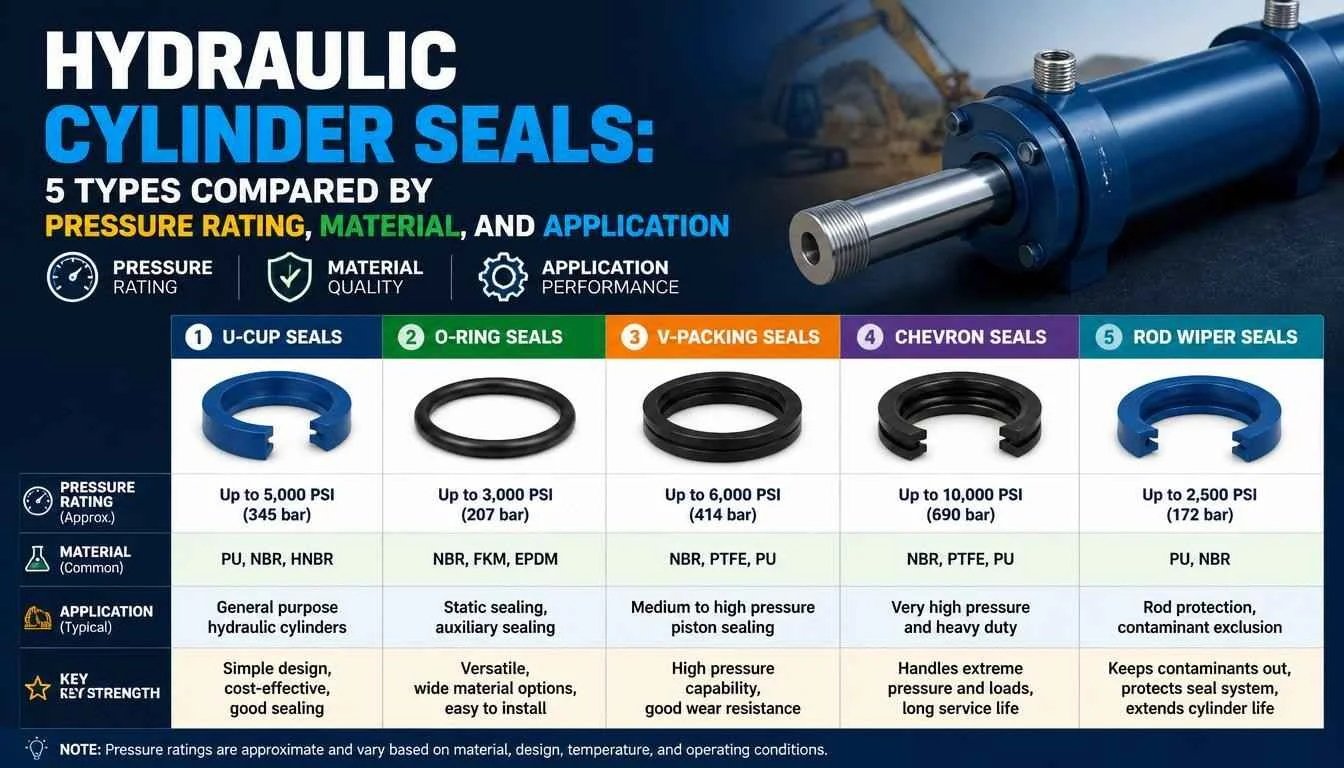
Different seal profiles are designed for different movement patterns, pressure directions, and installation locations. Identifying the correct seal type is the first step in preventing incorrect replacement and repeated leakage.
Hydraulic Rod Seals
Rod seals are installed in the cylinder gland or head and prevent hydraulic fluid from escaping along the reciprocating piston rod. They are exposed to pressure, friction, rod movement, and potential external contamination.
Single-acting rod seals are designed to seal pressure primarily from one direction. Other arrangements use multiple sealing elements to separate primary pressure retention from secondary leakage control. The correct configuration depends on the cylinder design and the required operating performance.
Hydraulic Piston Seals
Piston seals are fitted around the piston and prevent hydraulic fluid from bypassing it inside the cylinder barrel. They help maintain the pressure difference needed to extend or retract the cylinder under load.
Single-acting and double-acting cylinders may require different piston seal arrangements. A double-acting application generally needs a sealing design capable of handling pressure from both directions. Depending on the design, compact elastomer seals, polyurethane profiles, or PTFE-based assemblies may be used.
U-Cup Seals
U-cup seals have a cross-section shaped like the letter U. They are widely used in reciprocating hydraulic applications because their geometry can respond to system pressure and create sealing contact at the dynamic surface.
U-cup seals are available in different materials and profile designs. Selection should consider pressure direction, operating speed, groove dimensions, temperature, and the manufacturer’s recommended application limits.
Hydraulic Wiper and Scraper Seals
Wiper seals are fitted at the external end of a hydraulic cylinder to remove contaminants from the piston rod. They are especially important in construction, mining, agricultural, and outdoor equipment where rods are exposed to dust, sand, mud, and moisture.
A wiper is not a substitute for a rod seal. Its primary function is contamination exclusion, while the rod seal controls fluid leakage. Incorrect wiper selection can allow contaminants to enter the cylinder or create excessive friction against the rod.
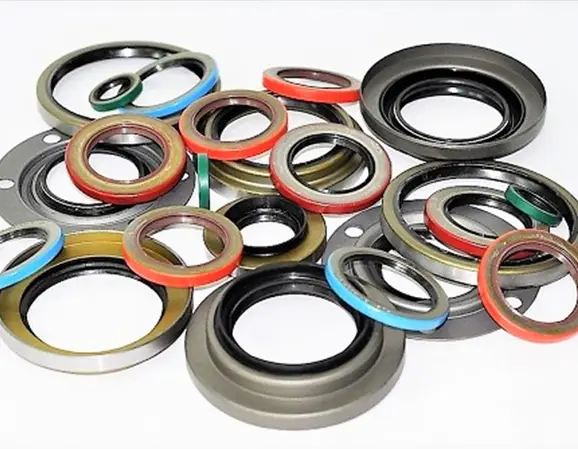
Rotary Shaft Oil Seals
Rotary shaft oil seals are used around rotating shafts in hydraulic pumps, motors, gearboxes, and related equipment. They are designed for rotational movement rather than the reciprocating motion found in cylinder rod and piston seals.
Important selection factors include shaft speed, pressure exposure, shaft hardness, surface finish, temperature, fluid compatibility, and lip design. A conventional rotary shaft seal should not automatically be substituted for a hydraulic rod or piston seal.
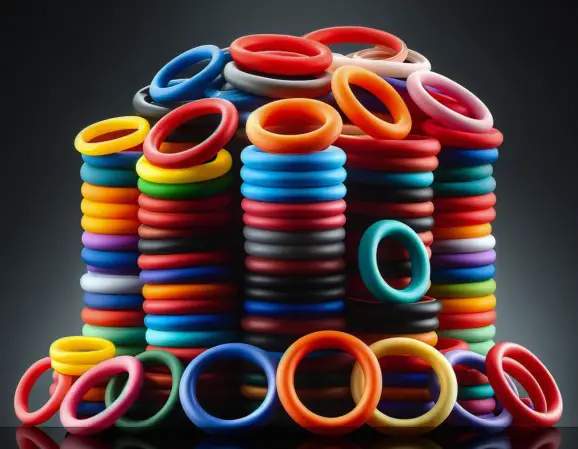
O-Rings and Backup Rings
O-rings are commonly used for static sealing and in selected dynamic applications. They are installed in a groove and compressed to create sealing contact. Under higher pressure or where extrusion clearance is significant, a suitable backup ring may be required to support the O-ring and reduce the risk of material being forced into the clearance gap.
For detailed design and compound compatibility information, consult the Parker O-Ring Handbook.
Hydraulic Seal Materials and Their Characteristics
Material selection affects chemical compatibility, friction, wear resistance, elasticity, compression set, and temperature capability. No material is suitable for every hydraulic application. The correct compound must be evaluated against the actual fluid formulation and operating conditions.
| Material | Typical Advantages | Selection Considerations |
|---|---|---|
| NBR | Good resistance to many petroleum-based oils; widely used and economical. | Check temperature limits, fluid additives, ozone exposure, and low-temperature flexibility. |
| HNBR | Improved heat, mechanical, and abrasion performance compared with many standard NBR compounds. | Verify compatibility with the actual fluid and the specific compound formulation. |
| FKM | Useful for many higher-temperature and chemically demanding applications. | Not universally compatible with all hydraulic fluids, particularly certain specialty fluids. |
| PU / TPU | High abrasion resistance, good mechanical strength, and suitability for many reciprocating seals. | Check hydrolysis resistance, temperature, fluid chemistry, and compression conditions. |
| EPDM | Good resistance to water, steam, and certain water-based fluids. | Generally unsuitable for petroleum-based mineral oils and many hydrocarbon fluids. |
| PTFE | Low friction and broad chemical resistance; used in specialized seal assemblies. | Requires suitable design support and installation; may be combined with an energizing element. |
NBR: A Common Choice for General Hydraulic Oils
Nitrile rubber is frequently used in hydraulic sealing because many NBR compounds offer good compatibility with petroleum-based hydraulic oils. It is available in different acrylonitrile contents and hardness grades, each with different low-temperature flexibility, oil resistance, and mechanical properties.
Do not assume that every NBR compound has the same performance. Hydraulic fluid additives, operating temperature, pressure cycling, and the required service life should be checked against the supplier’s compound data.
Polyurethane: For Wear-Intensive Reciprocating Applications
Polyurethane is commonly selected for hydraulic rod and piston seals where abrasion resistance and mechanical strength are important. It can be suitable for heavy-duty cylinders, but its performance depends on formulation, hardness, fluid compatibility, temperature, and resistance to hydrolysis.
FKM and PTFE: For More Specialized Conditions
FKM may be considered when higher temperature or specific chemical exposure makes standard elastomers unsuitable. PTFE-based sealing elements are often used where low friction, chemical resistance, or particular operating requirements are important. Both materials require application-specific evaluation rather than selection based on a general material label.
Material selection warning: Always verify compatibility with the exact hydraulic fluid, including its additives and water content where relevant. A general material chart is a screening tool, not a substitute for compound-specific compatibility data or application testing.
For additional reference, KODA’s O-Ring Handbook includes compound compatibility information, while KODA’s Guide to Seal Materials provides an additional overview of common oil seal compounds.
Where Hydraulic Oil Seals Are Used
Hydraulic seals are used wherever pressurized fluid produces controlled movement or force. Different industries expose seals to different combinations of load, contamination, speed, temperature, and operating cycles.
Construction and Earthmoving Equipment
Excavators, bulldozers, loaders, cranes, and compact construction machines use hydraulic cylinders for lifting, digging, steering, and positioning. Their seals must cope with heavy loads, impact, vibration, dirt, and changing ambient temperatures. Wipers and guide elements are particularly important because contamination and side loading can contribute to premature failure.
Agricultural Machinery
Tractors, harvesters, sprayers, and agricultural attachments use hydraulic systems for steering, lifting, and implement control. Dust, moisture, seasonal temperature changes, and long periods of storage can affect seal performance. Material selection and correct storage of replacement seals are important for maintenance planning.
Industrial Hydraulic Systems
Hydraulic presses, injection molding machines, machine tools, and automated production equipment depend on stable pressure and repeatable movement. Internal leakage across piston seals can reduce force or cause drift, while external leakage around rod seals can create housekeeping and safety concerns.
Hydraulic Pumps and Motors
Pumps and motors may use rotary shaft seals, O-rings, backup rings, and other specialized sealing components. Their requirements differ from those of reciprocating cylinders. Shaft speed, pressure at the seal location, shaft finish, runout, and fluid temperature should be evaluated before selecting a replacement.
Common Hydraulic Seal Problems and How to Diagnose Them
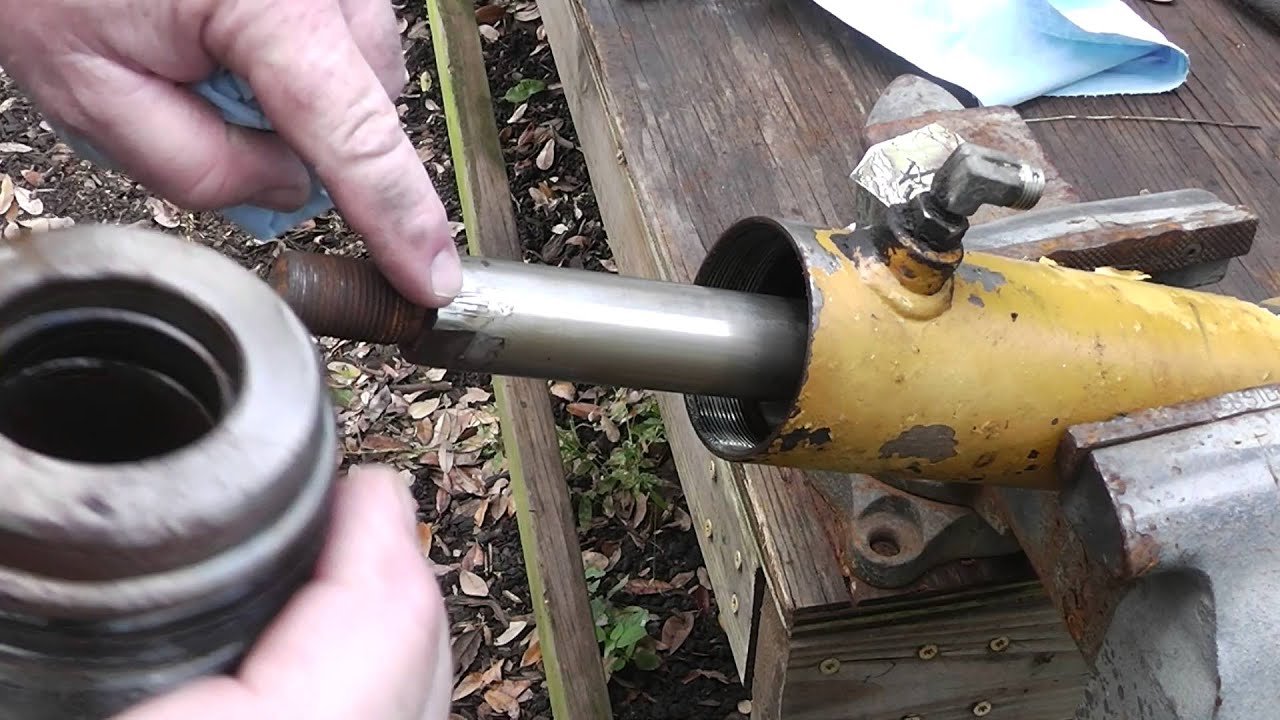
A hydraulic leak is a symptom, not a complete diagnosis. Replacing the seal without identifying the failure mechanism can lead to repeated downtime and unnecessary parts costs. The damaged seal should be inspected together with the rod, bore, gland, piston, guide elements, and hydraulic fluid.
External Oil Leakage
Oil appearing around the piston rod may indicate a worn or damaged rod seal, incorrect seal dimensions, a scratched rod surface, installation damage, or excessive system pressure. Before replacement, clean the area and confirm the actual source of the leak. Fluid running down from a hose connection or another component can be mistaken for rod seal failure.
Practical check: Inspect the rod for longitudinal scratches, corrosion, dents, and uneven wear. Also check whether the rod has excessive movement or misalignment inside the gland.
Internal Leakage and Cylinder Drift
A cylinder that cannot hold its position under load may have internal leakage across the piston seal. However, cylinder drift can also result from control valve leakage, hydraulic circuit design, or other component faults. Use the equipment manufacturer’s diagnostic procedure to isolate the source before dismantling the cylinder.
Extrusion and Nibbling
Extrusion occurs when seal material is forced into the clearance gap between mating components under pressure. The damaged edge may appear torn, chipped, or irregular. Excessive clearance, high pressure, pressure spikes, elevated temperature, and unsuitable seal hardness can increase the risk.
Possible corrective actions include checking the actual extrusion gap, verifying pressure peaks, selecting a suitable seal profile or material, and using a backup ring where the design requires one. Reducing clearance must follow the component manufacturer’s dimensional and tolerance requirements.
Abrasion and Excessive Wear
Worn sealing lips, polished contact areas, or uneven wear patterns may indicate excessive friction, contamination, poor lubrication, rod misalignment, or an unsuitable surface finish. If a new seal wears rapidly in the same location, inspect the hardware and operating conditions rather than repeatedly changing the seal material.
Hardening, Swelling, or Cracking
A seal that becomes hard or brittle may have experienced excessive heat, aging, or chemical incompatibility. Swelling or softening can indicate exposure to an unsuitable fluid or additive package. Compare the failed material with the actual hydraulic fluid specification and review the operating temperature history.
Installation Damage
Cuts, twisted profiles, pinched edges, and deformed sealing lips may be caused by sharp groove edges, threads, ports, incorrect tools, or excessive stretching during assembly. Installation damage can cause leakage immediately after startup or shorten the service life of a new seal.
| Observed condition | Potential cause | Recommended inspection |
|---|---|---|
| Torn or chipped seal edge | Extrusion, pressure spikes, excessive clearance | Measure clearance and review peak pressure. |
| Deep scratches or cuts | Contamination, damaged rod, sharp edges | Inspect rod, bore, grooves, and fluid cleanliness. |
| Hard or cracked elastomer | Heat, aging, chemical incompatibility | Review fluid type and temperature history. |
| Swollen or softened seal | Incompatible fluid or additives | Verify compound compatibility with the fluid supplier. |
| Uneven wear around circumference | Misalignment, side load, worn guide elements | Check rod alignment, bearing support, and cylinder condition. |
For further troubleshooting guidance, see the technical information from Parker on extrusion and nibbling, and Hallite’s surface roughness guidance.
How to Choose the Right Hydraulic Oil Seal
A reliable selection process starts with the application rather than the product catalogue. Before requesting a quotation or ordering replacement seals, collect the following technical information.
Step 1: Identify the Seal Location and Function
Determine whether the component is a rod seal, piston seal, wiper, rotary shaft seal, O-ring, or another sealing element. Record whether it is used in a cylinder, pump, motor, valve, or other hydraulic assembly. A photograph or assembly drawing can help prevent confusion between similar-looking profiles.
Step 2: Confirm the Operating Pressure
Record normal working pressure, maximum rated pressure, and any pressure spikes or cyclic fluctuations. Do not use only the average operating pressure when evaluating seal suitability. Pressure, temperature, material hardness, and extrusion clearance work together to determine the risk of seal deformation.
Step 3: Specify the Hydraulic Fluid and Temperature
Identify the fluid type and, where available, its specification or product name. Mineral oil, water-glycol fluids, phosphate ester fluids, biodegradable hydraulic fluids, and other specialty media can have different compatibility requirements. Record both the normal operating temperature and the expected minimum and maximum temperatures.
Step 4: Measure the Seal and Housing
For an existing seal, record the part number and measure the relevant dimensions. Depending on the seal type, these may include inside diameter, outside diameter, cross-section, groove diameter, groove width, and installation depth. For hydraulic cylinder applications, rod diameter, bore diameter, piston dimensions, and gland dimensions may also be required.
Nominal seal dimensions alone are not enough. Groove tolerances, radial clearance, installation stretch, and housing geometry can affect the final fit. Use the equipment drawing or the seal manufacturer’s installation dimensions wherever possible.
Step 5: Check Movement, Speed, and Duty Cycle
Specify whether the seal operates under reciprocating, rotary, or oscillating motion. For reciprocating systems, provide stroke length, cycle frequency, and approximate rod speed. For rotary seals, provide shaft speed and direction of rotation. Continuous operation and intermittent duty may create different thermal and wear conditions.
Step 6: Evaluate Hardware and Extrusion Clearance
Inspect the rod or bore for scratches, corrosion, wear, and out-of-round conditions. Check the surface finish and the support provided by guide rings or bearings. Under pressure, excessive clearance can allow a seal to extrude, so the maximum permissible gap must be checked against the selected seal design and operating pressure.
Step 7: Confirm Installation and Service Requirements
Consider whether the seal will be installed in an open or closed groove, whether assembly tools are available, and whether the equipment can be dismantled easily for maintenance. For OEM projects, also define expected service life, inspection requirements, packaging, traceability, and replacement-part availability.
Hydraulic Seal RFQ Checklist
To help a manufacturer identify a suitable sealing solution, include as much of the following information as possible:
- Seal type, profile, and installation position
- Part number, drawing, sample, or complete dimensions
- Hydraulic fluid specification
- Normal and maximum pressure
- Minimum, normal, and maximum temperature
- Movement type, speed, stroke, or shaft RPM
- Rod, bore, groove, and clearance information
- Required quantity, inspection needs, and packaging details
Hydraulic Seal Installation and Maintenance Best Practices
Correct installation is essential to achieving the intended performance of a hydraulic seal. Even a correctly specified product can fail if it is twisted, cut, contaminated, or installed over a sharp edge.
Before Installation
- Clean the groove, cylinder bore, rod, and surrounding components. Remove metal particles, dirt, and old seal fragments.
- Inspect the rod and bore for scratches, burrs, corrosion, and abnormal wear.
- Confirm the replacement seal’s part number, dimensions, material, and orientation.
- Remove sharp edges and protect threads, ports, and other features that the seal must pass over during assembly.
- Use clean hydraulic fluid or a lubricant approved for the seal material and application.
During Installation
- Use suitable installation sleeves, cones, or tools where required by the seal design.
- Avoid sharp metal tools that can cut or score the sealing surface.
- Do not twist the seal or stretch it beyond the manufacturer’s permitted installation method.
- Check the sealing lip direction and the arrangement of energizers or backup rings.
- Follow the manufacturer’s instructions for closed-groove installation and calibration.
After Installation
- Flush the hydraulic system when required to remove contamination introduced during maintenance.
- Restore the specified hydraulic fluid level and follow the equipment manufacturer’s commissioning procedure.
- Check for leakage during controlled startup and operation.
- Monitor abnormal temperature, noise, pressure loss, or cylinder movement.
- Record the seal specification and any failure observations for future maintenance.
Trelleborg’s Hydraulic Seals technical catalogue provides detailed installation recommendations, including the use of lead-in chamfers, clean assembly surfaces, compatible lubrication, and appropriate installation tools. Hallite also provides practical guidance in its Use and Fitting of Seals resource.
How to Reduce Premature Hydraulic Seal Failure
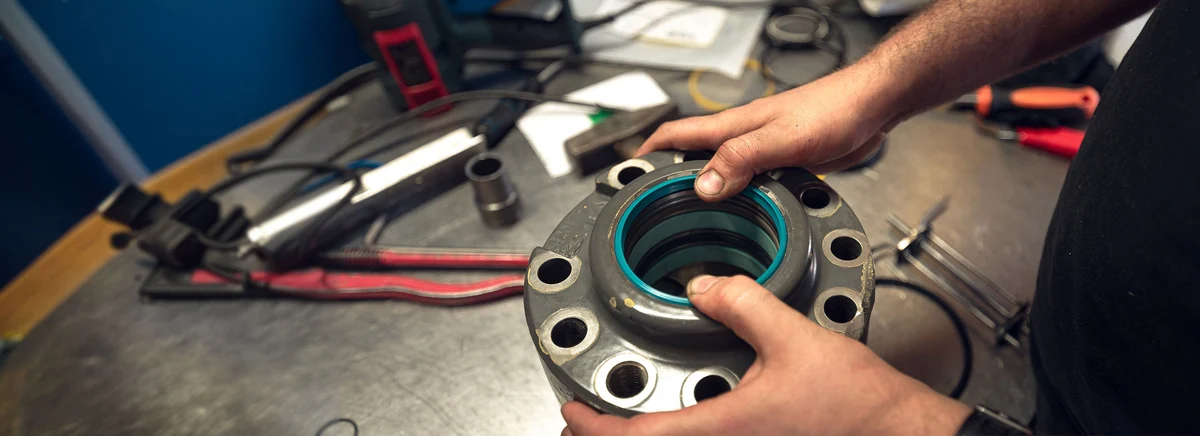
Repeated seal replacement is often a sign that the root cause has not been corrected. A preventive maintenance strategy should examine the complete hydraulic assembly and its operating environment.
- Maintain fluid cleanliness: Use the filtration level specified for the hydraulic system and investigate abnormal particle contamination.
- Control operating temperature: Investigate overheating, restricted cooling, excessive friction, and unsuitable duty cycles.
- Protect rod surfaces: Repair or replace damaged rods when scratches, corrosion, or plating defects compromise the sealing surface.
- Check guide elements: Worn bearings and guide rings can allow side loading and uneven seal contact.
- Verify system pressure: Check relief valve settings and investigate pressure spikes or abnormal operating conditions.
- Use application-approved materials: Confirm fluid compatibility and operating limits before changing seal compounds.
- Store replacement seals correctly: Keep seals clean, protected from direct sunlight, excessive heat, ozone sources, and mechanical deformation. Follow the supplier’s storage recommendations.
For dynamic hydraulic seals, surface finish is particularly important. A surface that is too rough may damage the sealing lip, while a surface that is excessively smooth may not maintain the intended lubrication conditions. Review the seal manufacturer’s recommended surface parameters for the specific material and profile. Hallite explains these considerations in its technical guide to surface roughness.
What B2B Buyers Should Evaluate When Choosing a Hydraulic Seal Manufacturer
For OEM manufacturers, distributors, hydraulic repair companies, and industrial wholesalers, supplier selection involves more than comparing unit prices. Product consistency, technical communication, inspection capability, and the ability to support repeat orders are also important.
Technical Product Support
A capable supplier should be able to review drawings, samples, part numbers, dimensions, and application details. Technical discussions should address seal profile, compound selection, operating conditions, and installation requirements instead of recommending a product based only on its outside dimensions.
Material and Dimensional Consistency
Ask how the supplier controls material identification, critical dimensions, visual quality, and batch consistency. Where relevant, request compound data, dimensional inspection records, and product specifications. Any performance or compliance claim should be supported by documentation appropriate to the product and application.
OEM and Custom Manufacturing
For non-standard applications, confirm whether the manufacturer can evaluate custom dimensions, profiles, materials, and packaging requirements. Drawings and physical samples can help establish the correct specification and reduce the risk of ordering an unsuitable replacement.
Quality Inspection and Traceability
Discuss the inspection methods used for the product, including dimensional checks, visual inspection, and application-specific testing where required. For recurring OEM or distributor orders, consistent product identification and batch traceability can simplify incoming inspection and after-sales support.
Export Packaging and Supply Communication
International buyers should also evaluate packaging protection, labelling, order communication, lead-time management, and documentation. Clear product descriptions and identification reduce confusion when handling multiple seal profiles, sizes, and materials.
Hydraulic Oil Seal Manufacturing and Customization Support from KODA
KODA supplies oil seals and related sealing products for automotive and industrial applications. Its manufacturing capabilities include metal case production and oil seal manufacturing, supporting customers with different product specifications and sourcing requirements.
For buyers evaluating hydraulic oil seals or related sealing components, the most effective starting point is to provide the application details together with a drawing, sample, part number, or dimensional list. This information helps clarify the required sealing structure and identify the specifications that need to be confirmed before production or quotation.
Depending on project requirements and product feasibility, discussions may cover dimensions, material options, product identification, packaging, and OEM requirements. For distributors and wholesalers, clear specifications can also help simplify repeat purchasing and inventory management.
Request a Hydraulic Seal Evaluation
Are you sourcing hydraulic oil seals for equipment manufacturing, maintenance, or distribution? Send KODA your product drawing, sample, part number, or size list. Include the hydraulic fluid, operating pressure, temperature, and movement type whenever available. This information will help the team review your requirements and discuss suitable sealing product options.
Frequently Asked Questions About Hydraulic Oil Seals
1. What is the difference between a hydraulic rod seal and a piston seal?
A rod seal prevents hydraulic fluid from leaking out along the moving piston rod, while a piston seal prevents fluid from bypassing the piston inside the cylinder. They operate at different locations and have different design requirements. They should not be interchanged unless the equipment and seal design specifically allow it.
2. Which material is best for hydraulic oil seals?
There is no single best material for all hydraulic systems. NBR is commonly used with many petroleum-based hydraulic oils, polyurethane is often selected for abrasion resistance in reciprocating applications, FKM may suit certain higher-temperature or chemical environments, and PTFE is used in specialized low-friction sealing designs. The final selection must consider the exact fluid, temperature, pressure, motion, and seal profile.
3. Why does a new hydraulic seal leak shortly after installation?
Possible causes include incorrect dimensions, wrong seal orientation, installation cuts, twisted profiles, contaminated grooves, damaged rod or bore surfaces, excessive extrusion clearance, or unsuitable material. If leakage occurs soon after replacement, inspect the installation and hardware before assuming the new seal itself is defective.
4. Can an O-ring replace a hydraulic rod or piston seal?
Not automatically. O-rings are suitable for many static sealing applications and selected dynamic designs, but a standard O-ring may not provide the friction, wear, extrusion resistance, or motion performance required by a particular rod or piston application. Follow the original equipment design or consult a sealing specialist before changing the seal type.
5. What information is needed to order the correct hydraulic oil seal?
Provide the seal type, part number or drawing, dimensions, hydraulic fluid, operating pressure, temperature range, movement type, speed, and installation details. For cylinder seals, rod diameter, bore diameter, groove dimensions, and extrusion clearance are particularly useful. A physical sample can also help confirm the original profile and dimensions.
6. What causes hydraulic seals to extrude?
Seal extrusion is commonly associated with excessive clearance, high pressure, pressure spikes, unsuitable material hardness, or elevated temperature. The seal may become damaged along its low-pressure edge. Check the actual clearance and operating pressure against the selected seal manufacturer’s design limits. A suitable backup ring or alternative seal profile may be required.
7. How can hydraulic seal service life be improved?
Use a seal material compatible with the hydraulic fluid, maintain fluid cleanliness, keep rod and bore surfaces within specification, prevent excessive side loading, control pressure and temperature, and follow the manufacturer’s installation instructions. Investigating the cause of previous seal failure is essential when planning a replacement.
Hydraulic oil seal performance is determined by the interaction of seal design, material, fluid compatibility, pressure, temperature, movement, hardware condition, and installation quality. By evaluating these factors before purchasing or replacing a seal, engineers and B2B buyers can reduce repeated failures, improve maintenance decisions, and specify products that better match their equipment requirements.