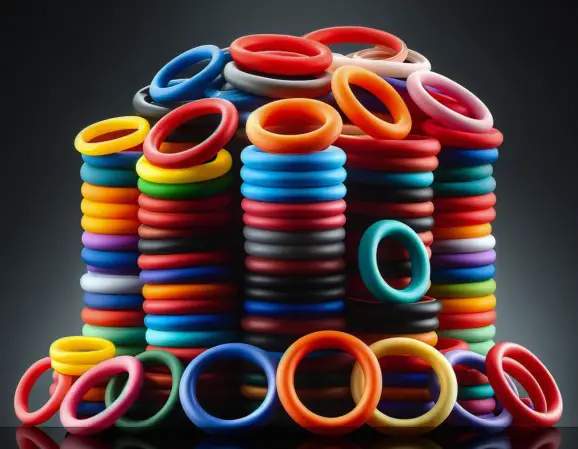
Yellow O-ring kits are commonly used as organized collections of elastomer sealing rings for equipment maintenance, hydraulic repairs, industrial servicing, and spare-parts inventory management. They allow technicians to identify, select, and replace sealing rings of different dimensions without ordering every size separately.
However, the yellow color alone does not identify the O-ring material, chemical resistance, temperature capability, or pressure rating. Yellow O-rings may be manufactured from different elastomers or colored compounds, depending on the supplier and application. Before selecting a kit, engineers and purchasing teams should verify the material specification, dimensions, hardness, and compatibility with the working fluid.
For global B2B buyers, distributors, and maintenance professionals, the real value of a yellow O-ring assortment lies in combining convenient size organization with traceable material identification. A properly specified kit can reduce maintenance delays, simplify stock control, and help prevent the use of unsuitable seals in critical equipment.
What Is a Yellow O-Ring Kit?
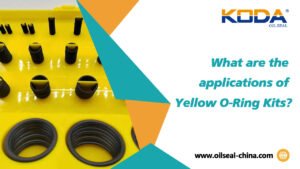
A yellow O-ring kit is an assortment of circular elastomer seals supplied in multiple sizes, usually arranged in a labeled storage case. Depending on the product, a kit may contain standard metric O-rings, inch-series O-rings, selected material grades, or seals intended for particular equipment types.
Each O-ring creates a seal by deforming within a suitably designed gland or between compatible mating surfaces. The resulting contact pressure restricts the movement of liquid or gas through the sealing interface.
Yellow may be used to improve visual identification, distinguish a product range, or satisfy a manufacturer’s color-coding convention. It is not a universal material designation, and there is no general rule that every yellow O-ring is made from FKM or has a higher temperature rating than a black O-ring.
What Should a Properly Specified Kit Include?
- Identifiable dimensions: Inside diameter and cross-sectional diameter, with an appropriate size reference.
- Material information: The elastomer designation and, where necessary, the specific compound or grade.
- Hardness specification: Shore A hardness where relevant to the application.
- Organized storage: Compartments and labeling that help prevent mixing sizes and materials.
- Traceability: Supplier part numbers, batch identification, and applicable inspection documents for controlled applications.
- Application guidance: Compatibility information and operating limitations where provided by the manufacturer.
Procurement note: Do not purchase a yellow O-ring kit solely because its color resembles an existing seal. Confirm the original part specification or identify the required dimensions, elastomer, hardness, and operating conditions before approving a replacement.
Main Applications of Yellow O-Ring Kits
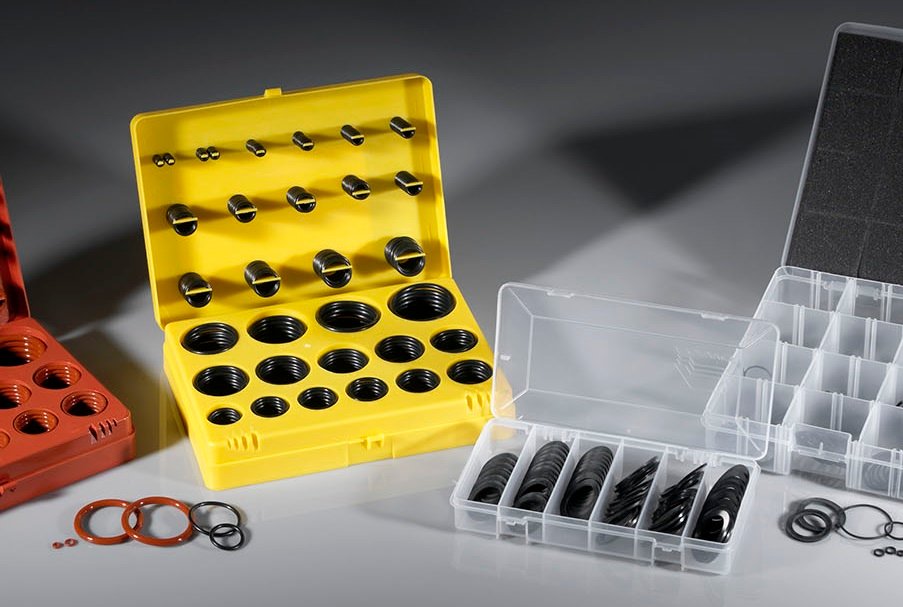
The applications of an O-ring kit depend on the seals included in the assortment. A kit containing oil-compatible NBR rings may suit different equipment from one containing FKM, EPDM, or silicone rings. The following applications are appropriate when the supplied material and dimensions match the equipment manufacturer’s requirements.
1. Hydraulic Systems and Industrial Machinery
Hydraulic equipment uses O-rings to seal compatible static joints, valve housings, cylinder components, manifolds, adaptors, and other connections. A well-organized O-ring assortment can help maintenance teams replace worn seals during scheduled servicing or troubleshooting.
For hydraulic applications, check the hydraulic fluid formulation, operating temperature, system pressure, gland dimensions, and risk of extrusion. NBR is widely used with many mineral-oil hydraulic fluids, while HNBR or FKM may be suitable for selected applications requiring different thermal, chemical, or mechanical properties.
Not every assortment is suitable for every hydraulic system. High-pressure or safety-critical equipment may require application-specific seals rather than general-purpose kits.
2. Automotive and Vehicle Maintenance
O-ring assortments can support maintenance of compatible automotive fluid connections, pumps, air-conditioning components, fuel-related assemblies, and other serviceable equipment. The correct material varies with the fluid and component design.
For example, a seal intended for engine oil is not automatically suitable for refrigerant service, gasoline, diesel fuel, or brake fluid. Air-conditioning systems may require refrigerant- and lubricant-compatible materials, while brake systems generally require seals specifically approved for the brake fluid and assembly.
Practical recommendation: For vehicle repairs, identify the original seal by part number or the equipment manufacturer’s service documentation. Do not substitute a generic O-ring based only on approximate dimensions.
3. Agricultural and Construction Equipment
Excavators, loaders, tractors, and agricultural machinery rely on hydraulic circuits, pumps, valves, and cylinders that may use O-rings in numerous sizes. An assortment can reduce delays when the correct replacement seal is included and its material is suitable for the system.
Mobile equipment often experiences vibration, pressure cycling, dirt, temperature variation, and long service intervals. When selecting replacement seals, verify the original dimensions, elastomer compatibility, hardness, and the condition of the gland and mating surfaces.
4. Manufacturing Equipment and Pneumatic Systems
Industrial production equipment may use O-rings in pneumatic valves, connectors, regulators, fixtures, and static housings. A maintenance kit can help technicians restore compatible connections without waiting for individual seals to be sourced.
For pneumatic applications, assess the gas or air quality, lubricant exposure, operating temperature, pressure, and decompression conditions. If oxygen, medical gases, or other specialized media are involved, use only components qualified for the specific service.
5. Pumps, Valves, and Fluid-Handling Equipment
O-rings are used in many pump housings, valve assemblies, inspection covers, and fluid-handling components. The appropriate material depends on the liquid or gas, cleaning chemicals, temperature, and sealing geometry.
For chemical-processing equipment, review the exact chemical composition and concentration instead of relying on broad labels such as “chemical resistant.” A compound that performs well in one solvent may swell, harden, or lose strength in another.
6. Maintenance Workshops and Spare-Parts Inventory
For industrial distributors and maintenance departments, an O-ring kit is primarily an inventory-management tool. It consolidates frequently used dimensions into one case, allowing staff to identify available sizes quickly and reduce repeated purchases of low-volume items.
For multi-material inventories, store different compounds and applications in clearly separated, labeled compartments. Keep technical specifications with the kit and replenish used sizes before critical maintenance work is scheduled.
How to Choose the Right Yellow O-Ring Kit
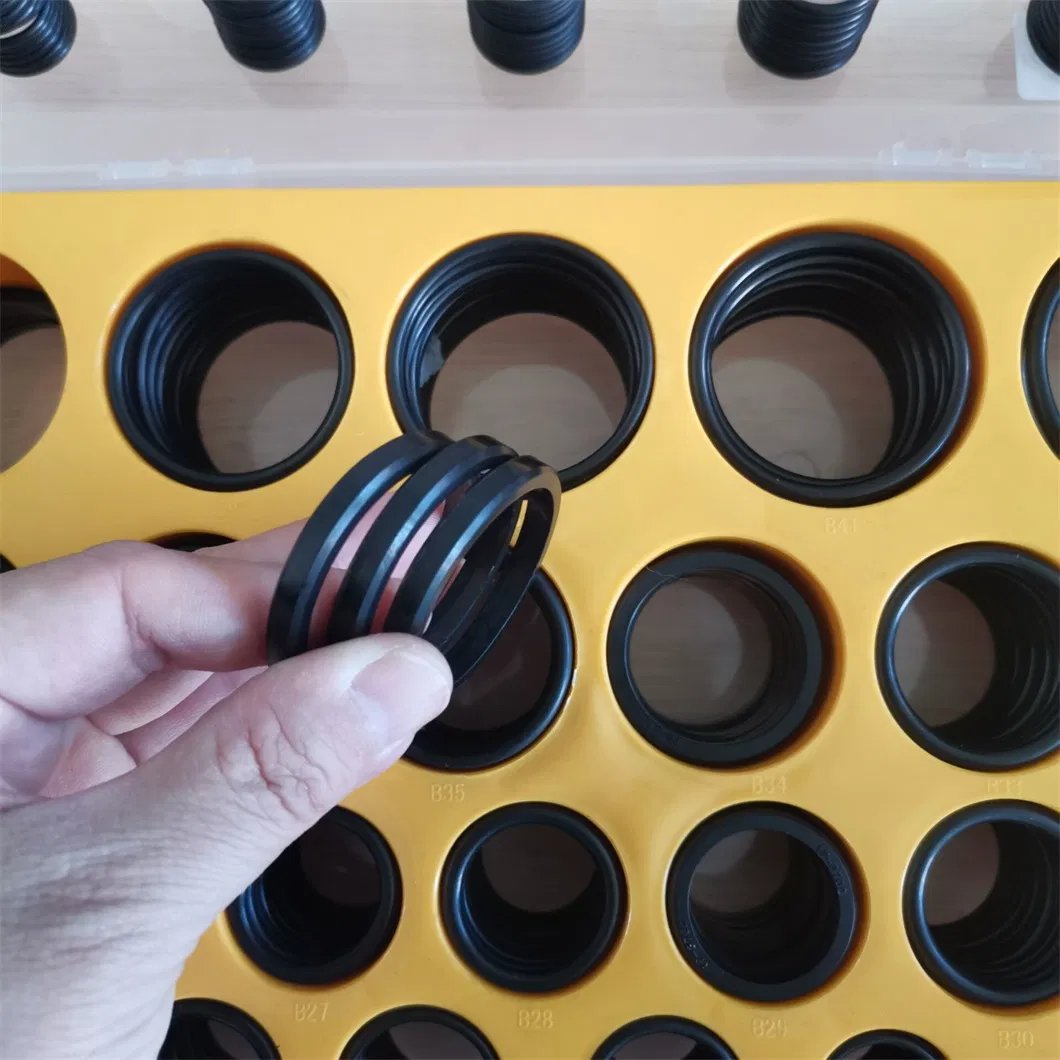
The most reliable selection process starts with the sealing application rather than the appearance of the product. The following checks help purchasing teams and engineers avoid common compatibility and dimensional errors.
Step 1: Identify the Elastomer Material
Ask the supplier to confirm whether the O-rings are NBR, FKM, EPDM, silicone, HNBR, or another specified elastomer. If the application is critical, request the exact compound designation and supporting technical documentation.
Step 2: Verify the Size Standard
Confirm whether the kit uses metric dimensions, AS568 inch-series sizes, or another specified sizing system. O-ring dimensions are defined by inside diameter and cross-sectional diameter. Outside diameter may be used as a secondary measurement but should not replace identification of the correct standard size.
Where possible, use the original part number, component drawing, or manufacturer specification. Measuring a used O-ring alone can be misleading because compression, stretching, swelling, and wear may have changed its dimensions.
Step 3: Check Fluid Compatibility
Record the actual working medium, including additives, cleaning agents, and relevant concentrations. Compare this information against the supplier’s compatibility data for the exact elastomer compound.
Step 4: Establish the Temperature Range
Consider continuous operating temperature, short-term peaks, cold starts, shutdown conditions, and thermal cycling. The allowable temperature range depends on the compound and can be reduced by chemical exposure or mechanical loading.
Step 5: Evaluate Pressure and Gland Design
Check pressure, pressure fluctuations, extrusion clearance, gland dimensions, and the required sealing function. High-pressure applications may require a suitable hardness, an optimized gland, backup rings, or a dedicated seal design.
Step 6: Review Quality and Supply Requirements
For OEM and distributor purchasing, specify material identification, dimensional tolerances, batch traceability, inspection requirements, packaging, and expected annual demand. A kit should be replenished with seals that meet the original specification rather than simply matching the color and nominal size.
| Selection factor | Information to confirm |
|---|---|
| Material | Elastomer designation, exact compound if required, and fluid compatibility. |
| Dimensions | Inside diameter, cross-sectional diameter, size standard, and tolerances. |
| Environment | Temperature range, pressure, media, and exposure to weather or cleaning agents. |
| Sealing design | Static or dynamic duty, gland geometry, surface finish, and extrusion risk. |
| Quality assurance | Inspection records, batch identification, applicable approvals, and supplier documentation. |
Common O-Ring Materials and Their Uses
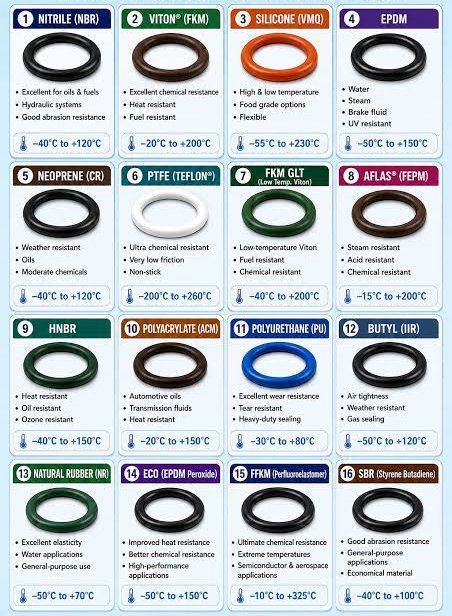
Understanding the material in an assortment is essential because different elastomers respond differently to oils, fuels, water, chemicals, and temperature changes.
NBR (Nitrile Rubber)
NBR is widely used in general industrial sealing and many hydraulic applications because of its compatibility with numerous mineral oils and petroleum-based fluids. Its suitability depends on the formulation, temperature, fluid additives, and mechanical conditions.
FKM (Fluoroelastomer)
FKM is frequently considered for elevated-temperature service and exposure to many oils, fuels, and chemicals. However, compatibility varies by compound, and some FKM grades perform poorly in certain strong bases, amines, or hot-water and steam conditions.
EPDM (Ethylene Propylene Diene Rubber)
EPDM is suitable for many water-based fluids, outdoor weathering conditions, and selected chemical applications. It is generally not suitable for petroleum oils and fuels, so its use must be confirmed against the actual medium.
Silicone (VMQ)
Silicone elastomers can offer flexibility over a broad temperature range and are used in selected industrial, electrical, and food-contact applications when the compound and component meet the relevant requirements. Mechanical strength, abrasion resistance, and fluid compatibility must be considered.
HNBR (Hydrogenated Nitrile Rubber)
HNBR can provide improved heat, aging, and mechanical performance compared with conventional NBR grades. It is used in selected automotive, oilfield, and industrial applications where its specific compound properties match the operating environment.
Remember: Material names describe broad elastomer families, not identical performance across every product. Two compounds with the same generic designation can differ in hardness, additives, curing system, temperature limits, and chemical resistance.
Correct O-Ring Installation and Maintenance
Even a correctly specified O-ring can fail prematurely if the gland is damaged or the seal is installed incorrectly. Use a repeatable installation process to reduce leaks and unplanned equipment downtime.
- Isolate the equipment: Shut down and depressurize the system according to the equipment manufacturer’s procedure before removing the existing seal.
- Inspect the old O-ring: Look for cuts, flattening, swelling, hardening, spiral damage, and extrusion. These signs may help identify the underlying failure mechanism.
- Clean the gland: Remove contamination and inspect for burrs, scratches, corrosion, and other surface defects.
- Verify the replacement: Confirm material, dimensions, hardness, and application compatibility before installation.
- Use an approved lubricant if required: Ensure that the lubricant is compatible with both the elastomer and working fluid.
- Avoid installation damage: Use suitable tools and prevent twisting, stretching beyond the specified limits, or cutting the ring on sharp edges.
- Inspect and test: Follow the specified commissioning and leak-test procedure before returning the equipment to service.
Do not reuse a damaged O-ring or increase tightening torque indiscriminately to compensate for leakage. Persistent leakage may indicate incorrect dimensions, excessive extrusion clearance, poor surface finish, unsuitable material, or an underlying equipment defect.
How to Store and Manage O-Ring Kits
Proper storage protects elastomer seals from premature aging and helps maintain inventory accuracy. Storage requirements depend on the material, packaging, and manufacturer’s instructions.
- Keep seals clean: Store O-rings in closed containers away from dust, moisture, oils, and incompatible chemicals.
- Control environmental exposure: Follow the supplier’s recommendations for temperature, humidity, light, ozone, and other environmental factors.
- Preserve identification: Keep material and size labels with their corresponding compartments.
- Use stock rotation: Record receiving dates and apply the manufacturer’s storage-life guidance.
- Separate incompatible materials: Avoid mixing compounds or sizes in unlabeled compartments.
- Inspect before use: Check for cracks, permanent deformation, contamination, or other visible deterioration.
For international distributors and OEM maintenance departments, inventory records should connect each replacement seal to a defined part number, size standard, material, and approved application. This is more reliable than using color alone as the identification method.
Technical References for O-Ring Selection
Engineers and purchasing teams can use established sealing references to verify dimensions, select elastomers, and evaluate gland design before approving a kit for industrial use.
- Parker Hannifin — O-Ring Handbook: Detailed engineering guidance on elastomer selection, applications, gland design, and sealing fundamentals.
- Parker O-Ring Selector: An engineering tool for evaluating O-ring materials and dimensions against specified service conditions.
- Trelleborg Sealing Solutions — O-Ring Technical Learning: Educational resources covering O-ring fundamentals, material properties, layout, and installation considerations.
- Trelleborg Sealing Solutions — O-Ring Products: An overview of elastomeric O-rings and their use in industrial sealing applications.
- ISO 3601-1 — O-ring dimensions and tolerances: Reference for checking the applicable O-ring dimensional standard and edition.
These references support technical selection but do not automatically certify an individual O-ring kit. For critical applications, confirm the current standard edition, exact compound specification, component drawing, and any required industry approvals with the supplier.
Frequently Asked Questions About Yellow O-Ring Kits
1. Does a yellow O-ring always mean it is made from FKM?
No. O-ring color is not a universal material identification system. Yellow O-rings may use different elastomers or color formulations, depending on the manufacturer. Always verify the material designation and technical documentation before use.
2. Can yellow O-ring kits be used in hydraulic systems?
Yes, provided that the kit contains the correct sizes and elastomer compounds for the hydraulic fluid, temperature, pressure, and gland design. General-purpose kits should not be assumed suitable for high-pressure or safety-critical equipment without validation.
3. How do I identify the correct O-ring size?
Use the original part number, component drawing, or the applicable dimensional standard. The key dimensions are inside diameter and cross-sectional diameter. Measuring a used seal can provide misleading results because operating conditions may have changed its dimensions.
4. How should an O-ring kit be stored?
Store the kit in clean, closed packaging under the manufacturer’s recommended conditions. Protect the elastomers from excessive heat, direct sunlight, ozone, contamination, and incompatible chemicals. Keep material and size labels intact and follow the specified storage-life guidance.
5. What information should I provide when purchasing an O-ring kit in bulk?
Provide the required dimensions and size standard, elastomer material, hardness where applicable, working medium, operating temperature, pressure conditions, annual quantity, and any traceability or approval requirements. This information helps the supplier recommend a suitable assortment and reduces the risk of incorrect substitutions.
Need an O-ring kit for industrial maintenance or OEM supply?
Before requesting a quotation, prepare your size list, material requirements, working-fluid information, and operating conditions. For distributors and bulk buyers, ask for a detailed kit inventory, material identification, dimensional information, and applicable quality documents so that the assortment can be evaluated against your actual requirements.