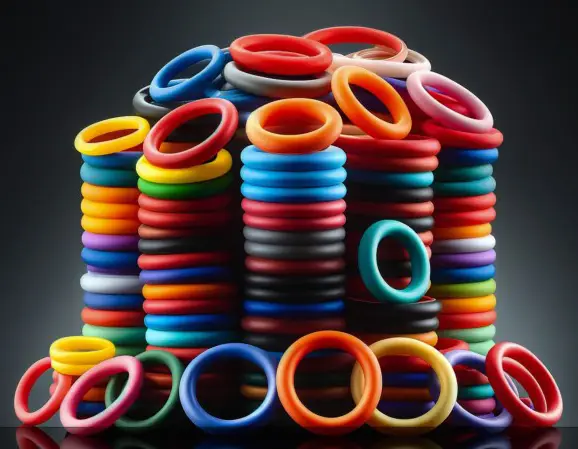

Silicone and food-grade silicone are not automatically the same thing.
Silicone rubber is widely used for O-rings, gaskets, tubing, seals, electrical components, automotive parts, medical products, and industrial equipment because of its flexibility, temperature resistance, weather resistance, and relatively stable performance.
However, the word “silicone” alone does not tell you whether a product is suitable for direct food contact.
This distinction becomes especially important when silicone O-rings, gaskets, tubing, or molded seals are used in food processing equipment, beverage systems, kitchen appliances, pharmaceutical manufacturing, or other hygienic applications.
A general-purpose silicone compound may be perfectly suitable for an industrial application while being inappropriate for a food-contact application. Food-grade silicone is developed, processed, tested, and documented for applications where contact with food or beverages introduces additional safety and compliance requirements.
Important distinction:
Food-grade silicone is not simply “better silicone.” It is silicone formulated and controlled for a specific application where food-contact safety and applicable regulatory requirements matter.
What Is Silicone Rubber?
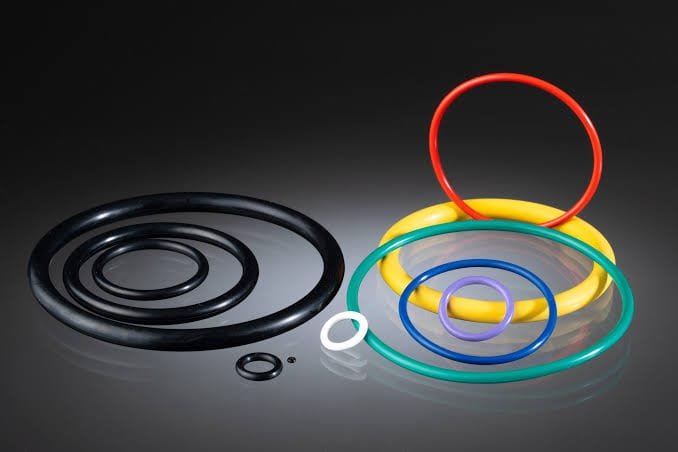
Silicone rubber is a synthetic elastomer based on a silicon-oxygen backbone with organic groups attached to the silicon atoms. This molecular structure gives silicone rubber a combination of properties that makes it useful across many demanding environments.
Depending on the formulation and curing system, silicone rubber can provide excellent flexibility, low-temperature performance, resistance to ozone and weathering, electrical insulation, and useful high-temperature capability.
Silicone is therefore used in many different industries.
- Automotive components
- Electrical and electronic products
- Industrial gaskets
- O-rings and sealing components
- Medical equipment
- Food-processing equipment
- Kitchen appliances
- Fluid-handling systems
- Pharmaceutical equipment
- Specialized tubing and hoses
But the final performance of a silicone product depends on much more than the base polymer.
The formulation, pigments, fillers, additives, curing chemistry, processing conditions, post-curing, surface treatment, and manufacturing controls can all influence whether a particular silicone product is appropriate for a specific application.
What Is Food-Grade Silicone?
Food-grade silicone generally refers to silicone materials intended for applications involving food contact and manufactured to meet the requirements applicable to that intended use.
For a sealing component, this distinction is particularly important.
A food-grade silicone O-ring may be used to seal a connection in food-processing machinery, beverage equipment, dispensing systems, appliances, or other equipment where the sealing material could come into contact with food or ingredients.
The material therefore needs to be evaluated not only for its mechanical sealing function but also for its suitability for the intended food-contact environment.
That can include considerations such as extractables, formulation ingredients, processing cleanliness, curing method, temperature, contact conditions, cleaning chemicals, and applicable regulatory requirements.
Silicone vs. Food-Grade Silicone: What Is the Real Difference?
The biggest mistake is to think that food-grade silicone is simply a different type of polymer.
In many cases, both products are based on silicone elastomers. The important difference is the formulation, manufacturing control, intended application, and demonstrated compliance.
| Factor | General Silicone | Food-Contact Silicone |
|---|---|---|
| Primary purpose | General industrial or consumer applications | Applications involving food contact where applicable requirements must be met |
| Formulation | Depends on intended application | Controlled for the intended food-contact application |
| Regulatory suitability | Not automatically suitable for food contact | Must satisfy applicable food-contact requirements |
| Traceability | Varies by supplier | Typically requires stronger material and documentation control |
| Typical uses | Industrial seals, electronics, automotive components | Food equipment, beverage systems, hygienic seals and gaskets |
The key point is that not every silicone O-ring should be considered a food-grade O-ring.
Why Food-Contact Compliance Matters
A sealing component used in a food-processing system has two jobs.
First, it must seal reliably.
Second, it must not create an unacceptable contamination risk under the conditions for which it is used.
These requirements are related but not identical.
An O-ring can have excellent compression resistance and still be unsuitable for a particular food-contact application if its formulation or documentation does not meet the applicable requirements.
This is why professional purchasing teams should avoid selecting a seal simply because the supplier describes it as “food safe.”
Instead, ask for the actual material specification and applicable compliance documentation.
For OEM and industrial purchasing:
“Food grade” should be treated as a technical and regulatory requirement, not simply a marketing description.
FDA, LFGB and EU Food-Contact Requirements
One reason food-grade silicone can be confusing is that different markets use different regulatory frameworks and standards.
For example, suppliers may reference FDA requirements in the United States, LFGB requirements in Germany, or European food-contact legislation such as Regulation (EC) No. 1935/2004 for applicable products and materials.
These references should not be treated as interchangeable labels.
The exact compliance requirement depends on the product, formulation, application, market, contact conditions, and applicable legislation.
FDA Compliance
For the U.S. market, food-contact silicone products may be evaluated against applicable FDA requirements, including relevant provisions governing rubber articles intended for repeated food contact.
A supplier should be able to identify the applicable regulatory basis for the specific material rather than simply stating that the product is “FDA approved.”
LFGB
LFGB is associated with German food-contact requirements and is commonly requested for silicone products intended for the European market.
Depending on the application, testing may evaluate migration or extractable substances under specified conditions.
EU Food-Contact Requirements
For products sold into Europe, applicable European food-contact legislation should be reviewed according to the specific material and use case.
A supplier’s documentation should therefore clearly state which regulatory requirements and test methods apply to the material being supplied.
Do not confuse a certificate with universal approval.
A test report or compliance statement normally applies to a defined material, formulation, manufacturer, testing condition, and intended use. Always confirm that the documentation matches the actual seal being purchased.
Is 100% Silicone Automatically Food Grade?

No.
The phrase “100% silicone” describes the material claim but does not, by itself, establish that a finished O-ring or gasket is suitable for food contact.
The final component may contain or be affected by curing agents, pigments, processing aids, fillers, surface treatments, or manufacturing residues.
Therefore, purchasing decisions should be based on the actual compound and finished-product compliance documentation rather than a generic statement such as “100% silicone.”
Does Color Determine Whether Silicone Is Food Grade?

Color alone is not a reliable way to determine food-contact suitability.
A white or translucent O-ring is not automatically food grade, and a colored silicone O-ring is not automatically industrial grade.
What matters is the compound, manufacturing process, intended application, and supporting compliance information.
Platinum-Cured Silicone vs. Peroxide-Cured Silicone
When discussing high-purity silicone for food, medical, or pharmaceutical applications, the curing system deserves attention.
Silicone rubber can be cured using different chemical systems. Two commonly discussed approaches are peroxide curing and platinum addition curing.
Peroxide-Cured Silicone
Peroxide curing is widely used in silicone manufacturing and can provide a practical balance of performance and cost.
The specific formulation and post-curing process are important because residual processing by-products can influence the suitability of the finished product for certain applications.
Platinum-Cured Silicone
Platinum-cured silicone is commonly selected when cleanliness, low extractables, and high-purity requirements are important.
It is frequently considered for food, pharmaceutical, medical, and other hygienic applications.
However, “platinum cured” should not automatically be interpreted as “food compliant.”
The actual compound and finished product still need to satisfy the requirements of the intended application.
Why Silicone Is Popular for Food-Processing Seals
Silicone has several characteristics that make it attractive for hygienic sealing applications.
- Wide usable temperature range for many formulations
- Good flexibility
- Good low-temperature performance
- Excellent resistance to ozone and weathering
- Good electrical insulation
- Useful resistance to many environmental conditions
- Ability to be molded into complex sealing profiles
- Availability in different hardnesses and colors
These properties make silicone useful for O-rings, gaskets, tubing, diaphragms, valves, and custom molded components.
However, silicone is not the best material for every food-processing application.
The actual fluid, temperature, cleaning chemicals, pressure, mechanical movement, compression, and expected service life must still be considered.
Food-Grade Silicone O-Rings: Where Are They Used?
Food-grade silicone O-rings can be used in many applications where a flexible elastomeric seal is required and the material is suitable for the operating environment.
Food and Beverage Equipment
Silicone seals may be used in pumps, valves, fittings, dispensing equipment, beverage machines, processing equipment, and other fluid-handling systems.
Kitchen Appliances
Silicone gaskets and O-rings can be found in equipment exposed to elevated temperatures and repeated cleaning cycles.
Pharmaceutical Processing
High-purity silicone components can be considered where flexibility and controlled material characteristics are required.
Medical Applications
Silicone is widely used in medical products, but food-grade compliance alone does not automatically mean that a component is suitable for a medical application. Medical applications may require additional biological, material, cleanliness, or regulatory requirements.
Food-Grade Silicone Is Not Suitable for Every Food Application
This is an important point that is often missed.
Even when an O-ring is manufactured from a compliant food-contact silicone compound, the application itself still needs to be evaluated.
Consider the following variables:
| Application Variable | Why It Matters |
|---|---|
| Food or beverage type | Different media can interact differently with elastomers |
| Temperature | Affects elasticity, compression set and long-term aging |
| Pressure | Influences extrusion and sealing force |
| Static or dynamic movement | Dynamic sealing introduces friction and wear |
| Cleaning chemicals | CIP and sanitation chemicals may affect the elastomer |
| Steam exposure | Repeated thermal cycles can influence service life |
| Contact time | Longer contact can change material exposure conditions |
How to Select a Food-Grade Silicone O-Ring
Selecting the correct food-grade O-ring should follow the same engineering principles used for any critical seal, with additional attention to food-contact requirements.
Step 1: Identify the O-Ring Size
Confirm the inside diameter, cross-section, applicable dimensional standard, and tolerance requirements.
Do not assume that an approximately similar size will provide equivalent sealing performance.
Step 2: Identify the Media
Determine exactly what the seal will contact.
Milk, water, beverage concentrates, oils, sauces, cleaning solutions, alcohol-containing fluids, and pharmaceutical formulations may create different material requirements.
Step 3: Determine the Temperature Range
Consider both continuous and intermittent temperature exposure.
Do not select a material solely from a generic maximum temperature number. Real service life depends on exposure time, compression, pressure, environment, and compound formulation.
Step 4: Check Cleaning and Sanitization Conditions
Food-processing equipment may experience repeated cleaning cycles involving hot water, steam, alkaline cleaners, acidic cleaners, or other sanitation processes.
The seal needs to withstand the actual cleaning procedure, not just the normal production temperature.
Step 5: Confirm Food-Contact Compliance
Request the supplier’s material declaration, applicable test reports, regulatory references, and lot or batch information where required.
Step 6: Evaluate the Seal Design
A compliant material cannot compensate for an incorrectly designed gland.
Compression, stretch, extrusion clearance, surface finish, groove geometry, and installation conditions all influence sealing performance.
How to Tell if a Silicone O-Ring Is Food Grade
There is no single visual inspection that can conclusively prove food-contact compliance.
The most reliable approach is documentation.
1. Check the Material Specification
The supplier should be able to identify the actual silicone compound rather than simply describing the product as “food safe.”
2. Request Compliance Documentation
Depending on the destination market and application, this may include relevant FDA regulatory references, EU food-contact documentation, LFGB testing, or other applicable documentation.
3. Check Batch Traceability
For critical applications, batch identification can help connect the finished seal with its material and manufacturing records.
4. Evaluate Manufacturing Cleanliness
A food-contact seal should be manufactured, handled, cleaned, and packaged according to requirements appropriate for its intended application.
5. Use Physical Checks Only as Preliminary Screening
Visual appearance, odor, flexibility, and stretching behavior may provide clues about a product, but they cannot replace laboratory testing or regulatory documentation.
Important:
A simple “pinch test” or stretching test can be used as a rough screening method, but it should never be treated as proof that a silicone O-ring complies with food-contact regulations.
Why the “Pinch Test” Can Be Misleading
Some silicone articles suggest stretching or pinching a product and checking whether the surface turns white as a way to identify fillers.
This may provide a simple visual observation, but it is not a reliable regulatory test.
Material formulation is more complex than what can be determined by looking at the color change of a stretched elastomer.
A professional buyer should therefore treat the pinch test as, at most, a preliminary indication rather than a certification method.
For industrial food-processing applications, supplier documentation and appropriate testing are far more important than a home-style material test.
Common Mistakes When Buying Food-Grade Silicone Seals
Mistake 1: Choosing Any Silicone O-Ring
A silicone O-ring is not automatically a food-contact O-ring.
Mistake 2: Looking Only at Color
White, translucent, red, blue, or another color does not determine regulatory suitability.
Mistake 3: Assuming “FDA Approved” Is Enough
The actual regulatory basis, formulation, testing conditions, and intended application should be confirmed.
Mistake 4: Ignoring Cleaning Chemicals
A seal may perform well during normal production but deteriorate during repeated cleaning or sterilization cycles.
Mistake 5: Ignoring Compression Set
Food-contact compliance does not automatically guarantee long-term sealing performance.
The seal must still maintain adequate contact pressure throughout its expected service life.
Mistake 6: Choosing Material Before Understanding the Application
Material selection should follow the actual operating conditions, not the other way around.
Silicone vs. Other Elastomers for Food-Contact Applications
Silicone is not the only elastomer used in food and beverage equipment.
Depending on the application, other materials such as EPDM, FKM, or specialized compounds may provide better resistance to particular fluids, temperatures, or mechanical conditions.
| Material | Typical Strength | Important Consideration |
|---|---|---|
| Silicone | Temperature flexibility and environmental resistance | Lower mechanical strength than some engineering elastomers |
| EPDM | Water, hot water and many polar media | Generally unsuitable for petroleum-based oils |
| FKM | High-temperature and chemical resistance in suitable applications | Food-contact suitability depends on the specific compound and requirements |
| NBR | Oil resistance and mechanical properties | Food-contact use requires an appropriate compliant formulation |
The best material is therefore determined by the complete application rather than by the word “food grade” alone.
Silicone O-Ring Performance: Food Safety Is Only One Requirement
A food-processing O-ring still needs to function as an O-ring.
This means engineers must consider:
- O-ring cross-section
- Inside diameter
- Gland dimensions
- Compression ratio
- Pressure
- Temperature
- Fluid compatibility
- Surface finish
- Static or dynamic movement
- Installation method
- Cleaning cycles
- Expected service life
A compliant material installed in an incorrectly designed groove can still leak.
When Should You Choose Food-Grade Silicone?
Food-contact silicone should be considered when the sealing component may come into direct or indirect contact with food or beverages and the applicable requirements call for a suitable compliant material.
Typical applications include:
- Food-processing machinery
- Beverage dispensing equipment
- Brewing equipment
- Kitchen appliances
- Water and beverage systems
- Food pumps and valves
- Filling and packaging equipment
- Pharmaceutical processing equipment
- Hygienic fluid-handling systems
The exact suitability should always be verified against the actual process conditions.
How Suppliers Can Help Reduce Food-Contact Seal Problems
A professional seal supplier should not simply provide a silicone O-ring based on dimensions.
For demanding applications, the supplier should be able to discuss:
- Silicone compound selection
- Hardness options
- Dimensional standards
- Food-contact compliance
- Curing system
- Cleaning and sanitation exposure
- Temperature limits
- Pressure conditions
- Static or dynamic sealing
- Custom O-ring sizes
- Material documentation
- Batch traceability
Food-Grade Silicone for OEM Applications
OEM customers often need more than an off-the-shelf O-ring.
They may require a specific diameter, cross-section, hardness, color, surface finish, packaging method, labeling system, or custom profile.
In these situations, the supplier should establish the technical specification before production begins.
For OEM projects, define these parameters before ordering:
• Material compound
• Hardness
• Dimensional standard
• Tolerance
• Color
• Surface finish
• Food-contact requirement
• Applicable market regulations
• Operating temperature
• Operating pressure
• Contact media
• Cleaning and sterilization conditions
Quality Control for Food-Grade Silicone O-Rings
Food-contact sealing components require a more disciplined approach to quality control because the product must satisfy both sealing-performance and application-specific requirements.
Depending on the project, quality control can include:
- Incoming material verification
- Compound identification
- Dimensional inspection
- Hardness testing
- Tensile and elongation testing
- Compression set testing
- Visual inspection
- Surface inspection
- Post-curing control where applicable
- Food-contact compliance documentation
- Batch traceability
For high-volume OEM production, automated or controlled visual inspection can also help identify surface defects and dimensional inconsistencies.
What Should You Ask a Food-Grade Silicone Supplier?
Before purchasing food-grade silicone O-rings or gaskets, ask the supplier the following questions:
☑ What exact silicone compound is being supplied?
☑ Is the compound suitable for the intended food-contact application?
☑ Which regulatory requirements does the material meet?
☑ Can the supplier provide supporting compliance documentation?
☑ Is the material platinum cured or peroxide cured?
☑ What hardness options are available?
☑ What are the operating temperature limits?
☑ How does the material perform against the actual process fluid?
☑ How does it perform during cleaning and sanitation?
☑ Can the supplier provide batch traceability and quality records when required?
Frequently Asked Questions
Is all silicone food grade?
No. Silicone is a broad family of elastomeric materials, and a general-purpose silicone product should not automatically be used in a food-contact application. The specific compound and finished product must be evaluated against the requirements of the intended use.
Is food-grade silicone safer than regular silicone?
For applications requiring food contact, an appropriately compliant food-contact silicone is the correct choice because it is specifically formulated and controlled for that application. General-purpose silicone may not have the required formulation or supporting compliance documentation.
Are silicone O-rings suitable for food processing?
They can be, provided the specific silicone compound, finished O-ring, manufacturing process, and application conditions meet the applicable requirements. Temperature, pressure, food media, cleaning chemicals, and mechanical conditions must also be considered.
Is platinum-cured silicone always food grade?
No. Platinum curing is a manufacturing method, not a universal food-contact certification. A platinum-cured silicone component still needs to meet the applicable requirements for its intended application.
Can I identify food-grade silicone by its color?
No. Color is not a reliable indicator of food-contact compliance. The material specification and supporting documentation are much more important.
Does a pinch test prove that silicone is food grade?
No. A pinch or stretch test may provide a simple visual indication of certain formulation characteristics, but it cannot establish regulatory compliance or prove that an O-ring is suitable for food contact.
What is better for food applications: silicone or EPDM?
Neither material is universally better. Silicone may be attractive for temperature flexibility and certain hygienic applications, while EPDM can offer strong resistance to hot water and many polar fluids. The actual food media, cleaning chemicals, temperature, pressure, and sealing motion should determine the material choice.
Silicone vs. Food-Grade Silicone: The Bottom Line
The difference between general silicone and food-grade silicone is not simply a matter of appearance or softness.
It is about formulation, manufacturing control, intended use, testing, documentation, and regulatory suitability.
A standard silicone O-ring can be an excellent industrial sealing component, but that does not automatically make it appropriate for food contact.
For food-processing and beverage applications, buyers should verify the actual material specification and applicable compliance requirements before placing an order.
At the same time, food-contact compliance should never replace basic seal engineering. The O-ring still needs to have the correct dimensions, hardness, compression, gland design, temperature capability, pressure resistance, chemical compatibility, and expected service life.
The right food-grade seal is more than a compliant material.
It is a sealing solution that combines the correct silicone compound, appropriate regulatory documentation, accurate dimensions, controlled manufacturing, suitable gland design, and compatibility with the real operating environment.
Need a Food-Grade Silicone O-Ring or Gasket?
If you are sourcing silicone O-rings, food-grade silicone gaskets, silicone tubing, or custom sealing components for food, beverage, pharmaceutical, or hygienic equipment, the best starting point is to define the complete application.
Please provide the seal dimensions, silicone hardness, operating temperature, pressure, contact medium, cleaning conditions, application type, and required market compliance whenever possible.
A qualified sealing supplier can then help determine whether standard silicone, food-contact silicone, platinum-cured silicone, or another elastomer is the most appropriate solution.
Looking for a reliable silicone sealing solution?
Contact our technical team for help selecting the right silicone O-ring, food-grade gasket, or custom silicone seal for your application.
Send us your drawing, dimensions, material requirements, operating conditions, or existing seal sample, and we can help evaluate the appropriate sealing solution.