
Do silicone O-rings stretch?
Yes. Silicone O-rings are flexible elastomeric seals that can be stretched during installation, but flexibility does not mean unlimited elongation is acceptable.
In an OEM sealing application, an O-ring that is stretched too far may look perfectly normal during assembly while its cross-section becomes smaller than intended. That reduction can decrease sealing squeeze, increase the risk of leakage, and shorten the service life of the seal.
For this reason, engineers should not evaluate a silicone O-ring simply by asking whether it can stretch. The more useful question is:
How much stretch is appropriate for the specific groove, cross-section, temperature, pressure, and sealing medium?
Engineering Quick Answer:
A small amount of uniform ID stretch is normally acceptable during installation. As a practical starting point, many static O-ring applications target approximately 1%–5% installed ID stretch, but this is not a universal limit. Groove geometry, seal cross-section, material formulation, hardness, temperature, and application requirements must also be considered.
How Much Can a Silicone O-Ring Stretch?
Silicone rubber has good flexibility and elastic recovery, which makes silicone O-rings easy to install in many static sealing applications. However, the amount of stretch should be controlled rather than treated as unlimited.
When an O-ring is stretched around a shaft, plug, fitting, or other mating component, its inside diameter increases. At the same time, the rubber cross-section becomes slightly thinner.
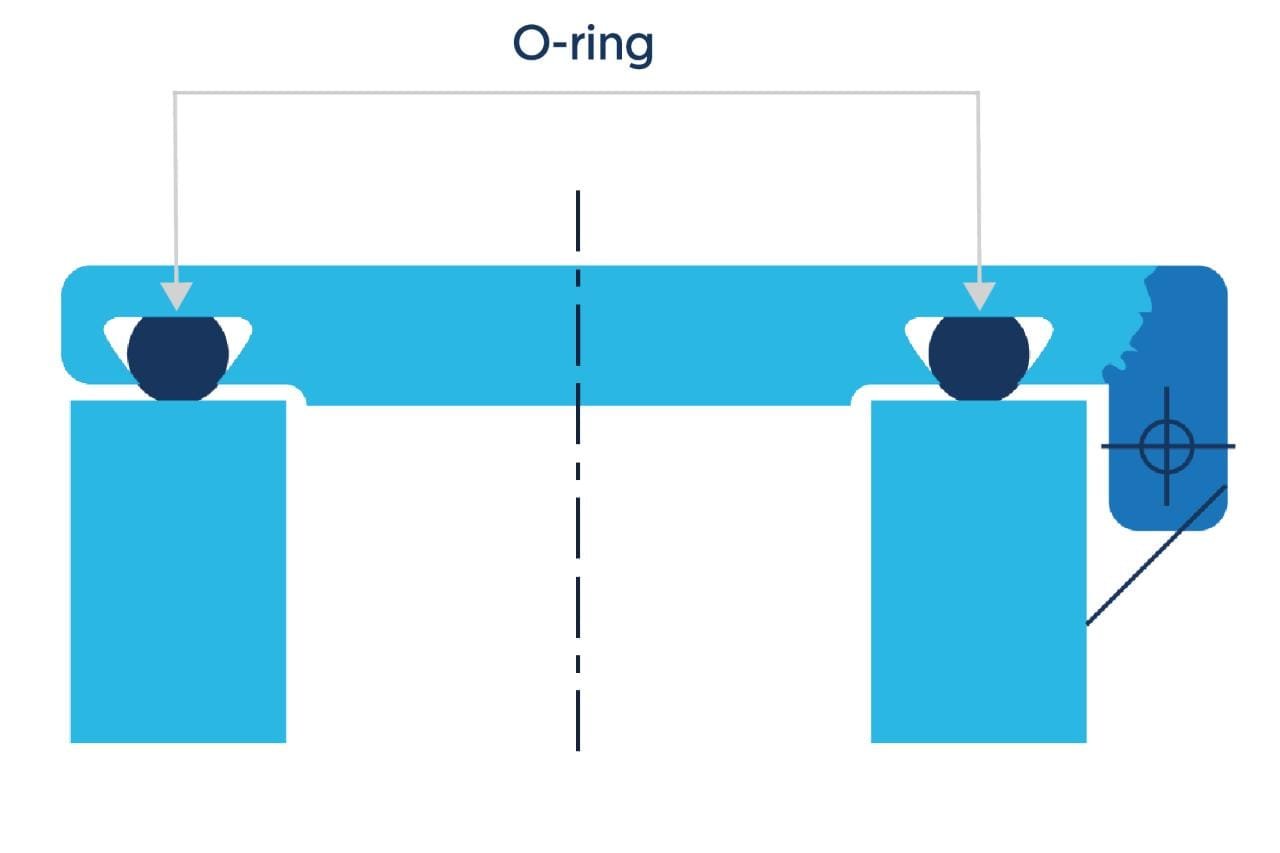
This relationship is important because the O-ring does not seal simply because it is present inside the groove. The seal depends on controlled deformation and contact pressure between the O-ring and the mating surfaces.
If the O-ring is stretched excessively, the reduction in cross-sectional area can reduce the intended squeeze. Once the sealing force becomes insufficient, leakage can occur even though the O-ring itself has no visible crack or tear.
Important:
Do not confuse installation stretch with the maximum elongation of the silicone material. A silicone compound may have a high elongation-at-break value in a laboratory tensile test, but that does not mean an O-ring should be installed at that elongation.
Why Does Excessive Stretch Reduce Sealing Performance?
An O-ring creates a seal through controlled interference and deformation. When the ring is stretched, the rubber redistributes around its circumference.
Excessive stretching can create several problems:
- Reduced cross-section: The O-ring becomes thinner after excessive ID expansion.
- Lower squeeze: A thinner cross-section may no longer provide the intended compression inside the gland.
- Higher installation stress: Excessive tension can make assembly more difficult and increase the possibility of damage.
- Permanent deformation: Depending on compound and service conditions, excessive deformation may reduce elastic recovery.
- Leakage: Insufficient contact pressure can allow gas or liquid to pass through the sealing interface.
These problems become particularly important in applications where a small leak can result in equipment downtime, contamination, pressure loss, or premature component failure.
What Determines Silicone O-Ring Stretchability?
Not every silicone O-ring behaves in exactly the same way. Stretch performance depends on the compound and the complete sealing design.
1. Silicone Compound
Silicone O-rings are available in different formulations for industrial, food-contact, medical, electrical, high-temperature, and other applications. The formulation affects elasticity, tensile strength, tear resistance, compression set, and temperature performance.
Therefore, two silicone O-rings with identical dimensions can behave differently if their compounds or curing systems are different.
2. Rubber Hardness
Durometer is another important factor. Softer silicone compounds generally deform more easily, while harder compounds provide greater resistance to deformation.
However, choosing a softer O-ring simply because it is easier to stretch is not necessarily the correct engineering decision. Hardness should be selected according to pressure, groove design, assembly method, sealing force, and operating environment.
3. Cross-Sectional Diameter
O-ring cross-section has a direct influence on sealing performance. A small change in cross-section can significantly affect the available squeeze in a precision groove.
For this reason, engineers should evaluate ID and cross-section together instead of selecting an O-ring only by nominal inside diameter.
4. Temperature
Temperature changes the mechanical behavior of silicone rubber. At elevated temperatures, the elastomer may become softer and experience greater deformation. At low temperatures, flexibility can change depending on the specific compound.
A silicone O-ring selected for a room-temperature application should not automatically be assumed to provide identical performance at elevated temperatures.
5. Pressure
Pressure changes the sealing conditions inside the gland. In higher-pressure applications, excessive clearance can introduce extrusion risk, while insufficient squeeze can create leakage.
Silicone O-rings are often selected for their temperature flexibility rather than for extremely high-pressure sealing. When pressure levels are demanding, the material, hardness, groove clearance, backup-ring requirements, and extrusion resistance should be reviewed together.
Silicone O-Ring Stretch vs. O-Ring Compression
One of the most common mistakes in O-ring selection is treating stretch and compression as independent issues.
They are closely related. When the O-ring ID is stretched, the cross-sectional diameter changes. If the original O-ring was already selected near the lower end of the required cross-section, excessive stretch can reduce the available squeeze after installation.
For OEM design:
Always evaluate the installed O-ring condition rather than relying only on the free-state dimensions shown on a drawing or catalog.
What Happens When a Silicone O-Ring Is Over-Stretched?
Over-stretching does not always produce an immediate visible failure. This is one reason why installation-related O-ring problems can be difficult to diagnose.
Loss of Sealing Force
If excessive ID stretch significantly reduces the O-ring cross-section, the installed seal may not generate enough contact force against the groove and mating surface.
Higher Risk of Leakage
Reduced squeeze can create a leakage path, particularly when the application experiences pressure fluctuations, thermal cycling, vibration, or dimensional movement.
Surface Damage During Assembly
Excessive stretching can also make installation more difficult. If the O-ring is pulled over a sharp edge, thread, groove, or fitting feature, the rubber may be nicked or cut.
Reduced Service Life
Repeated stretching, twisting, and mechanical abuse can accelerate seal deterioration. Silicone has excellent temperature characteristics, but it should still be protected from unnecessary mechanical damage.
How to Install a Silicone O-Ring Without Excessive Stretching
Correct installation is just as important as choosing the correct material.
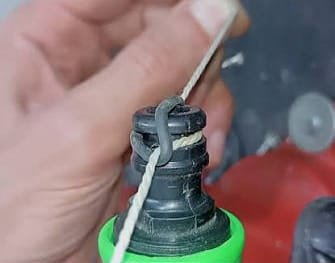
A high-quality silicone O-ring can still fail if it is installed incorrectly.
Step 1: Confirm the O-Ring Dimensions
Before assembly, verify the inside diameter and cross-section. For OEM
replacement work, measuring the groove is often more reliable than selecting a replacement solely from an old, deformed O-ring.
Step 2: Inspect the Groove
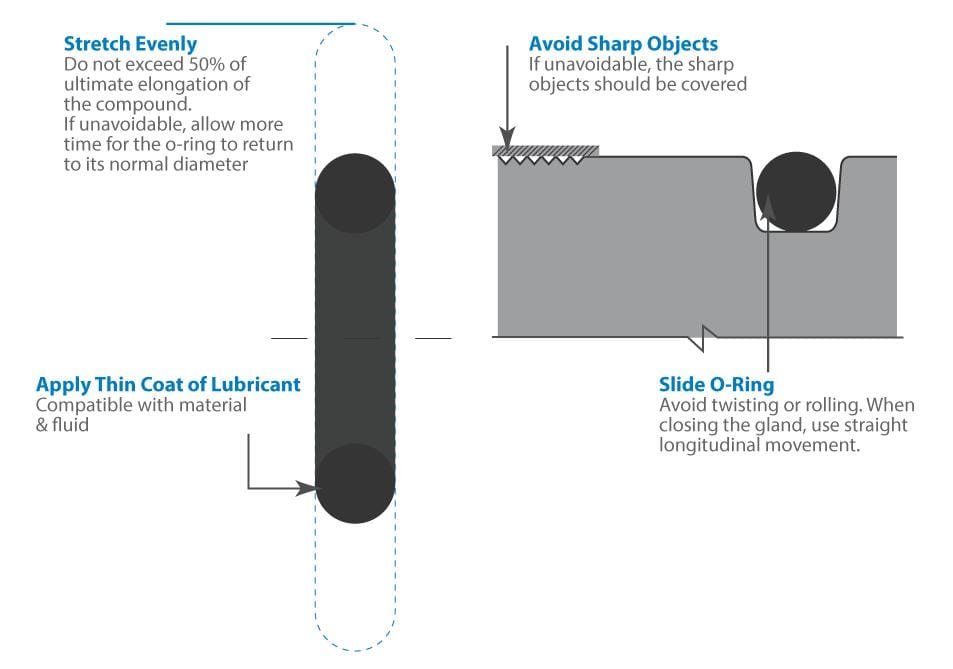
Remove dirt, metal particles, old seal fragments, and other contamination from the groove. Sharp edges and burrs should be removed because they can cut the silicone during assembly.
Step 3: Lubricate When Compatible
A compatible lubricant or the application fluid can reduce installation friction. However, lubricant selection must be based on chemical compatibility with the silicone compound and the process media.
Step 4: Stretch Evenly
Never pull an O-ring aggressively from only one side. Distribute the installation force around the circumference so the ring expands uniformly.
Step 5: Avoid Twisting
A twisted O-ring can create an uneven sealing interface. After installation, visually inspect the ring around the entire circumference before closing the assembly.
Step 6: Allow Recovery When Necessary
If an O-ring has been expanded significantly during assembly, particularly in small-diameter applications, allowing the material to recover before final assembly may help prevent dimensional instability.
Installation Rule:
The goal is not to make the O-ring as tight as possible. The goal is to achieve the correct installed geometry and sealing compression with the least unnecessary mechanical stress.
How to Tell If a Silicone O-Ring Has Been Over-Stretched
If a silicone O-ring has already been removed from service, several visual and dimensional checks can help determine whether installation stretch may have contributed to failure.
- Compare the removed O-ring ID with the original specification.
- Check whether the cross-section has become noticeably thinner.
- Look for cuts, nicks, surface cracks, or tearing.
- Inspect for permanent deformation or loss of circular shape.
- Check whether the O-ring feels unusually loose after installation.
- Look for localized wear that may indicate twisting or uneven assembly.
A stretched O-ring should not automatically be reused simply because there is no visible damage. If the seal has experienced significant deformation or the original dimensional condition cannot be verified, replacement is normally the safer choice for an OEM assembly.
Can Silicone O-Rings Stretch Over Time?
Silicone O-rings can undergo dimensional and mechanical changes during service, but the reason should be investigated rather than described simply as “stretching.”
Temperature exposure, compression set, chemical interaction, pressure, repeated assembly, and mechanical movement can all influence the long-term behavior of an elastomer.
If an O-ring becomes permanently larger after service, engineers should examine the complete operating environment. The problem may be related to material compatibility or thermal aging rather than installation stretch alone.
Silicone O-Ring Selection: What Should OEM Buyers Specify?
For OEM and industrial purchasing, specifying only “silicone O-ring” is usually not enough information for a reliable production seal.
A useful specification should include:
- O-ring inside diameter (ID)
- O-ring cross-section
- Silicone compound or material grade
- Hardness / Shore A
- Operating temperature
- Operating pressure
- Sealing medium
- Static or dynamic application
- Regulatory requirements where applicable
- Quantity and production requirements
For food, pharmaceutical, medical, or other regulated applications, additional requirements such as FDA, USP Class VI, 3-A, or other applicable standards may need to be specified separately. Material compliance should never be assumed simply because the product is made from silicone.
For premium O-rings and seals, trust us for reliable solutions. Contact us today for expert guidance and high-quality sealing products.
When Should You Choose Silicone Instead of Another O-Ring Material?
Silicone is particularly useful when temperature flexibility, weather resistance, electrical insulation, and clean sealing are important. It is commonly considered for applications where conventional elastomers may not provide the required temperature performance.
However, silicone is not the universal solution for every sealing application.
If the application involves fuels, petroleum oils, aggressive chemicals, high mechanical wear, or demanding dynamic movement, other elastomers such as FKM, HNBR, EPDM, or NBR may provide a better balance of properties depending on the actual media and operating conditions.
Material Selection Principle:
Do not select an O-ring because it has the highest temperature rating alone. The correct material must be compatible with the temperature + pressure + media + movement + groove design + service life of the application.
Silicone O-Ring Stretch: Practical Engineering Summary
Silicone O-rings can stretch, and a controlled amount of ID stretch is often necessary for installation. The important issue is preventing excessive deformation that changes the installed cross-section and reduces sealing performance.
For many static applications, approximately 1%–5% ID stretch can be used as an initial engineering reference. It should not, however, be treated as a universal specification for every O-ring design.
The final stretch requirement should be evaluated together with O-ring dimensions, groove geometry, hardness, material formulation, temperature, pressure, sealing media, and installation method.
In other words:
A good O-ring installation is not the tightest installation—it is the installation that produces the correct sealing geometry.
Frequently Asked Questions About Silicone O-Ring Stretch
Do silicone O-rings stretch?
Yes. Silicone O-rings are elastic and can be stretched during installation. However, excessive stretch can reduce the O-ring cross-section and negatively affect sealing performance.
How much should a silicone O-ring stretch?
For many static sealing applications, approximately 1%–5% ID stretch is a useful starting reference. The appropriate value depends on the O-ring size, groove, material, temperature, pressure, and application.
Can stretching an O-ring cause leakage?
Yes. Excessive stretching can reduce the effective cross-section and sealing squeeze. If contact pressure becomes insufficient, leakage may occur.
Should a silicone O-ring be installed tightly?
It should be installed with the correct amount of interference and stretch specified for the application. Making the O-ring excessively tight is not a substitute for correct groove and seal design.
Can I reuse a stretched silicone O-ring?
Reuse should be avoided when the O-ring has permanent deformation, visible damage, significant dimensional change, or uncertain service history. For critical OEM sealing applications, replacing the seal is generally the safer approach.
Why does my silicone O-ring become larger after installation?
Installation stretch can increase the O-ring’s inside diameter. Long-term dimensional changes may also result from temperature, chemical exposure, compression set, or mechanical loading. The operating conditions should be evaluated before identifying the cause.
Need a Silicone O-Ring for an OEM Application?
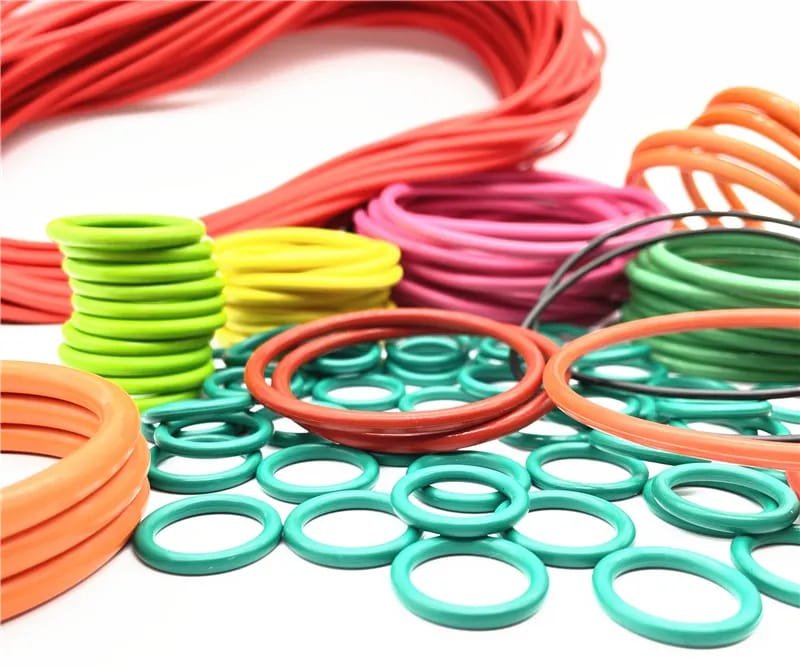
Choosing the correct O-ring is more than matching an inside diameter. For OEM applications, the seal should be selected according to the actual groove dimensions, cross-section, material requirements, hardness, temperature, pressure, sealing medium, and production requirements.
KODA Oil Seal And O-Ring can support OEM and industrial sealing requirements with silicone O-rings and other elastomer sealing solutions based on drawings, samples, specifications, and application conditions.
If you are replacing an existing seal or developing a new sealing assembly, provide the O-ring ID, cross-section, material, hardness, working temperature, pressure, medium, and application type. These details allow the sealing specification to be evaluated more accurately before production.
Looking for a reliable OEM O-Ring solution?
Send us your drawing, sample dimensions, or current O-ring specification. Our sealing team can help review the material, dimensions, stretch requirements, and application conditions to identify a more suitable sealing solution.