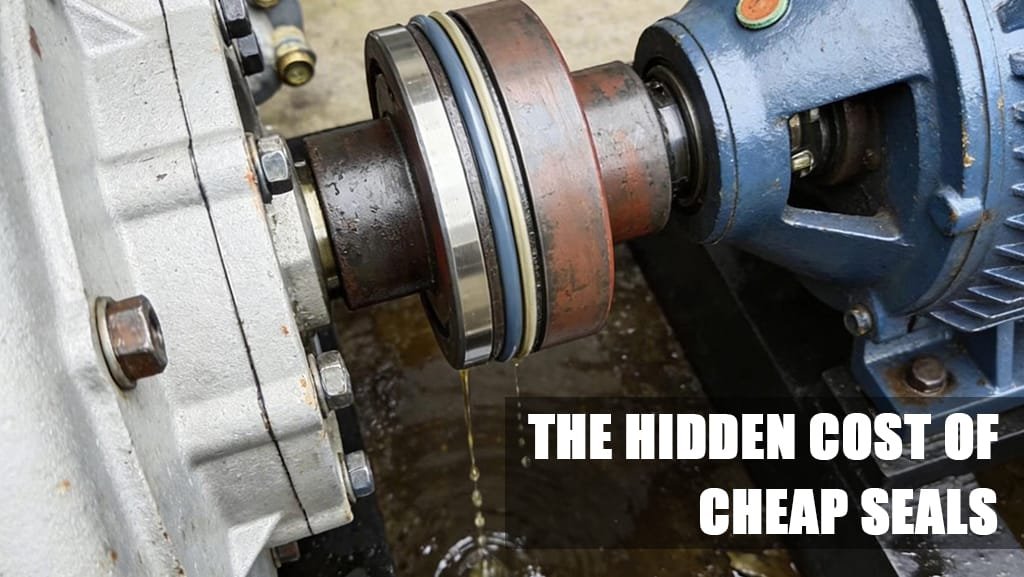
The cheapest seal is rarely the cheapest sealing solution.
When purchasing O-rings, oil seals, hydraulic seals, gaskets, or other sealing components, it is easy to compare suppliers by unit price. A seal that costs a few cents less may appear to offer an immediate purchasing advantage.
But the purchase price represents only one part of the real cost.
When a low-cost seal fails prematurely, the actual financial impact can include equipment downtime, fluid loss, emergency maintenance, replacement labor, contaminated products, production delays, damaged mating components, warranty claims, and even customer dissatisfaction.
That is why professional engineers and purchasing teams should evaluate sealing products based on total cost of ownership rather than purchase price alone.
The key question is not: “How much does this seal cost?”
The better question is: “How much will this seal cost us over its entire service life?”
What Is the Hidden Cost of a Cheap Seal?
A sealing component may represent only a very small percentage of the total value of a machine or production system.
However, its functional importance can be much greater than its purchase price suggests.
An O-ring may cost only a fraction of a dollar, while the hydraulic cylinder, pump, valve, compressor, gearbox, or production line that depends on that O-ring may represent thousands or millions of dollars in equipment and operating value.
When the seal fails, the component’s low purchase price becomes almost irrelevant compared with the cost of the resulting failure.
The hidden cost can be divided into several categories:
- Unplanned equipment downtime
- Emergency maintenance labor
- Replacement parts and service costs
- Fluid loss
- Product contamination
- Production scrap
- Equipment damage
- Reinstallation and testing
- Expedited shipping
- Warranty or customer claims
- Lost production capacity
- Safety and environmental risks
Why a Low-Cost Seal Can Become an Expensive Component
The price of an elastomeric seal is influenced by material, compound formulation, manufacturing process, tooling, inspection requirements, packaging, certification, order volume, and supply-chain conditions.
Reducing unnecessary cost is reasonable. However, reducing the price by sacrificing material suitability, dimensional consistency, manufacturing control, or application support can create a much larger cost later.
For example, suppose an inexpensive O-ring is installed in a hydraulic system.
If the compound is not suitable for the hydraulic fluid or operating temperature, the O-ring may swell, soften, harden, lose compression, or crack.
The resulting leakage may not occur immediately. The seal might operate for weeks or months before the material degradation becomes severe enough to affect sealing performance.
At that point, the customer may have to stop the machine, remove the cylinder or valve, replace the seal, refill lost fluid, clean the equipment, and restart the system.
The original saving on the seal may be the smallest number in the entire failure equation.
The Five Major Costs Behind Seal Failure
1. Downtime Cost
Downtime is often the largest hidden cost associated with seal failure.
A production machine cannot manufacture products while it is being inspected, disassembled, repaired, cleaned, tested, and returned to service.
For continuous production environments, even a short shutdown can have a significant financial impact.
The cost becomes even greater when the failed seal is located deep inside equipment that requires extensive disassembly.
Example:
A $0.50 O-ring that fails during production may require two technicians, several hours of downtime, replacement fluid, cleaning materials, and additional testing.
The replacement O-ring still costs $0.50. The failure does not.
2. Maintenance Labor
Replacing a seal is not always a simple component swap.
Depending on the application, technicians may need to remove guards, piping, covers, shafts, bearings, cylinders, pumps, or other components before reaching the sealing interface.
Labor costs therefore depend on accessibility as well as the price of the replacement seal.
A seal with a longer and more predictable service life can reduce the number of maintenance interventions required over the life of the equipment.
3. Fluid Loss
Seal leakage can result in the loss of hydraulic oil, lubricants, process fluids, refrigerants, chemicals, water, or other valuable media.
In some applications, the cost of the lost fluid can exceed the cost of the sealing component many times over.
Leakage can also create secondary problems by contaminating nearby components, floors, insulation, electrical systems, or finished products.
4. Secondary Equipment Damage
A failed seal does not always remain a seal problem.
Leakage can affect bearings, shafts, electrical components, braking systems, sensors, lubrication systems, and other nearby components.
For example, a rotary shaft seal that loses lubricant may allow contamination to enter a bearing housing. The resulting bearing failure can become significantly more expensive than the original seal replacement.
5. Production and Quality Loss
In manufacturing and processing environments, sealing failure can introduce contaminants into the production process.
This may result in rejected products, cleaning operations, material waste, batch loss, or customer complaints.
For food, pharmaceutical, medical, semiconductor, and other controlled environments, the consequences can be particularly serious.
Cheap Seals Often Fail Because of the Wrong Material
One of the most important factors in seal performance is elastomer compatibility.
Different elastomers behave differently when exposed to oils, fuels, solvents, water, steam, refrigerants, acids, alkalis, high temperatures, low temperatures, and aggressive chemicals.
For this reason, material selection should always be based on the complete operating environment.
NBR
Nitrile rubber is widely used for many petroleum-based oil and hydraulic applications because it offers good mechanical properties, abrasion resistance, and cost efficiency.
However, NBR is not suitable for every fluid or temperature range.
FKM
FKM is frequently selected for applications requiring stronger resistance to elevated temperatures and many aggressive fluids.
It can be an appropriate choice for demanding automotive, chemical, fuel, and industrial applications when the specific compound is compatible with the operating environment.
EPDM
EPDM is well known for resistance to hot water, weathering, ozone, and many polar fluids.
However, it is generally not the preferred elastomer for petroleum-based oils and fuels.
HNBR
HNBR provides a combination of oil resistance, mechanical strength, temperature performance, and aging resistance that makes it useful in demanding applications.
Silicone
Silicone materials can perform well across broad temperature ranges and are commonly considered where flexibility and temperature stability are important.
FFKM
Perfluoroelastomer compounds are used in highly demanding environments where exceptional chemical and temperature resistance is required.
They are more expensive, but in applications where a seal failure can cause major downtime or contamination, the higher material cost may be justified.
Price Is Not the Same as Quality
A common purchasing mistake is assuming that the highest-priced seal must be the highest-quality seal.
That is not necessarily true.
A technically appropriate NBR seal may outperform an expensive FKM seal if the application is specifically suited to NBR.
Likewise, an expensive FFKM compound can be unnecessary for a low-temperature, non-aggressive application.
The objective is not to buy the most expensive seal.
The engineering objective is:
Select the lowest-cost sealing solution that reliably meets the required service life, compatibility, performance, safety, and quality requirements.
How Manufacturing Quality Affects Seal Life
Two seals made from nominally similar materials can have different performance if their manufacturing processes are different.
Important factors include compound consistency, curing conditions, molding accuracy, trimming quality, surface finish, dimensional control, contamination control, and final inspection.
Dimensional Consistency
O-rings and precision seals must maintain appropriate dimensions so they can function correctly inside the gland or housing.
An incorrect cross-section or inside diameter can change compression, stretch, extrusion behavior, and contact pressure.
Surface Quality
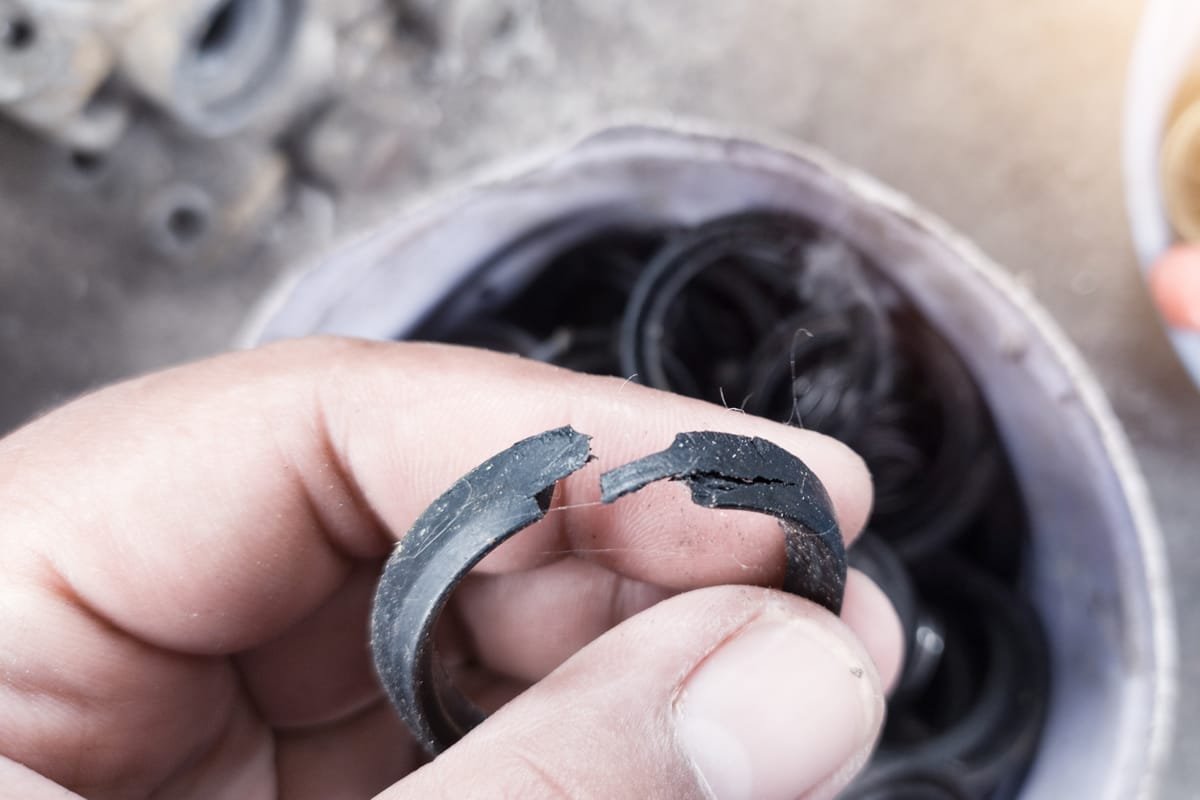
Cuts, cracks, flash, voids, scratches, and other defects can create leakage paths or accelerate wear.
Compound Consistency
The physical and chemical properties of an elastomer depend heavily on its formulation and curing process.
A consistent compound helps produce more predictable compression set, hardness, tensile strength, elongation, chemical resistance, and temperature performance.
Common Seal Failure Modes You Should Understand
Compression Set
Compression set occurs when an elastomer loses its ability to recover after being compressed for an extended period.
The result can be reduced sealing force and leakage, particularly in static applications.
Extrusion
Under pressure, an O-ring can be forced into the clearance gap between mating components.
Excessive extrusion can damage the sealing element and create a leakage path.
Pressure, temperature, clearance, hardness, material properties, and gland design should therefore be considered together.
Chemical Swelling
An incompatible fluid can cause an elastomer to swell or change its physical properties.
This can increase friction, interfere with installation, distort dimensions, or reduce sealing reliability.
Thermal Degradation
Continuous exposure to temperatures beyond the compound’s capability can accelerate aging and reduce elasticity.
Abrasion and Wear
Dynamic seals can experience wear when sliding or rotating against a mating surface.
Poor lubrication, excessive surface roughness, contamination, excessive pressure, and improper material selection can accelerate wear.
Installation Damage
Even a high-quality seal can fail immediately if it is cut, twisted, stretched excessively, contaminated, or installed over a sharp edge.
Why the Cheapest Seal May Increase Maintenance Frequency
Suppose two seals have different purchase prices but different service lives.
| Factor | Low-Cost Seal | Application-Matched Seal |
|---|---|---|
| Purchase price | Lower | Higher |
| Material selection | May be generic | Application-specific |
| Expected service life | Potentially shorter | More predictable |
| Maintenance frequency | Potentially higher | Potentially lower |
| Downtime exposure | Higher if failure is premature | Lower when properly specified |
| Total ownership cost | Can become high | Often easier to control |
The key variable is not the unit price. It is the relationship between purchase cost, service life, maintenance cost, and failure consequence.
How to Calculate the Real Cost of a Seal
A simple purchasing comparison can be misleading.
A more useful approach is to estimate the total cost associated with the sealing component.
Total Seal Cost = Purchase Price + Installation Cost + Maintenance Cost + Downtime Cost + Fluid Loss + Failure Consequences
This is not a formal accounting formula for every application, but it provides a useful engineering framework for purchasing decisions.
If a seal costs twice as much but lasts three times longer and prevents repeated shutdowns, the higher purchase price may represent a lower overall cost.
When Should You Pay More for a Seal?
A higher-performance sealing solution becomes easier to justify when failure consequences are high.
Consider upgrading the sealing solution when:
- Equipment downtime is expensive.
- The seal is difficult to access.
- The application operates continuously.
- The fluid is hazardous or expensive.
- Temperature or pressure is demanding.
- The equipment is safety-critical.
- Leakage can contaminate products.
- Maintenance access is limited.
- Repeated seal failures have already occurred.
- The equipment is used in regulated environments.
How to Choose a Reliable Seal Supplier
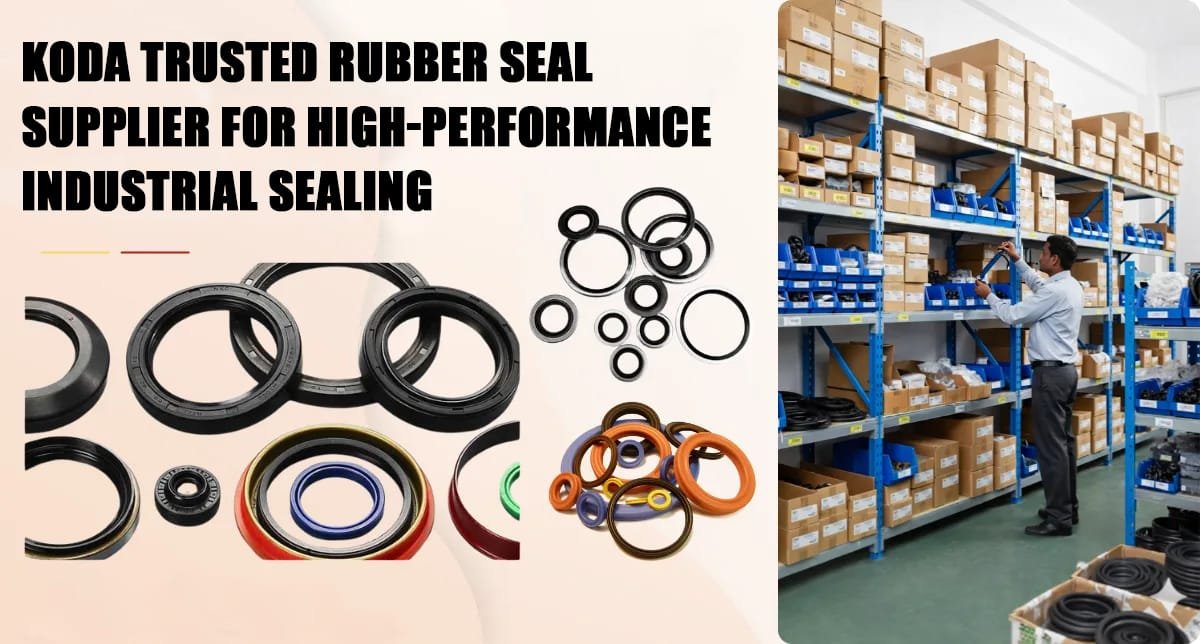
The supplier you choose can have a major influence on sealing reliability.
Do not evaluate a supplier solely by comparing unit prices.
Instead, consider the following criteria.
1. Material Expertise
Can the supplier explain why a particular elastomer is appropriate for your fluid and temperature conditions?
2. Engineering Support
Can they help investigate repeated leakage, compression set, extrusion, swelling, or installation problems?
3. Quality Control
Ask about dimensional inspection, material identification, batch control, visual inspection, and traceability.
4. Manufacturing Capability
For custom seals, the supplier should have suitable tooling, molding, machining, finishing, and inspection capabilities.
5. Supply Reliability
A technically excellent seal is not useful if it cannot be delivered when production needs it.
6. Technical Documentation
Material data, dimensional specifications, compatibility information, inspection requirements, and application guidelines can help engineers make better decisions.
Why Application Engineering Can Save More Than a Low Unit Price
One of the most effective ways to reduce sealing costs is to prevent the wrong seal from being selected in the first place.
A technically experienced supplier can review:
- Seal dimensions
- Groove geometry
- Fluid compatibility
- Operating temperature
- System pressure
- Static or dynamic movement
- Shaft speed
- Surface finish
- Clearance
- Installation conditions
- Expected service life
This can be particularly valuable when designing a new product or troubleshooting repeated failures.
In many cases, the most cost-effective sealing solution is the one that prevents the engineering problem before production begins.
Cheap Seals vs. Engineered Sealing Solutions
There is an important difference between buying a low-cost component and selecting a cost-effective sealing solution.
A commodity seal may be perfectly suitable for a simple, low-risk application.
The problem occurs when a generic product is used in an application with requirements that exceed its capabilities.
For example, a standard NBR O-ring may work very well in a suitable oil application but perform poorly in an environment involving incompatible chemicals, extreme temperatures, or special gas exposure.
The correct response is not automatically to purchase the most advanced material.
Instead, the application should be analyzed and the sealing system engineered accordingly.
Quality Seals Can Reduce Unplanned Maintenance
Preventive maintenance is generally less expensive than emergency repair.
A sealing program should therefore consider the expected service life of seals and establish replacement intervals where appropriate.
For critical equipment, condition monitoring can also help identify leakage or degradation before a complete failure occurs.
Maintenance teams should record:
- Seal type
- Material
- Hardness
- Installation date
- Operating hours
- Failure date
- Failure location
- Observed failure mode
- Operating temperature
- Operating pressure
- Fluid or media
This information can reveal patterns that are invisible when seals are simply replaced without recording the cause of failure.
What to Do When a Seal Fails Prematurely
Do not immediately assume that the replacement seal is defective.
A failed seal contains valuable diagnostic information.
Inspect the Seal
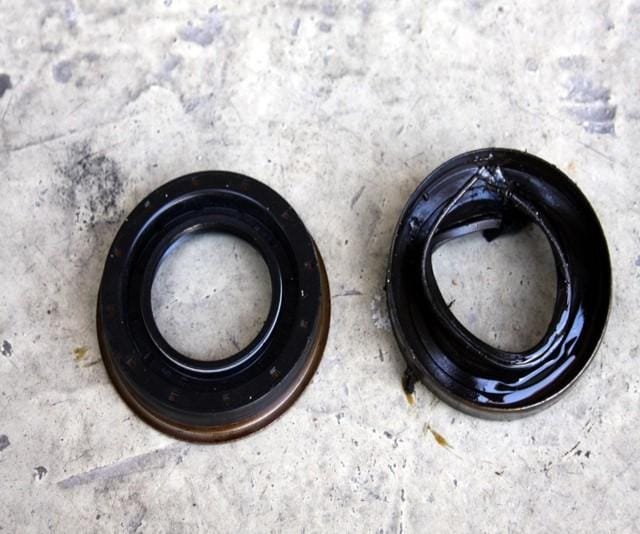
Look for cuts, swelling, cracking, flattening, extrusion, abrasion, hardening, discoloration, or deformation.
Inspect the Mating Surface
Check shafts, bores, grooves, flanges, and other contact surfaces for scratches, corrosion, excessive roughness, wear tracks, or dimensional problems.
Review Operating Conditions
Confirm actual pressure, temperature, speed, fluid composition, and operating cycles rather than relying only on the original design assumptions.
Review Installation
Check whether the seal was twisted, stretched, cut, contaminated, improperly lubricated, or installed in the wrong orientation.
Confirm Material Compatibility
Compare the actual fluid and temperature exposure with the material’s verified compatibility.
Do not throw away the failed seal before inspection.
The failure pattern may provide more useful information than the replacement component itself.
The Hidden Cost of Poor Seal Selection in Different Industries
Automotive
A failed seal can cause fluid leakage, warranty issues, assembly problems, or vehicle reliability concerns. Automotive production also places strong emphasis on dimensional consistency and repeatability.
Hydraulics
Hydraulic seal failures can result in fluid loss, reduced system pressure, contamination, and machine downtime.
Food and Beverage
Sealing failures may create hygiene and contamination risks. Material selection, cleanability, regulatory requirements, and resistance to cleaning chemicals can become critical.
Chemical Processing
Chemical compatibility becomes a primary consideration. An elastomer that performs well in water may degrade rapidly when exposed to a specific solvent or chemical.
Oil and Gas
High pressure, temperature, aggressive fluids, explosive decompression, and demanding maintenance conditions can make seal selection particularly important.
Medical and Pharmaceutical
Sealing materials may need to meet specific cleanliness, regulatory, extractables, or compatibility requirements.
A Practical Checklist Before Buying Cheap Seals
Before selecting the lowest-priced sealing component, ask these questions:
☑ Is the material compatible with the actual fluid?
☑ Is the temperature within the material’s capability?
☑ Is the pressure within the seal design limits?
☑ Is the seal static or dynamic?
☑ Is the shaft or mating surface suitable?
☑ Is the gland correctly designed?
☑ Does the supplier control dimensions?
☑ Is batch or lot traceability available when required?
☑ What happens if the seal fails?
☑ What is the expected total cost over the seal’s service life?
The Best Seal Is the One That Prevents the Most Problems
The purpose of a sealing component is not simply to fill a groove or close a gap.
Its purpose is to maintain system integrity under real operating conditions.
That means the correct seal must work with the fluid, temperature, pressure, motion, mating surfaces, equipment geometry, and maintenance environment.
A low-cost seal that fails repeatedly may become one of the most expensive components in the system.
A properly engineered seal may have a higher initial purchase price but provide a lower cost over the entire service life of the equipment.
Total Cost of Ownership Should Guide Seal Purchasing
The smartest purchasing strategy is not to avoid cost.
It is to control the costs that actually matter.
When evaluating O-rings, oil seals, hydraulic seals, gaskets, or custom sealing products, consider the complete economic picture:
Lower Purchase Price ≠ Lower Operating Cost
Application-Matched Quality + Reliable Supply + Correct Installation = Lower Total Risk
This approach allows purchasing teams, engineers, and maintenance managers to make decisions based on reliability rather than simply unit price.
Conclusion: Don’t Buy the Cheapest Seal. Buy the Right Seal.
Seals are small components, but their failure can create disproportionately large consequences.
The real cost of a seal includes much more than its purchase price. Downtime, labor, fluid loss, equipment damage, production waste, emergency shipping, and customer impact can quickly exceed the original component cost.
That is why professional sealing selection should focus on material compatibility, dimensional accuracy, application conditions, manufacturing quality, installation practices, service life, and supplier reliability.
The goal is not to spend more money on every seal.
The goal is to prevent avoidable failures.
When the correct O-ring, oil seal, hydraulic seal, or gasket is selected for the application and supported by appropriate engineering and quality control, the sealing component becomes an asset to equipment reliability rather than a recurring maintenance problem.
Need Help Selecting the Right Seal?
If you are experiencing repeated leakage, short seal life, unexpected O-ring failure, compression set, extrusion, swelling, or premature oil-seal failure, provide the seal dimensions, material, operating temperature, pressure, fluid, movement type, and application environment.
Our technical team can help evaluate the application and recommend a suitable sealing material, profile, size, and performance level.