
Understanding the Engineering Value of Silicone O-Rings
Silicone O-rings are widely valued because they combine excellent temperature flexibility, reliable environmental resistance, stable elastic behavior, and suitability for many demanding sealing applications. Compared with many conventional elastomers, silicone rubber can remain flexible at very low temperatures while also maintaining useful properties at elevated temperatures. This broad thermal capability makes silicone an important material for aerospace equipment, medical devices, food-processing systems, electrical enclosures, laboratory instruments, automotive components, and industrial machinery.
The value of Silicone O-Rings is not limited to temperature resistance. Depending on the compound formulation, silicone can also provide good resistance to ozone, weathering, ultraviolet exposure, and many outdoor environmental conditions. It is available in a wide range of hardness levels, colors, and specialized formulations, including compounds designed for food-contact, medical, electrical, flame-resistant, or high-temperature applications.
✔ Engineering Value: Silicone O-rings are often selected when stable elasticity across a wide temperature range, resistance to weathering, low-temperature flexibility, or application-specific cleanliness is more important than maximum abrasion resistance or the lowest possible material cost.
However, silicone is not automatically the best choice for every sealing environment. Material selection must consider the actual fluid, temperature, pressure, motion, surface condition, compression, regulatory requirements, and expected service environment. A silicone compound that performs well in a static high-temperature enclosure may not be suitable for a high-speed dynamic seal exposed to abrasive surfaces or petroleum-based fluids.
What Are Silicone O-Rings?
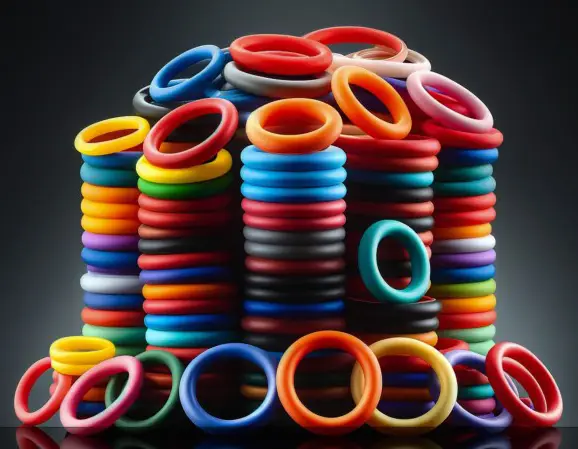
A silicone O-ring is an elastomeric sealing component with a circular cross-section manufactured from silicone rubber. The polymer backbone of silicone rubber contains alternating silicon and oxygen atoms, commonly described as a siloxane structure. This molecular structure contributes to the material’s characteristic thermal stability and flexibility.
Many industrial silicone O-rings are produced from silicone elastomers based on polydimethylsiloxane chemistry. The final performance depends on the complete compound formulation, including polymer type, reinforcing fillers, pigments, curing system, processing conditions, and any additives used to achieve specific mechanical or regulatory properties.
Silicone O-rings create a seal by being compressed between mating surfaces. The elastic material deforms to fill controlled gaps and generate contact pressure. In service, system pressure may further energize the seal by increasing the force acting on the O-ring.
The sealing mechanism depends on several factors:
- O-ring cross-section
- Groove dimensions
- Compression percentage
- Material hardness
- Elastic recovery
- Surface finish
- Fluid pressure
- Temperature
- Static or dynamic movement
For this reason, an O-ring should be evaluated as part of a complete sealing system rather than as an isolated component.
Why Silicone O-Rings Provide Unique Value
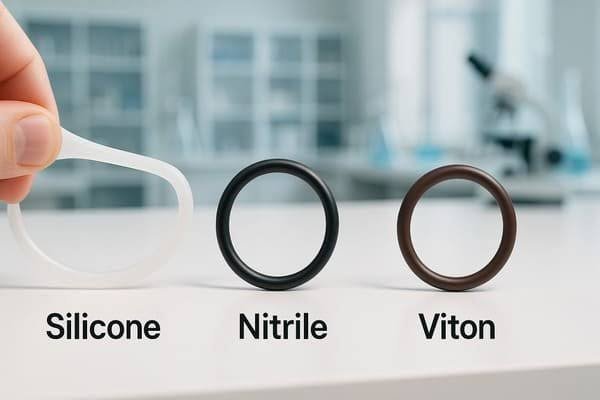
The popularity of silicone O-rings is strongly connected to their ability to remain flexible over a broad temperature range. Many conventional elastomers become increasingly stiff as temperature decreases. Silicone compounds can often retain useful flexibility at lower temperatures, although the exact minimum service temperature depends on the compound and application.
At elevated temperatures, silicone can also maintain useful elastic properties where some general-purpose elastomers may experience accelerated aging. The actual upper temperature limit depends on the compound, exposure duration, oxygen availability, pressure, and contact media.
Silicone also offers useful resistance to:
- ☀️ Ultraviolet exposure
- 🌦 Outdoor weathering
- ⚡ Ozone exposure
- 🌬 Atmospheric aging
- 🌡 Repeated temperature changes
- 🔌 Many electrical insulation environments
These characteristics make silicone especially valuable in applications where environmental stability is important.
Silicone O-Ring Material Properties
Silicone O-ring properties vary by formulation. Published material values should therefore be treated as representative ranges rather than guaranteed values for every silicone compound.
| Property | Typical Engineering Significance |
|---|---|
| Shore A hardness | Influences compression force, conformity, installation, and extrusion resistance |
| Tensile strength | Indicates resistance to tensile loading under standardized test conditions |
| Elongation | Indicates the ability to stretch before rupture in a controlled test |
| Compression set | Indicates permanent deformation after controlled compression exposure |
| Thermal stability | Supports use across broad temperature conditions |
| Thermal conductivity | Influences heat transfer through the elastomer |
| Environmental resistance | Supports outdoor and ozone-exposed applications |
Actual material properties should be confirmed using the supplier’s compound-specific technical data and, when required, application testing.
Silicone O-Ring Hardness and Seal Performance
Silicone O-rings are commonly available in a range of Shore A hardness levels. Softer compounds may provide improved conformity to surface irregularities and may require lower assembly force. Harder compounds may provide greater resistance to deformation and may be considered where pressure or clearance conditions increase the risk of extrusion.
Hardness alone does not determine seal quality. The same nominal hardness can produce different behavior when compounds have different filler systems, curing chemistry, compression-set performance, or tensile properties.
Common hardness standards include ASTM D2240 and relevant ISO 48 methods. The selected test method and specimen geometry can affect reported values.
⚙ Expert Tip: Select hardness together with groove geometry, pressure, clearance gap, temperature, and motion. Increasing hardness without correcting excessive clearance may not prevent extrusion.
Temperature Resistance of Silicone O-Rings
Temperature performance is one of the most important reasons engineers select silicone O-rings. Many silicone compounds can remain flexible over a broader temperature range than common general-purpose elastomers.
Typical temperature capability is often described using broad reference ranges, but actual limits must be verified for the specific compound. A general silicone formulation may be suitable for approximately −60°C to +200°C in some applications, while specialized formulations may differ. These values are not universal ratings and should not be used as guaranteed service limits.
| Temperature Condition | Potential Silicone Behavior |
|---|---|
| Very low temperature | Many silicone compounds retain useful flexibility |
| Moderate operating temperature | Stable elastic sealing performance when properly designed |
| High temperature | Useful thermal stability, subject to compound and exposure conditions |
| Extreme temperature cycling | Thermal expansion, compression set, and system tolerances require evaluation |
Temperature alone is not sufficient for material selection. A silicone O-ring exposed to high temperature in air may behave differently from one exposed to high temperature in oil, steam, vacuum, pressure, or an aggressive chemical.
Low-Temperature Flexibility
Low-temperature flexibility is a major advantage of silicone. In cold environments, a seal must remain sufficiently elastic to maintain contact pressure and compensate for dimensional changes in the sealing assembly.
Potential applications include:
- Cold-storage equipment
- Outdoor electrical enclosures
- Refrigeration systems
- Aerospace components
- Low-temperature instrumentation
- Climate-exposed industrial equipment
Low-temperature performance should be evaluated using the actual compound because formulation, hardness, and curing system can affect flexibility.
Thermal Conductivity and Heat Transfer
Silicone rubber generally has low thermal conductivity compared with metals. Representative unfilled silicone elastomers may have thermal conductivity values in the approximate range of 0.15 to 0.25 W/m·K, although the actual value depends on the compound, filler content, density, and test method.
This relatively low conductivity means that silicone is generally a thermal insulator rather than an efficient heat conductor.
For an illustrative one-dimensional heat-transfer estimate:
Heat Flow Rate = Thermal Conductivity × Area × Temperature Difference ÷ Thickness
For example, assume a silicone layer with an illustrative thermal conductivity of 0.20 W/m·K, an area of 0.01 m², a temperature difference of 20 K, and a thickness of 0.002 m:
Q = 0.20 × 0.01 × 20 ÷ 0.002 = 20 W
This calculation demonstrates the engineering relationship only. Real O-ring heat transfer is more complex because the contact area, compression, interface resistance, geometry, and surrounding materials influence the result.
Chemical Resistance of Silicone O-Rings
Silicone has useful resistance to many environmental conditions, but it is not universally resistant to all chemicals. Chemical compatibility must be evaluated for the exact compound and operating environment.
Silicone may perform well in many applications involving:
- Water-based environments
- Outdoor atmospheric exposure
- Ozone
- Ultraviolet exposure
- Some dilute chemical solutions
- Application-specific food or medical environments
Silicone may not be the preferred material for prolonged exposure to many petroleum oils, fuels, hydrocarbons, or certain solvents. Swelling, softening, strength loss, or dimensional changes may occur depending on the fluid and temperature.
For oil-intensive applications, materials such as NBR or FKM may be more appropriate, depending on the complete operating conditions.
Silicone O-Rings Compared with Other Elastomers
| Material | Key Advantage | Important Limitation |
|---|---|---|
| Silicone | Wide temperature flexibility and environmental resistance | May have lower abrasion and tear resistance than some alternatives |
| NBR | Good resistance to many petroleum-based oils | More limited weathering and low-temperature performance |
| FKM | High-temperature and chemical resistance | Higher cost and compound-dependent low-temperature limitations |
| EPDM | Water, steam, ozone, and weather resistance | Generally unsuitable for many petroleum oils |
| Fluorosilicone | Improved fuel and oil resistance with silicone-like temperature performance | Higher cost and application-specific mechanical limitations |
Material selection should be based on the complete operating environment rather than a single property comparison.
Silicone O-Rings in Food and Beverage Equipment
Silicone is commonly considered for food and beverage equipment because specialized formulations can be manufactured to meet applicable food-contact requirements. These applications may include processing equipment, dispensing systems, beverage machinery, filling equipment, and sanitary connections.
Compliance should never be assumed solely because an O-ring is described as silicone. The specific compound, colorant, additives, manufacturing controls, and applicable regulatory requirements must be verified.
Potential requirements may involve:
- FDA food-contact regulations
- EU food-contact requirements
- Specific customer material specifications
- Migration or extractables testing
- Traceability documentation
A material declaration should identify the exact compound and applicable compliance basis.
Silicone O-Rings in Medical Applications
Medical and healthcare applications may use specialized silicone compounds because of their flexibility, thermal stability, and suitability for carefully controlled formulations.
Potential applications include:
- Medical devices
- Laboratory equipment
- Fluid-handling components
- Diagnostic instruments
- Disposable or reusable device assemblies
Medical suitability is application-specific. A general-purpose silicone O-ring should not automatically be considered medical grade.
Relevant requirements may include biocompatibility evaluation, extractables and leachables analysis, sterilization compatibility, traceability, and controlled manufacturing.
Silicone O-Rings in Electrical and Electronic Equipment
Silicone O-rings are commonly used in electrical enclosures because they can maintain flexibility under environmental exposure and provide useful electrical insulation properties.
Typical applications include:
- Outdoor control cabinets
- Lighting equipment
- Electrical junction boxes
- Sensor housings
- Battery enclosures
- Telecommunications equipment
Electrical enclosure performance depends on the complete design, including compression, groove geometry, housing stiffness, fastener load, surface condition, and environmental exposure.
Silicone O-Rings in Aerospace Applications
Aerospace applications often involve large temperature changes, low-pressure conditions, vibration, and strict material requirements. Silicone may be selected because of its broad temperature flexibility and environmental stability.
However, aerospace sealing requires application-specific qualification. Material selection may involve low-temperature testing, outgassing requirements, flammability, fluid compatibility, pressure cycling, and traceability.
General silicone properties should not be used as proof of aerospace qualification.
Silicone O-Ring Standards and Test Methods
Several ASTM and ISO standards may be relevant when evaluating silicone O-ring materials and dimensions.
- ASTM D2000: Classification system for rubber products used in automotive applications
- ASTM D2240: Durometer hardness testing
- ASTM D395: Compression-set testing
- ASTM D412: Tensile properties and elongation
- ASTM D471: Effects of liquids on rubber properties
- ASTM D573: Rubber deterioration in an air oven
- ISO 3601: O-ring dimensions, tolerances, and quality requirements
- ISO 48: Rubber hardness measurement
- ISO 815: Compression-set testing
- ISO 1817: Effects of liquids on vulcanized rubber
The correct test standard depends on the product specification and application. A test result should always identify the test method, temperature, duration, specimen condition, and acceptance criteria.
Compression and Silicone O-Ring Sealing
O-ring compression is commonly calculated using the original cross-section and installed gland height.
Compression (%) = (Original Cross-Section − Installed Height) ÷ Original Cross-Section × 100%
For an illustrative example, consider a silicone O-ring with an original cross-section of 3.50 mm installed into a gland with an effective compressed height of 2.80 mm:
Compression = (3.50 − 2.80) ÷ 3.50 × 100% = 20%
This is a mathematical example only. Actual compression requirements depend on static or dynamic service, pressure, hardness, gland design, thermal expansion, and applicable engineering guidance.
Compression Set and Long-Term Reliability
Compression set is an important property because an O-ring must maintain sufficient elastic recovery throughout service.
Compression set may be influenced by:
- Temperature
- Compression level
- Exposure duration
- Compound formulation
- Curing conditions
- Contact fluid
ASTM D395 and ISO 815 provide established methods for evaluating compression-set behavior under controlled laboratory conditions.
Laboratory compression-set results are useful for comparing compounds but should not be converted directly into guaranteed equipment life. Real service conditions may include pressure cycling, thermal cycling, vibration, fluid exposure, and manufacturing tolerances.
Case Example: Silicone O-Ring for a High-Temperature Electrical Enclosure
Case Example — Illustrative Industry Experience
Consider an outdoor electrical enclosure exposed to high summer temperatures, low winter temperatures, ultraviolet radiation, rain, and repeated thermal cycling. A silicone O-ring may be evaluated because it can retain flexibility over a broad temperature range and offers useful resistance to weathering and ozone.
The engineering review would include the enclosure material, groove dimensions, cover stiffness, fastener spacing, compression distribution, temperature range, ultraviolet exposure, and required ingress-protection performance.
If leakage occurs after field exposure, the investigation should examine compression loss, uneven cover loading, damaged surfaces, permanent deformation, assembly errors, and possible contamination.
This case is an illustrative engineering example based on common industry practice. It does not describe a real customer, a verified factory test, or a guaranteed service-life result.
Laboratory Test Example for Silicone O-Rings
Laboratory Test Example — Demonstration Only
A laboratory evaluation may include hardness measurement, tensile testing, elongation testing, compression-set testing, heat aging, fluid immersion, dimensional inspection, and visual examination.
For an illustrative compression-set calculation, assume a specimen has an original thickness of 10.0 mm, is compressed to 7.5 mm, and measures 8.2 mm after recovery.
Compression Set (%) = (Original Thickness − Recovered Thickness) ÷ (Original Thickness − Compressed Thickness) × 100%
Compression Set = (10.0 − 8.2) ÷ (10.0 − 7.5) × 100% = 72%
This example demonstrates the calculation method only. It is not a recommended performance value and does not represent a real factory result.
Actual test conditions, specimen geometry, temperature, exposure duration, and standard requirements must be defined before interpreting the result.
Failure Mode Analysis of Silicone O-Rings
Failure Mode Analysis — Illustrative Engineering Example
Permanent flattening: May indicate excessive compression, thermal aging, long-term stress, or unsuitable compression-set performance.
Extrusion: May be associated with excessive pressure, large clearance gaps, insufficient hardness, or unsuitable gland design.
Swelling: May indicate exposure to an incompatible oil, fuel, solvent, or chemical.
Surface cracking: May result from severe thermal aging, chemical attack, mechanical stress, or unsuitable environmental conditions.
Tearing: May be caused by sharp edges, excessive stretching, rough surfaces, or unsuitable dynamic operation.
Leakage without visible damage: May indicate insufficient compression, uneven clamping force, dimensional variation, or surface defects.
This failure analysis is an illustrative industry example. It does not represent a real customer investigation or fabricated test result.
Common Silicone O-Ring Failure Modes
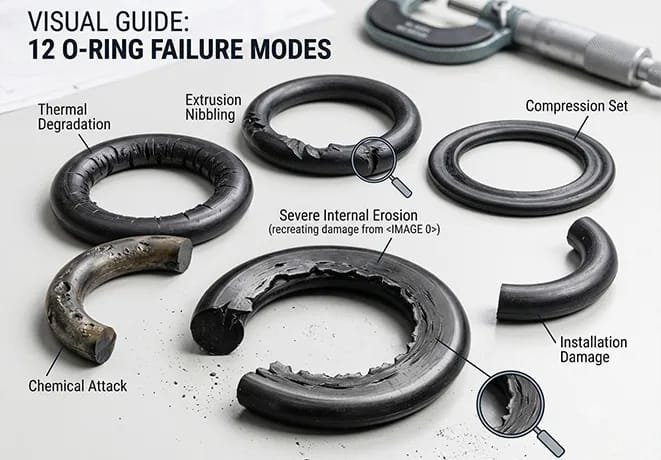
1. Compression Set
Long-term compression or elevated temperature may reduce elastic recovery. The O-ring can become permanently flattened and may lose contact pressure.
2. Chemical Swelling
Exposure to incompatible fluids may change the dimensions and mechanical properties of silicone. Swelling can increase friction, alter compression, or cause assembly difficulties.
3. Extrusion Damage
High pressure can force the elastomer into clearance gaps. Repeated pressure cycles may cause nibbling or material loss.
4. Mechanical Tearing
Silicone may have lower tear and abrasion resistance than some specialized elastomers. Sharp edges, rough surfaces, and excessive installation force can cause damage.
5. Installation Damage
Cuts, twisting, pinching, and contamination introduced during installation can create leakage paths.
Silicone O-Ring Installation Guide
Correct installation is essential for seal reliability.
- 🔍 Inspect the O-ring before installation.
- 🧹 Clean the groove and mating surfaces.
- 🛠 Remove burrs and sharp edges.
- 🧴 Use a compatible lubricant when permitted.
- 🔄 Avoid twisting the O-ring.
- 📏 Prevent excessive stretching.
- 🧩 Use suitable installation tools.
- ✔ Confirm that the O-ring is seated evenly.
Installation Warning: Silicone can be damaged by sharp threads, keyways, corners, or rough surfaces. Use installation sleeves or protective tools when the seal must pass over discontinuities.
Surface Finish and Silicone O-Ring Performance
Surface finish affects leakage, friction, wear, and long-term seal reliability.
Potential surface problems include:
- Longitudinal scratches
- Sharp machining marks
- Burrs
- Pitting
- Corrosion
- Surface contamination
A surface that is too rough may abrade the O-ring. A surface with deep scratches may create leakage paths. Surface requirements should be selected according to the application and applicable design guidance.
How to Select the Right Silicone O-Ring
| Selection Question | Engineering Importance |
|---|---|
| What is the minimum temperature? | Determines low-temperature flexibility requirements |
| What is the maximum temperature? | Determines thermal-aging and compression-set requirements |
| What fluid contacts the seal? | Determines chemical compatibility |
| Is the seal static or dynamic? | Determines friction, wear, and mechanical requirements |
| What pressure is applied? | Determines extrusion risk and possible backup-ring needs |
| Is regulatory compliance required? | May require specific compound documentation and testing |
| Will the seal be exposed outdoors? | Weathering and ultraviolet resistance become important |
Static and Dynamic Silicone O-Ring Applications
Silicone O-rings are often well suited to static sealing applications because static seals generally experience less friction and abrasion than dynamic seals.
Typical static applications include:
- Electrical enclosures
- Cover seals
- Flange connections
- Sensor housings
- Laboratory equipment
- Food-processing components
Dynamic applications require additional evaluation because repeated motion can increase friction, wear, heat generation, and mechanical stress.
For high-speed or abrasive dynamic applications, alternative materials may provide better wear resistance.
Silicone O-Rings and Environmental Resistance
Silicone’s resistance to ozone and weathering makes it useful for outdoor and environmentally exposed equipment.
Unlike some elastomers that can crack after prolonged ozone exposure, silicone generally maintains useful stability under atmospheric conditions.
However, outdoor performance still depends on the complete assembly. Water can enter through poor compression, damaged surfaces, uneven fastener loading, or incorrect groove dimensions even when the O-ring material itself has strong weather resistance.
The Economic Value of Silicone O-Rings
Silicone O-rings may cost more than some general-purpose rubber materials, but the material can provide value when its unique properties reduce failure risk.
Total sealing cost may include:
- Material cost
- Installation labor
- Maintenance requirements
- Equipment downtime
- Leakage risk
- Product contamination
- Replacement frequency
A lower-cost material may create higher lifecycle costs if it becomes brittle at low temperature, ages rapidly at elevated temperature, or fails under environmental exposure.
Silicone can therefore be economically valuable when its temperature and environmental capabilities match the application.
Expert Tips for Silicone O-Ring Selection
Expert Tip 1: Verify the complete temperature range, including startup, shutdown, storage, and abnormal conditions.
Expert Tip 2: Do not assume all silicone compounds have identical chemical resistance.
Expert Tip 3: For oil or fuel exposure, evaluate compatibility carefully and compare silicone with fluorosilicone, NBR, or FKM where appropriate.
Expert Tip 4: Use compound-specific documentation when food-contact, medical, aerospace, or electrical requirements apply.
Expert Tip 5: Investigate failed seals using the complete assembly conditions rather than replacing the material based only on appearance.
The Long-Term Value of Silicone O-Rings
Silicone O-rings remain valuable because many modern systems operate across wider temperature ranges and face increasingly demanding environmental conditions.
Electrical equipment, renewable-energy systems, transportation components, laboratory instruments, food-processing equipment, medical devices, and outdoor industrial machinery may all benefit from silicone’s combination of flexibility and environmental stability.
The correct application of silicone requires a complete engineering review. Material selection should include temperature, pressure, fluid compatibility, mechanical movement, groove geometry, surface finish, regulatory requirements, and expected service conditions.
When the compound and sealing design are properly matched to the application, silicone O-rings can provide reliable performance and long-term value.
For product information and available configurations, review Silicone O-Rings and compare the material requirements with the actual operating environment.
Frequently Asked Questions
1. What are Silicone O-Rings used for?
Silicone O-rings are used in applications requiring broad temperature flexibility, environmental resistance, electrical insulation, or specialized food, medical, and industrial performance. Common applications include electrical enclosures, laboratory equipment, food-processing systems, automotive components, and outdoor equipment.
2. What temperature can Silicone O-Rings withstand?
Many silicone compounds can operate across a broad temperature range, with some general formulations commonly described around approximately −60°C to +200°C. Actual limits depend on the compound, exposure duration, pressure, fluid, and application. Always verify the compound-specific temperature rating.
3. Are Silicone O-Rings resistant to oil?
Silicone is not universally resistant to petroleum oils and fuels. Some oils and hydrocarbons may cause swelling or property changes. For oil-intensive applications, NBR, FKM, or fluorosilicone may be more appropriate depending on the operating conditions.
4. Are Silicone O-Rings suitable for food or medical applications?
Specialized silicone compounds may be suitable for food-contact or medical applications, but suitability must be verified for the exact compound and regulatory requirement. General-purpose silicone should not automatically be considered food-grade or medical-grade.
5. Why should Silicone O-Rings be selected instead of NBR O-Rings?
Silicone may be preferred when low-temperature flexibility, high-temperature stability, ozone resistance, weathering resistance, or specialized regulatory requirements are important. NBR may be more suitable for many petroleum-oil applications and can offer stronger cost efficiency and mechanical durability in those environments.