Choosing between NBR and FKM rubber is an important decision when specifying oil seals, O-rings, gaskets and other industrial sealing components. Although both elastomers are widely used in applications involving oils and fuels, they differ in temperature capability, chemical compatibility, resistance to environmental aging, low-temperature flexibility and material cost.
NBR, also known as nitrile rubber or Buna-N, is widely selected for general-purpose oil and hydraulic sealing. FKM, a family of fluoroelastomers often associated with the Viton® brand, is commonly used when higher temperatures or resistance to particular aggressive fluids are required.
However, FKM is not automatically a better choice for every application. The correct material depends on the actual fluid, temperature, pressure, motion, service life and compound formulation.
Quick answer: Choose NBR when its oil resistance, temperature capability and mechanical properties meet the application requirements at an economical cost. Consider FKM when higher-temperature performance, ozone resistance or compatibility with specific fuels and chemicals justifies the additional cost. Always verify the exact compound before approving a seal.
What Is NBR Rubber?
Nitrile butadiene rubber (NBR) is a synthetic elastomer made from acrylonitrile and butadiene. It is widely used in oil seals, O-rings, hydraulic components, fuel-system parts and general industrial sealing products.
One of NBR’s main advantages is its resistance to many petroleum-based oils and fuels. Its performance depends partly on acrylonitrile (ACN) content, which influences oil resistance, low-temperature flexibility and other physical properties.
Higher-ACN NBR grades generally offer improved resistance to swelling in many oils and hydrocarbons, but they can have reduced flexibility at low temperatures. Lower-ACN formulations may provide better low-temperature performance, although oil compatibility must be checked carefully.
Key Advantages of NBR
- Oil resistance: Suitable for many mineral oils, lubricants and petroleum-based fluids.
- Cost efficiency: Often an economical choice for high-volume sealing applications.
- Mechanical properties: Provides useful elasticity, tensile strength and wear resistance in properly formulated compounds.
- Wide availability: Commonly available in O-rings, rotary shaft seals, gaskets and molded rubber parts.
- Compound flexibility: Different grades can be formulated for specific hardness, temperature and application requirements.
Limitations of NBR
Standard NBR generally has more limited resistance to ozone, outdoor weathering and sustained elevated temperatures than FKM. Certain aromatic hydrocarbons, aggressive chemicals and specialized synthetic fluids can also create compatibility problems.
NBR should therefore be selected according to the actual service environment rather than the general label “oil-resistant rubber.”
What Is FKM Rubber?
FKM is the ASTM D1418 designation commonly used for a family of fluorocarbon elastomers. The ISO designation FPM is also encountered in industry. Viton® is a trademark associated with particular fluoroelastomer products, not the generic name for every FKM compound.
FKM is frequently selected for demanding sealing applications because many grades provide excellent resistance to heat, ozone, weathering, mineral oils, fuels and a broad range of chemicals.
However, FKM is not one uniform material. Fluorine content, polymer structure, cure system and compound formulation can significantly affect its performance. A standard FKM grade may behave very differently from a grade designed for low-temperature service, aggressive chemicals or specialized fuels.
Key Advantages of FKM
- Higher temperature capability: Many grades can withstand temperatures beyond the typical range of standard NBR.
- Chemical resistance: Offers excellent compatibility with many oils, fuels and industrial chemicals when the grade is correctly selected.
- Ozone and weather resistance: Generally performs well in environments where conventional NBR can age or crack.
- Long-term sealing potential: Can provide durable service under suitable thermal and chemical conditions.
- Industrial versatility: Used in automotive, machinery, chemical-processing and other demanding sealing applications.
Limitations of FKM
FKM usually costs more than standard NBR and may offer less low-temperature flexibility than a suitably selected low-temperature NBR grade. Some FKM formulations also perform poorly with particular ketones, esters, amines, hot-water conditions or other incompatible media.
For this reason, FKM should not be described as resistant to every chemical. Compatibility must be verified against the exact fluid, concentration, temperature and compound.
NBR vs FKM: Main Differences at a Glance
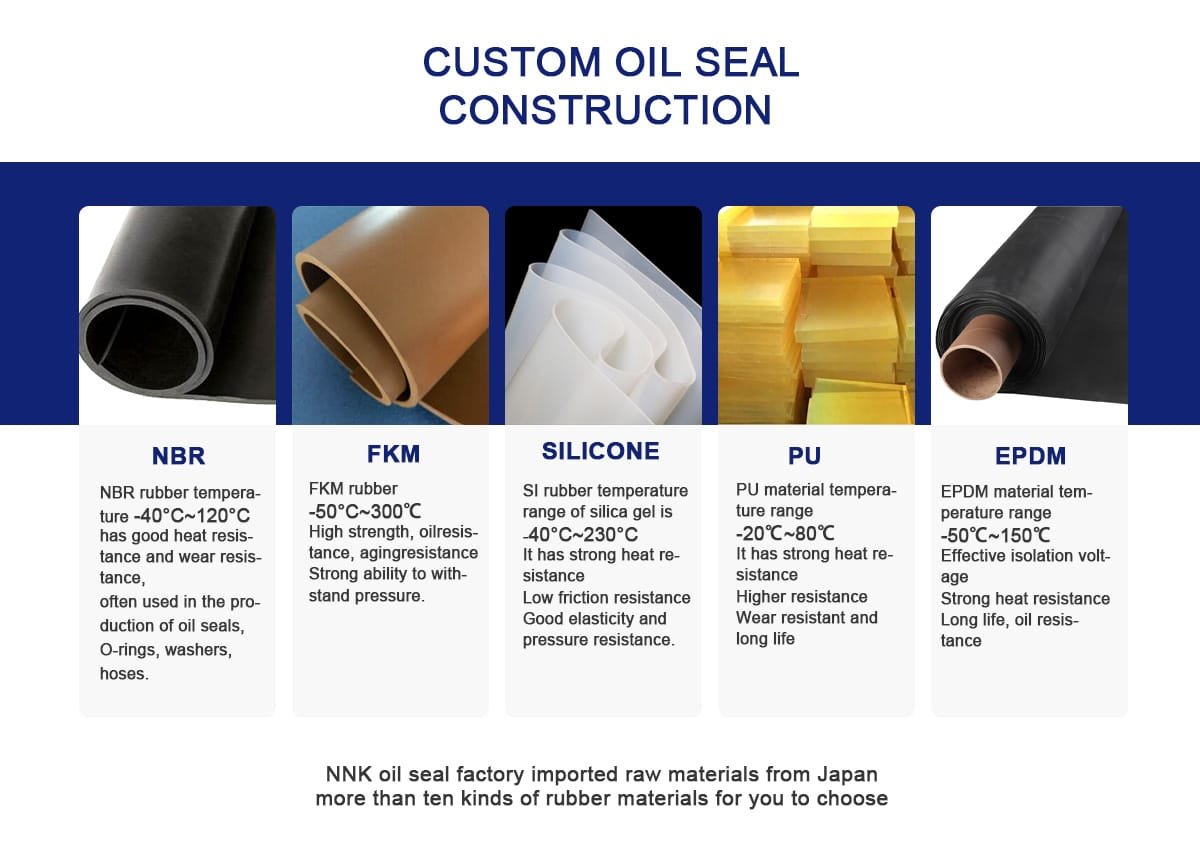
The following table provides a general comparison. These are broad material-family characteristics, not guaranteed specifications for every commercially available compound.
| Property | NBR | FKM |
|---|---|---|
| Primary advantage | Economical oil-resistant sealing | Heat and chemical resistance for demanding applications |
| Petroleum oils | Generally good to excellent | Generally good to excellent |
| Temperature capability | Moderate; grade dependent | Typically higher for standard high-temperature grades |
| Low-temperature flexibility | Can be very good with suitable grades | Depends strongly on grade; standard grades may be limited |
| Ozone and weathering | Generally limited without suitable protection | Generally excellent |
| Fuel resistance | Good for many fuels; formulation matters | Often excellent for many fuels; verify fuel blend |
| Ketones and esters | Often poor | Many standard grades are also unsuitable for certain ketones and esters |
| Relative material cost | Usually lower | Usually higher |
| Common applications | Hydraulic seals, oil seals, O-rings and general machinery | Hot-oil seals, automotive components and demanding industrial applications |
For a more detailed fluid-by-fluid assessment, consult the Parker O-Ring Handbook, which provides compound compatibility ratings across a range of elastomer families and fluids.
How to Distinguish NBR and FKM Rubber
When an old O-ring or oil seal has no label, it can be difficult to determine its material. Visual inspection may provide clues, but no simple appearance-based method can reliably confirm whether a part is NBR or FKM.
Method 1: Check the Part Number and Documentation
The most reliable first step is to locate the original part number, material code, supplier specification, drawing or certificate of conformity.
Check whether the documentation identifies NBR, FKM/FPM, a compound designation, hardness, temperature requirements or a customer-specific material standard.
For replacement seals, a documented material specification is much more useful than relying on the appearance of an old part.
Method 2: Use Color Only as a Preliminary Clue
NBR is commonly supplied in black, while FKM may be black, brown, green or another color depending on the formulation and manufacturer.
However, both materials can be manufactured in similar colors. Pigments, fillers, coatings, aging and supplier-specific color conventions can make identification even more difficult.
Identification rule: A black O-ring is not necessarily NBR, and a brown or green O-ring is not necessarily FKM. Color can help organize known parts, but it cannot establish polymer identity or chemical compatibility.
Method 3: Do Not Rely on Touch or Hardness Alone
Some FKM compounds may feel firmer than some NBR compounds, but hardness varies with formulation, cure system, filler content and Shore A rating.
A 90 Shore A NBR part can feel harder than a 70 Shore A FKM part. Aging, heat exposure and chemical swelling can also change the feel of a used seal.
Therefore, hand-feel is not a reliable way to identify the polymer family. If hardness is important, measure it using an appropriate durometer and compare the result with the specified compound requirements.
Method 4: Review Performance History Carefully
Failure history can help narrow down possible material problems. For example, rapid swelling in a particular fluid may suggest incompatibility, while surface cracking after ozone exposure may indicate that the compound is unsuitable for the environment.
However, these symptoms are not unique to one polymer. Incorrect temperature, excessive compression, poor storage, installation damage and incompatible fluids can affect both NBR and FKM.
Use service history as diagnostic evidence, not as definitive material identification.
Method 5: Request Laboratory Material Identification
If material identity affects safety, product approval, warranty or critical equipment performance, laboratory analysis is the appropriate next step.
Depending on the question, a qualified laboratory may use methods such as FTIR spectroscopy, thermogravimetric analysis or other polymer-identification techniques. These methods can help identify the polymer family or distinguish formulation characteristics, but the test plan should be selected by the laboratory for the sample and the required level of certainty.
Do not use open-flame burning or uncontrolled chemical immersion as a home identification test. Such tests can produce hazardous decomposition products, damage samples and still fail to identify the exact compound reliably.
NBR vs FKM Temperature Range
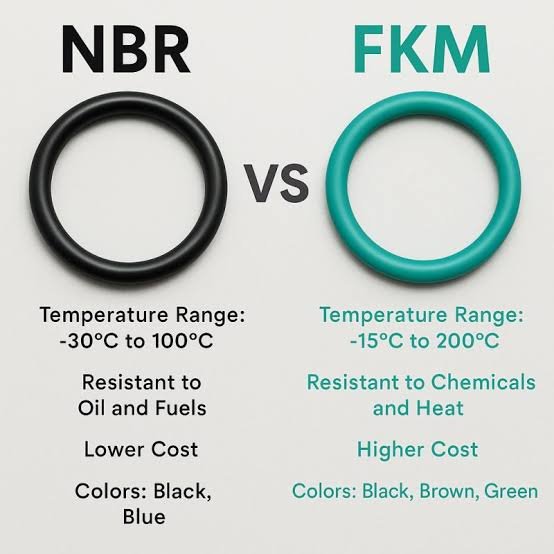
Temperature capability is one of the main reasons engineers compare NBR and FKM. Nevertheless, a material’s temperature range is not a single universal number.
As a broad screening reference, many standard NBR compounds are used around -30°C to +100°C or +120°C, while many standard FKM compounds are used at elevated temperatures approaching +200°C. Some specially formulated grades operate outside these approximate ranges.
These figures are not interchangeable with a product’s certified operating limits. A seal exposed to hot oil, shaft friction or rapid temperature cycling may behave differently from a static specimen tested in air.
What Determines the Actual Temperature Limit?
- Compound formulation: Different recipes within the same polymer family can have different aging and flexibility characteristics.
- Fluid exposure: Oil, fuel, additives and chemicals may change the material’s performance at elevated temperatures.
- Continuous versus intermittent operation: Short exposure and continuous service are not equivalent.
- Mechanical loading: Compression, friction and pressure can accelerate deterioration.
- Low-temperature requirements: A seal must remain sufficiently flexible at the minimum operating or start-up temperature.
- Required service life: A material that survives a brief test may not meet long-term sealing requirements.
When reviewing temperature limits, request the compound data sheet and confirm whether the stated limits apply to continuous service, intermittent exposure or a specific test environment.
NBR vs FKM Oil Resistance
Both NBR and FKM can be excellent choices for oil-sealing applications, but their performance depends on the oil formulation, temperature and elastomer grade.
When NBR Is a Good Choice
NBR is widely used for mineral oils, many hydraulic fluids, greases and petroleum-based lubricants. It is often suitable for machinery and automotive sealing where temperature requirements remain within the chosen compound’s limits.
For many cost-sensitive applications, upgrading to FKM may not provide a meaningful benefit if the existing NBR compound already meets the required swelling, aging and sealing-performance limits.
When FKM May Be Preferable
FKM is frequently considered for hot oils, demanding fuel exposure and applications where improved chemical or environmental resistance is required.
However, the phrase “fuel resistant” is not enough to approve a compound. Gasoline blends, oxygenated fuels, biodiesel mixtures, additives and aromatic content can influence swelling and long-term performance.
Always confirm compatibility with the actual fluid specification rather than assuming that all fuels or synthetic oils behave identically.
Chemical Compatibility: Why FKM Is Not Universal
One common material-selection mistake is assuming that FKM resists every aggressive chemical while NBR is suitable only for ordinary oil.
In reality, both materials have compatibility limits. Standard FKM grades may be unsuitable for certain ketones, esters, amines, hot-water conditions and other specific media. NBR may be unsuitable for some aromatic solvents, oxidizing chemicals and fluids outside its compatibility range.
Compatibility must be checked using the exact chemical, concentration, temperature, exposure duration and compound.
| Service Medium | NBR Considerations | FKM Considerations |
|---|---|---|
| Mineral oil | Often suitable | Often suitable |
| Hydraulic fluid | Depends on fluid type and additives | Depends on fluid type and compound |
| Gasoline and fuel blends | Verify blend and swelling requirements | Often advantageous, but verify blend |
| Aromatic hydrocarbons | May swell significantly | Often better resistance, grade dependent |
| Ketones such as MEK | Generally poor compatibility | Many standard grades are also unsuitable |
| Hot water or steam | Check temperature and exposure carefully | Standard grades may be unsuitable; verify the specific formulation |
This table is a preliminary guide only. For critical equipment, consult the Parker O-Ring Handbook and request confirmation from the compound supplier.
NBR vs FKM for Oil Seals
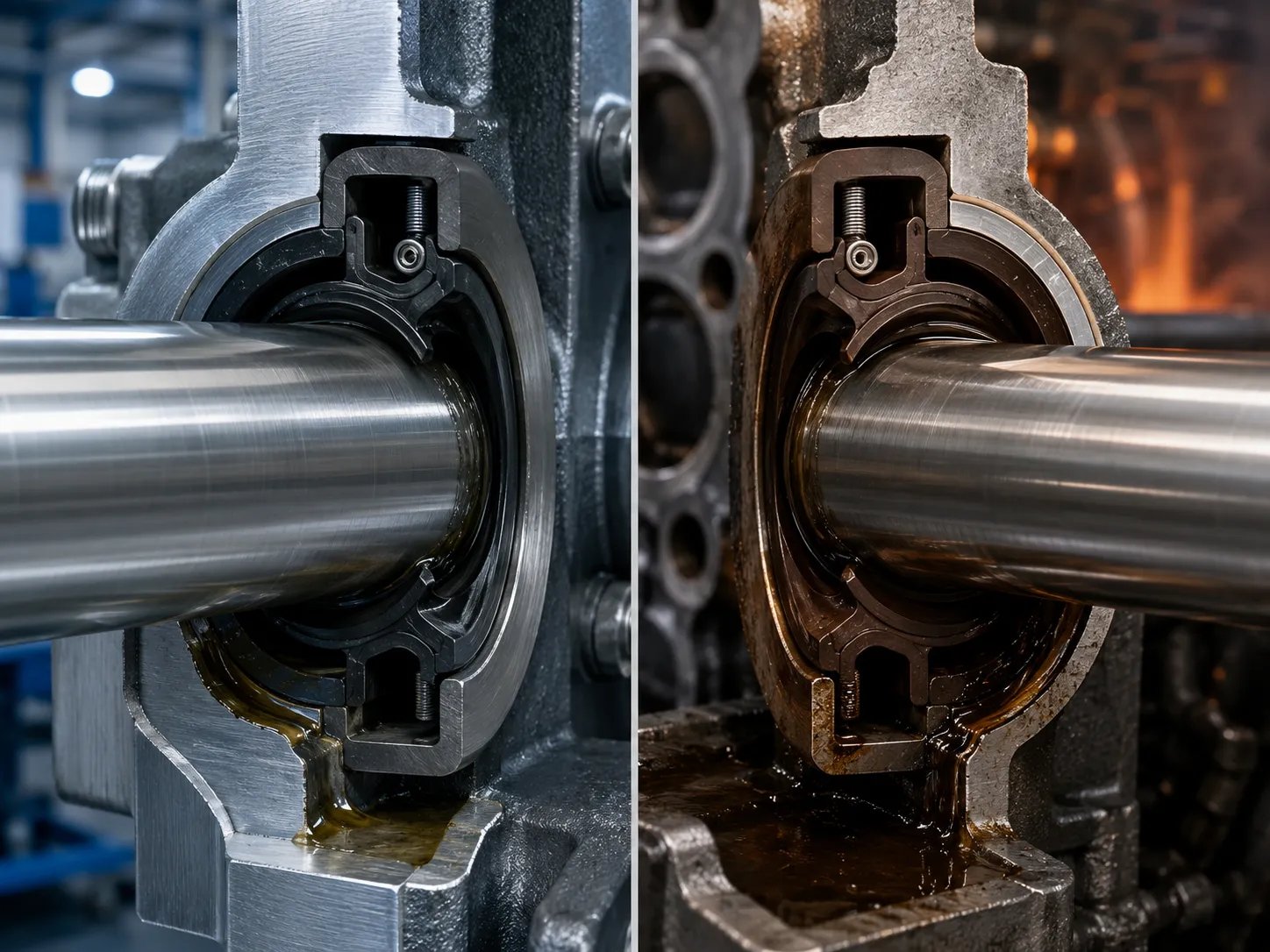
Oil seals are dynamic sealing components that retain lubricant around rotating shafts. Material selection must account for more than chemical resistance because the sealing lip is subject to friction, wear and temperature rise.
NBR Oil Seals
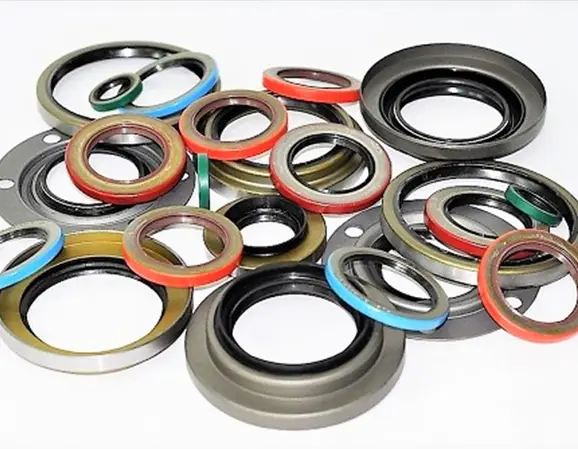
NBR oil seals are commonly used in gearboxes, pumps, motors, agricultural machinery, general industrial equipment and automotive applications where the selected compound can withstand the operating environment.
They can be an economical solution when the lubricant is compatible, the temperature is within specification and the shaft surface and installation conditions are suitable.
FKM Oil Seals
FKM oil seals are often selected for hot-oil applications, demanding automotive environments and machinery exposed to particular fuels or chemicals.
The additional material cost may be justified when it improves resistance to thermal aging or fluid attack. But an FKM lip can still fail prematurely if the shaft is worn, lubrication is inadequate, the installation is incorrect or the seal is used beyond its pressure and speed limits.
Oil Seal Selection Checklist
- Confirm shaft diameter, housing bore and seal width.
- Identify the exact oil or fluid.
- Confirm minimum, continuous and maximum temperature.
- Determine shaft speed and operating duty.
- Check the shaft surface finish and runout.
- Confirm the lip design, spring arrangement and dust-exclusion requirements.
- Check whether the application has pressure beyond the seal’s intended design.
- Verify the material designation and compound specification.
NBR vs FKM for O-Rings
NBR and FKM are both commonly used for O-rings, but the correct choice depends on the application rather than the O-ring shape.
NBR O-rings are widely used in hydraulic fittings, pneumatic equipment, pumps, valves and general industrial machinery. They are often selected for petroleum-based fluids and cost-sensitive applications.
FKM O-rings are frequently used in higher-temperature systems, fuel-handling equipment, automotive assemblies and applications requiring resistance to particular chemicals or outdoor exposure.
When choosing an O-ring, confirm its inside diameter, cross-section, hardness, gland design, compression, pressure and installation conditions. A compatible compound can still leak if the groove is incorrectly designed or the O-ring is damaged during assembly.
Common Signs of Incorrect Material Selection
Premature seal failure may indicate that the material does not match the application, but the physical appearance alone cannot identify the exact root cause.
Excessive Swelling
Swelling may indicate fluid incompatibility. It can change seal dimensions, increase friction and affect the ability of the component to remain correctly positioned in its groove or housing.
Hardening or Loss of Elasticity
Hardening may result from thermal aging, chemical exposure or long-term compression. Verify the actual temperature and the specified compound before changing materials.
Cracking or Surface Deterioration
Cracking can be associated with heat, ozone, environmental exposure, chemical attack or installation damage. It is not proof that the failed part was NBR or FKM.
Repeated Leakage
If a replacement seal fails soon after installation, investigate the shaft, housing, lubricant, temperature, pressure and installation process. Upgrading from NBR to FKM will not correct mechanical damage or an incorrectly designed sealing arrangement.
Practical recommendation: Record the failure mode, operating conditions and actual fluid before selecting a replacement. If the original material is unknown, use documentation or laboratory identification rather than guessing from color.
How to Specify NBR or FKM for Purchasing
For industrial buyers, the polymer name alone is not a complete purchasing specification. A technically useful request for quotation should identify the compound requirements and the sealing application.
Include the following information whenever possible:
- Material: NBR, FKM/FPM or a customer-approved compound designation.
- Hardness: Required Shore A value and tolerance.
- Temperature: Minimum, continuous and peak operating temperature.
- Fluid: Exact oil, fuel, chemical or lubricant specification.
- Dimensions: Seal drawing, nominal dimensions and tolerances.
- Application: Static, reciprocating or rotary sealing.
- Performance: Compression set, tensile properties, swelling limits or other required test results.
- Compliance: Applicable OEM, industry or customer-specific requirements.
- Traceability: Batch identification and documentation, where required.
For automotive rubber products, ASTM D2000 provides a classification system based on heat-aging resistance, oil-swelling resistance and additional properties. The current listing is ASTM D2000-18(2024)e1. When a particular application has requirements beyond the classification, the standard advises the purchaser and supplier to establish the relevant properties, test methods and limits in advance.
Is FKM Worth the Higher Cost?
The answer depends on the cost of failure, not just the purchase price of the seal.
If NBR provides sufficient resistance to the fluid and temperature, FKM may offer little practical benefit. In that situation, NBR can provide an effective balance of performance and cost.
However, if NBR deteriorates because of excessive heat, incompatible fluid or environmental exposure, repeated replacement can increase maintenance labor, equipment downtime, lubricant loss and warranty costs.
In such cases, an appropriately selected FKM compound may offer better long-term value, provided it is compatible with the application.
A better purchasing question
Instead of asking, “Which material is better?”, ask: “Which qualified compound will meet the required service life at the lowest total operating cost?”
Frequently Asked Questions
Can I identify FKM by its brown color?
No. Brown is a common color for some FKM products, but FKM and NBR can both be produced in different colors. Confirm the material through documentation or appropriate testing.
Is FKM always better than NBR?
No. FKM generally offers better high-temperature and ozone performance, along with excellent resistance to many oils and chemicals. NBR may be more economical and may provide better low-temperature flexibility in selected grades. The correct material depends on the complete application.
Can I replace an NBR oil seal with an FKM oil seal?
Sometimes, but not automatically. Confirm dimensions, lip design, fluid compatibility, temperature, shaft speed, installation conditions and the specific FKM compound. Also consider whether the original NBR seal failed because of material limitations or another problem.
Is FKM resistant to all chemicals?
No. Many FKM grades resist a broad range of oils, fuels and chemicals, but certain ketones, esters, amines and other media can attack particular formulations. Check compatibility for the exact compound and service conditions.
Which material is best for hydraulic oil?
NBR is commonly used with many petroleum-based hydraulic oils. FKM may be appropriate for elevated temperatures or particular fluids. Some hydraulic fluids require other materials, so identify the exact fluid specification before selecting a compound.
Does FKM last longer than NBR?
It can last longer when its temperature and chemical resistance better match the application. However, service life also depends on compound quality, compression, shaft condition, installation, lubrication and operating duty. FKM is not guaranteed to outlast NBR in every environment.
Can a simple burn test distinguish NBR from FKM?
It is not recommended. Burning elastomers can release hazardous decomposition products, and the results are not a reliable way to establish the exact polymer or compound. Use traceable documentation or qualified laboratory analysis.
Conclusion: Choose the Compound, Not Just the Polymer Name
NBR and FKM are both important elastomers in modern sealing technology. NBR is often the practical choice for general-purpose oil sealing, hydraulic systems and cost-sensitive applications. FKM is frequently preferred when higher-temperature capability, improved ozone resistance or compatibility with particular demanding fluids is required.
Neither material should be selected based on color, feel or price alone. The decisive factors are the actual operating temperature, fluid chemistry, mechanical conditions, required service life and verified compound properties.
For oil seals, O-rings and other industrial sealing components, a documented material specification is the best starting point for reliable performance. When the application is critical, confirm compatibility with the compound supplier and define the required tests before approving production.
Need help choosing NBR or FKM?
Prepare the seal drawing or dimensions, fluid specification, minimum and maximum temperature, pressure and movement type. This information allows the supplier to assess whether NBR, FKM or another elastomer is the most appropriate option for your application.