
Custom silicone rubber molding transforms a carefully selected elastomer into precision components designed for specific operating conditions. Successful production requires more than a suitable material and a mold. Engineers must coordinate part geometry, tooling design, curing conditions, dimensional requirements, and inspection methods to achieve consistent performance from prototype to mass production.
Define the Application Before Designing the Mold

The most reliable silicone molding projects begin with a clear definition of the component’s intended function. A sealing gasket for industrial equipment, for example, may require resistance to compression set and exposure to oils, while a soft-touch medical component may place greater emphasis on hardness, surface quality, and documented material compliance.
Before requesting a quotation, establish the following requirements:
- Operating environment: Specify minimum and maximum temperatures, exposure duration, humidity, UV exposure, and contact with oils, fuels, cleaning agents, or other chemicals.
- Mechanical performance: Define hardness, tensile strength, tear resistance, elongation, flexibility, and compression-set requirements where relevant.
- Dimensional requirements: Identify critical dimensions, sealing surfaces, mating components, and tolerances that affect assembly or function.
- Regulatory requirements: Identify the exact food-contact, medical, electrical, or industry-specific requirements applicable to the finished part.
- Production expectations: Estimate annual volume, initial order quantity, expected product life, color, surface finish, and packaging requirements.
These inputs help prevent a common engineering mistake: selecting a silicone compound based only on its advertised temperature range or Shore A hardness. Two compounds with similar hardness can perform differently in tear resistance, compression set, chemical exposure, and long-term aging.
Select the Right Silicone Rubber Material
Silicone rubber is available in several material systems, each suited to different processing methods and applications. The choice should be based on the complete set of performance requirements rather than a single property.
High-Consistency Silicone Rubber (HCR/HTV)
High-consistency silicone rubber is commonly processed as a solid or highly viscous compound. Depending on the formulation and component design, it can be suitable for compression molding, transfer molding, and other specialized processes. Typical applications include industrial gaskets, protective boots, electrical insulation components, and various molded seals.
Material preparation and cure behavior must be controlled carefully. Inconsistent compound preparation, incorrect material loading, or unsuitable curing conditions can contribute to variations in appearance and physical properties.
Liquid Silicone Rubber (LSR)
Liquid silicone rubber is generally supplied as a two-component system and is often processed through metered mixing and injection molding. Its flow characteristics can support automated manufacturing, repeatable filling, and the production of complex geometries when the material, mold, and machine are properly matched.
LSR may be appropriate for high-volume components, intricate details, and applications requiring a controlled production process. However, it requires compatible metering equipment, suitable tooling, and careful management of material contamination and curing conditions.
| Selection Factor | What to Evaluate |
|---|---|
| Hardness | Required deformation, sealing force, and assembly behavior. |
| Compression set | Ability to recover after prolonged compression under specified conditions. |
| Tear resistance | Resistance to tearing during demolding, installation, and service. |
| Chemical compatibility | Performance after exposure to the actual fluid, concentration, temperature, and duration. |
| Compliance documentation | Grade-specific declarations, test reports, and evidence for the intended application. |
For initial technical screening, consult the manufacturer’s solid and liquid silicone rubber material and processing guidelines. Confirm final selection against the current technical data sheet for the exact grade, because published properties and recommended processing conditions are material-specific.
Design the Component for Manufacturability
A component can look correct in a CAD model and still be difficult to mold consistently. Design for manufacturability (DFM) reviews how the part will fill, cure, release from the mold, and maintain its required dimensions after processing.
Wall Thickness and Geometry
Sudden changes in wall thickness, narrow flow paths, deep recesses, and thin flexible sections can complicate material flow and demolding. Where the application permits, use smooth transitions and avoid unnecessary geometric complexity. If the design requires very thin sections or substantial thickness changes, discuss filling and cure behavior with the molding engineer before finalizing the tooling.
Parting Lines, Gates, and Venting
The parting line determines where the mold separates and where flash may form. Place it away from critical sealing surfaces or visible cosmetic areas whenever practical. For injection-molded LSR parts, gate location and venting must be designed around the flow path so that air can escape as the cavity fills.
Poor venting can contribute to trapped air, incomplete filling, or localized surface defects. An unsuitable gate location can create weld lines or uneven filling. These issues are usually easier and less expensive to address during the design review than after production tooling has been completed.
Shrinkage and Tolerances
Mold cavity dimensions do not automatically equal final part dimensions. The finished geometry can be influenced by compound formulation, cure conditions, cavity layout, cooling, demolding, post-curing, and the time elapsed before measurement.
Avoid applying one generic shrinkage value to every feature. Validate critical dimensions using trial parts produced with the intended material and a representative production process. Where a part interfaces with rigid metal or plastic components, evaluate the assembled condition as well as the individual molded dimensions.
Choose the Appropriate Silicone Molding Process
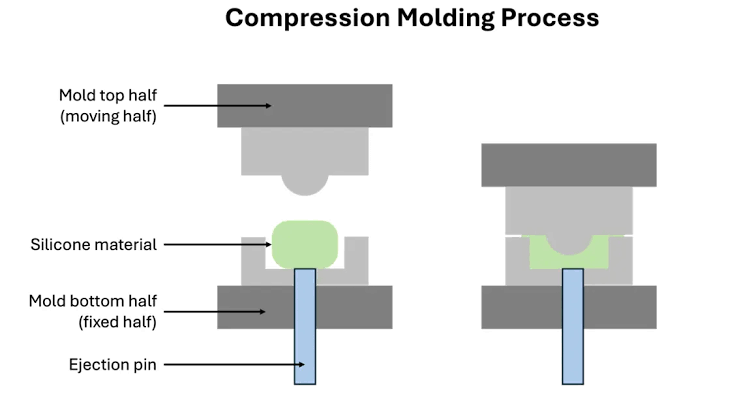
Compression molding, transfer molding, and liquid silicone rubber injection molding are not interchangeable. The most economical process depends on part geometry, production volume, material system, quality requirements, and tooling investment.
Compression Molding
In compression molding, a measured amount of uncured silicone compound is placed into a heated mold. The mold closes, the compound flows into the cavity, and heat and pressure support curing. The method can be suitable for many solid silicone components, particularly when the geometry and production requirements align with this process.
Key controls include charge weight, charge placement, mold cleanliness, cavity condition, closing behavior, and the material-specific cure cycle. Excess material can increase flash, while insufficient or poorly positioned material may contribute to incomplete filling.
Transfer Molding
Transfer molding moves the compound from a loading chamber into the mold cavities through passages. It can be useful for certain intricate shapes and parts incorporating inserts, depending on the material and tool design. The process requires attention to transfer paths, material flow, venting, and the potential effects of handling on inserts and finished surfaces.
LSR Injection Molding
LSR injection molding meters and mixes the liquid components before injecting the compound into a controlled mold. With a properly engineered system, it can provide repeatable production and support automation for complex parts.
The main considerations include metering accuracy, mixing ratio, temperature control, injection settings, cavity balance, venting, and contamination prevention. The tooling and equipment requirements may make the process less attractive for some low-volume projects.
| Process | Potential Advantages | Main Considerations |
|---|---|---|
| Compression | Direct tooling approach; suitable for many solid silicone geometries. | Charge preparation, flash control, and manual handling may affect consistency. |
| Transfer | Can accommodate selected complex parts and insert-molding designs. | Transfer passages, flow behavior, and material waste need evaluation. |
| LSR injection | Potential for automation, repeatability, and high-volume production. | Requires compatible metering, injection equipment, and specialized tooling. |
The best process is the one that meets functional requirements at an acceptable total cost. A meaningful quotation should consider not only piece price, but also tooling, cycle time, expected scrap, secondary finishing, inspection, and production volume.
Prepare the Material and Control the Molding Cycle
Once the mold and material have been approved, production moves to material preparation and molding. The specific steps depend on whether the compound is a solid HCR/HTV material or a two-component LSR system.
- Verify the material: Confirm the grade, lot number, shelf life, storage conditions, and applicable processing instructions before production.
- Prepare the compound: Use the specified mixing, weighing, preforming, or metering procedure. For two-component materials, confirm the required ratio and equipment setup.
- Inspect the tooling: Check the cavity, parting surfaces, vents, inserts, and any relevant release or cleaning requirements.
- Set process parameters: Establish the appropriate mold temperature, pressure, injection settings, and cure time according to the material supplier’s recommendations and validated production trials.
- Run and verify trial parts: Evaluate filling, surface appearance, dimensions, demolding, and curing before releasing the process for routine production.
- Record production data: Document the material lot, machine settings, inspection results, and any adjustments made during the run.
There is no universal cure temperature or cycle time that is correct for every silicone rubber. The required conditions depend on the formulation, part thickness, mold design, equipment, and required properties. Unverified parameter changes can cause under-cure, scorching, excessive flash, or unstable dimensions.
Demolding, Deflashing, and Post-Curing
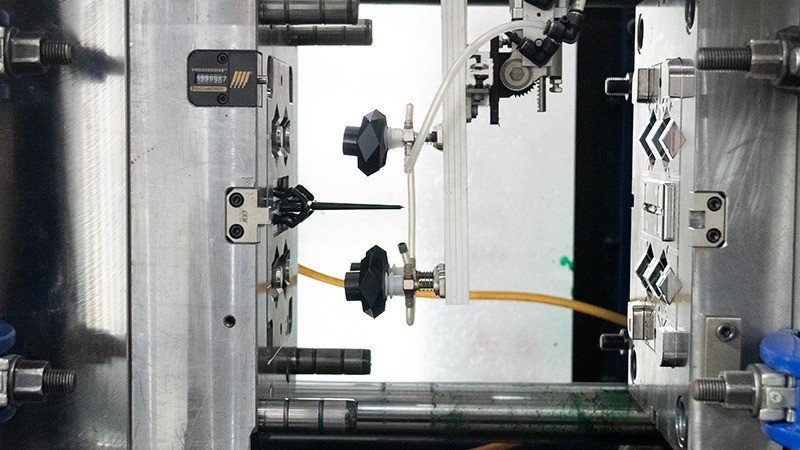
After the material has reached the required cure state, the molded component is removed from the tool. Demolding should avoid excessive stretching, twisting, or pulling at thin sections, sharp corners, and delicate features.
Depending on the part design and process, secondary operations may include manual trimming, automated deflashing, surface cleaning, insert finishing, or post-curing. Post-curing is not automatically required for every silicone component. It should be performed when specified by the material supplier, design requirements, or validation plan.
When post-curing is used, document the time, temperature, loading arrangement, and any cooling or conditioning requirements. Evaluate the finished component after the defined conditioning period, particularly when dimensions, compression behavior, volatile content, or regulatory requirements are important.
A useful production control is to establish an approved reference sample and clear acceptance criteria for flash, surface defects, color, and deformation. This helps operators distinguish an acceptable process variation from a defect that requires corrective action.
Quality Inspection and Performance Validation
Quality control should verify whether the molded component meets the requirements established during design and material selection. A visual inspection alone cannot confirm the performance of a sealing component or a part exposed to demanding service conditions.
Dimensional Inspection
Measure critical features using suitable instruments and a defined measurement method. For flexible components, the applied measuring force, part support, conditioning time, and measurement location can influence the result. Establish these details in the inspection procedure to improve repeatability.
Material and Mechanical Testing
Depending on the application, testing may include Shore hardness, tensile strength, elongation, tear resistance, compression set, aging, or chemical compatibility. Test methods and acceptance limits should be agreed upon before production. For seals, functional testing under representative compression, pressure, or fluid exposure may provide more useful evidence than hardness data alone.
Traceability and Documentation
Maintain traceability between the finished parts, material batch, production date, process records, and inspection results. For regulated or safety-critical applications, confirm the required documentation before selecting a supplier, including material declarations, test reports, change-control procedures, and any application-specific validation records.
For medical applications, the U.S. FDA lists ASTM F2038-18 as a recognized consensus standard covering the selection of silicone elastomers, gels, and foams used in medical applications. The related ASTM F2042-18 addresses crosslinking and fabrication. Applicability depends on the specific device and regulatory context.
For food-contact projects, consult the relevant FDA requirements and guidance on food-contact substances. Do not assume that every silicone compound is automatically FDA-compliant. Compliance must be substantiated for the particular material, intended use, and applicable conditions.
Troubleshooting Common Silicone Molding Defects

When a molded part fails inspection, identify the defect pattern before changing the material or the process. Similar symptoms can have different causes, so adjustments should be based on recorded evidence and controlled trials.
| Defect | Possible Causes | Recommended Checks |
|---|---|---|
| Excessive flash | Worn parting surfaces, excessive charge, unsuitable closing or injection conditions. | Inspect shut-off surfaces, charge weight, clamp condition, and process records. |
| Incomplete filling | Insufficient material, restricted flow, unsuitable injection settings, or premature curing. | Check material quantity, gate and vent design, flow path, and the validated process window. |
| Bubbles or air traps | Air entrapment, inadequate venting, material-feed air, or unsuitable processing conditions. | Inspect vents and feed systems; evaluate filling sequence and approved degassing procedures. |
| Sticky or under-cured parts | Insufficient cure, incorrect mixing ratio, poor mixing, or material incompatibility. | Verify batch identity, metering, mixing, mold temperature, and cure time against the grade-specific instructions. |
| Tearing during demolding | Thin sections, sharp corners, excessive undercuts, or difficult release. | Review geometry, draft and parting line, mold condition, and demolding technique. |
| Dimensional variation | Variation in material, cure cycle, cavity temperature, post-curing, or measurement technique. | Compare cavity and part measurements, review batch records, and standardize conditioning and measurement methods. |
These are starting points for investigation, not universal diagnoses. For example, trapped air may result from a venting issue, but material-feed conditions or the filling sequence may also contribute. Change one controlled variable at a time where practical, record the result, and confirm that the corrective action does not introduce another defect.
WACKER’s silicone rubber processing guidelines provide further material and process information, including injection-molding troubleshooting references.
How to Evaluate a Custom Silicone Molding Supplier
Choosing a supplier involves more than comparing unit prices. A capable manufacturing partner should be able to explain how material selection, tooling design, process controls, and inspection plans support the requirements of the finished component.
- Engineering support: Can the supplier review drawings, critical dimensions, parting lines, and manufacturability risks before tooling begins?
- Material traceability: Can the supplier identify the material grade, batch, technical data, and relevant compliance documentation?
- Tooling capability: Can the supplier explain cavity configuration, venting, gating, insert handling, and maintenance expectations?
- Process validation: Are trial runs, first-article inspection, and production acceptance criteria clearly defined?
- Corrective action: Can the supplier investigate recurring defects using process data and documented corrective actions?
- Commercial transparency: Does the quotation separate tooling charges, sample costs, production pricing, secondary operations, and inspection requirements?
Before placing a production order, agree on sample approval, critical dimensions, permissible flash, cosmetic acceptance criteria, packaging, lot identification, and procedures for approving material or process changes.
Frequently Asked Questions About Custom Silicone Rubber Molding
How do I choose between compression molding and LSR injection molding?
Compare material compatibility, part geometry, annual demand, dimensional requirements, automation needs, and tooling cost. Compression molding can be suitable for many solid silicone parts, while LSR injection molding may offer advantages for automated production of compatible liquid silicone compounds. A design and process review is needed to make the final decision.
Can silicone rubber be used for high-temperature applications?
Some silicone grades are designed for elevated-temperature service, but the allowable range depends on the specific compound and exposure conditions. Continuous operating temperature, short-term peaks, chemical contact, mechanical load, and aging requirements should all be evaluated against the grade-specific technical data.
Why do custom silicone parts have flash?
Flash can develop when material escapes through the parting line or other mold interfaces. Potential contributors include tool wear, excess material, poor shut-off contact, and unsuitable process settings. The correct response is to identify the source rather than rely solely on more aggressive trimming.
Does every silicone molded part need post-curing?
No. Post-curing depends on the material formulation, application, required properties, and supplier recommendations. If it is necessary, its conditions should be specified and validated rather than selected arbitrarily.
What information should I provide for a custom silicone molding quotation?
Provide a 2D drawing and preferably a 3D CAD model, annual quantity, prototype quantity, material and hardness requirements, operating environment, critical tolerances, color, surface finish, regulatory requirements, and any testing or documentation needs. If the material is not yet determined, explain the part’s function and service conditions so the supplier can recommend a suitable grade.
Conclusion: Build Quality into Every Stage
Reliable custom silicone rubber molding begins with application requirements and continues through material selection, design for manufacturability, tooling, process validation, and inspection. Each stage influences the consistency and performance of the finished component.
By defining critical requirements early, using grade-specific processing data, investigating defects systematically, and documenting quality checks, manufacturers and buyers can reduce avoidable rework and make more informed production decisions. The objective is not simply to produce a molded shape, but to deliver a silicone component that performs reliably in its intended application.