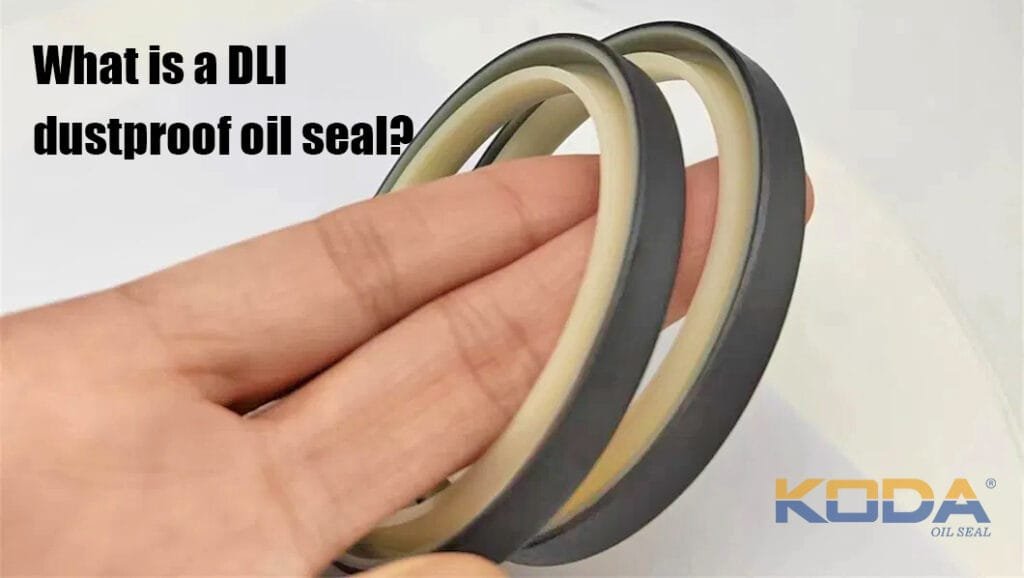
What Is a DLI Dustproof Oil Seal?
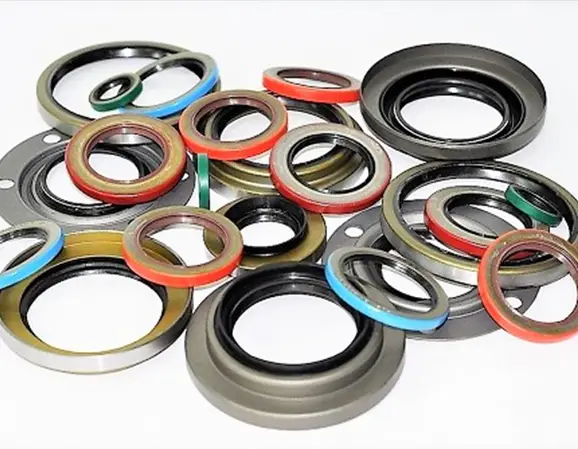
A DLI dustproof oil seal is a specialized rotary sealing component designed primarily to protect a rotating shaft, bearing assembly, or mechanical housing from dust, dirt, mud, water splash, and other external contaminants. In many applications, the DLI design is associated with a dust-excluding or dust-lip configuration used together with a primary sealing lip to improve protection in harsh operating environments.
Unlike a conventional oil seal that is selected mainly to retain lubricating oil or grease, a dustproof seal has a second critical responsibility: preventing external contaminants from entering the sealing system. This is especially important in agricultural machinery, construction equipment, automotive systems, industrial gearboxes, wheel hubs, electric motors, and other rotating equipment exposed to abrasive particles.
When engineers search for a DLI dustproof seal, the key question is usually not simply “What size seal do I need?” The correct selection requires an understanding of shaft speed, shaft diameter, housing dimensions, lubricant type, temperature, contamination level, pressure, installation conditions, and the expected movement of the sealing lip.
✔ Engineering Insight: A dustproof oil seal does not merely block visible dirt. Its performance depends on the interaction between lip geometry, contact pressure, shaft surface condition, elastomer properties, lubricant behavior, and the contamination environment.
Why Are Dustproof Oil Seals Important?
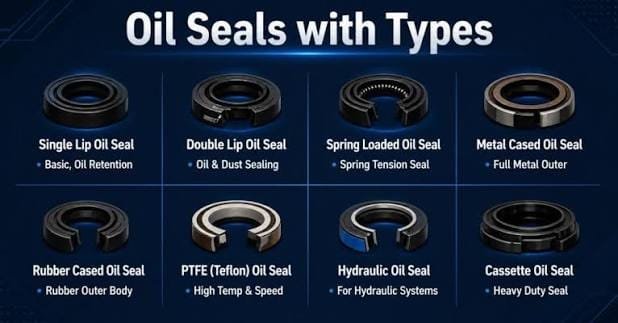
Rotating machinery often operates in environments where airborne particles, soil, sand, metal dust, water, and other contaminants are present. Once these contaminants enter a bearing or lubricated chamber, they can accelerate wear and shorten component life.
Contamination can cause several problems:
- 🛡 Abrasive wear of bearings and shafts
- ⚙ Increased friction and torque
- 💧 Lubricant contamination and degradation
- 🔧 Premature seal lip wear
- 🌫 Corrosion of internal metal components
- 🔥 Increased operating temperature
- 📉 Reduced reliability and maintenance intervals
In a contaminated environment, even a well-designed primary oil-retaining lip may not be sufficient. A dedicated dust lip provides an additional barrier against external particles before they reach the primary sealing interface.
Basic Construction of a DLI Dustproof Seal
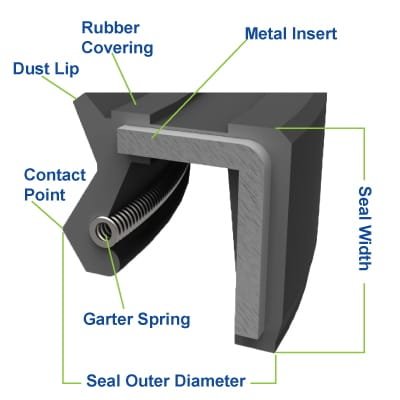
A typical dustproof oil seal may consist of several functional elements. The exact construction depends on the manufacturer’s design, but the main components commonly include a sealing element, a dust-excluding lip, a metal reinforcement or case, and sometimes a spring-loaded primary sealing lip.
| Component | Main Function |
|---|---|
| Primary sealing lip | Retains oil, grease, or other internal lubricant |
| Dust lip | Restricts entry of dust, dirt, mud, and external contaminants |
| Metal case or reinforcement | Provides structural support and housing retention |
| Garter spring | Maintains radial contact force on the shaft in many oil-retaining designs |
| Elastomer body | Provides flexibility, sealing contact, and environmental resistance |
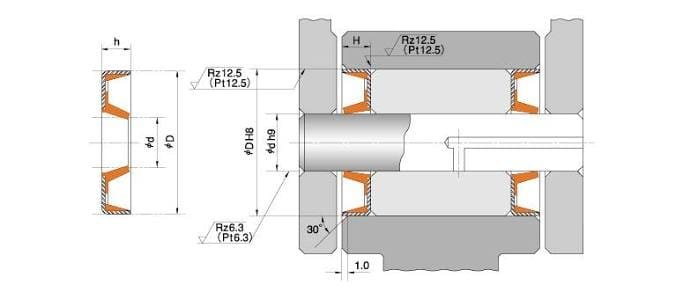
The dust lip and primary oil lip must work together. If the dust lip is too tight, friction and heat can increase. If it is too loose, contaminants may pass through the sealing interface.
How Does a DLI Dustproof Seal Work?
The sealing mechanism is based on controlled contact between the elastomer lip and the rotating shaft. The lip creates a narrow contact zone around the shaft. This contact zone must be sufficient to restrict the passage of contaminants while allowing the shaft to rotate with acceptable friction.
In a simplified engineering model, the performance of a rotary seal depends on the balance between:
Sealing capability = Contact force + Lip geometry + Material elasticity + Shaft surface quality + Lubrication + Environmental resistance
This is not a universal design equation, but it illustrates an important engineering principle: seal performance is a system result rather than a property of the rubber compound alone.
During operation, the shaft rotates relative to the seal. The sealing lip experiences friction, deformation, thermal effects, and possible lubrication-film formation. The dust lip must also resist external contaminants that may be driven toward the sealing interface by rotation, pressure, vibration, or environmental movement.
DLI Dustproof Seal Versus a Conventional Oil Seal
| Characteristic | Conventional Oil Seal | DLI Dustproof Oil Seal |
|---|---|---|
| Primary purpose | Retain lubricant | Retain lubricant and improve contamination exclusion |
| External contamination protection | Depends on design | Enhanced through dedicated dust-excluding geometry |
| Typical environment | Clean to moderately contaminated | Dusty, dirty, wet, or abrasive environments |
| Friction potential | Generally lower depending on design | May be higher because of additional lip contact |
A DLI configuration is not automatically superior for every application. In a clean, high-speed, low-contamination environment, a lower-friction sealing design may be more appropriate. The correct design depends on the actual operating conditions.
Materials Commonly Used in Dustproof Oil Seals
Material selection is one of the most important factors in oil seal performance. Common elastomer families include nitrile rubber, hydrogenated nitrile rubber, fluoroelastomer, silicone rubber, and other specialized compounds.
NBR — Nitrile Rubber
NBR is widely used for general-purpose oil seals because it provides a practical balance of oil resistance, mechanical strength, abrasion resistance, and cost.
Many NBR compounds are commonly available in hardness ranges around 70 to 90 Shore A, although the exact value depends on the formulation.
NBR is often suitable for mineral oils and greases, but its resistance to ozone, weathering, and certain aggressive chemicals is more limited than that of some specialty elastomers.
HNBR — Hydrogenated Nitrile Rubber
HNBR generally provides improved resistance to heat, ozone, and aging compared with conventional NBR. It is commonly considered for demanding automotive, industrial, and hydraulic applications.
FKM — Fluoroelastomer
FKM is selected when high-temperature performance and resistance to many oils, fuels, and chemicals are important. It may be a suitable choice for demanding environments, although its low-temperature performance and cost must be considered.
Silicone Rubber
Silicone offers excellent flexibility over a broad temperature range and strong resistance to ozone and weathering. However, silicone is not the best choice for every oil or abrasion environment.
Hardness and Its Effect on Dust Lip Performance
Elastomer hardness affects the deformation behavior and contact force of the sealing lip. A softer compound can conform more easily to surface irregularities, while a harder compound may provide greater resistance to mechanical damage and deformation.
However, hardness should not be treated as a simple “higher is better” value.
Expert Tip: The best seal hardness is determined by the combined requirements of shaft speed, surface roughness, temperature, pressure, contamination, lip geometry, and material compatibility.
For example, an excessively hard dust lip may increase friction and accelerate shaft wear. An excessively soft lip may be vulnerable to deformation, tearing, or extrusion under unfavorable conditions.
Temperature Resistance
Temperature affects both the elastomer and the lubricant. As temperature increases, rubber modulus, compression behavior, chemical aging, and lubricant viscosity can change.
A general thermal engineering relationship for dimensional change can be expressed as:
ΔL = α × L₀ × ΔT
Where:
ΔL = dimensional change
α = coefficient of thermal expansion
L₀ = original dimension
ΔT = temperature change
This equation is particularly relevant when a metal shaft, housing, and elastomer seal have different thermal expansion behavior. The resulting dimensional changes can influence radial interference and sealing contact.
Actual temperature capability must always be confirmed from the material manufacturer’s technical data and application-specific testing.
Dust, Sand, and Abrasive Contamination
Dust contamination is not a single type of problem. Fine airborne dust, coarse sand, mud particles, metal debris, and agricultural soil can behave differently.
Fine particles may migrate through very small clearances. Coarse particles may damage the lip mechanically. Abrasive particles can become trapped at the sealing interface and act like grinding media.
The severity of contamination depends on:
- Particle size
- Particle hardness
- Concentration
- Moisture content
- Shaft speed
- Seal lip design
- External pressure or splash conditions
- Frequency of contamination exposure
A dustproof seal should therefore be selected based on the actual contamination environment rather than simply the word “dustproof.”
Water and Mud Resistance
Water exposure can create additional challenges. Water may reduce lubrication at the dust lip, promote corrosion of metal components, and transport fine particles into the sealing interface.
Mud can be particularly aggressive because it may contain water, soil, mineral particles, and organic contaminants. Once dried, mud can increase mechanical resistance and damage the sealing lip during shaft movement.
In applications exposed to high-pressure water jets, a standard dust lip may not be sufficient. The seal system may require special geometry, additional shielding, drainage features, or a different sealing architecture.
Shaft Surface Requirements
The shaft is part of the sealing system. A high-quality seal cannot compensate for a severely damaged or incorrectly finished shaft surface.
Important shaft factors include:
- Diameter accuracy
- Roundness
- Surface roughness
- Hardness
- Wear grooves
- Corrosion
- Runout
- Misalignment
A worn shaft can create a groove at the sealing contact track. The new seal may then contact the damaged area and fail to create a stable sealing interface.
Important: Shaft surface specifications should be defined according to the seal manufacturer’s requirements. There is no single surface roughness value that is correct for every elastomer, speed, lubricant, and seal design.
Housing and Bore Requirements
The housing bore controls the external retention and sealing condition of the oil seal. Incorrect bore diameter, damage, corrosion, excessive chamfer, or poor alignment can lead to leakage or seal movement.
The housing should be inspected for:
- Correct diameter
- Roundness
- Surface damage
- Corrosion
- Sharp edges
- Contamination
- Correct axial seating depth
Press-fit requirements vary according to the seal design and housing material. The correct interference should be obtained from the manufacturer’s dimensional specification.
Installation Method for a DLI Dustproof Oil Seal
Step 1: Verify the Seal
Confirm the seal dimensions, material, orientation, and design before installation. Check for damage caused by storage or handling.
Step 2: Inspect the Shaft
Remove burrs, rust, sharp edges, and contamination. If a worn sealing track is present, the repair strategy should be evaluated before installing the new seal.
Step 3: Inspect the Housing
Clean the bore and confirm that the housing is free of debris, corrosion, and mechanical damage.
Step 4: Lubricate the Appropriate Lip
Where specified by the manufacturer, apply a compatible lubricant to the primary sealing lip. The dust lip may require different treatment depending on the design and environmental conditions.
Step 5: Use the Correct Installation Tool
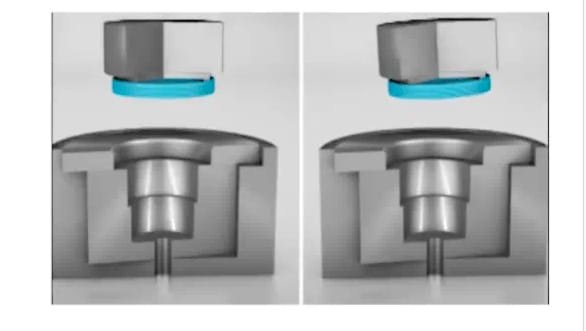
Apply installation force evenly and avoid striking the elastomer directly with sharp tools. The seal should be pressed squarely into position.
Step 6: Confirm Orientation
For many oil seal designs, the primary sealing lip must face the lubricant side while the dust-excluding lip faces the contamination side. The actual orientation must be confirmed from the specific design drawing.
Installation Warning: A correctly manufactured seal can fail immediately if it is installed backwards, tilted, cut by a shaft edge, contaminated during installation, or driven to an incorrect depth.
How to Select the Correct DLI Dustproof Seal
| Selection Factor | Engineering Question |
|---|---|
| Shaft diameter | What is the actual shaft diameter and tolerance? |
| Housing bore | Is the bore dimension and surface condition suitable? |
| Rotational speed | What is the normal and maximum shaft speed? |
| Temperature | What are the continuous and peak temperatures? |
| Lubricant | Is the elastomer compatible with the actual oil or grease? |
| Contamination | Is the environment dusty, sandy, muddy, wet, or chemically aggressive? |
| Pressure | Is the seal exposed to pressure or only atmospheric conditions? |
Common ASTM and ISO Standards
Oil seal evaluation may involve several standards depending on the property being investigated. No single standard covers every aspect of rotary seal performance.
- ASTM D2240: Durometer hardness testing of rubber and elastomeric materials.
- ASTM D412: Tensile properties of vulcanized rubber and thermoplastic elastomers.
- ASTM D395: Compression set testing of rubber materials.
- ASTM D471: Evaluation of the effect of liquids on rubber properties.
- ASTM D573: Accelerated aging of rubber in an air oven.
- ASTM D624: Tear strength testing of rubber and elastomeric materials.
- ISO 37: Tensile stress-strain properties of rubber.
- ISO 48: Hardness determination for rubber and elastomeric materials.
- ISO 815: Compression set testing of rubber.
- ISO 6194: Rotary shaft lip-type sealing systems and related terminology and requirements.
The applicable standard should be selected according to the material, seal design, test objective, and customer specification.
Friction, Heat, and Rotational Speed
A rotary seal generates friction as the shaft rotates against the sealing lip. The resulting frictional heat can be influenced by lip contact force, shaft speed, lubricant, temperature, surface condition, and seal geometry.
A simplified relationship for frictional power is:
P = F × v
Where:
P = frictional power
F = friction force
v = sliding velocity
As rotational speed increases, sliding velocity increases. If friction force remains significant, heat generation can increase accordingly.
This is why a dustproof seal designed for severe contamination may not be the best choice for a very high-speed, low-contamination application.
Case Example: Dusty Agricultural Machinery
Case Example — Illustrative Industry Experience
Consider a rotating shaft in agricultural equipment operating in dry soil and airborne dust. The assembly contains grease that must remain inside while external particles must be restricted from entering the bearing area.
An engineering team may select a multi-lip dustproof oil seal after evaluating shaft speed, shaft diameter, grease compatibility, operating temperature, soil contamination, and maintenance conditions.
The validation program may include visual inspection, dimensional checks, dust exposure, rotation testing, temperature monitoring, and post-test examination of the sealing lip and shaft track.
If the seal shows accelerated wear, the investigation should not automatically conclude that the material is defective. Possible causes may include excessive shaft runout, poor surface finish, improper installation, abrasive contamination, excessive interference, or lubricant incompatibility.
This case is an illustrative industry scenario based on common engineering practice. It does not represent a real customer, factory test result, or guaranteed service-life curve.
Laboratory Test Example
Laboratory Test Example — Demonstration Only
A laboratory investigation of a dustproof oil seal may compare sealing behavior before and after controlled contamination exposure.
A possible test program could include:
- Initial dimensional inspection
- Elastomer hardness measurement
- Visual inspection of the lip
- Controlled shaft rotation
- Dust exposure under defined conditions
- Temperature monitoring
- Leakage or contamination evaluation
- Post-test inspection of the shaft track
For a material property comparison, percentage change may be calculated as:
Percentage Change = (Final Value − Initial Value) ÷ Initial Value × 100%
For example, if a measured hardness changes from 80 Shore A to 78 Shore A after an environmental exposure, the change can be calculated as:
(78 − 80) ÷ 80 × 100% = −2.5%
This calculation demonstrates a method of data analysis only. Actual acceptance limits must be defined by the product specification, material requirements, applicable test standards, and application needs.
This laboratory example is not a real customer test, factory test result, or fabricated lifetime claim.
Failure Mode Analysis
Failure Mode Analysis — Illustrative Engineering Example
Assume a DLI dustproof seal is found with a worn dust lip and contamination inside the bearing housing.
A systematic investigation should examine the direction and pattern of wear. A uniform polished wear track may indicate normal contact. Localized damage may suggest shaft runout, misalignment, foreign-particle attack, or installation damage.
Potential failure causes may include:
- Incorrect seal orientation
- Damaged shaft surface
- Excessive shaft eccentricity
- Contaminants trapped at the lip
- Incorrect seal dimensions
- Excessive lip interference
- Unsuitable elastomer
- High temperature
- High-pressure water exposure
The correct root cause should be established through evidence. Useful methods may include dimensional inspection, microscopy, hardness testing, lubricant analysis, shaft measurement, and comparison with the original installation conditions.
This is an illustrative failure analysis based on common industry engineering practice. It is not presented as an actual customer failure investigation.
Common Failure Modes of DLI Dustproof Seals
1. Dust Lip Wear
Continuous contact with abrasive particles can gradually wear the dust lip. The severity depends on particle hardness, contamination concentration, shaft speed, lip pressure, and material resistance.
2. Leakage from the Primary Lip
Oil leakage may result from lip damage, shaft wear, excessive runout, incorrect installation, poor lubrication, or material incompatibility.
3. Hardening and Cracking
Long-term thermal aging, ozone exposure, chemical attack, or unsuitable material selection may cause the elastomer to harden and crack.
4. Swelling
Exposure to incompatible oils, fuels, or chemicals can cause elastomer swelling and dimensional changes.
5. Seal Lip Tearing
Tearing may occur during installation, especially when the shaft has sharp edges, burrs, splines, keyways, or damaged surfaces.
6. Excessive Friction
Excessive contact force, incorrect dimensions, inadequate lubrication, or high shaft speed can increase friction and temperature.
7. Metal Case Corrosion
Moisture and corrosive environments can attack exposed metal components if the seal construction and material selection are not suitable.
DLI Dustproof Seal Material Comparison
| Material | Advantages | Limitations |
|---|---|---|
| NBR | Good general oil resistance and cost efficiency | Limited resistance to ozone and severe weathering |
| HNBR | Improved heat, ozone, and aging resistance | Higher cost than standard NBR |
| FKM | Strong high-temperature and chemical performance | Higher cost and application-specific low-temperature limitations |
| Silicone | Excellent temperature flexibility and weathering resistance | May have lower abrasion resistance in some applications |
How to Improve Dustproof Seal Service Life
- ✔ Select the correct elastomer for the actual lubricant and environment.
- ✔ Maintain proper shaft surface quality.
- ✔ Control shaft runout and eccentricity.
- ✔ Protect the seal during installation.
- ✔ Keep the installation area clean.
- ✔ Avoid forcing the seal over sharp edges without protection.
- ✔ Use compatible assembly lubricants.
- ✔ Confirm correct installation depth and orientation.
- ✔ Consider contamination severity when selecting the lip design.
- ✔ Inspect the shaft whenever replacing a worn seal.
Expert Tips for Engineers and Maintenance Teams
Expert Tip 1: Do not replace a failed seal without investigating the shaft and housing. A new seal installed on a damaged shaft may fail again quickly.
Expert Tip 2: A dustproof seal may require a different material from the primary oil-retaining seal if the external environment and internal lubricant create different chemical demands.
Expert Tip 3: If friction or temperature is unusually high, investigate lip interference, shaft speed, lubrication, misalignment, and contamination before assuming a material problem.
Expert Tip 4: The most expensive seal is not automatically the best seal. The correct solution is the one that matches the actual operating conditions.
DLI Dustproof Seal Applications
DLI-style dustproof oil seals may be used in many rotating systems where protection from external contaminants is important.
- 🚜 Agricultural machinery
- 🏗 Construction equipment
- 🚗 Automotive components
- ⚙ Industrial gearboxes
- 🔩 Electric motors
- 🛞 Wheel hubs
- 🔧 Pumps and rotating equipment
- 🏭 Manufacturing machinery
- ⛏ Mining equipment
- 🌲 Forestry equipment
Each application requires its own evaluation. A seal suitable for a dry industrial environment may not be suitable for mud, abrasive sand, high-pressure water, or high-temperature chemical exposure.
Why Correct DLI Seal Selection Matters
Many seal failures are caused by mismatched application conditions rather than poor manufacturing quality. A seal can be correctly manufactured and still fail if the material, dimensions, geometry, or installation method does not match the system.
For this reason, selection should begin with a complete operating profile:
Operating Profile = Shaft + Housing + Speed + Temperature + Lubricant + Contamination + Pressure + Installation
Once these factors are known, the appropriate seal design and elastomer can be selected more reliably.
Final Engineering Perspective
A DLI dustproof oil seal is more than a simple rubber ring around a rotating shaft. It is a carefully engineered component that helps protect lubricated mechanical systems from external contamination while supporting reliable rotation and lubricant retention.
The performance of a DLI dustproof seal depends on the interaction between elastomer material, lip geometry, shaft condition, housing design, lubricant, speed, temperature, and contamination.
For general industrial applications, NBR may provide an effective balance of performance and cost. For higher temperatures and more demanding aging conditions, HNBR or FKM may be more appropriate. Silicone and other specialized materials may be selected when flexibility, weathering, or extreme temperature performance is the primary requirement.
The most reliable engineering approach is to define the operating environment, select a suitable seal configuration, verify material compatibility, inspect shaft and housing conditions, install the seal correctly, and validate performance through representative testing.
Whether the application involves agricultural machinery, construction equipment, industrial drives, automotive systems, or other rotating equipment, the correct dustproof sealing solution can significantly reduce contamination-related wear and improve system reliability.
Frequently Asked Questions
1. What is a DLI dustproof oil seal?
A DLI dustproof oil seal is a rotary sealing component designed to retain lubricant while helping prevent dust, dirt, sand, water, and other external contaminants from entering a rotating mechanical assembly. Its design commonly includes a dust-excluding lip or additional contamination barrier.
2. What is the difference between a dustproof seal and a standard oil seal?
A standard oil seal primarily focuses on retaining oil or grease. A dustproof oil seal provides additional protection against external contaminants through its sealing geometry. The correct design depends on the application environment, shaft speed, lubricant, temperature, and contamination level.
3. Which material is best for a DLI dustproof seal?
There is no single material that is best for every application. NBR is commonly used for general oil resistance and cost efficiency, HNBR provides improved heat and aging resistance, FKM is suitable for many demanding chemical and high-temperature environments, and silicone may be selected for wide-temperature flexibility and weathering resistance.
4. Why does a dustproof oil seal fail prematurely?
Common causes include incorrect installation, damaged shaft surfaces, excessive runout, incompatible lubricant, unsuitable elastomer selection, excessive temperature, abrasive contamination, excessive lip interference, and high-pressure water exposure. A complete failure analysis should examine the seal, shaft, housing, lubricant, and operating environment.
5. How can I choose the correct DLI dustproof seal?
Start with the shaft diameter, housing bore, rotational speed, temperature range, lubricant type, contamination conditions, pressure, and installation requirements. Then select the appropriate seal dimensions, lip configuration, elastomer, and material grade based on the manufacturer’s technical specifications and application validation.