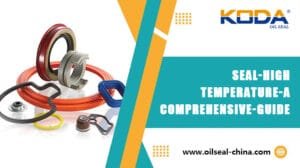
High-temperature seals are essential components in systems where heat, pressure, chemical exposure, and mechanical movement can compromise sealing performance. They are used in engines, industrial furnaces, hydraulic equipment, chemical processing systems, compressors, pumps, and many other applications that operate above ordinary ambient conditions.
However, selecting a seal for a hot environment involves more than choosing a rubber material with a high published temperature rating. A seal that performs well in dry heat may deteriorate rapidly when exposed to hot oil, aggressive chemicals, steam, or repeated thermal cycling. The correct solution must match the actual operating environment, sealing geometry, and expected service life.
Engineering takeaway: Select a high-temperature seal based on the temperature at the seal interface, the actual fluid, pressure, motion, exposure duration, and compression-set performance—not on the maximum temperature printed in a material brochure.
What Are High-Temperature Seals?
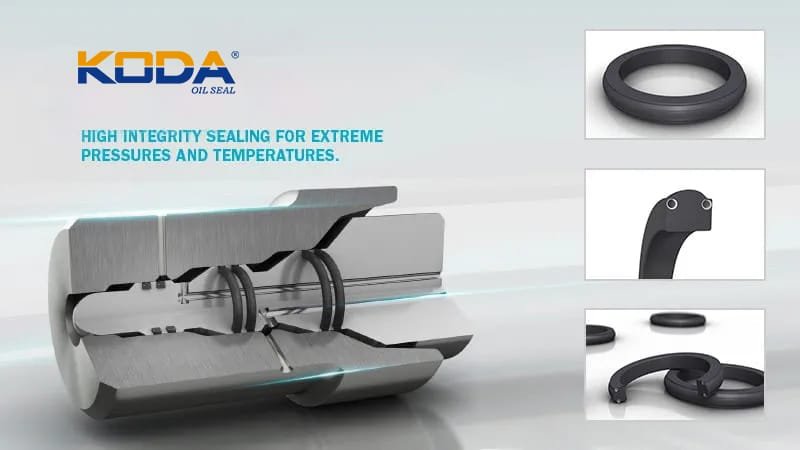
High-temperature seals are components engineered to maintain a reliable barrier against liquids, gases, lubricants, or contaminants under elevated thermal conditions. Depending on the application, they may be manufactured from elastomers, thermoplastics, composite materials, or metallic sealing materials.
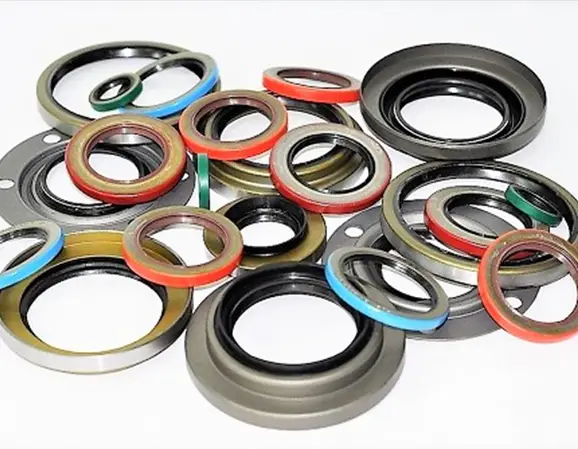
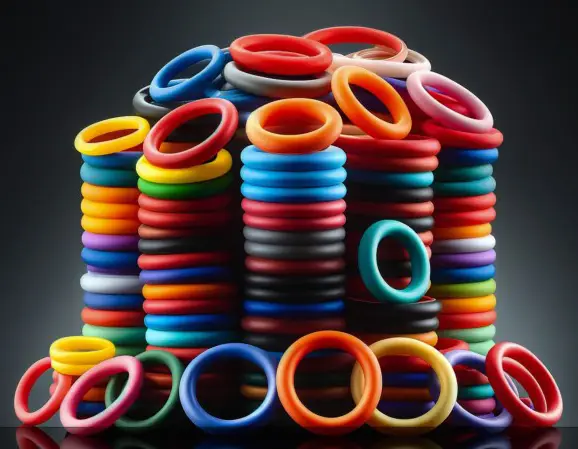
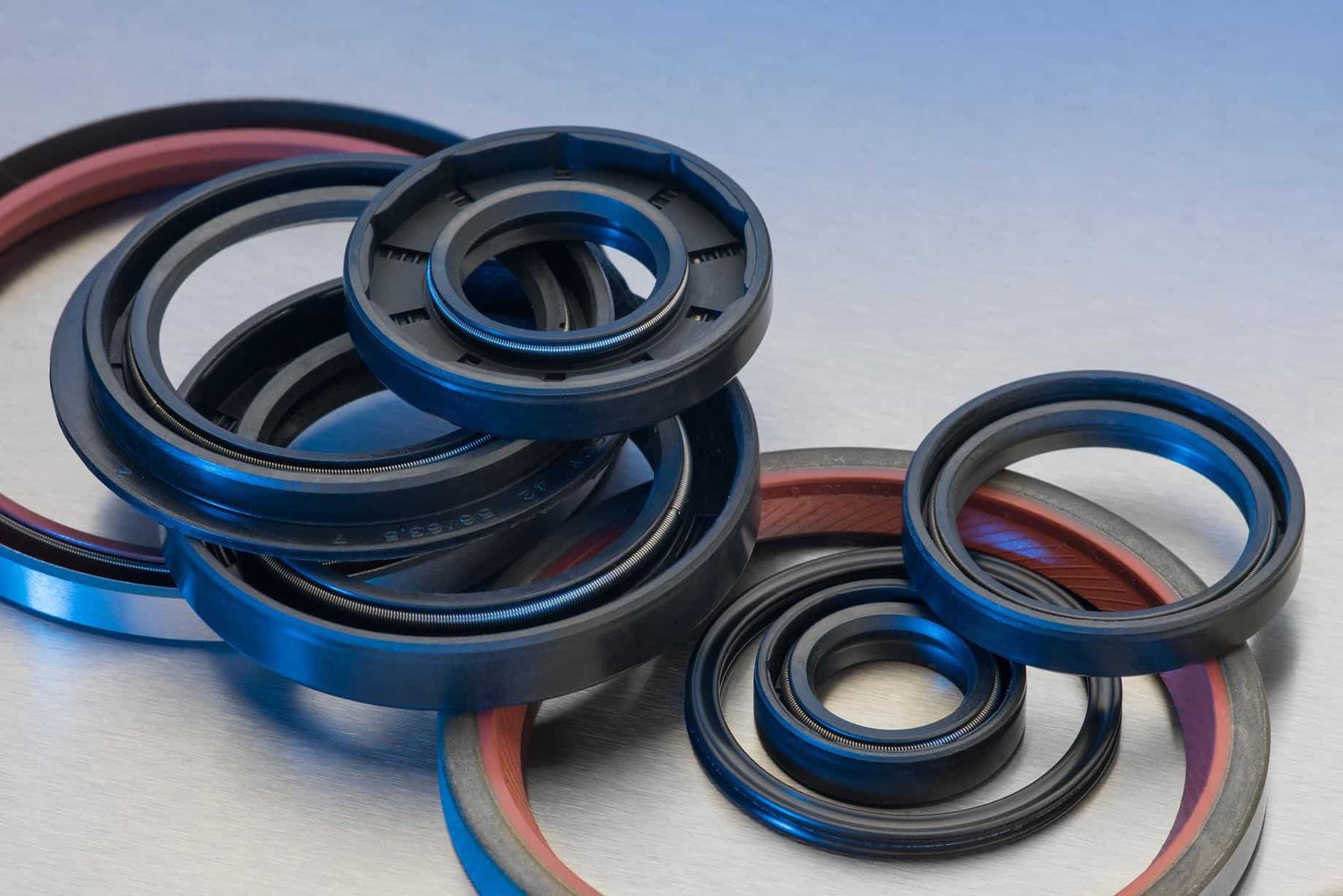
In industrial sealing systems, the term commonly refers to O-rings, rotary shaft oil seals, gaskets, bonded seals, and custom-molded components made from heat-resistant compounds.
Common high-temperature sealing products
- High-temperature O-rings: Used in static and selected dynamic applications to seal fluids or gases within a properly designed gland.
- High-temperature oil seals: Designed to retain lubricants and exclude contaminants around rotating shafts.
- High-temperature gaskets: Used between mating surfaces in piping, housings, engines, and process equipment.
- Custom-molded seals: Engineered for unusual geometries, special media, or demanding operating cycles.
- Metal and composite seals: Considered when elastomers cannot meet the required temperature, pressure, or chemical-resistance requirements.
The best seal is not necessarily the material with the highest temperature capability. It is the sealing solution that maintains the required function under the complete set of service conditions.
Why High Temperature Causes Seal Failure
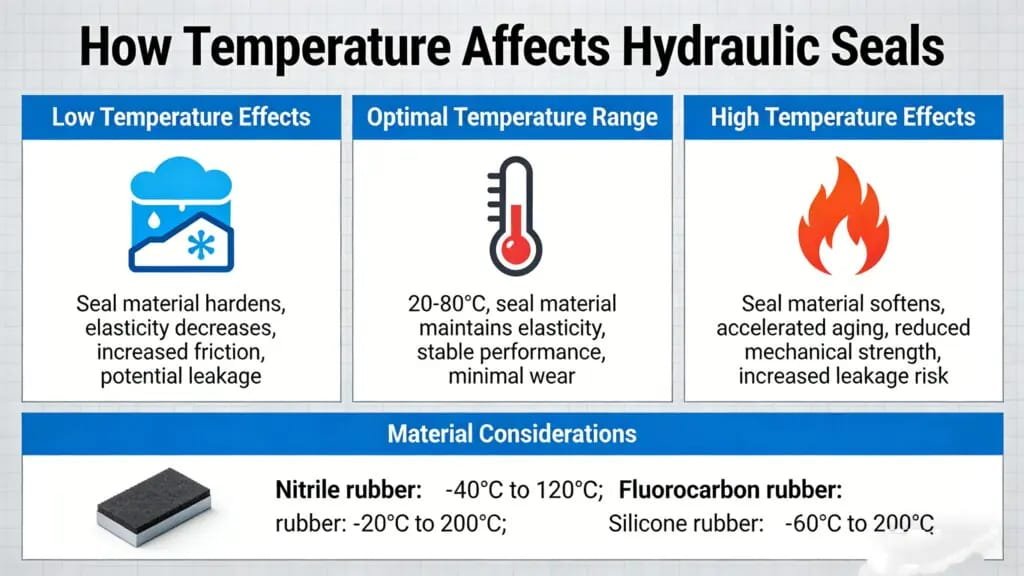
Heat changes the physical and chemical behavior of sealing materials. As temperature increases, an elastomer may soften, lose mechanical strength, undergo accelerated chemical aging, or become less capable of recovering after compression.
Thermal aging and hardening
Prolonged exposure to elevated temperatures can accelerate chemical reactions within an elastomer. Depending on the compound and environment, the material may harden, crack, lose elasticity, or develop a permanently altered structure.
When an aged seal can no longer recover after compression, its ability to maintain contact with the sealing surface may decline, increasing the risk of leakage.
Compression set and loss of sealing force
Compression set describes the permanent deformation that remains after a material has been compressed and then released under specified test conditions. At elevated temperatures, compression set may increase, reducing the seal’s ability to recover and maintain contact pressure.
This is particularly important for static O-rings and gaskets that depend on sustained compression to maintain a seal. A compound with suitable heat resistance but poor compression-set performance may still fail prematurely.
Thermal expansion and gland limitations
Elastomers generally expand as temperature rises. If a seal is installed in a gland with insufficient available volume, thermal expansion and fluid-induced swelling can combine to increase gland fill.
Excessive gland fill may increase friction, accelerate wear, or create damaging stress. In some applications, elevated temperature can also change the dimensions of metal housings and shafts, affecting squeeze and clearances.
Chemical attack becomes more severe
A fluid that is reasonably compatible with a seal at room temperature may cause greater swelling, extraction, or chemical degradation at elevated temperature. Compatibility must therefore be evaluated at the actual service temperature and concentration.
Thermal cycling and repeated start-stop operation
Equipment that repeatedly heats and cools places additional demands on sealing systems. Differences in thermal expansion between the seal and its housing can alter contact pressure. Repeated cycling may also accelerate fatigue, cracking, or loss of elasticity in unsuitable materials.
Practical warning: A seal that survives a brief temperature spike may not withstand continuous operation at the same temperature. Always distinguish continuous operating temperature, peak temperature, and exposure duration.
High-Temperature Seal Materials Compared
Material selection begins with the chemical family, but the actual compound formulation is equally important. Different grades within the same material family can have different temperature limits, hardness, compression-set behavior, and fluid compatibility.
| Material | Typical strengths | Key limitations | Common applications |
|---|---|---|---|
| FKM | Good heat resistance and resistance to many oils, fuels, and chemicals | Low-temperature flexibility and chemical resistance vary by grade; not suitable for every fluid | Automotive, pumps, engines, industrial fluid systems |
| FFKM | Very broad chemical resistance and high-temperature capability in selected grades | High cost; performance depends strongly on formulation and process conditions | Chemical processing, semiconductor equipment, demanding process systems |
| Silicone (VMQ) | Broad temperature flexibility, including low-temperature service; good weathering resistance | Often lower tear and abrasion resistance; limited suitability for many fuels and oils | Appliances, electrical equipment, selected static seals |
| EPDM | Good resistance to weathering, ozone, hot water, steam, and many polar fluids | Generally unsuitable for petroleum oils and many hydrocarbon fuels | Water systems, heating systems, steam-related applications |
| HNBR | Improved heat and mechanical performance compared with many conventional NBR compounds | Chemical and temperature capability depend on the compound and fluid | Automotive, oilfield, hydraulic and industrial equipment |
| PTFE | Broad chemical resistance and low friction | Limited elastic recovery; sealing design may require energizers or special geometry | Chemical equipment, low-friction and specialized sealing systems |
Important: This table is a qualitative comparison, not a guaranteed temperature-rating chart. Obtain the exact compound’s technical data sheet and verify performance under the intended fluid, pressure, and exposure conditions.
FKM vs. FFKM: Which Is Suitable for High-Temperature Sealing?
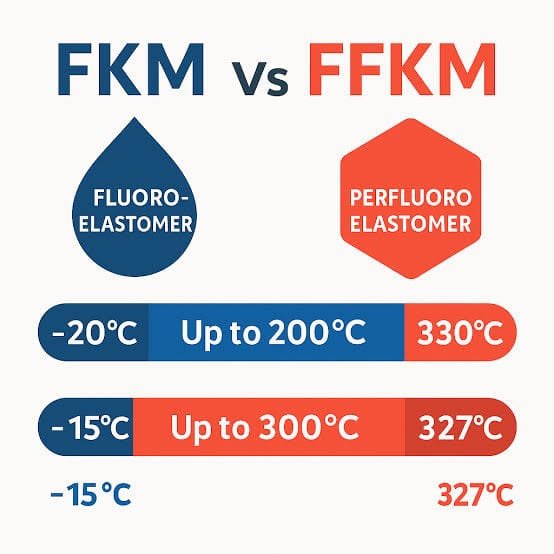
FKM and FFKM are both fluorinated elastomer families, but they are not interchangeable. FKM is widely used where heat resistance and compatibility with oils or fuels are important. FFKM is designed for demanding chemical environments and can offer higher temperature capability in selected formulations.
When FKM may be appropriate
- Sealing many petroleum-based oils and fuels within the compound’s compatibility limits.
- Applications requiring a balance of heat resistance, mechanical performance, and cost.
- Rotary shaft seals and O-rings exposed to selected automotive or industrial fluids.
When FFKM may be considered
- Highly aggressive chemical environments that exceed the capability of more conventional elastomers.
- Processes where contamination control and chemical compatibility are critical.
- Applications where the additional material cost is justified by verified service requirements.
Neither material should be selected by family name alone. Chemical compatibility, temperature limits, compression set, permeation, and mechanical requirements must be checked for the exact compound.
Understanding Temperature Ratings: Continuous, Peak, and Short-Term Exposure
Temperature ratings are meaningful only when their test conditions and intended service duration are understood. A material may tolerate a short excursion above its recommended continuous range without being suitable for sustained operation at that temperature.
Three temperature values to record
- Continuous temperature: The temperature the seal experiences during normal, sustained operation.
- Peak temperature: The highest temperature reached during startup, shutdown, cleaning, or process excursions.
- Exposure duration: How long the seal remains at each temperature, including the number of thermal cycles.
For example, a seal near a hot engine component may experience a different temperature from the surrounding exhaust gas. Heat transfer, housing material, airflow, fluid circulation, and the seal’s location all influence the actual temperature at the sealing interface.
Measure or estimate the temperature at the seal itself rather than relying solely on the temperature of a nearby heat source.
Applications of High-Temperature Seals
Automotive and transportation
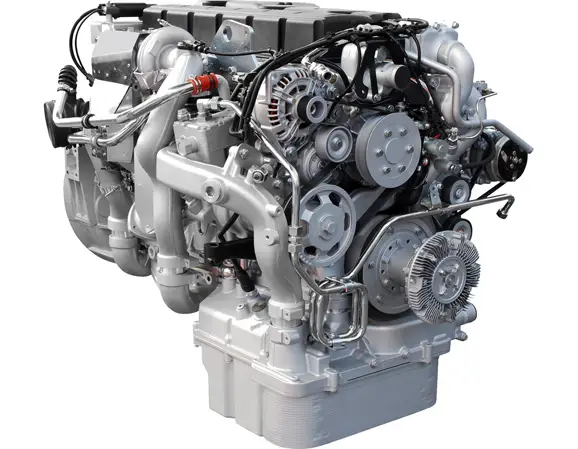
High-temperature seals are used in engine-related systems, transmissions, turbocharger-associated equipment, and other components exposed to elevated temperatures and lubricants. Selection must account for oil chemistry, shaft speed, vibration, and temperature cycling.
Industrial pumps and compressors
Pumps and compressors may expose seals to hot lubricants, process fluids, pressure fluctuations, and continuous movement. Shaft seals require attention to shaft finish, runout, lubrication, and frictional heat.
Chemical processing equipment
Reactors, valves, piping systems, and chemical pumps may operate at elevated temperatures while handling corrosive or reactive media. Material compatibility must be confirmed against the actual chemical, concentration, temperature, and cleaning process.
Heating, steam, and hot-water systems
Steam and hot-water systems often require materials with appropriate resistance to heat, water exposure, and compression set. EPDM may be suitable for many water and steam applications, but the specific compound, steam conditions, and system pressure must be verified.
Industrial ovens and thermal equipment
Ovens, dryers, and thermal processing equipment may use seals for access doors, ducts, and static joints. Depending on temperature and contact conditions, silicone, specialized elastomers, PTFE-based designs, or non-elastomeric materials may be considered.
High-Temperature O-Ring Selection: A Practical Engineering Process
A reliable selection process starts with operating conditions and works toward the material, dimensions, and validation plan. The following steps help reduce avoidable failures.
Step 1: Identify the sealing medium
Record the exact fluid or gas, including its chemical name, concentration, additives, and potential contaminants. For mixtures, obtain the full composition when possible. Do not assume that two fluids with similar names have identical compatibility.
Step 2: Define the full temperature profile
Document minimum temperature, continuous operating temperature, peak temperature, and exposure duration. Include startup, shutdown, cleaning, sterilization, and abnormal operating conditions where applicable.
Step 3: Determine pressure and movement
Specify operating pressure, pressure spikes, vacuum conditions, and whether the seal is static, reciprocating, oscillating, or rotating. Dynamic applications require additional attention to friction, wear, lubrication, and extrusion.
Step 4: Confirm material and compound
Compare candidate compounds using technical data sheets and compatibility references. Review hardness, compression set, tensile strength, elongation, heat aging, and fluid resistance under relevant test conditions.
Step 5: Review gland geometry
Check O-ring cross-section, groove dimensions, squeeze, gland fill, extrusion gap, surface finish, and thermal expansion. A high-performance compound cannot compensate for an improperly designed gland.
Step 6: Validate under representative conditions
When failure would be costly or safety-critical, test the selected seal under realistic temperature, fluid, pressure, and cycling conditions. Accelerated aging tests can help compare materials, but they should not be treated as a direct guarantee of field service life.
Selection rule: Confirm the compound, gland design, and service conditions together. Material selection and mechanical design should be treated as one engineering decision.
Common Causes of High-Temperature Seal Failure
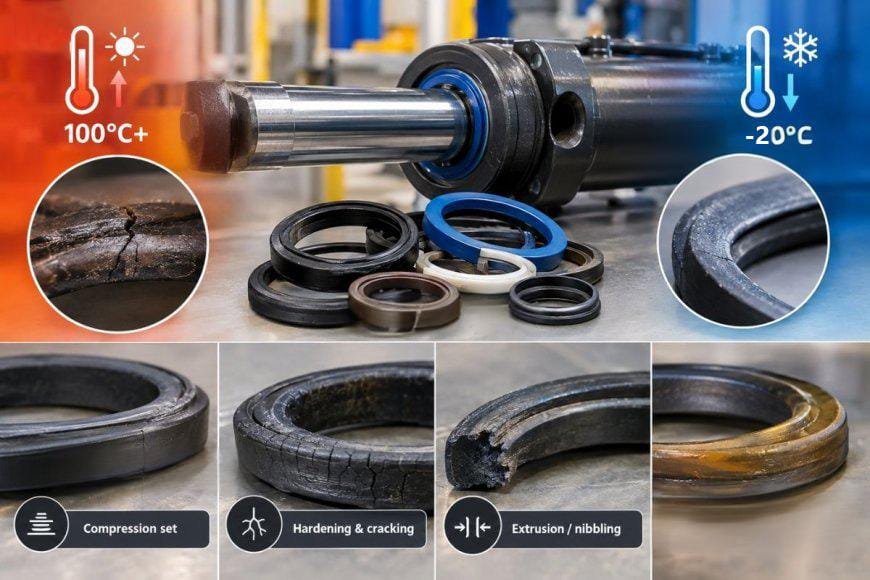
| Observed symptom | Possible cause | What to investigate |
|---|---|---|
| Hard, brittle seal | Thermal aging or chemical degradation | Actual seal temperature, exposure time, fluid compatibility |
| Flattened seal with leakage | Compression set or insufficient recovery | Compound selection, squeeze, thermal aging, gland dimensions |
| Swollen or soft seal | Fluid incompatibility or excessive swelling | Fluid composition, temperature, material grade |
| Cut, nicked, or torn seal | Installation damage or sharp gland edges | Installation tools, chamfers, lubrication, assembly procedure |
| Extruded or nibbling edges | Excessive clearance, pressure, or softened material | Pressure peaks, extrusion gap, hardness, backup-ring needs |
| Rapid wear in rotating service | Frictional heat, poor lubrication, shaft defects | Shaft speed, surface finish, runout, lubrication, seal design |
Failure analysis should include photographs, seal dimensions, installation history, fluid samples where appropriate, operating logs, and the location of leakage. Replacing the seal with a higher-temperature material without identifying the root cause may reproduce the same failure.
Installation Practices for High-Temperature Seals
Even a correctly selected seal can fail early if it is damaged during installation or placed in a poorly prepared gland.
- Inspect the gland: Remove dirt, burrs, corrosion, and sharp edges that could damage the seal.
- Verify dimensions: Confirm the seal size and gland dimensions against the approved drawing or design standard.
- Use compatible assembly lubricants: Avoid lubricants that may attack the seal material or contaminate the process.
- Prevent twisting and stretching: Install O-rings evenly without rolling, cutting, or excessive deformation.
- Protect the sealing surface: Use appropriate installation tools and protect the seal from threads, keyways, and sharp corners.
- Follow the specified assembly procedure: Apply the correct tightening sequence and torque where applicable.
- Conduct a controlled leak test: Verify sealing performance under the approved commissioning conditions before returning equipment to full service.
How to Improve High-Temperature Seal Service Life
- Control the actual seal temperature: Improve cooling, insulation, heat shielding, or component layout where practical.
- Choose a compound with a suitable safety margin: Avoid operating continuously at the edge of a material’s published limit.
- Verify fluid compatibility: Evaluate the complete medium at the actual operating temperature.
- Optimize gland design: Check squeeze, gland fill, extrusion gap, and dimensional changes caused by heat.
- Reduce friction in dynamic systems: Review lubrication, shaft finish, speed, alignment, and seal geometry.
- Monitor operating conditions: Track temperature excursions, leakage, pressure fluctuations, and maintenance intervals.
- Use application-based testing: Validate critical sealing systems with representative fluids and thermal cycles.
High-Temperature Seal Selection Checklist
Before requesting a quotation or approving a seal design, prepare the following information:
- ☐ Seal type: O-ring, oil seal, gasket, custom seal, or other design
- ☐ Exact fluid or gas and its concentration
- ☐ Minimum, continuous, and peak temperatures
- ☐ Duration and frequency of temperature excursions
- ☐ Operating pressure, pressure spikes, or vacuum
- ☐ Static or dynamic operation; shaft speed or stroke where relevant
- ☐ Required dimensions, drawing, and tolerances
- ☐ Candidate material family and exact compound grade
- ☐ Hardness, color, and any required material approvals
- ☐ Expected service life and maintenance interval
- ☐ Applicable industry, customer, or regulatory requirements
- ☐ Required inspection, testing, and documentation
Frequently Asked Questions
What material is best for high-temperature seals?
There is no single material that is best for every high-temperature application. FKM, FFKM, silicone, EPDM, HNBR, PTFE-based designs, and other materials each have different strengths. The right choice depends on the fluid, temperature profile, pressure, movement, and required service life.
Can standard NBR O-rings be used at high temperatures?
Some specialized NBR compounds can tolerate higher temperatures than conventional grades, but standard NBR is generally not the first choice for sustained high-temperature service. Verify the exact compound’s temperature and fluid-resistance data before use.
Are FKM seals suitable for every hot oil application?
No. FKM is compatible with many oils, but performance varies by formulation and fluid chemistry. Some additives, chemicals, and operating conditions may require a different compound. Confirm compatibility using the exact fluid and temperature.
Can silicone seals be used in high-temperature equipment?
Silicone can provide useful high- and low-temperature flexibility in selected applications, particularly static sealing. However, its mechanical strength, tear resistance, and compatibility with oils and fuels may limit its suitability for certain dynamic or fluid-contact applications.
Why does a high-temperature seal leak even when the material rating is sufficient?
Possible causes include compression set, chemical incompatibility, excessive gland fill, incorrect squeeze, pressure extrusion, installation damage, shaft wear, or a mismatch between the published rating and actual service conditions.
How can I estimate the service life of a high-temperature seal?
A published temperature rating alone cannot predict service life. Reliable estimation requires compound-specific aging data, fluid compatibility, mechanical conditions, thermal cycling, and application testing. Field history and controlled validation are valuable for critical equipment.
What information should I provide when ordering custom high-temperature seals?
Provide the seal drawing or dimensions, operating medium, temperature range, pressure, movement, installation conditions, material requirements, and expected service life. If the seal is replacing an existing part, include the original part number and details of any failure.
Conclusion: Choose High-Temperature Seals by the Complete Operating Profile
High-temperature sealing performance depends on the interaction between material chemistry, thermal exposure, fluid compatibility, mechanical design, and installation quality. Selecting a seal solely by its maximum temperature rating can lead to premature leakage, equipment downtime, and unnecessary replacement costs.
A structured selection process—starting with the actual operating environment and continuing through compound verification, gland review, and application testing—helps engineers identify a sealing solution that meets performance and service-life requirements.
Need a high-temperature sealing solution?
For an accurate material recommendation or custom seal quotation, prepare your operating temperature, medium, pressure, dimensions, and application details. These inputs help determine whether an existing compound is suitable or whether a specialized material and design should be evaluated.
For OEM and industrial applications, confirm the selected compound’s technical data, dimensional requirements, and validation plan before production approval.