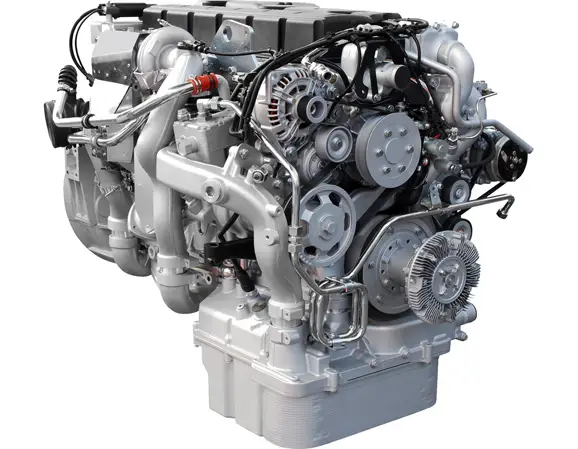
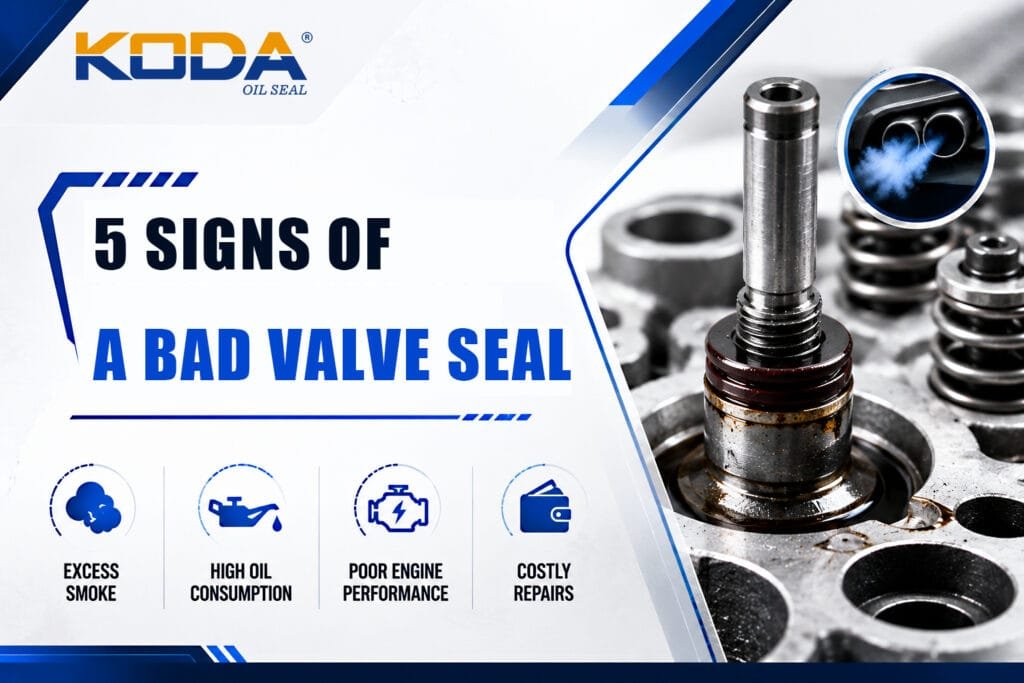
A valve stem seal is a relatively small component inside an engine, but its effect on oil control, combustion quality, emissions, and engine durability can be significant. When the seal begins to deteriorate, the first symptom may be nothing more than a brief puff of blue smoke. If the problem continues, however, oil consumption can increase, carbon deposits can accumulate, spark plugs can become contaminated, and other engine components may eventually be affected.
The challenge is that a failing valve stem seal does not always produce the same symptoms as a piston ring, turbocharger, PCV system, or head-gasket problem. Correct diagnosis therefore requires more than simply looking for smoke from the exhaust.
This guide explains the most common signs of a bad valve stem seal and, more importantly, shows how to interpret those symptoms, what may cause premature seal failure, when replacement should be considered, and how to select a suitable replacement valve seal for an automotive or industrial engine.
Quick Diagnostic Summary
A valve stem seal problem should be considered when an engine produces blue-gray smoke after a cold start, after extended idling, or immediately after engine braking and acceleration, especially when the engine is also consuming oil without an obvious external leak.
These symptoms are useful clues, but they are not proof by themselves. A proper diagnosis should also consider valve guides, piston rings, crankcase ventilation, turbocharger seals, cylinder condition, and the engine’s operating history.
What Does a Valve Stem Seal Do?
A valve stem seal controls the amount of lubricating oil that reaches the interface between the valve stem and valve guide.
The valve train requires lubrication because the valve stem moves continuously through the guide while the engine is operating. However, excessive oil must not enter the combustion chamber.
The valve stem seal therefore has a carefully controlled job: allow sufficient lubrication while limiting unwanted oil migration along the valve stem.
If the seal loses its ability to maintain contact with the valve stem, engine oil can pass into the combustion chamber. The oil is then burned together with the air-fuel mixture, producing characteristic blue or blue-gray exhaust smoke.
Modern valve stem seals are available in different designs and materials depending on the engine configuration and operating conditions. Common constructions include positive-type seals, umbrella-style seals, and other application-specific profiles.
The correct design must match the valve stem diameter, valve guide dimensions, retainer arrangement, installation geometry, temperature, lubricant, and engine manufacturer requirements.
How Long Do Valve Stem Seals Last?
There is no single mileage figure that applies to every valve stem seal.
Service life depends on the elastomer compound, engine temperature, oil quality, valve guide condition, valve stem movement, installation accuracy, lubrication, and the overall design of the engine.
A seal installed in a well-maintained engine may operate for a very long period, while the same type of seal can deteriorate prematurely in an engine exposed to excessive heat, contaminated oil, poor lubrication, or incorrect installation.
Mileage can therefore be used as a maintenance reference, but symptoms and inspection results are more reliable than mileage alone when deciding whether a valve stem seal needs replacement.
5 Common Signs of a Bad Valve Stem Seal
1. Blue Smoke After a Cold Start
One of the most recognizable symptoms of worn valve stem seals is blue or blue-gray smoke immediately after starting an engine that has been parked for several hours.
During an extended shutdown period, oil can migrate into areas around the valve train. If a valve stem seal is no longer sealing properly, oil may pass along the valve stem and enter the combustion chamber.
When the engine starts, this accumulated oil is burned. The result can be a noticeable puff of blue smoke from the exhaust.
The smoke may disappear after several seconds or minutes as the remaining oil is consumed. That does not necessarily mean the problem has disappeared.
Diagnostic clue:
Blue smoke that is strongest immediately after a long shutdown and then decreases as the engine runs can point toward valve stem seal leakage, although other faults must be ruled out.
2. Blue Smoke After Extended Idling
A second common symptom appears when the engine has been idling for an extended period.
Under certain operating conditions, intake manifold vacuum can encourage oil to accumulate around the valve stem and guide area. If the valve stem seal has hardened, cracked, worn, or lost its sealing lip, oil can be drawn past the seal.
When engine speed or load changes, the accumulated oil may enter the combustion chamber and produce a visible cloud of blue-gray smoke.
This pattern is particularly useful because the smoke may not be continuously visible while driving.
For example, an engine may idle normally for several minutes and then produce smoke when the accelerator is applied. This type of operating pattern should prompt inspection of the valve stem sealing system.
3. Blue or Gray Smoke During Acceleration After Engine Braking
Engine braking can provide another useful diagnostic clue.
When a vehicle decelerates with the throttle closed, intake vacuum can increase significantly. Depending on the engine design and condition of the valve train, this can encourage oil to migrate toward the valve stem area.
If the valve stem seals are deteriorated, oil may enter the combustion chamber during this period.
When the throttle is opened again, the accumulated oil can burn and create a temporary burst of blue-gray exhaust smoke.
This is different from an engine that produces heavy smoke continuously under acceleration. Continuous smoke under load can have several possible causes, including piston-ring wear, turbocharger problems, excessive crankcase pressure, or other oil-control issues.
4. Increasing Engine Oil Consumption
A failing valve stem seal can allow engine oil to enter the combustion chamber without producing a visible external oil leak.
This makes oil consumption an important warning sign.
If the oil level drops faster than expected between scheduled oil changes, first determine whether the oil is leaking externally. If there is no obvious external leak, internal oil consumption should be investigated.
A valve stem seal is one possible source, but it is not the only one.
Other potential causes include worn piston rings, cylinder-wall wear, turbocharger oil leakage, crankcase ventilation problems, and excessive engine operating temperature.
Do not diagnose a valve seal from oil consumption alone.
Oil consumption tells you that oil is being lost or burned. It does not automatically identify the component responsible for the loss.
5. Spark Plug Fouling or Engine Misfire
When excessive engine oil enters the combustion chamber, oil deposits can accumulate on spark plugs and other combustion components.
Depending on the engine design and severity of the leak, this can contribute to poor ignition, rough running, misfires, increased emissions, and reduced combustion efficiency.
A fouled spark plug should not automatically be blamed on the valve stem seal. Incorrect fuel mixture, worn piston rings, injector problems, ignition-system faults, and other conditions can also cause deposits or misfires.
However, when spark-plug fouling occurs together with blue smoke and increased oil consumption, the valve train and oil-control system deserve closer inspection.
Other Symptoms That May Accompany Valve Stem Seal Failure
Depending on the engine design and severity of the problem, worn valve stem seals may be associated with several additional symptoms.
- Blue or blue-gray exhaust smoke
- Increasing oil consumption
- Oil deposits around combustion components
- Fouled spark plugs
- Intermittent engine misfire
- Rough running after startup
- Increased exhaust emissions
- Carbon accumulation over extended service
- Reduced combustion efficiency in severe cases
Not every engine will show all of these symptoms. Some engines can continue operating for a considerable period with only increased oil consumption and occasional smoke.
How to Tell a Valve Stem Seal Problem From Piston Ring Wear
This distinction is extremely important because both problems can produce oil consumption and blue exhaust smoke.
A valve stem seal controls oil around the valve stem and guide. A piston ring, by contrast, controls the relationship between the piston, cylinder wall, combustion chamber, and crankcase.
The location of the oil-control failure is therefore different.
| Symptom Pattern | Possible Valve Stem Seal | Possible Piston Ring / Cylinder Issue |
|---|---|---|
| Smoke after cold start | Common diagnostic clue | Possible, but pattern depends on wear |
| Smoke after prolonged idle | Can be a strong clue | Less specific |
| Smoke under heavy acceleration | Possible | Often requires investigation |
| High crankcase pressure | Not normally the primary cause | Can be associated with blow-by |
| Compression loss | Usually not the primary symptom | May be significant depending on wear |
A compression test and leak-down test can provide useful information when piston-ring or valve-sealing problems are suspected. However, test results should always be interpreted together with the engine’s smoke pattern, oil consumption, crankcase pressure, and mechanical condition.
Valve Stem Seal vs. PCV System Problems
The crankcase ventilation system should also be checked before replacing valve stem seals.
A malfunctioning PCV system can alter crankcase pressure and intake vacuum conditions, potentially increasing oil consumption or allowing oil mist to enter the intake system.
If a vehicle suddenly begins consuming oil, checking the PCV valve, hoses, separators, and associated passages can be a relatively simple first diagnostic step.
Replacing valve stem seals without addressing excessive crankcase pressure may fail to solve the underlying problem.
Valve Stem Seal vs. Turbocharger Oil Leakage
On turbocharged engines, the turbocharger should also be considered when blue smoke and oil consumption occur.
A turbocharger contains rotating components and oil-lubricated bearing systems. Depending on the failure mode, oil can enter the intake or exhaust side of the turbocharger.
This can produce symptoms that resemble other forms of oil consumption.
Before replacing a large number of valve seals, inspect the turbocharger, intake system, intercooler where applicable, crankcase ventilation, and exhaust system when the vehicle is turbocharged.
Professional diagnostic principle:
The visible symptom is not always located at the failed component. Oil entering the combustion chamber can originate from several systems. A systematic diagnosis reduces unnecessary parts replacement.
What Causes Valve Stem Seals to Fail?
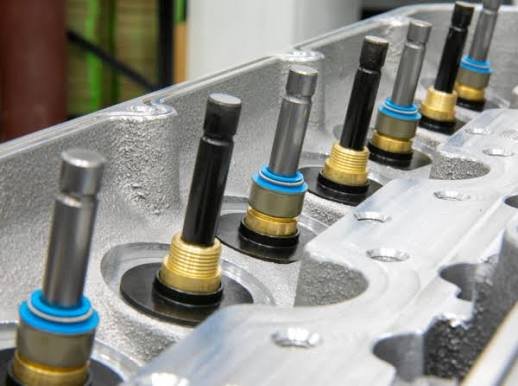
1. Thermal Aging
Valve stem seals operate in a high-temperature environment. Repeated heating and cooling cycles can gradually change the properties of the elastomer.
Long-term exposure to elevated temperature can cause hardening, loss of elasticity, cracking, or deterioration of the sealing lip.
2. Incorrect Material Selection
A seal compound must be compatible with the engine oil, additives, temperature, and operating environment.
Using an elastomer that is unsuitable for the lubricant or temperature can accelerate swelling, shrinkage, hardening, or loss of sealing force.
This is particularly important when replacing an original valve seal with an aftermarket component. The replacement should match the required material and performance specification rather than only the physical dimensions.
3. Poor Installation
Installation damage is a common source of premature seal failure.
A sealing lip can be cut or deformed when it passes over a sharp groove, valve stem end, retainer feature, or other mechanical edge.
The seal can also be installed at an incorrect depth or damaged by excessive force.
For this reason, the correct installation tool and protective sleeve should be used when specified by the engine design.
4. Worn Valve Guide or Valve Stem
A new valve stem seal cannot compensate indefinitely for excessive clearance between the valve stem and guide.
If the guide or valve stem is significantly worn, abnormal movement can place additional stress on the seal and prevent the sealing lip from maintaining a stable contact surface.
When replacing valve stem seals during an engine rebuild, valve stem and guide condition should therefore be inspected at the same time.
5. Poor Lubrication and Contaminated Oil
Engine oil performs more than one job. It lubricates moving components while also helping control heat and contamination.
Degraded oil, excessive contamination, incorrect oil viscosity, or extended service intervals can contribute to accelerated wear throughout the valve train.
Regular oil and filter maintenance can help reduce the conditions that contribute to premature seal deterioration.
How to Check for a Bad Valve Stem Seal
A practical inspection should begin with the easiest checks before major engine disassembly.
Step 1: Check the Engine Oil Level
Record the oil level and compare consumption over a known distance or operating period.
Do not rely on a single low oil reading. Establish whether oil is actually being consumed faster than expected.
Step 2: Inspect for External Oil Leaks
Check the valve cover, oil pan, crankshaft seals, filter housing, turbocharger connections, and other potential leak points.
If oil is leaving the engine externally, the problem may have nothing to do with valve stem seals.
Step 3: Observe the Exhaust During a Cold Start
Start the engine after it has been parked for an extended period and observe the exhaust.
A short burst of blue-gray smoke can be a useful clue, particularly when combined with increased oil consumption.
Step 4: Observe the Engine After Extended Idling
Allow the engine to idle under normal operating conditions and then observe the exhaust when the throttle is opened.
A noticeable blue smoke event can indicate oil entering the combustion chamber during the idle period.
Step 5: Check Spark Plugs
On gasoline engines, spark plug condition can provide additional information.
Oil contamination or abnormal deposits on one or more plugs may help identify a cylinder-specific problem.
Step 6: Test Compression and Perform a Leak-Down Test
If internal engine wear is suspected, compression testing and leak-down testing can help determine whether the problem involves the combustion chamber, valves, piston rings, or cylinder sealing.
These tests should be interpreted by someone familiar with the specific engine design.
Step 7: Inspect the Valve Train
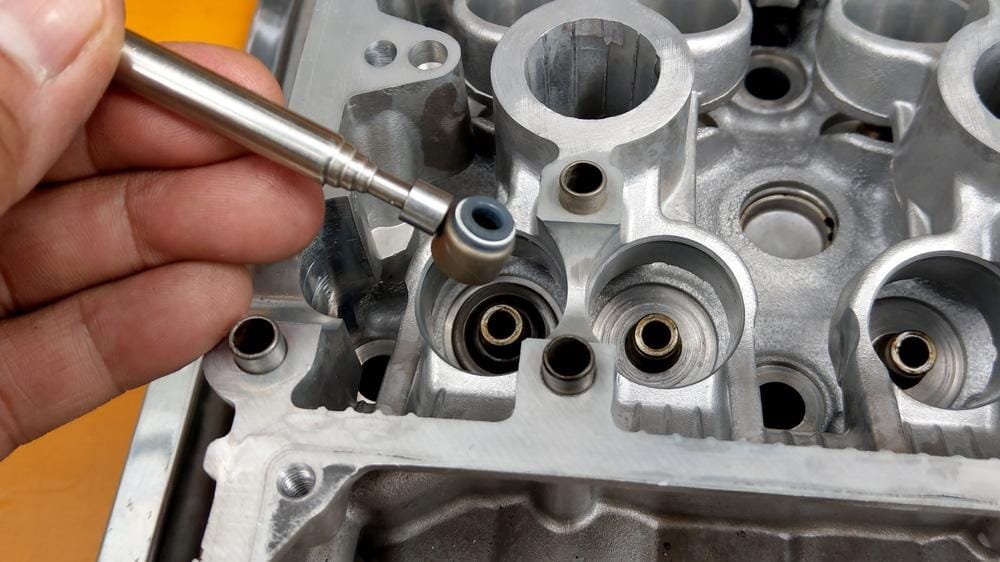
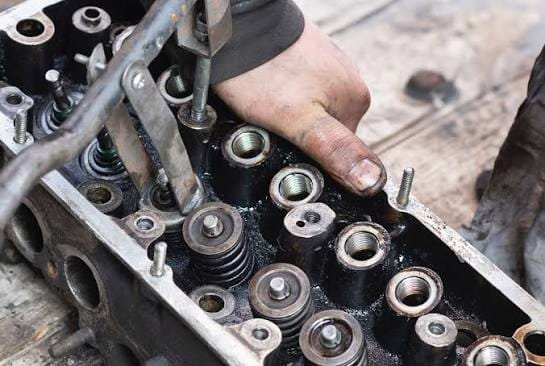
If the evidence points toward the valve train, remove the necessary components and inspect the valve stem seals, valve stems, valve guides, retainers, and related components.
Look for hardened rubber, cracks, torn sealing lips, loss of elasticity, incorrect seating, or abnormal wear.
Can You Replace Valve Stem Seals Without Removing the Cylinder Head?
In some engine designs, valve stem seals can be replaced without removing the cylinder head. Specialized procedures and tools may allow the valves to remain supported while the valve springs and seals are removed.
Whether this is practical depends entirely on the engine architecture and the manufacturer’s service procedure.
Other engines require cylinder-head removal to provide proper access and support.
A major advantage of the cylinder-head-off approach is that the technician can inspect the valve guides, valve seats, valves, springs, and other components at the same time.
The head-on procedure may reduce labor in suitable engines but requires appropriate tools, technician experience, and careful control of the valves during service.
How to Install a Valve Stem Seal Correctly
Correct installation is essential because the sealing lip is relatively delicate compared with the surrounding engine components.
- Verify the correct seal part number and dimensions.
- Confirm the elastomer material and application requirements.
- Inspect the valve stem and guide before installation.
- Clean the installation area thoroughly.
- Protect the sealing lip from sharp edges.
- Use the recommended installation sleeve when required.
- Press the seal straight onto the valve guide.
- Avoid excessive impact force.
- Confirm that the seal is seated at the specified position.
- Inspect the lip after installation for damage or displacement.
Installation Warning
A valve stem seal can look undamaged from the outside while its sealing lip has already been cut during installation. Using the correct protective sleeve and installation tool is therefore not simply a convenience—it can prevent an immediate or premature oil-control failure.
What Materials Are Used for Valve Stem Seals?
Valve stem seals can be manufactured from different elastomer compounds depending on the engine environment.
NBR can be suitable for certain general-purpose oil-sealing applications where temperature requirements are moderate.
FKM / Fluoroelastomer is often selected for higher-temperature environments and applications requiring strong resistance to many oils, fuels, and chemicals.
ACM / Polyacrylate can be considered for certain automotive applications where hot oil and elevated-temperature performance are important.
Silicone may be used in specialized applications where its temperature flexibility and other material characteristics are advantageous.
The correct material depends on the engine oil, temperature, speed, valve stem movement, sealing geometry, and expected service life.
Why Valve Stem Seal Material Matters
Choosing a valve seal only by size can create problems even when the replacement part physically fits the valve guide.
The elastomer must maintain its sealing properties throughout the expected temperature range and remain compatible with the engine lubricant and additives.
A material that becomes excessively hard can lose sealing contact. A material that swells excessively can interfere with valve movement or change the intended sealing geometry. A material that loses elasticity may fail to follow the valve stem during repeated movement.
For OEM and aftermarket applications, the material should therefore be selected from the actual operating environment rather than from dimensional compatibility alone.
How to Prevent Premature Valve Stem Seal Failure
Preventive maintenance starts before the seal fails.
- Use the engine manufacturer’s recommended lubricant specification.
- Maintain appropriate oil-change intervals.
- Replace oil filters according to the maintenance schedule.
- Avoid prolonged operation at abnormal temperatures.
- Inspect the crankcase ventilation system.
- Check valve guide and stem condition during major repairs.
- Use the correct replacement seal material.
- Follow the correct installation procedure.
- Protect the sealing lip during assembly.
- Investigate abnormal oil consumption early.
A small valve seal problem can be relatively inexpensive to address when identified early. Continued oil consumption, however, can create secondary problems that increase repair complexity.
When Should Valve Stem Seals Be Replaced?
Valve stem seals should generally be considered for replacement when there is convincing evidence of deterioration, leakage, hardened sealing lips, physical damage, or abnormal oil-control behavior.
They may also be replaced as part of a cylinder-head rebuild when the valve train is already disassembled.
However, replacing seals simply because an engine has reached a particular mileage is not always necessary. The condition of the seals and the operating symptoms should be considered together.
For a high-mileage engine with several oil-control symptoms, replacing valve stem seals without inspecting valve guides, piston rings, PCV components, and other possible sources may not solve the underlying problem.
5 Signs of a Bad Valve Stem Seal: Diagnostic Checklist
| Observed Symptom | What It May Indicate | Recommended Check |
|---|---|---|
| Blue smoke at startup | Oil entering combustion chamber during shutdown | Valve seals, guides, oil-control system |
| Blue smoke after idling | Possible oil migration under vacuum conditions | Valve seals and PCV system |
| Smoke after engine braking | Possible oil pulled into combustion chamber | Valve seals, guides, intake system |
| Increasing oil consumption | Internal or external oil loss | Leaks, valve seals, rings, PCV, turbo |
| Plug fouling / misfire | Possible oil contamination of combustion process | Spark plugs, compression, ignition and oil-control systems |
OEM Valve Stem Seal Selection
For an OEM or replacement valve stem seal, the correct specification should include more than the outside diameter of the seal.
Useful information includes:
- Valve stem diameter
- Valve guide outside diameter
- Seal height
- Installation position
- Valve stem movement
- Engine operating temperature
- Engine oil specification
- Expected service life
- Required elastomer material
- Hardness where specified
- Spring or garter-spring configuration
- Metal reinforcement requirements
- OEM drawing or sample
For replacement or custom production, supplying a drawing or original sample can significantly reduce the risk of dimensional mismatch.
Why Custom Valve Stem Seals May Be Necessary
Not every engine uses the same valve guide diameter, seal profile, installation height, or spring configuration.
For older engines, discontinued equipment, specialty machinery, agricultural engines, motorcycles, or low-volume production, a standard catalog seal may not provide the correct fit.
A custom valve stem seal can be developed around the actual valve guide, stem dimensions, operating temperature, lubricant, and installation geometry.
For these applications, the most useful starting information is usually an engineering drawing, physical sample, dimensional measurement, or original part number.
Need a replacement or custom valve stem seal?
Provide the original seal, drawing, dimensions, engine model, operating temperature, lubricant specification, and application conditions. A sealing manufacturer can then evaluate the profile, elastomer, dimensions, and production requirements before recommending a replacement.
Frequently Asked Questions About Bad Valve Stem Seals
What are the first signs of a bad valve stem seal?
A brief burst of blue or blue-gray smoke after a cold start is one of the most recognizable clues. Blue smoke after extended idling or after engine braking can provide additional evidence.
Can bad valve stem seals cause blue smoke?
Yes. A deteriorated valve stem seal can allow engine oil to enter the combustion chamber, where it is burned and produces blue or blue-gray exhaust smoke.
Can a bad valve stem seal cause oil consumption?
Yes. If oil passes through the valve stem sealing system and enters the combustion chamber, the engine can consume oil without producing an obvious external leak.
Can you drive with bad valve stem seals?
An engine may continue operating with deteriorated valve stem seals, but continued oil consumption can create additional problems. The severity of the leak and the effect on the engine should be assessed before continued operation.
Can bad valve seals cause a misfire?
They can contribute to misfire if oil entering the combustion chamber contaminates spark plugs or affects combustion. However, ignition, fuel, compression, and other engine faults should also be investigated.
How can I tell if my valve stem seals are leaking?
Look for a combination of symptoms rather than relying on one sign. Blue smoke after cold starts, smoke after extended idling, smoke after engine braking, increased oil consumption, and oil-fouled spark plugs can collectively point toward a valve sealing problem.
Do valve stem seals affect engine compression?
Valve stem seals primarily control oil around the valve stem and guide. A compression problem should not automatically be attributed to the seal. Low compression is more commonly associated with issues involving valves, valve seats, piston rings, cylinder wear, or head-gasket sealing.
What is the best material for a valve stem seal?
There is no single best material for every engine. NBR, FKM, ACM, silicone, and other elastomers may be appropriate depending on temperature, lubricant, chemical exposure, valve movement, and service requirements.
Can a new valve stem seal fail quickly?
Yes. Premature failure can result from incorrect material selection, installation damage, incorrect dimensions, excessive valve-guide clearance, poor lubrication, abnormal engine temperature, or contamination.
Conclusion
Valve stem seals are small components, but they perform an important oil-control function inside the engine. When they deteriorate, the most recognizable warning signs can include blue exhaust smoke after startup, smoke after extended idling, smoke after engine braking, increasing oil consumption, and oil-related spark plug fouling or misfire.
However, these symptoms should be treated as diagnostic clues rather than automatic proof of valve stem seal failure. Piston rings, valve guides, PCV systems, turbochargers, external oil leaks, and other engine problems can produce similar symptoms.
The most reliable approach is to combine the smoke pattern, oil-consumption history, engine operating conditions, compression or leak-down results, and physical inspection before deciding on a repair.
For OEM and replacement applications, correct valve stem seal selection also requires attention to profile, dimensions, elastomer compound, temperature, lubricant compatibility, valve-guide condition, and installation method.
A properly selected and correctly installed valve stem seal can help maintain controlled lubrication, reduce unwanted oil entry into the combustion chamber, and support long-term engine reliability.