Peugeot Oil Seal
Categories
Auto Oil Seal
- Auto Oil Seal
- TOYOTA Oil Seal
- Nissan/Honda oil seal
- Isuzu Oil Seal
- MITSUBISHI/FUSO Oil Seal
- SUZUKI Oil Seal
- HYUNDAI/KIA Oil Seal
- HINO Oil Seal
- Ford / Chevrolet Oil Seal
- Peugeot Oil Seal
- VW/Iveco Oil Seal
- PEUGEOT Oil Seal
- LADA Oil Seal
- Caterpillar Oil Seal
- HYUNDAI Oil Seal
- MAZDA Oil seals
- BENZ Oil Seal
- VOLVO Oil Seal
- BPW Oil Seal
- MAN oil Seals
- RENAULT Oil Seals
- SCANIA Oil Seal
- FORD Oil Seal
- MACK Oil Seal
- DAF Oil Seals
- PERKINS Oil Seal
Motorcycle Oil Seal
Agricultural Machine Oil Seal
Construction Machinery Oil Seal
Truck Wheel Hub Oil Seal
Cassette Wheel Hub Oil Seal
Power Steering Oil Seal and Kit
Hydraulic Pump Oil Seal
JCB SEAL KIT
Concrete Mixer Gearbox Oil Seal
Wheel Cylinder Brake Cup Seal
Engine Valve Cover Gasket
Bonded Seals
End Cover Cap Seals
Speak with a Product Expert
Please contact our professional sales team to discuss your application needs. We have dedicated staff available to answer your calls Monday through Friday, from 8:30 AM to 6:00 PM Beijing time.
New Customers:
+86 18730921709
Existing/Repeat Customers:
Email:sales@kodaseal.com
NEWS
Symptoms of a Damaged Crankshaft Oil Seal and Replacement Tips
Common Causes of Oil Seal Failure
What is the Importance of Metal Detectable O-Rings?
Peugeot Oil Seal
Peugeot oil seals are used throughout the engine, transmission, differential, axle and other rotating assemblies to retain lubricants while preventing dust, moisture and contaminants from entering sensitive mechanical areas.
Choosing a replacement Peugeot oil seal is more complicated than matching a vehicle model with a generic seal. The correct component may depend on the shaft diameter, housing bore, seal width, lip configuration, material, operating temperature, lubricant, rotational speed and the exact engine or transmission configuration.
This guide explains how to identify a Peugeot oil seal, how to interpret dimensions and OE references, which seal locations are most common, how to diagnose leakage, and what information should be supplied when purchasing a replacement seal.
If you have questions about Peugeot Oil Seal, please contact us!
Important: A Peugeot oil seal with the same outside dimensions is not necessarily a direct replacement. The sealing lip design, material, installation position and operating conditions must also be compatible with the application.
SHOW MORE
What Is a Peugeot Oil Seal?
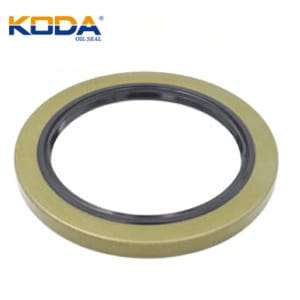
A Peugeot oil seal is generally a radial shaft seal designed to control lubricant leakage around a rotating or oscillating shaft. Depending on the application, it may also be called a shaft seal, rotary shaft seal, radial lip seal, transmission oil seal, differential seal or axle seal.
In an automotive system, the seal normally has two important functions:
- Fluid retention: keeping engine oil, transmission oil, gear oil or grease inside the intended housing.
- Contamination exclusion: reducing the entry of dust, water and other contaminants into the assembly.
ISO 6194-1 defines dimensional requirements for rotary shaft lip-type seals incorporating elastomeric sealing elements and specifies nominal dimensions and tolerances associated with seals, shafts and housings. The current ISO version remains ISO 6194-1:2007, which was reviewed and confirmed in 2023. ISO 6194-1
For Peugeot applications, this means the replacement process should consider the entire sealing system rather than treating the seal as an isolated rubber component.
Where Are Peugeot Oil Seals Used?
Different Peugeot assemblies use different oil seal designs. A seal intended for a crankshaft should not automatically be substituted for a gearbox or differential seal simply because the dimensions appear similar.
Peugeot Crankshaft Oil Seal
The crankshaft seal is installed around the rotating crankshaft and is responsible for retaining engine oil. Depending on engine design, there may be front and rear crankshaft sealing locations.
A leaking crankshaft seal can produce oil around the timing-side area, crank pulley area or the transmission side of the engine. A rear crankshaft leak can be particularly difficult to diagnose because the oil may appear near the bell housing.
One catalog example listed for Peugeot applications is a 85 × 105 × 9 mm rear crankshaft seal associated with OE reference 0514.A2 and TU5JP4 1.6L applications. This should be treated as a catalog reference rather than universal Peugeot fitment; engine code, production year and exact application must be verified before ordering.
Peugeot Camshaft Oil Seal
Camshaft oil seals control lubricant around the camshaft where it passes through the cylinder head or related housing.
Because the camshaft rotates continuously while the engine is running, the sealing lip must maintain controlled contact with the shaft without creating excessive friction.
A catalog example is a 36 × 50 × 7 mm camshaft seal associated with reference 01712001. Again, dimensions and reference numbers should be confirmed against the exact engine before installation.
Peugeot Gearbox Drive Shaft Seal
Transmission and gearbox drive shaft seals are among the most frequently searched Peugeot oil seal products.
These seals are installed around rotating shafts where the transmission housing interfaces with the drivetrain. Their main task is to retain transmission lubricant while keeping road contamination away from the shaft and housing.
Unlike an engine crankshaft seal, a gearbox shaft seal may operate with different lubricant chemistry, shaft speeds, housing geometry and contamination exposure. Therefore, the correct replacement should be selected for the actual transmission location.
Peugeot Differential and Axle Oil Seal
Differential seals are designed to retain gear oil around differential output shafts or axle interfaces.
A damaged differential seal can result in gear-oil leakage around the axle or transmission-to-differential connection. Continued leakage can reduce lubricant level and potentially contribute to abnormal gear or bearing wear.
The catalog page includes Peugeot differential/axle examples such as 40 × 58 × 11.3 mm and approximately 29.9 × 47 × 11.3 mm configurations. These dimensions should be used as identification references rather than assumed vehicle-wide specifications.
How to Read Peugeot Oil Seal Dimensions
Most radial oil seal dimensions are written in a format similar to:
Shaft Diameter × Housing Bore Diameter × Seal Width
For example, a seal described as 40 × 58 × 11.3 mm generally indicates:
- 40 mm — nominal shaft diameter
- 58 mm — nominal housing bore diameter
- 11.3 mm — seal width
These dimensions correspond to the fundamental dimensional concept used for radial shaft seals. ISO 6194-1 specifies nominal dimensions and tolerances for the seal, shaft and housing, which is important when determining interchangeability. ISO 6194-1 technical reference
However, dimensional matching is only the first step. You should also verify the lip arrangement, spring configuration, sealing direction, material and installation depth.
Common Peugeot Oil Seal Sizes and References
The original Peugeot page contains a large catalog of dimensions and references. The following examples are useful for search and identification purposes:
| Reference / Type | Example Size | Potential Application |
|---|---|---|
| 6312127 | 29.85 × 47 × 11.3 mm | Peugeot shaft / transmission-related application |
| 6314507 | 40 × 58 × 11.3 mm | Peugeot differential / shaft application |
| 0514.A2 | 85 × 105 × 9 mm | Example crankshaft rear application |
| 0514.A3 | 42 × 66 × 6 mm | Example crankshaft front application |
| 01712001 | 36 × 50 × 7 mm | Example camshaft application |
| 312144 | Approximately 40 × 58 × 10 mm | Example gearbox drive shaft seal |
| 55490645 / AEW1728 | Shock absorber-related reference | Peugeot application |
The original catalog lists many additional TGR, TGL, SGL, SGR, SCR, SC, TC, TBL, TBGR and VC configurations. These product codes describe different seal constructions and should not be interpreted as interchangeable simply because their dimensions are close.
Fitment warning: OE references and dimensions shown here are examples from a product catalog. Always verify the exact Peugeot model, engine/transmission code, production year, installation position and original seal before placing an order.
Peugeot Oil Seal Materials
The elastomer material is one of the most important differences between apparently similar oil seals.
NBR — Nitrile Rubber
NBR is one of the most common materials for rotary oil seals because of its good resistance to mineral oils, fuels and many petroleum-based fluids.
Parker identifies standard NBR as a common rotary shaft seal material, with a typical operating range around -29°C to +121°C for the referenced compound family. Actual limits depend on the formulation and application. Parker Rotary Seal Design Guide
HNBR — Hydrogenated Nitrile Rubber
HNBR is a modified nitrile elastomer with improved resistance to heat aging, ozone, abrasion and demanding environments compared with conventional NBR.
Parker lists HNBR compounds for approximately -40°C to +149°C in its rotary seal material guide, but this should not be treated as a universal rating for every HNBR compound.
FKM — Fluorocarbon Rubber
FKM is often considered when higher temperature capability or specific chemical resistance is required. It can be a better choice for some high-temperature oil and chemical environments, although it is usually more expensive than standard NBR.
The correct material depends on the actual oil, additives, temperature, pressure and speed. A higher-priced material is not automatically a better seal.
Why Does a Peugeot Oil Seal Leak?
A leaking seal does not always mean the rubber component itself was defective. In many cases, the root cause is associated with the shaft, housing, lubricant, installation or operating conditions.
1. Worn Shaft Surface
A radial seal lip operates against the shaft surface. If the shaft develops a groove at the sealing contact area, installing another identical seal may only provide a temporary solution.
SKF explains that a worn or damaged seal counterface can prevent the seal from performing correctly. Its maintenance guidance also describes repair options including shaft rework, replacement of the counterface or the use of a wear sleeve. SKF SPEEDI-SLEEVE information
2. Incorrect Installation
Installation damage can occur when the lip passes over a keyway, spline, thread, groove or sharp shaft edge.
A seal can also be installed at the wrong depth or with the sealing lip facing the wrong direction.
SKF recommends suitable installation sleeves for applications where the sealing lip has to pass over grooves, threads or gearing.
3. Excessive Shaft Runout
If the shaft does not rotate concentrically, the seal lip may lose proper contact on part of each revolution. This can increase leakage and accelerate wear.
4. Excessive Pressure
Many conventional radial shaft seals are primarily intended for low-pressure sealing. ISO 6194-1 specifically describes this seal category as suitable for low-pressure conditions.
If a Peugeot application experiences significant pressure, the sealing design must be reviewed rather than assuming a conventional oil seal can handle the additional load.
5. Wrong Lubricant or Temperature
Elastomer compatibility depends on both fluid and temperature. An oil that is compatible with one seal material may cause swelling, shrinkage or degradation in another.
6. Contamination
Dirt particles can enter the sealing interface and damage both the lip and shaft. This is particularly important around wheel, axle and differential locations where road contamination is common.
How to Replace a Peugeot Oil Seal Correctly
Replacing an oil seal should be treated as a sealing-system repair rather than simply removing one rubber component and pressing in another.
Recommended inspection sequence
- Identify the exact leaking location.
- Confirm the shaft and housing dimensions.
- Record the original seal orientation.
- Remove the old seal without damaging the housing.
- Inspect the shaft sealing track for grooves or corrosion.
- Inspect the housing bore for damage.
- Clean the sealing area.
- Lubricate the appropriate lip and shaft surface.
- Use the correct installation tool.
- Install the seal to the specified depth and orientation.
- Check for abnormal shaft movement or runout.
SKF’s maintenance documentation specifically advises that a removed radial shaft seal should not be reused and that the shaft counterface should be inspected before installing the replacement.
How to Identify a Peugeot Oil Seal Without an OE Number
Sometimes the original seal has no readable part number. In that situation, dimensional measurement becomes particularly important.
Measure:
- Shaft diameter
- Housing bore diameter
- Overall seal width
- Outer diameter and metal/rubber case design
- Number and orientation of sealing lips
- Presence of garter spring
- Presence of dust lip
- Original material, if known
Do not measure a badly deformed old seal and assume that every measured dimension represents its original specification. Where possible, measure the shaft and housing directly.
Why the Same Size Does Not Always Mean the Same Seal
Consider two seals that both fit a 40 mm shaft and a 58 mm housing. They may still differ in:
- Rubber material
- Hardness
- Lip geometry
- Spring design
- Dust-exclusion capability
- Pressure capability
- Temperature capability
- Installation depth
- Rotational speed capability
SKF’s radial shaft seal product information demonstrates how seal designs can incorporate features such as auxiliary lips, garter springs and modified lip geometries for different operating requirements.
Therefore, dimension matching is necessary but not always sufficient.
Peugeot Oil Seal Selection Checklist
| Selection Factor | What to Confirm |
|---|---|
| Vehicle | Peugeot model and production year |
| Engine | Engine code and displacement |
| Transmission | Transmission type and configuration |
| Location | Crankshaft, camshaft, gearbox, differential or axle |
| Dimensions | Shaft × housing × width |
| Material | NBR, HNBR, FKM, PTFE or specified compound |
| OE reference | Original part number where available |
What Information Should Be Included in a Peugeot Oil Seal RFQ?
For distributors, repair shops and OEM buyers, providing complete information can significantly reduce the risk of receiving the wrong seal.
A useful RFQ should include:
- Peugeot model
- Engine or transmission code
- Vehicle year
- OE number
- Seal dimensions
- Application position
- Material requirement
- Operating temperature
- Lubricant or fluid
- Rotational speed, when relevant
- Required quantity
- Drawing or photograph of the original seal, if available
If the OE number is unavailable, a clear dimensional drawing can often be more useful than the vehicle model alone.
Peugeot Oil Seal for 405, 206, 207, 307 and Other Models
Peugeot oil seal searches are often made using a vehicle model such as Peugeot 405, 206, 207 or 307. Model-based searching is useful for finding an initial product category, but it should not be used as the final fitment confirmation.
For example, the catalog referenced above contains an application for a 0514.A2 / 85 × 105 × 9 mm rear crankshaft seal associated with Peugeot 206, 207 and 307 TU5JP4 1.6L applications. It also lists a 0514.A3 / 42 × 66 × 6 mm front crankshaft example for TU3JP/TU5JP engines.
These examples demonstrate why engine code and sealing location matter. The same Peugeot model can be produced with different engines, transmissions or production configurations.
Peugeot Oil Seal vs O-Ring
Oil seals and O-rings both provide sealing, but they solve different engineering problems.
Oil Seal
Primarily used around shafts or rotating components. The lip maintains controlled contact with the shaft while retaining lubricant and excluding contaminants.
O-Ring
Normally installed in a groove and compressed between mating surfaces. It is widely used for static and selected dynamic sealing applications.
Replacing a Peugeot shaft oil seal with an O-ring simply because both are made from elastomer is not an equivalent sealing solution.
Frequently Asked Questions
What is the most common Peugeot oil seal?
There is no single universal Peugeot oil seal. Common categories include crankshaft seals, camshaft seals, gearbox drive shaft seals and differential/axle seals. The exact part depends on the vehicle and installation location.
How do I find the correct Peugeot oil seal?
Start with the OE number if available. Otherwise, provide the Peugeot model, engine or transmission code, installation location and the three basic dimensions: shaft diameter, housing bore and seal width.
Can I use a different brand with the same dimensions?
Potentially, but dimensions alone are not enough. Material, lip configuration, pressure, speed, temperature and application conditions should also be compatible.
Why does my new Peugeot oil seal still leak?
Possible causes include a worn shaft, incorrect installation depth, damaged lip, incorrect orientation, excessive shaft runout, unsuitable lubricant, contamination or an incorrect seal specification.
Should the shaft be inspected when replacing an oil seal?
Yes. A groove worn into the shaft at the seal contact position can cause a replacement seal to leak again. SKF specifically recommends inspecting the seal counterface and provides wear-sleeve solutions for suitable applications.
Is NBR suitable for Peugeot oil seals?
NBR is widely used for petroleum-oil and automotive sealing applications. Parker lists standard NBR as a common rotary shaft seal material with good oil and fuel resistance. However, the correct compound should be selected according to the actual temperature and fluid.
Final Guide to Choosing a Peugeot Oil Seal
A reliable Peugeot oil seal selection process should not stop at searching for a vehicle model or copying an OE number from an online catalog.
The better approach is to combine vehicle identification, engine/transmission information, seal location, dimensions, material and operating conditions.
For simple applications, an OE reference and dimensional check may be enough. For demanding applications, additional information such as shaft speed, temperature, lubricant, pressure and contamination level becomes important.
Most importantly, if an old Peugeot oil seal has failed, investigate why it failed before installing the replacement. A worn shaft, incorrect installation or incompatible material can cause a new seal to fail even when its dimensions are correct.
Looking for a Peugeot oil seal?
For accurate identification, provide the Peugeot model, engine or transmission code, OE number, seal dimensions and application location. If the original seal is available, photographs showing the complete seal, markings and sealing lip can also help identify the correct construction.
 TA oil seal
Oil Seal 72X105X13-TA
- TA oil seal
Oil Seal 35X55-61X9-14.5-TA
- TA oil seal
Oil Seal 120X150X13-TA
- TA oil seal
Oil Seal 40X52X7-TA
- TA oil seal
Oil Seal 100X130X13-TA
- TA oil seal
Oil Seal 75X100X13-TA
- TA oil seal
Oil Seal 48X62X7-TA
- TA oil seal
Oil Seal 125X150X15-TA
- TA oil seal
Oil Seal 120X150X15-TA