O-Rings in Oil & Gas Applications: Engineering Performance Under Extreme Pressure
The oil and gas industry represents one of the most demanding environments for sealing technology. From offshore drilling platforms and subsea equipment to refineries, pipelines, and hydraulic control systems, sealing components must operate reliably under extreme pressure, temperature fluctuations, aggressive chemicals, and continuous mechanical stress. Among all sealing solutions, O-Rings remain one of the most widely used and trusted designs because of their simple structure, excellent sealing efficiency, and adaptability across thousands of industrial applications.
However, choosing an O-ring for oil and gas service is far more complex than selecting a standard rubber ring. Engineers must consider pressure rating, extrusion resistance, explosive decompression risk, chemical compatibility, temperature range, compression set, and installation conditions. A seal that performs well in a low-pressure hydraulic system may fail immediately in a high-pressure gas environment.
This article provides an engineering-focused analysis of how O-rings perform under oil and gas pressure conditions, including material selection, pressure failure mechanisms, industry standards, application examples, testing methods, and practical selection guidelines.
🔧 Engineering Insight:
In oil and gas sealing systems, O-ring reliability depends on the complete sealing design—not only the rubber compound. Groove geometry, extrusion gap, pressure direction, backup rings, and surface finish are equally important factors.
Why O-Rings Are Critical in Oil & Gas Equipment
Oil and gas equipment operates under conditions where even microscopic leakage can create serious safety, environmental, and economic consequences. O-rings are widely used because they provide effective static and dynamic sealing while requiring minimal installation space.
Typical oil and gas applications include:
- ✔ Hydraulic control systems
- ✔ Blowout preventers (BOP)
- ✔ Wellhead equipment
- ✔ Downhole drilling tools
- ✔ Valve assemblies
- ✔ Subsea connectors
- ✔ Pumps and compressors
- ✔ Pipeline instrumentation systems
Unlike many mechanical components, O-rings provide sealing through controlled deformation. When compressed inside a properly designed gland, the elastomer creates contact stress against sealing surfaces, preventing fluid or gas migration.
Understanding Pressure Effects on O-Ring Performance
Pressure is one of the most important factors influencing O-ring performance. As system pressure increases, the elastomer is forced toward the clearance gap between mating components. If the extrusion gap exceeds the material capability, the O-ring can deform permanently or develop surface damage.
Low Pressure vs High Pressure Sealing
| Pressure Range | Main Risk | Recommended Design Consideration |
|---|---|---|
| Below 10 MPa | Normal wear and aging | Standard groove design |
| 10-35 MPa | Extrusion risk | Harder compounds or backup rings |
| 35-70 MPa | Material deformation | High-performance elastomers |
| Above 70 MPa | Extreme extrusion and decompression | Specialized high-pressure sealing design |
Actual pressure capability depends on hardness, temperature, extrusion gap, hardware tolerance, and elastomer formulation. Therefore, pressure ratings should always be evaluated as part of the complete sealing system.
Material Selection for Oil & Gas O-Rings
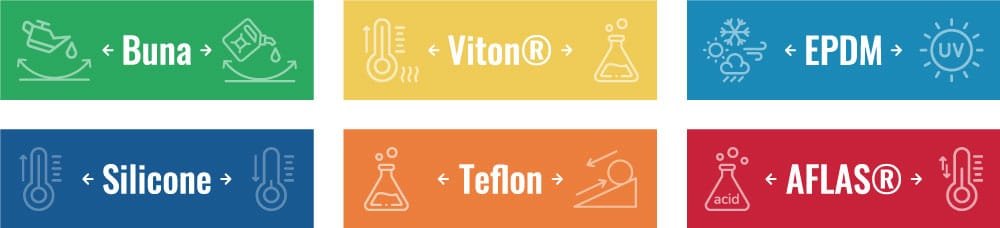
The oil and gas industry uses several elastomer materials because operating conditions vary significantly between upstream, midstream, and downstream applications.
| Material | Temperature Range | Advantages | Typical Applications |
|---|---|---|---|
| NBR (Nitrile) | -40°C to +100°C | Excellent petroleum oil resistance | Hydraulic systems, general oil applications |
| HNBR | -40°C to +150°C | Improved heat and abrasion resistance | High-performance oilfield equipment |
| FKM (Viton) | -20°C to +200°C | Excellent chemical and temperature resistance | Refinery equipment, aggressive fluids |
| FFKM | Up to +327°C | Extreme chemical resistance | Critical high-temperature environments |
| EPDM | -50°C to +150°C | Excellent water and steam resistance | Steam systems and water injection |
High Pressure Oil & Gas Sealing Challenges
1. O-Ring Extrusion Failure
Extrusion is one of the most common O-ring failures in high-pressure systems. When pressure pushes the elastomer into the clearance gap, small pieces of material may shear away, creating leakage paths.
⚠ Failure Prevention:
For pressures above approximately 10-20 MPa, engineers often consider backup rings, tighter extrusion gaps, higher hardness compounds, or reinforced sealing designs.
2. Rapid Gas Decompression (RGD)
Oil and gas environments frequently involve high-pressure gases such as methane, carbon dioxide, and hydrogen sulfide. During high-pressure exposure, gas molecules can diffuse into elastomer structures. If pressure decreases rapidly, trapped gas expands and may create internal cracks.
This phenomenon is known as Rapid Gas Decompression (RGD) or explosive decompression.
Materials used for severe gas applications are often selected according to recognized qualification methods such as NORSOK M-710 or API-related requirements depending on the application.
3. Chemical Swelling and Degradation
Crude oil, drilling fluids, additives, cleaning chemicals, and production gases can affect elastomer properties. Chemical exposure may cause swelling, hardness changes, cracking, or loss of elasticity.
| Chemical Media | Preferred Material |
|---|---|
| Hydraulic Oil | NBR / HNBR |
| High Aromatic Fluids | FKM |
| Steam Injection | EPDM / FKM |
| Sour Gas (H₂S) | HNBR / FKM / FFKM |
Important Industry Standards
Oil and gas sealing components are commonly evaluated according to international testing standards.
| Standard | Purpose |
|---|---|
| ASTM D2000 | Rubber material classification |
| ASTM D2240 | Hardness measurement |
| ASTM D395 | Compression set evaluation |
| ASTM D412 | Tensile strength and elongation testing |
| ISO 3601 | O-ring dimensional standard |
| NORSOK M-710 | Critical oil and gas elastomer qualification |
Hardness Selection and Pressure Capability
O-ring hardness is typically measured using Shore A values. Softer materials provide better low-pressure sealing and surface conformity, while harder materials resist extrusion under higher pressure.
| Hardness | Application Characteristics |
|---|---|
| 60 Shore A | Excellent flexibility, low pressure |
| 70 Shore A | General industrial standard |
| 80-90 Shore A | High-pressure applications |
Surface Finish and Groove Design
Even the best elastomer cannot compensate for poor hardware design. O-ring grooves require controlled dimensions, proper surface finish, and correct compression levels.
Typical engineering recommendations include:
- ✔ Smooth sealing surfaces
- ✔ No sharp machining edges
- ✔ Controlled groove tolerance
- ✔ Correct squeeze percentage
- ✔ Proper lubrication during installation
Case Example (Industry Experience)
Example Only – Engineering Scenario
A subsea valve application required sealing performance under high pressure and exposure to hydrocarbon fluids. Engineers evaluated several elastomer options and selected a high-hardness FKM compound combined with backup ring protection. The design review focused on extrusion resistance, chemical compatibility, and temperature stability. This example represents typical engineering practices and does not describe a specific customer project or verified field data.
Laboratory Test Example
Illustrative Testing Method
A laboratory evaluation may expose O-rings to pressure cycling, temperature aging, compression set testing, and chemical immersion. Engineers measure changes in hardness, volume, tensile strength, and leakage performance. Actual results depend on compound formulation, test conditions, and equipment configuration.
Common O-Ring Failure Analysis
| Failure | Cause | Solution |
|---|---|---|
| Extrusion Damage | Excessive pressure gap | Backup rings or harder material |
| Cracking | Chemical attack or aging | Select compatible elastomer |
| Permanent Flattening | Compression set | Improve temperature selection |
| Leakage | Wrong groove design | Optimize sealing geometry |
| Explosive Decompression | Rapid pressure release | Use RGD-qualified materials |
Expert Selection Guide for Oil & Gas O-Rings
Before selecting an O-ring, engineers should evaluate:
- ✔ Operating pressure
- ✔ Maximum and minimum temperature
- ✔ Fluid composition
- ✔ Gas exposure risk
- ✔ Required service life
- ✔ Dynamic or static sealing movement
- ✔ Regulatory requirements
A reliable sealing system combines correct O-Rings material selection with professional design practices. For customized industrial applications, selecting the correct compound and manufacturing quality is often more important than simply choosing the highest-priced material.
Frequently Asked Questions
1: What O-ring material is best for oil and gas applications?
The best material depends on temperature, pressure, and chemical exposure. NBR is commonly used for petroleum oils, while HNBR, FKM, and FFKM are preferred for more severe conditions.
2: Why do O-rings fail in high-pressure systems?
The most common causes are extrusion, incorrect hardness selection, poor groove design, chemical incompatibility, and rapid gas decompression.
3: Can standard O-rings be used in offshore equipment?
Standard O-rings may not be suitable for offshore environments. Offshore applications often require materials qualified for temperature, pressure, and aggressive chemicals.
4: What hardness is recommended for high-pressure oil systems?
Higher hardness materials such as 80-90 Shore A compounds are often considered for high-pressure applications, especially when extrusion resistance is critical.
5: How can engineers extend O-ring service life?
Service life can be improved through correct material selection, proper lubrication, optimized groove design, controlled installation, and regular inspection.