
What Are Backup Rings and Why Are They Important?
Backup rings, also known as anti-extrusion rings, are rigid sealing components installed alongside elastomer O-rings to prevent seal extrusion when systems operate under elevated pressure. In hydraulic, pneumatic, chemical processing, aerospace, and heavy industrial equipment, pressure can force an O-ring into the clearance gap between mating components. Once extrusion begins, the sealing element rapidly deteriorates, leading to leakage, contamination, equipment downtime, and expensive maintenance.
Modern Backup Rings significantly improve sealing reliability by mechanically supporting the elastomer. Instead of allowing the O-ring to deform uncontrollably, the backup ring absorbs extrusion forces while maintaining the sealing geometry under dynamic or static pressure.
📌 Engineering Insight: Backup rings do not create the primary seal. Their primary function is preventing extrusion, extending seal life, reducing maintenance frequency, and enabling O-rings to perform under significantly higher operating pressures.
How Backup Rings Work
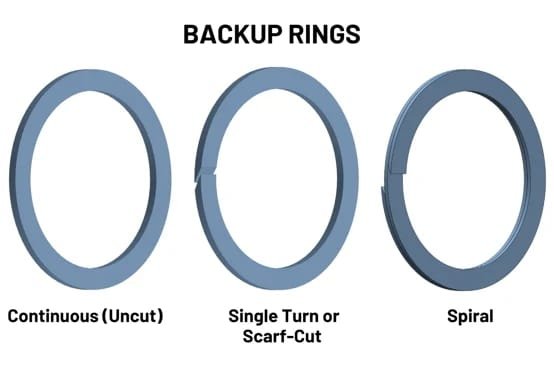
An elastomer O-ring seals by elastic deformation. Under increasing pressure, the elastomer is pushed toward the clearance gap. If pressure exceeds the material’s extrusion resistance, the O-ring begins flowing into the gap. Eventually, repeated pressure cycles shear off portions of the seal.
A backup ring occupies this clearance gap before pressure is applied. Because backup rings are manufactured from much harder engineering materials than elastomers, they resist deformation and physically block extrusion.
✔ High-pressure capability
✔ Improved seal reliability
✔ Longer maintenance intervals
✔ Better resistance to pressure spikes
✔ Increased equipment uptime
Pressure Distribution Inside a Sealing System
When hydraulic pressure rises, force is transferred uniformly throughout the sealed fluid. The pressure compresses the O-ring against both sealing surfaces while simultaneously attempting to force the elastomer into any available clearance. The backup ring acts as a rigid barrier that eliminates this extrusion path.
The higher the operating pressure, the more important the backup ring becomes. Pressure cycling, shock loading, temperature variation, and dynamic shaft movement further increase extrusion risks.
Common Materials Used for Backup Rings
| Material | Typical Hardness | Temperature | Advantages | Typical Applications |
|---|---|---|---|---|
| Virgin PTFE | Shore D 55-60 | -200°C to +260°C | Excellent chemical resistance | Chemical plants |
| Glass-filled PTFE | Higher stiffness | Up to +260°C | Better wear resistance | Hydraulic cylinders |
| PEEK | Rockwell M99 | Up to +250°C | Very high strength | Aerospace |
| Nylon | Rockwell R115 | -40°C to +120°C | Economical | General industry |
Engineering Properties Comparison
| Property | PTFE | PEEK | Nylon |
|---|---|---|---|
| Density (g/cm³) | 2.15 | 1.30 | 1.14 |
| Thermal Conductivity W/m·K | 0.25 | 0.29 | 0.26 |
| Water Absorption | Nearly zero | Very low | Moderate |
| Chemical Resistance | Excellent | Excellent | Good |
Relevant Engineering Standards
Professional sealing systems often reference internationally recognized engineering standards during design, production, and inspection.
- ISO 3601 — O-ring dimensions and tolerances
- ISO 3601-3 — Housing design recommendations
- ASTM D4894 — PTFE material specification
- ASTM D2240 — Hardness testing
- ASTM D543 — Chemical resistance evaluation
- ISO 1302 — Surface roughness requirements
⚙ Typical Surface Finish Recommendation
Dynamic sealing surfaces generally require Ra 0.2–0.8 μm for reliable long-term sealing performance.
Selecting the Right Backup Ring
Selecting an appropriate backup ring requires evaluating several engineering parameters rather than focusing solely on pressure rating.
| Selection Factor | Engineering Consideration |
|---|---|
| Pressure | Maximum working and surge pressure |
| Temperature | Continuous and peak operating temperature |
| Media | Chemical compatibility |
| Clearance Gap | Gap between moving components |
| Motion | Static or dynamic application |
| Seal Hardness | Usually 70–90 Shore A O-ring |
For engineering support and product specifications, please contact us.
Single vs Double Backup Rings

Single backup rings are commonly installed on the low-pressure side of the O-ring. Double backup rings are recommended when pressure direction alternates or when pressure reversal may occur.
⭐ Expert Tip
Bidirectional hydraulic systems usually achieve longer service life using backup rings installed on both sides of the O-ring.
Installation Best Practices
Proper installation is essential for reliable sealing performance. Before assembly, inspect all grooves for burrs, scratches, contamination, or sharp edges. Apply compatible lubricant to reduce installation friction. Avoid twisting the O-ring during assembly and ensure the backup ring is correctly positioned according to pressure direction.
- Clean sealing grooves thoroughly.
- Inspect surface finish.
- Use appropriate installation tools.
- Avoid excessive stretching.
- Verify backup ring orientation.
- Check gland dimensions.
Case Example (Industry Experience)
Example Only: A hydraulic cylinder operating near 35 MPa experienced recurring O-ring failures every few months. Inspection showed extrusion damage caused by excessive clearance under pressure. Engineers replaced the original seal with the same O-ring combined with PTFE backup rings. Subsequent maintenance inspections reported substantially reduced extrusion damage and significantly longer service intervals. This example represents common industry experience rather than a documented customer project.
Laboratory Test Example
Illustrative Laboratory Example: Engineers may evaluate backup ring effectiveness using repeated hydraulic pressure cycling between low and maximum design pressure while monitoring leakage, dimensional stability, and extrusion under controlled temperature. Such laboratory procedures are representative engineering methods and are presented only as examples rather than actual factory test data.
Failure Mode Analysis
| Failure | Possible Cause | Recommended Action |
|---|---|---|
| Extrusion | Large clearance | Install backup ring |
| Nibbling | Pressure cycling | Use harder material |
| Chemical attack | Material incompatibility | Choose PTFE or PEEK |
| Wear | Poor lubrication | Improve lubrication |
| Cracking | Temperature aging | Upgrade material |
Industries That Depend on Backup Rings

Backup rings are widely used in hydraulic presses, injection molding machines, mining equipment, offshore platforms, aerospace hydraulic systems, agricultural machinery, oil and gas equipment, pharmaceutical processing, semiconductor manufacturing, chemical reactors, industrial pumps, construction machinery, marine equipment, robotics, and high-pressure instrumentation.
Expert Selection Tips
🔧 Choose PTFE when chemical resistance is the priority.
🔧 Select glass-filled PTFE for improved wear resistance.
🔧 Consider PEEK for extremely high pressure and elevated temperatures.
🔧 Verify groove dimensions according to ISO 3601 recommendations.
🔧 Always evaluate pressure spikes rather than only nominal operating pressure.
Frequently Asked Questions
1. When should a backup ring be used?
Backup rings are generally recommended whenever operating pressure, clearance gap, or pressure cycling creates a risk of O-ring extrusion, especially in hydraulic systems.
2. What material is most commonly used?
Virgin PTFE is the most widely used material because of its excellent chemical resistance, low friction, and broad operating temperature range.
3. Can backup rings improve seal life?
Yes. Properly selected backup rings significantly reduce extrusion damage, helping extend O-ring service life and improve equipment reliability.
4. Are two backup rings always better than one?
Not always. Double backup rings are primarily recommended for bidirectional pressure applications. Single-direction pressure usually requires only one correctly positioned backup ring.
5. How can engineers select the correct backup ring?
Engineers should evaluate pressure, temperature, chemical compatibility, clearance gap, O-ring hardness, dynamic motion, applicable standards, installation space, and long-term maintenance requirements before selecting the most appropriate Backup Rings solution.