

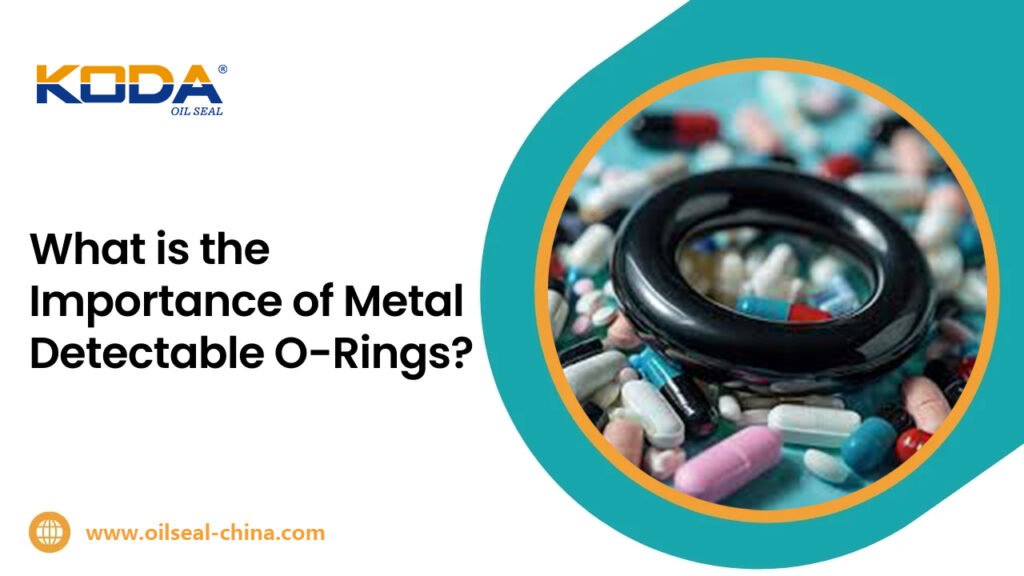
In food processing, beverage production, pharmaceutical manufacturing, and other contamination-sensitive operations, even a small damaged sealing component can create a product quality concern. O-rings are used throughout pumps, valves, mixers, filling machines, pipe connections, and processing equipment. Over time, pressure changes, friction, chemical exposure, repeated cleaning, and normal aging can cause a seal to wear, crack, or release fragments.
Metal-detectable O-rings are engineered from specially formulated elastomers containing detectable additives. When a fragment enters a product stream, appropriately configured metal-detection equipment may identify it, allowing the affected product to be investigated and controlled before it proceeds further through production.
Unlike conventional O-rings, which are generally selected primarily for sealing performance, detectable O-rings combine sealing functionality with an additional contamination-monitoring measure. They are especially useful where a foreign-material control program requires equipment components to be detectable if they become damaged or go missing.
Key takeaway
A metal-detectable O-ring is not a substitute for preventive maintenance, hygienic design, or a validated inspection system. It adds another layer of control by helping make certain rubber fragments detectable under suitable production conditions.
What Are Metal-Detectable O-Rings?
Metal-detectable O-rings are circular elastomeric sealing components manufactured using compounds that contain additives capable of generating a detectable response in compatible metal-detection systems. The additives are incorporated into the material formulation so that detection can remain possible when the component is damaged and a fragment separates from the original seal.
These seals are available in different elastomer families and dimensions. Depending on the compound and application, options may include detectable silicone, nitrile rubber, or other specially formulated materials. The correct selection depends on the process fluid, operating temperature, pressure, cleaning chemicals, compression requirements, and applicable food-contact or industry requirements.
The term “metal-detectable” describes a detection characteristic, not a universal performance guarantee. Detectability varies with the compound formulation, fragment size and shape, product characteristics, detector configuration, conveyor speed, and operating settings. A component should therefore be evaluated using the actual inspection system and production conditions in which it will be used.
How Detectable O-Rings Differ from Standard O-Rings
| Feature | Standard O-ring | Metal-detectable O-ring |
|---|---|---|
| Primary function | Provides sealing between mating surfaces. | Provides sealing with an additional detectable-material feature. |
| Material formulation | Selected for sealing, elasticity, wear, and fluid compatibility. | Uses a specially formulated compound intended to produce a detectable response. |
| Fragment inspection | Rubber fragments may be difficult for conventional metal detectors to identify. | Fragments may be detected when the material, detector, product, and settings are suitable. |
| Typical use | General industrial and equipment sealing. | Applications where foreign-material detection is an important control measure. |
| Validation requirements | Dimensional, material, and functional checks as appropriate. | The same checks, plus verification of detection performance under real operating conditions. |
Detectable additives can influence material properties, so a detectable compound should not be assumed to have exactly the same performance as an otherwise similar standard elastomer. Evaluate sealing performance, compression set, chemical resistance, mechanical strength, and detection capability together.
Why Metal-Detectable O-Rings Matter in Contamination Control

1. Improving Foreign-Material Detection
Rubber seals are often installed in locations that are difficult to inspect continuously, including valve bodies, pump assemblies, filling nozzles, transfer lines, and mixing equipment. Mechanical wear, excessive compression, incorrect installation, or chemical attack may cause small pieces of rubber to separate from the seal.
Conventional rubber is generally not reliably detected by a standard metal detector because it does not provide the same detectable response as metal-containing material. A properly formulated metal-detectable O-ring can improve the likelihood that a fragment will be identified by a compatible inspection system.
This additional detection capability is particularly valuable where fragments could enter food, beverages, or other products and where visual inspection alone cannot provide sufficient control.
2. Supporting a Stronger Food Safety Program
Food safety programs rely on identifying hazards, establishing appropriate controls, monitoring performance, and taking corrective action when a control fails. Detectable sealing components can support a foreign-material prevention strategy by making certain equipment-related contamination events easier to identify.
For example, if an O-ring is found to be missing or damaged during a scheduled inspection, the maintenance team can investigate whether fragments may have entered the process stream. If a detectable fragment is identified by the inspection system, the facility can follow its established procedures for product hold, investigation, equipment inspection, and disposition.
However, using detectable O-rings alone does not establish compliance with a food safety standard. The facility must also assess hazards, validate its inspection process, maintain records, and follow applicable regulatory and customer requirements.
3. Reducing the Impact of Equipment-Related Contamination
A suspected rubber fragment can trigger product segregation, production stoppages, equipment inspections, cleaning, and quality investigations. Depending on the process, the affected product may need to be held while the source and extent of contamination are determined.
Detectable seals can help shorten the time needed to recognize certain foreign-material events. Earlier identification may support a more targeted investigation and reduce unnecessary disruption, although actual savings depend on the facility’s process controls and response procedures.
Practical recommendation
Identify sealing components in high-risk locations, document their part numbers and service intervals, and include them in preventive maintenance inspections. Detectability is most effective when combined with a documented plan for identifying wear, responding to alarms, and tracing affected product.
How Metal-Detectable O-Rings Work
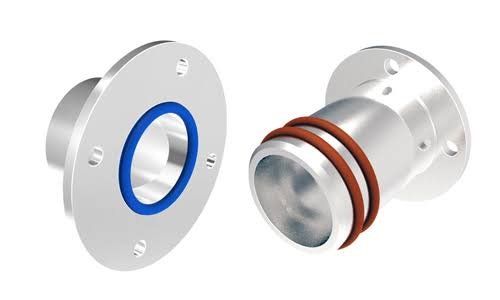
The detection mechanism begins with the compound formulation. Special additives are incorporated into the elastomer to produce a response that a compatible metal detector can recognize. When a detectable O-ring remains intact, the detector is not normally inspecting the component inside the machine; the practical benefit becomes important if material enters a product stream and passes through an inspection point.
If a seal breaks, wears, or loses a fragment, the detached material may travel with the product or remain in equipment, depending on the process design. When the fragment passes through a properly configured detector, the system may trigger an alarm or automatic rejection mechanism.
- Material engineering: The O-ring compound is formulated with detectable additives while retaining the properties needed for sealing.
- Component installation: The O-ring is fitted into the designated groove and operated within its specified conditions.
- Potential fragment release: Wear, damage, chemical exposure, or installation problems may cause a piece of material to separate.
- Inspection: A compatible metal detector evaluates the product stream using validated settings and suitable test procedures.
- Response and investigation: An alarm or rejected product is managed according to the facility’s foreign-material control procedure.
Not every fragment will necessarily be detected. Detector sensitivity, the amount and distribution of detectable additive, fragment dimensions, product effect, orientation, line speed, and the inspection system’s configuration all influence the result. Testing is therefore essential before a detectable O-ring is approved for a particular production line.
Metal Detection vs. X-Ray Inspection
Metal detection and X-ray inspection are different technologies. A metal-detectable O-ring is designed to produce a response in a compatible metal detector. An X-ray-detectable component is formulated or constructed to provide sufficient X-ray contrast under a suitable inspection setup. Some products are designed for one method, while others are formulated for both.
| Consideration | Metal detection | X-ray inspection |
|---|---|---|
| Detection principle | Detects changes in the electromagnetic field caused by detectable material. | Identifies differences in X-ray attenuation between a contaminant and the surrounding product. |
| Suitable component | Metal-detectable material verified for the detector in use. | X-ray-detectable material verified for the inspection system in use. |
| Key variables | Product effect, detector frequency and settings, fragment size, and line conditions. | Material density, product thickness, image contrast, fragment orientation, and system settings. |
| Important limitation | Performance varies by compound and product conditions; detection is not guaranteed for every fragment. | A fragment may be difficult to identify if its X-ray contrast against the product is insufficient. |
Do not assume that a metal-detectable O-ring is automatically X-ray detectable, or that a component designed for X-ray inspection will be detected by a metal detector. Confirm the intended detection method with the manufacturer and validate the component using the equipment installed at the facility.
For product selection, see Metal Detectable vs. X-Ray Detectable Rubber for an additional discussion of inspection-method differences and application considerations.
Choosing the Right Elastomer for Metal-Detectable O-Rings
The best material is determined by the operating environment, not by detectability alone. An O-ring must maintain sealing force, resist the process medium, tolerate the required temperature, and withstand repeated operation or cleaning. A detectable formulation that cannot survive the application may increase maintenance frequency and introduce additional contamination risk.
| Material family | Potential advantages | What to verify |
|---|---|---|
| Silicone | Often selected for temperature flexibility and applications requiring soft, compliant sealing. | Tear resistance, abrasion, compression set, process-fluid compatibility, cleaning conditions, and food-contact documentation. |
| NBR | Commonly used for many petroleum-based oils and suitable general sealing duties. | Compatibility with fats, cleaning chemicals, temperature, and the specific process medium. |
| FKM | Often considered for demanding temperature and chemical environments. | Compound-specific compatibility, cleaning agents, low-temperature behavior, and applicable food-contact requirements. |
| Other specialty compounds | May address specific chemical, mechanical, or process requirements. | Detectability, mechanical properties, regulatory status, and performance in the actual operating environment. |
These descriptions are general material-selection guidance rather than guaranteed ratings for every detectable compound. Detectable additives and compound processing can influence hardness, resilience, tensile strength, elongation, and compression set. Obtain the technical data for the exact grade before approving it for production.
Silicone O-Rings for Food and Beverage Processing
Silicone is used in many food and beverage applications because suitable grades can offer flexibility over a broad temperature range. However, conventional silicone and metal-detectable silicone are not interchangeable by default. Their mechanical properties, additive systems, and compliance documentation may differ.
For applications involving direct food contact, verify the compound’s intended use and supporting documentation. Confirm that the material is suitable for the food type, contact conditions, cleaning chemicals, temperature, and duration of use. Do not infer food-contact compliance solely from the material name or the fact that it is detectable.
NBR and FKM for Demanding Service Conditions
NBR and FKM may be appropriate for selected applications where oils, fats, process chemicals, or elevated temperatures influence material selection. The correct compound depends on the actual chemical formulation and operating cycle. A material that withstands the main process fluid may still be unsuitable for the cleaning or sanitizing chemicals used between production runs.
Where chemical compatibility is uncertain, request a compatibility assessment from the seal supplier or compound manufacturer. Include concentrations, temperature, exposure duration, and whether the component is exposed continuously or intermittently.
Food-Contact Compliance: What Buyers Should Check
Food-contact compliance is a separate requirement from metal detectability. A detectable O-ring may be suitable for use in equipment outside the product-contact zone, but direct contact with food or ingredients can require additional material and regulatory verification.
In the United States, 21 CFR 177.2600 addresses rubber articles intended for repeated use in contact with food, subject to its specific conditions and requirements. Whether this regulation applies to a particular O-ring depends on the article, its composition, intended use, and applicable provisions.
A statement that a material is “FDA compliant” should be supported by documentation for the actual compound and intended application. The phrase should not be treated as a universal approval of every product made from the same polymer family, nor as proof that a finished component meets every customer’s requirements.
Depending on the application, buyers may also need to review relevant NSF/ANSI/CAN 51 requirements, customer specifications, sanitary-design criteria, or other jurisdiction-specific rules. These requirements have distinct scopes; one certificate or declaration does not automatically replace another.
Compliance checklist
- Request the exact compound designation and technical data sheet.
- Confirm the intended food-contact conditions and applicable regulatory provisions.
- Check whether certificates or declarations apply to the raw compound or the finished component.
- Verify cleaning and sanitizing chemical compatibility.
- Retain supplier documents, lot information, and material-change records as required by the quality system.
Official regulatory text is available through the Electronic Code of Federal Regulations. For international operations, confirm the applicable local regulations and customer-specific requirements with the relevant compliance team.
Industries and Equipment That Benefit from Detectable O-Rings

Food Processing and Packaging
Food manufacturers use O-rings in pumps, valves, mixing systems, conveyors, filling heads, dosing equipment, and product-transfer connections. These components can be exposed to oils, fats, sugars, acids, detergents, sanitizers, hot water, and repeated disassembly.
Detectable O-rings can be especially valuable in locations where wear or seal damage could introduce material into the product stream. Priority should be given to high-risk components based on the facility’s hazard analysis, maintenance history, product exposure, and ability to inspect downstream.
Dairy and Beverage Production
Dairy and beverage systems often use repeated cleaning and sanitizing cycles. Seals may experience thermal cycling, pressure variation, and contact with chemicals that affect elastomer performance over time.
For these environments, choose a detectable O-ring that meets the required hygiene and material specifications. Verify compatibility with the complete cleaning-in-place or sanitizing cycle, not just the normal production liquid.
Pharmaceutical and Personal-Care Manufacturing
Pharmaceutical and personal-care equipment may require careful control of particles, residues, and material compatibility. Detectable O-rings can support foreign-material control where their use is appropriate, but they do not independently establish suitability for cleanroom, hygienic, or pharmaceutical processing.
Evaluate extractables, leachables, cleaning validation, traceability, and any applicable product-contact requirements as part of the overall material qualification. The required evidence depends on the product, process, and regulatory framework.
Industrial Mixing, Filling, and Transfer Equipment
Detectable seals may also be used in selected packaging, ingredient handling, and industrial processing applications where a foreign-material control plan calls for detectable elastomer components. The appropriate solution depends on whether the seal is exposed to the product and whether the downstream inspection equipment can identify the expected fragments.
Not every production line needs metal-detectable O-rings. The decision should be based on risk assessment, process layout, existing detection controls, maintenance data, and the consequences of a component failure.
How to Validate Metal-Detectable O-Rings on a Production Line
Purchasing a detectable component is only the first step. A robust validation process establishes whether the chosen O-ring material can be detected under the conditions that matter to the facility. Laboratory claims or generic detection statements should not replace an application-specific assessment.
1. Define the Intended Detection Method
Confirm whether the production line uses metal detection, X-ray inspection, or both. Obtain the supplier’s information on the detectable compound and any limitations relating to fragment size, detector type, or inspection conditions.
2. Test Representative Fragments
Where safe and practical, use representative test pieces prepared or approved under a controlled validation procedure. Consider the fragment sizes and shapes that could realistically result from seal wear or breakage. Avoid relying solely on a complete O-ring because the system may respond differently to a small fragment.
3. Use the Actual Product and Packaging
Product characteristics can influence detection performance. Moisture, salt content, density, temperature, product orientation, packaging, and conveyor speed may affect the inspection response. Conduct validation using the actual product and packaging conditions whenever applicable.
4. Verify Detector Settings and Rejection Controls
Confirm that the inspection system operates with the approved settings and that alarms, automatic rejection devices, and reject verification procedures function as intended. Include the relevant challenge tests and records required by the facility’s food safety or quality program.
5. Document the Acceptance Criteria
Define what constitutes a successful result before testing begins. Record the test material, fragment dimensions, product and packaging conditions, detector settings, line speed, number of trials, results, corrective actions, and approval decision. Repeat the validation when material formulations, products, packaging, equipment, or operating settings change in a way that could affect detection.
Critical engineering point
There is no single fragment-size threshold that applies to every metal-detectable O-ring and every food product. Detection limits must be established for the actual combination of compound, detector, product, packaging, and operating conditions.
For additional guidance, see How to Validate Metal-Detectable Silicone Rubber and the supplier’s application-specific technical information. Validation should be performed by personnel qualified to operate the inspection equipment and manage the associated product-safety risks.
Common Causes of O-Ring Failure

Detectable O-rings remain sealing components and can fail for many of the same reasons as conventional elastomeric seals. Detectability does not prevent compression set, chemical attack, mechanical damage, or incorrect installation. Understanding the likely failure mechanisms helps reduce the probability of fragments entering the process stream.
| Failure mode | Possible causes | Recommended action |
|---|---|---|
| Cracking or hardening | Heat aging, oxidation, incompatible chemicals, or excessive cleaning temperatures. | Review the compound specification and the complete operating and cleaning cycle. |
| Swelling or softening | Fluid absorption or incompatibility with process chemicals. | Verify compatibility using the actual fluid composition, concentration, and temperature. |
| Cut or torn seal | Sharp groove edges, incorrect installation tools, excessive stretching, or mechanical damage. | Inspect the gland, improve assembly practices, and use the correct installation method. |
| Extrusion or deformation | Excessive pressure, incorrect clearance, unsuitable hardness, or improper groove design. | Review pressure, clearance, hardness, and the manufacturer’s design recommendations. |
| Abrasion and surface wear | Repeated movement, rough mating surfaces, contamination, or poor lubrication. | Inspect the mating components and assess whether the seal design suits the movement and environment. |
| Loss of sealing force | Compression set, incorrect dimensions, aging, or material degradation. | Confirm groove dimensions, compression, compound properties, and replacement interval. |
When a seal fails, replace it with a suitable component and investigate the root cause. If the O-ring was installed in a product-contact location, follow the facility’s foreign-material procedure to assess whether product could have been affected. A detector alarm should be treated according to the site’s validated response process rather than dismissed as a routine nuisance.
Installation and Maintenance Best Practices
Correct installation and preventive maintenance remain essential even when a detectable compound is used. A damaged O-ring can leak, lose sealing force, or release fragments. Good maintenance practices help prevent failure rather than relying on downstream inspection to identify every incident.
- Verify the part number: Match the O-ring dimensions, material grade, hardness, and drawing to the equipment specification.
- Inspect the groove: Remove contamination and check for burrs, corrosion, scratches, and dimensional damage.
- Use compatible lubricants: Follow the component manufacturer’s instructions and avoid unapproved assembly compounds.
- Prevent twisting and cutting: Install the O-ring without pinching, overstretching, or dragging it across sharp edges.
- Monitor service conditions: Check for leakage, swelling, cracking, discoloration, flattening, or signs of abrasion during scheduled inspections.
- Set replacement intervals: Use operating history, failure analysis, and manufacturer recommendations to determine a suitable maintenance schedule.
- Maintain traceability: Record seal location, part number, lot or batch identification where available, installation date, and inspection findings.
Do not extend the service interval solely because the O-ring is detectable. The additive system improves the potential for fragment identification; it does not necessarily increase wear life or eliminate the need for replacement.
How to Specify Metal-Detectable O-Rings for Procurement
A clear purchase specification helps prevent errors in dimensions, compound selection, detection capability, and compliance documentation. Procurement teams should share the operating requirements with the seal supplier rather than requesting a generic “food-grade detectable O-ring.”
Information to Include in an RFQ
- O-ring inside diameter, cross-section, tolerance, and applicable standard or drawing.
- Material family, exact compound designation, hardness, and color requirements if applicable.
- Operating temperature, pressure, movement, and contact medium.
- Cleaning and sanitizing chemicals, concentrations, exposure duration, and cycle frequency.
- Intended inspection method: metal detection, X-ray inspection, or both.
- Detector make or model, product characteristics, line speed, and known validation requirements.
- Required food-contact declarations, certificates, material traceability, or customer-specific approvals.
- Quantity, packaging, labeling, sample requirements, and expected delivery schedule.
For custom components, provide the original seal sample or a dimensioned drawing where available. A supplier can then assess whether a standard size is suitable or whether a custom formulation or geometry is required. Any proposed alternative should be reviewed for both sealing performance and validated detectability.
Selecting a Reliable Detectable Seal Supplier
A capable supplier should be able to explain the detectable material’s intended use, provide relevant technical information, and clarify the limits of the detection claim. Buyers should evaluate material documentation and application support alongside price and lead time.
Before approving a supplier, consider the following:
- Does the supplier provide a technical data sheet for the exact detectable compound?
- Are dimensional tolerances, hardness, and other critical properties defined?
- Can the supplier explain whether the product is metal detectable, X-ray detectable, or both?
- Is there supporting documentation for food-contact use where required?
- Can the supplier support samples, application evaluation, and changes to the specification?
- Are batch identification, packaging, and quality records suitable for the facility’s traceability system?
Avoid accepting broad claims such as “detectable in all applications” or “fully compliant with every food safety standard” without supporting evidence. Detection and regulatory suitability are application-specific and should be verified against documented requirements.
Authoritative Technical and Regulatory Resources
For reliable purchasing and validation decisions, use the actual regulatory text, relevant industry guidance, and technical information for the equipment and compound being considered. The following resources can help establish a sound technical basis:
- Electronic Code of Federal Regulations — 21 CFR 177.2600: official U.S. regulatory text covering rubber articles intended for repeated use in contact with food, subject to the conditions specified in the regulation.
- U.S. Food and Drug Administration — Food Contact Substances: background information on food-contact substances and the U.S. regulatory framework.
- U.S. FDA — Food Safety Modernization Act: official information on preventive approaches to food safety and relevant regulatory programs.
- NSF — NSF/ANSI 51 Food Equipment Materials: information on material requirements for components used in food equipment. Confirm the applicable edition, certification scope, and exact product status.
- BRCGS: information about food safety and product-safety standards used by food manufacturers and suppliers. Check the relevant standard and customer requirements for the specific facility.
- Metal-Detectable Silicone Validation Guide: practical discussion of detection testing under real production conditions.
- Metal-Detectable vs. X-Ray-Detectable Rubber: comparison of the two detection approaches and the considerations involved in selecting detectable rubber.
Regulations, standards, and certifications have different scopes. Verify current requirements for the intended market and application, and request product-specific documentation from the supplier before approval.
Frequently Asked Questions
1. What is the main purpose of a metal-detectable O-ring?
Its primary purpose is to provide a seal while improving the potential for a detached rubber fragment to be identified by a compatible metal detector. This supports foreign-material control in applications where a damaged O-ring could enter a product stream. It does not eliminate the need for maintenance or inspection-system validation.
2. Can a metal detector detect every broken piece of a metal-detectable O-ring?
No. Detection depends on the compound, fragment size and shape, detector settings, product effect, conveyor speed, and other operating conditions. Validate the smallest realistic fragments using the actual product and inspection system before relying on the component as part of a contamination-control program.
3. Are metal-detectable O-rings automatically FDA compliant?
No. Detectability and food-contact compliance are separate properties. For direct food-contact use, verify the exact compound, intended conditions, and supporting documentation against the applicable requirements, including relevant provisions of 21 CFR 177.2600 where applicable.
4. What is the difference between metal-detectable and X-ray-detectable O-rings?
Metal-detectable O-rings are formulated to produce a response in compatible metal-detection systems, while X-ray-detectable components are designed to provide sufficient contrast under suitable X-ray inspection conditions. Some materials support both methods, but this must be confirmed by the supplier and validated on the intended equipment.
5. How do I select the right metal-detectable O-ring for my production line?
Confirm the dimensions, compound, hardness, process fluid, operating temperature, pressure, cleaning chemicals, and intended detection method. Obtain technical and food-contact documentation where required, then test representative fragments under real production conditions. The final selection should meet sealing, compliance, and validated detection requirements together.