The operating temperature of an O-ring is one of the most critical factors influencing sealing reliability, leakage prevention, service life, compression set, and overall equipment performance. Whether used in hydraulic systems, pneumatic equipment, automotive engines, aerospace components, food processing machinery, or semiconductor manufacturing, every O-ring material has a specific temperature range where it performs optimally. Exceeding these limits may cause hardening, softening, shrinkage, swelling, thermal degradation, cracking, or permanent deformation.
Understanding how temperature affects elastomer behavior helps engineers choose suitable materials, optimize groove designs, reduce maintenance costs, and improve long-term equipment reliability. Modern engineering standards such as ASTM D2000, ASTM D1414, ASTM D395, ASTM D471, ISO 3601, and ISO 23936 provide standardized methods for evaluating temperature resistance and sealing performance.
📌 Engineering Insight: Temperature does not simply determine whether an O-ring survives. It simultaneously affects elasticity, hardness, thermal expansion, compression force, chemical compatibility, lubricant behavior, and leakage risk.
Why Temperature Has Such a Significant Influence on O-Ring Performance
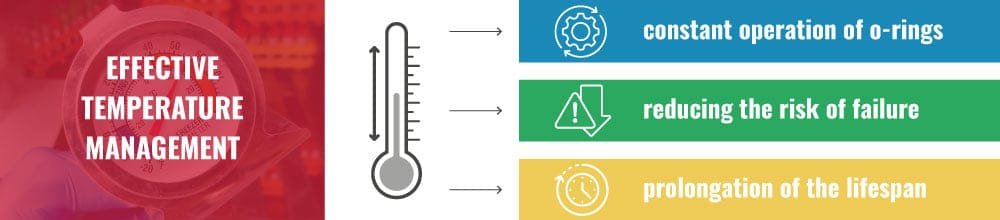
Unlike metallic seals, elastomer O-rings depend entirely on elastic deformation. During installation, the seal is compressed between two mating surfaces. This compression creates the sealing force that blocks fluid or gas leakage. Temperature directly changes the mechanical properties of the elastomer.
As temperature rises, polymer chains become more mobile, reducing modulus and hardness. Excessive heat accelerates oxidation, chain scission, cross-link degradation, and permanent compression set. At extremely low temperatures, molecular mobility decreases dramatically, making the elastomer stiff and unable to recover after deformation.
⭐ Key Temperature Effects
• Elasticity reduction
• Hardness variation
• Compression set increase
• Chemical aging acceleration
• Crack formation
• Seal leakage
• Reduced fatigue life
How Heat Changes Elastomer Properties
Elevated temperatures increase the kinetic energy of polymer molecules. Initially, this allows the material to become more flexible. However, prolonged exposure initiates oxidation and irreversible chemical aging.
Heat causes oxygen molecules to attack polymer chains. Depending on the elastomer chemistry, this may lead to additional cross-linking or chain degradation. Either mechanism eventually increases hardness and reduces elasticity.
Compression set also rises significantly at high temperatures. Once compressed for extended periods, the O-ring loses its ability to rebound, causing sealing force to decline.
🔥 Common High Temperature Symptoms
✔ Hard surface
✔ Surface cracking
✔ Permanent flattening
✔ Increased leakage
✔ Reduced elongation
✔ Brittleness after cooling
How Low Temperature Affects O-Rings
At low temperatures, elastomers approach their glass transition temperature (Tg). Molecular motion slows dramatically, making the material rigid and unable to follow dynamic sealing surfaces.
If the operating temperature approaches or falls below Tg, sealing force decreases because the O-ring can no longer maintain contact pressure. During startup, equipment often experiences leakage until the seal warms.
Repeated low-temperature cycling also causes fatigue cracking due to differential thermal contraction between the elastomer and surrounding metal components.
Typical Temperature Ranges of Common O-Ring Materials
| Material | Typical Operating Range | Typical Applications |
|---|---|---|
| NBR (Buna-N) | -40°C to +120°C | Hydraulic oil, fuel systems |
| HNBR | -40°C to +150°C | Automotive, compressors |
| FKM (Viton®) | -20°C to +200°C | Chemical processing |
| FFKM | -25°C to +327°C | Semiconductor |
| EPDM | -50°C to +150°C | Steam, water |
| Silicone | -60°C to +230°C | Medical, food |
| VMQ Low Temperature Grade | -80°C to +200°C | Cryogenic equipment |
Temperature and Hardness Relationship
Most engineering O-rings are manufactured with hardness between Shore A 50 and Shore A 90.
| Hardness | Characteristics |
|---|---|
| 50-60 Shore A | Excellent low-pressure sealing |
| 70 Shore A | General industrial applications |
| 75 Shore A | Hydraulic systems |
| 90 Shore A | High-pressure applications |
Temperature causes effective hardness to change. A 70 Shore A O-ring operating at -40°C behaves much harder than at room temperature.
Thermal Expansion Considerations
Elastomers generally have thermal expansion coefficients between 150×10⁻⁶ and 300×10⁻⁶ /°C, significantly higher than steel (approximately 12×10⁻⁶ /°C).
During heating, O-rings expand more rapidly than surrounding metal glands. During cooling, they contract much more. Groove dimensions must therefore accommodate thermal movement while maintaining proper squeeze.
📐 Engineering Calculation Example
Thermal Expansion = Original Diameter × Expansion Coefficient × Temperature Difference
Example:
50 mm O-ring
Coefficient = 200 ×10⁻⁶ /°C
Temperature Increase = 150°C
Expansion ≈ 50 × 200×10⁻⁶ ×150 = 1.5 mm
This dimensional change should be considered during groove design.
Compression Set Under High Temperature
Compression set represents the permanent deformation remaining after prolonged compression.
ASTM D395 provides standardized testing methods for measuring compression set. Lower values indicate better elastic recovery.
Compression set generally increases exponentially with temperature. Even premium materials may experience permanent deformation if continuously exposed near their upper temperature limit.
Heat Transfer Characteristics
Most elastomers possess relatively low thermal conductivity.
| Material | Thermal Conductivity (W/m·K) |
|---|---|
| NBR | 0.13-0.20 |
| FKM | 0.18-0.25 |
| Silicone | 0.18-0.22 |
Because thermal conductivity is low, temperature gradients may exist across thick sealing sections, especially in high-temperature equipment.
ASTM and ISO Standards Related to Temperature Performance
Several internationally recognized standards evaluate thermal resistance.
📚 Common Standards
ASTM D2000 — Rubber material classification
ASTM D1414 — O-ring testing procedures
ASTM D395 — Compression set evaluation
ASTM D471 — Fluid compatibility testing
ISO 3601 — O-ring dimensions and quality requirements
ISO 23936 — Compatibility with oil and gas environments
Chemical Resistance at Elevated Temperature
Chemical compatibility changes dramatically as temperature increases. Fluids that are compatible at room temperature may aggressively attack elastomers above 120°C due to accelerated diffusion and chemical reaction rates.
Always evaluate both fluid type and operating temperature rather than considering chemical resistance alone.
Typical Industrial Applications
Temperature-resistant O-rings are widely used in:
• Automotive turbochargers
• Hydraulic cylinders
• Steam valves
• Semiconductor vacuum systems
• Aerospace fuel systems
• Oil & gas drilling
• Chemical reactors
• Medical sterilization equipment
• Food processing machinery
Learn more about high-quality O-Rings designed for demanding industrial environments.
Installation Recommendations for Extreme Temperatures
Proper installation reduces temperature-related failures.
✔ Lubricate during assembly.
✔ Avoid twisting.
✔ Maintain proper squeeze.
✔ Remove sharp edges.
✔ Select compatible lubricants.
✔ Verify groove dimensions according to ISO 3601.
Professional engineers often select premium O-Rings when equipment experiences repeated thermal cycling.
Failure Mode Analysis (Industry Experience Example)
🔍 Failure Mode Analysis (Illustrative Example)
This example summarizes a representative engineering scenario rather than data from a specific customer or factory test.
An FKM O-ring installed inside a chemical transfer pump experienced leakage after approximately two years of cyclic operation between ambient temperature and about 180°C.
Inspection showed increased hardness, visible compression set, slight circumferential cracking, and reduced elasticity. Groove dimensions remained within tolerance, indicating thermal aging rather than installation damage.
Corrective actions included selecting a higher-temperature compound, optimizing maintenance intervals, and improving thermal management around the sealing chamber.
Laboratory Test Example
🧪 Laboratory Test Example
This laboratory example illustrates a common evaluation method and does not represent proprietary factory data.
Test standards included ASTM D395 for compression set and ASTM D1414 for seal evaluation.
Representative test sequence:
• Temperature: 150°C
• Duration: 70 hours
• Compression: 25%
• Measurements: hardness, dimensions, elastic recovery, compression set, and surface appearance.
Such testing helps engineers compare different elastomer compounds before production use.
Case Example (Engineering Experience)
🏭 Case Example (Industry Experience)
This case is an illustrative engineering example based on common industrial practice and is not presented as a specific customer project.
A hydraulic power unit operating outdoors experienced seasonal leakage during winter startup. The original NBR seals became excessively stiff below -30°C.
Engineers evaluated the operating profile and replaced the seals with a low-temperature HNBR compound while adjusting groove tolerances and lubrication procedures.
The revised sealing system significantly improved startup sealing reliability and reduced maintenance frequency during cold-weather operation.
Material Selection Guide Based on Temperature
| Operating Temperature | Recommended Material |
|---|---|
| Below -50°C | Low-temperature Silicone |
| -40°C to 120°C | NBR |
| 120°C to 150°C | HNBR / EPDM |
| 150°C to 200°C | FKM |
| Above 250°C | FFKM |
Engineers seeking reliable sealing solutions often compare multiple O-Rings materials according to operating temperature, fluid compatibility, pressure, and expected service life before final selection.
Frequently Asked Questions
1. What happens if an O-ring operates above its maximum temperature?
Continuous overheating accelerates oxidation, increases compression set, hardens the elastomer, and eventually causes leakage or seal failure.
2. Which O-ring material performs best at extremely high temperatures?
FFKM generally offers the highest continuous temperature capability among elastomer O-ring materials, making it suitable for the most demanding chemical and semiconductor applications.
3. Why do O-rings leak during cold startup?
Low temperatures reduce elasticity. The seal cannot fully recover or maintain contact pressure until it warms above its effective operating range.
4. Which international standards evaluate O-ring temperature performance?
Common standards include ASTM D2000, ASTM D1414, ASTM D395, ASTM D471, ISO 3601, and ISO 23936.
5. How should engineers choose the correct O-ring for temperature-critical applications?
Material selection should consider minimum and maximum operating temperatures, thermal cycling, pressure, media compatibility, hardness, compression set resistance, applicable ASTM/ISO standards, groove design, expected service life, and verification through representative engineering testing. For additional product information and engineering options, explore industrial-grade O-Rings.