
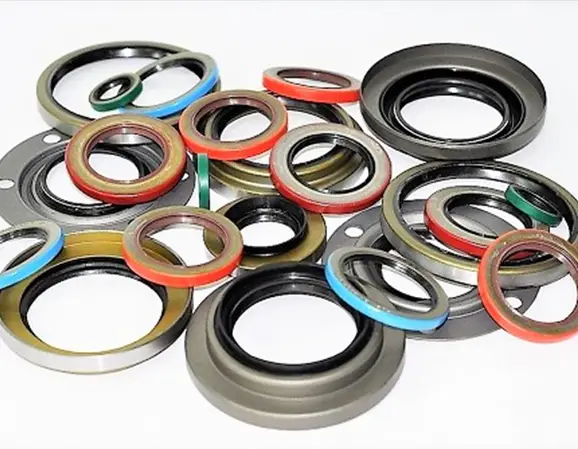
A radial shaft seal, also called a rotary shaft seal, oil seal, or shaft lip seal, is designed to prevent lubricants from escaping along a rotating shaft while simultaneously limiting the entry of water, dust, dirt, and other contaminants from the surrounding environment.Unlike a static O-ring, a radial shaft seal operates at the interface between a stationary housing and a rotating shaft. This means the sealing element must continuously manage several competing requirements:
How Does a Radial Shaft Seal Work?
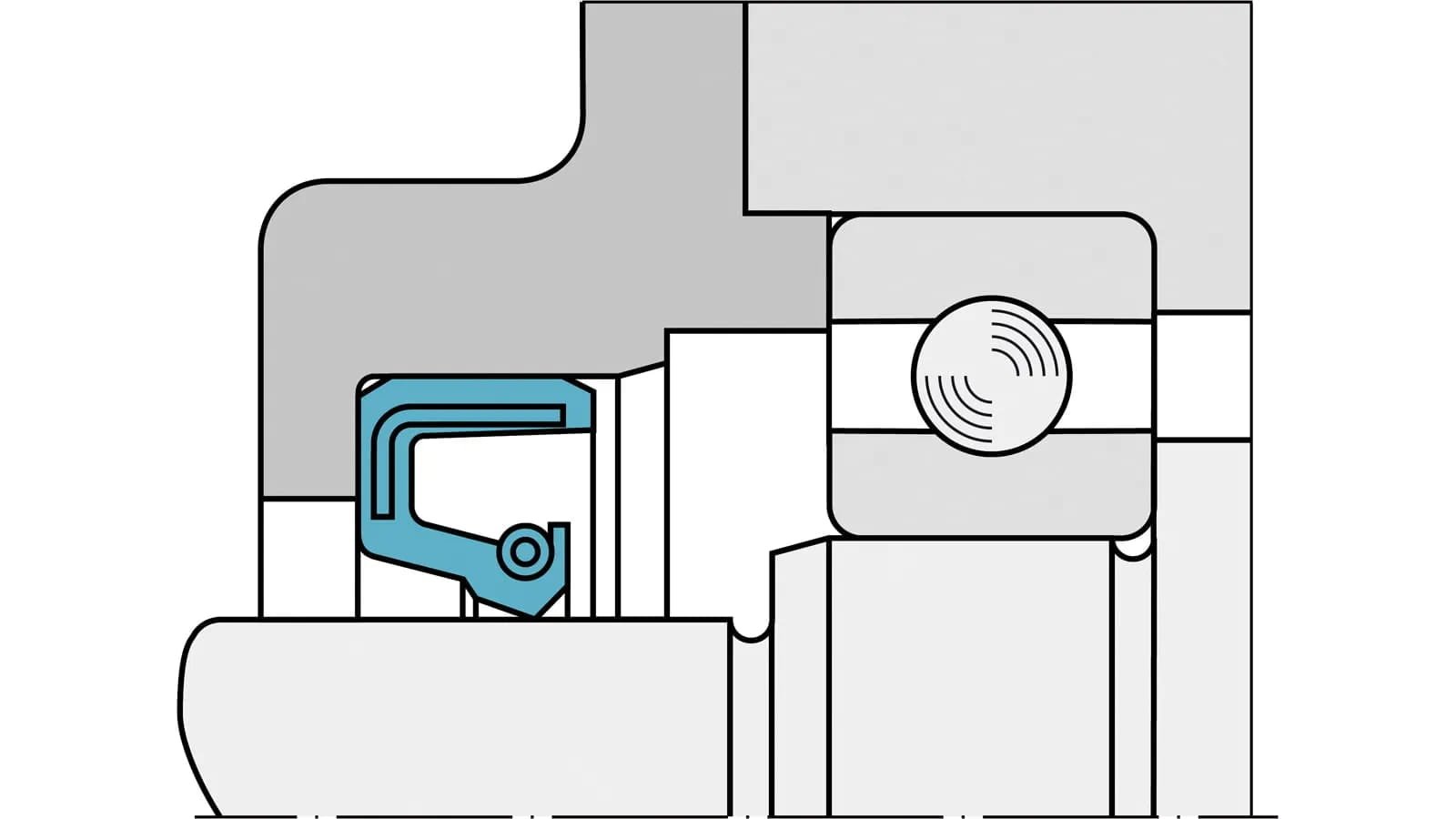
A conventional radial shaft seal consists of several functional elements rather than simply a piece of rubber.
The typical construction includes:
- Elastomeric sealing body
- Main sealing lip
- Garter spring
- Metal reinforcing or stiffening ring
- Outer casing or sealing surface
- Optional dust/protective lip
The main sealing lip contacts the rotating shaft and creates the primary barrier against lubricant leakage. A garter spring maintains the required radial force as the elastomer ages and as operating conditions change.
An optional protective or dust lip is positioned toward the outside environment. Its function is not to replace the primary sealing lip, but to reduce the entry of dust, water, mud, and other contaminants.
Modern radial shaft seals may also incorporate special lip geometries, twist elements, reinforced metal structures, or modified outer surfaces for specific operating conditions.
The Seal Is a System, Not an Isolated Component
A radial shaft seal can only perform correctly when the following components work together:
Seal compound + lip geometry + spring force + shaft surface + housing + lubricant + speed + temperature + pressure
This is why installing a new oil seal does not necessarily solve a recurring leakage problem. If the shaft running surface is worn or the operating conditions exceed the seal’s design envelope, the replacement seal may fail again.
Where Are Radial Shaft Seals Used?
Radial shaft seals are suitable for a wide range of rotating equipment.
Gearboxes and Power Transmission
Gearboxes rely on seals to retain lubricating oil around rotating shafts.
Typical locations include:
- Input shafts
- Output shafts
- Intermediate shafts
- Bearing housings
- Differential assemblies
The seal must retain the lubricant while preventing dust and moisture from reaching bearings and gears.
Electric Motors
Motor shaft seals are used where lubricant retention or environmental exclusion is required.
The selection must consider shaft speed, temperature, grease or oil compatibility, and the possibility of dust or moisture entering from the outside.
Pumps
Pump shaft sealing is particularly sensitive because the shaft may operate continuously at relatively high speed while the surrounding fluid can be chemically aggressive.
The seal compound should therefore be selected according to the actual fluid rather than simply the pump manufacturer’s generic temperature rating.
Agricultural and Construction Machinery
Agricultural and construction equipment often combines:
- High contamination
- Mud
- Water
- Dust
- Shock loading
- Shaft movement
- Temperature fluctuations
A standard single-lip oil seal may not provide sufficient contamination protection in these conditions. A design incorporating an additional protective lip or a more robust sealing configuration may be more appropriate.
Wind Turbines and Heavy Machinery
Large rotating equipment requires careful consideration of shaft diameter, speed, lubricant, environmental exposure, and maintenance accessibility.
In these applications, a small sealing problem can result in lubricant loss, bearing contamination, increased maintenance frequency, and unplanned downtime.
Radial Shaft Seal Types: WA, WB and WC
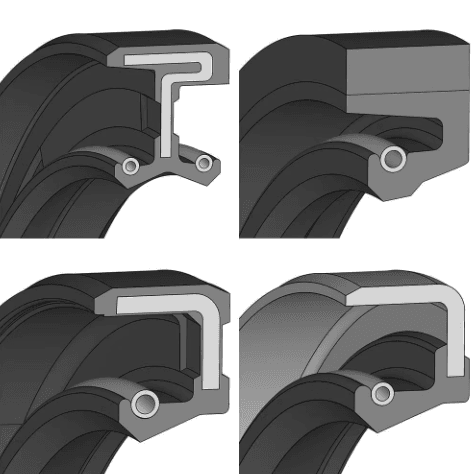
One of the most useful ways to select a radial shaft seal is to understand the construction of the outer casing.
The common Dichtomatik configurations include WA, WB, and WC, with protective-lip variants such as WAS, WBS, and WCS.
| Design | Outer Construction | Main Advantage | Typical Selection Logic |
|---|---|---|---|
| WA | Elastomer-covered outer surface | Excellent static sealing to housing | Useful where housing sealing is critical |
| WB | Metal outer surface | Precise, rigid fit in housing bore | Suitable where accurate metal-to-metal seating is desired |
| WC | Metal outer surface + additional reinforcement | Greater structural rigidity | Useful for demanding installation or structural requirements |
| WAS/WBS/WCS | Corresponding design + protective lip | Additional contamination protection | Useful in dirty or wet environments |
WA: Elastomer-Outer Radial Shaft Seal
The elastomer-covered outside diameter provides good static sealing against the housing.
This design can be advantageous when the housing bore may have minor surface imperfections or when reliable sealing between the seal OD and housing is important.
It is often a practical choice for general industrial equipment.
WB: Metal-Outer Radial Shaft Seal
A metal outer surface provides a rigid and precise seating interface in the housing bore.
This construction can be useful where:
- Accurate press-fitting is required
- Housing dimensions are tightly controlled
- A rigid installation is preferred
The trade-off is that the housing bore generally needs better dimensional and surface control.
WC: Reinforced Metal-Outer Design
WC incorporates additional metal reinforcement to increase structural rigidity.
This can be useful when the application requires greater mechanical stability or when the seal installation environment places additional demands on the outer structure.
The correct choice should be based on the housing design rather than assuming that a reinforced seal is always better.
What Is the Protective Lip Used For?
A protective lip, often called a dust lip or exclusion lip, is located on the environmental side of the seal.
Its primary function is to prevent contaminants from reaching the main sealing lip.
This is particularly useful in:
- Agricultural machinery
- Construction equipment
- Wheel-end assemblies
- Off-road equipment
- Pumps exposed to dirty environments
- Machinery operating outdoors
The protective lip does introduce additional contact and friction, so it should not be added automatically to every application.
When Should You Choose a Double-Lip Design?
A seal with a protective lip is generally worth considering when contamination is a greater concern than minimizing every possible increment of friction.
For example:
Clean electric motor → standard single sealing lip may be sufficient
Mud and water exposure → protective lip becomes much more valuable
The selection should therefore be based on the environmental side of the seal, not merely the lubricant inside the housing.
NBR vs. FKM vs. PTFE: Which Material Should You Choose?
| Requirement | NBR | FKM | PTFE |
| Mineral oil | Excellent | Excellent | Excellent |
| General grease | Excellent | Excellent | Excellent |
| High temperature | Moderate | Very good | Excellent |
| Chemical resistance | Moderate | Very good | Excellent |
| Ozone/weathering | Moderate | Very good | Excellent |
| Wear resistance | Very good | Very good | Application-dependent |
| Low friction | Good | Good | Excellent |
| Dry-running capability | Limited | Limited | Better suited |
| Cost | Low | Medium/High | High |
| General industrial use | Excellent | Very good | Specialty |
The correct material is the one that meets the actual operating envelope, not necessarily the most expensive material available.
Shaft Wear and Oil Seal Replacement
A radial shaft seal normally contacts a narrow track on the shaft.
After thousands of hours, this contact can produce a visible or measurable wear groove.
Installing a new seal in exactly the same position can cause the new lip to follow the existing worn track.
The result may be immediate or premature leakage.
Three Practical Solutions
1. Replace or re-machine the shaft
Best when shaft condition is severely damaged.
2. Change the seal running position
If the housing and shaft geometry allow it, positioning the new lip on an unworn portion of the shaft can restore sealing.
3. Install a shaft repair sleeve
A shaft repair sleeve can provide a new wear-resistant running surface without replacing the entire shaft.
Dichtomatik specifically positions shaft repair sleeves as an economical solution for worn shaft surfaces and notes that they can eliminate costly shaft replacement or reworking.
How to Select a Radial Shaft Seal
Use the following engineering sequence rather than starting with the seal part number.
Step 1: Identify the Shaft Diameter
Measure the actual shaft diameter at the sealing location.
Do not rely solely on a nominal drawing dimension when replacing an existing seal.
Inspect for:
- Wear
- Grooves
- Corrosion
- Surface damage
- Excessive runout
Step 2: Measure the Housing Bore
Confirm:
- Housing diameter
- Bore condition
- Roundness
- Surface finish
- Installation depth
The housing determines whether an elastomer-coated or metal-outer design is more appropriate.
Step 3: Identify the Fluid
Specify the actual medium:
- Mineral oil
- Synthetic oil
- Grease
- Hydraulic fluid
- Fuel
- Water
- Coolant
- Chemical fluid
Do not select NBR simply because the equipment is “industrial.”
Step 4: Determine Temperature
Record:
- Minimum temperature
- Continuous operating temperature
- Maximum temperature
- Duration of temperature peaks
Step 5: Calculate Shaft Speed
Use shaft diameter and rpm to determine circumferential velocity.
This provides a more meaningful basis for evaluating lip friction and heat generation.
Step 6: Check Pressure
Determine whether the application is:
- Pressureless
- Slightly pressurized
- Pressure-cycling
- Continuously pressurized
If pressure is significant, verify that the seal design is actually intended for that duty.
Step 7: Evaluate Contamination
Ask:
What is on the air side of the seal?
If the answer includes mud, dust, water spray, abrasive particles, or other contaminants, consider a protective-lip design.
Step 8: Select the Outer Construction
Choose between:
- Elastomer-covered outer diameter
- Metal outer diameter
- Reinforced metal outer diameter
based on housing requirements and installation conditions.
Radial Shaft Seal vs. Cassette Seal
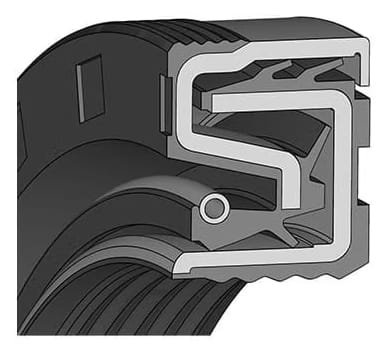
A conventional radial shaft seal and a cassette seal serve related purposes but are not interchangeable in every application.
A cassette seal integrates multiple sealing and contamination-protection functions into a more rigid package.
Dichtomatik describes cassette seals as highly rigid constructions with grease-filled labyrinth structures, multiple radial and axial sealing/dirt lips, and a spring-energized primary sealing lip. They are particularly suited to heavy-duty and highly contaminated environments such as agricultural, forestry, construction, and material-handling equipment.
| Feature | Radial Shaft Seal | Cassette Seal |
| Construction | Compact lip seal | Integrated multi-component sealing system |
| Contamination protection | Depends on design | Very high |
| Installation | Relatively simple | More specialized |
| Heavy-duty environments | Application-dependent | Strong candidate |
| Shaft preparation | Usually important | Can be less demanding depending on design |
| Cost | Generally lower | Generally higher |
| Typical use | General rotating equipment | Severe contamination/heavy-duty machinery |
For normal industrial oil retention, a conventional radial shaft seal may be the more economical solution.
For severe contamination and heavy-duty equipment, a cassette seal may justify its higher cost.
Radial Shaft Seal vs. V-Ring
A V-ring seals axially against a counterface while rotating with the shaft.
V-rings are commonly used for excluding:
- Dust
- Dirt
- Grease
- Oil
- Splash water
They are often used together with radial shaft seals or as pre-sealing elements for bearings.
A practical combination can therefore be:
Primary radial shaft seal + external V-ring
This configuration can move some of the environmental contamination away from the main oil seal and improve overall sealing performance.
Final Engineering Takeaway
A radial shaft seal is a small component with a surprisingly large influence on equipment reliability.
The most expensive mistake is usually not buying the wrong seal—it is selecting the seal only by dimensions.
A reliable rotary shaft sealing solution requires the engineer to consider the complete operating environment:
Shaft diameter → housing → lubricant → temperature → pressure → circumferential speed → contamination → shaft condition → material → lip design → installation
For general mineral-oil applications, NBR remains an effective and economical starting point. FKM becomes more attractive as temperature and chemical demands increase, while PTFE constructions provide another option where low friction, broad chemical resistance, or difficult lubrication conditions justify a specialty design.
Likewise, the choice between WA, WB, WC, and protective-lip variants should be based on the housing, contamination level, and mechanical requirements—not simply on which profile appears more robust.
If repeated oil-seal replacement is occurring, investigate the shaft running surface, pressure, temperature, lubricant compatibility, contamination, and installation procedure before changing the seal again. In many cases, correcting the surrounding sealing system delivers a much larger improvement in service life than upgrading the seal material alone.
For OEMs, maintenance teams, and industrial buyers, the best specification is therefore not simply “oil seal + size.” It is a complete operating-condition specification that allows the seal construction and material to be matched to the actual machine.