Why High-Pressure Sealing Requires More Than a Standard Seal
As hydraulic and fluid power systems continue to evolve, operating pressures are increasing across nearly every industrial sector. Modern hydraulic cylinders, injection molding machines, mining equipment, offshore systems, aerospace actuators, and heavy construction machinery frequently operate under conditions that place extraordinary demands on sealing components.
Traditional sealing solutions often struggle when subjected to extreme pressure loads, pressure spikes, and dynamic motion. Seal extrusion, compression set, leakage, and premature wear become common concerns. To address these challenges, engineers increasingly rely on advanced sealing technologies specifically developed for high-pressure environments. Among the most effective solutions available today are T-Seals.
Known for their exceptional extrusion resistance, pressure stability, and long-term sealing performance, T-Seals have become a preferred choice in critical hydraulic and pneumatic applications where reliability cannot be compromised.
What Are T-Seals?
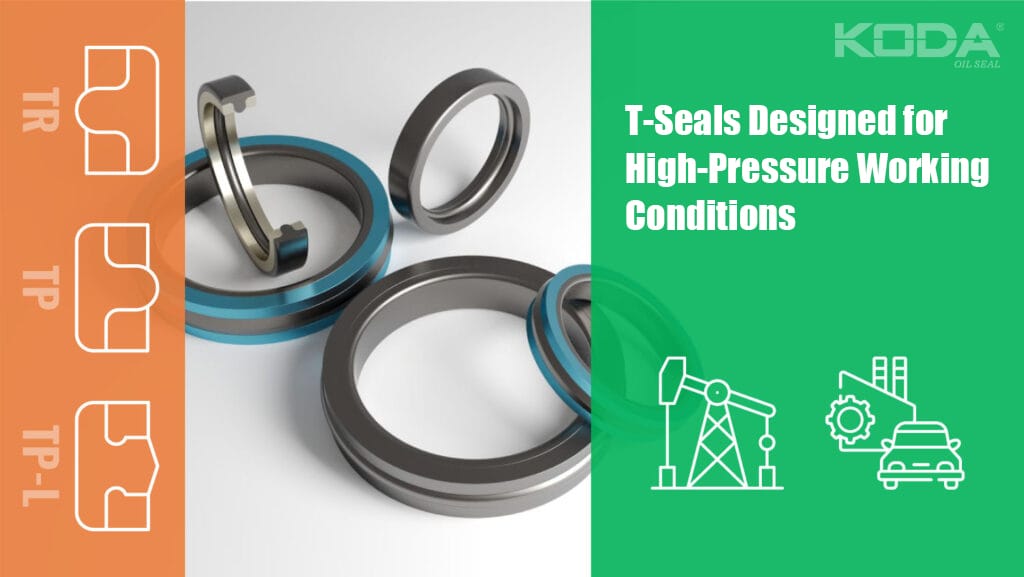
T-Seals are specialized sealing assemblies engineered for demanding pressure applications. Unlike conventional O-rings, a T-Seal consists of a central elastomer sealing element combined with two anti-extrusion backup rings positioned on either side of the seal.
When viewed in cross-section, the profile resembles the letter “T,” which gives the seal its name. This unique design enables the seal to maintain excellent sealing performance under conditions where traditional elastomer seals might fail.
The combination of elastomer flexibility and backup ring support allows T-Seals to handle high pressures while minimizing extrusion risks.
Core Components of a T-Seal
✔ Elastomer sealing element
✔ Dual anti-extrusion backup rings
✔ Pressure-responsive sealing geometry
✔ Enhanced groove stability
✔ Bidirectional sealing capability
How T-Seals Work Under High Pressure
The effectiveness of a T-Seal lies in its ability to combine elastic sealing force with mechanical support. During operation, system pressure energizes the elastomer sealing element, forcing it against mating surfaces and creating a highly effective seal.
At the same time, the backup rings prevent the elastomer from being forced into sealing gaps. This is particularly important in high-pressure systems where extrusion can quickly destroy conventional seals.
As pressure increases, the seal becomes even more effective because the pressure itself enhances sealing contact forces.
Why T-Seals Excel in High-Pressure Applications

Several unique design characteristics make T-Seals particularly suitable for demanding environments.
Outstanding Extrusion Resistance
One of the most common causes of seal failure in hydraulic systems is extrusion. Backup rings significantly reduce this risk by supporting the elastomer sealing element.
Bidirectional Sealing Capability
Many hydraulic systems experience pressure from alternating directions. T-Seals provide reliable sealing performance regardless of pressure direction.
Longer Service Life
Reduced seal deformation and improved load distribution contribute to extended operational life.
Superior Pressure Cycling Resistance
Repeated pressure fluctuations often cause conventional seals to fatigue. T-Seals are specifically engineered to withstand continuous pressure cycling.
Enhanced Groove Stability
The T-shaped profile helps maintain proper positioning within the sealing groove, reducing the likelihood of twisting or displacement.
These advantages explain why T-Seals are widely specified in critical industrial applications.
Common Industries That Use T-Seals
The versatility of T-Seals has led to their adoption across a broad range of industries.
Hydraulic Equipment Manufacturing
Hydraulic cylinders, presses, lifting systems, and power units frequently rely on T-Seals to maintain pressure integrity.
Construction Machinery
Excavators, bulldozers, loaders, and cranes operate under extreme pressure conditions where reliable sealing is essential.
Mining Operations
Mining equipment faces severe mechanical loads and contamination exposure, making robust sealing solutions indispensable.
Aerospace Systems
Aircraft hydraulic systems require lightweight, durable, and highly reliable sealing components.
Oil and Gas Industry
High-pressure valves, pumps, and drilling equipment often utilize T-Seals to ensure leak-free performance.
T-Seals vs O-Rings: Understanding the Differences
Although both sealing solutions perform similar functions, significant differences exist between T-Seals and traditional O-rings.
Pressure Capacity
T-Seals generally support significantly higher operating pressures due to their backup ring design.
Extrusion Protection
O-rings often require separate backup rings at elevated pressures, whereas T-Seals incorporate this protection into the design.
Installation Stability
T-Seals are less prone to twisting and rolling during assembly.
Service Life
High-pressure applications frequently demonstrate longer service intervals when using T-Seals instead of conventional O-rings.
Materials Commonly Used in T-Seals
Material selection plays a critical role in determining sealing performance and durability.
NBR (Nitrile Rubber)
Provides excellent resistance to hydraulic fluids, lubricants, and petroleum-based oils.
FKM (Fluoroelastomer)
Offers exceptional heat resistance and chemical compatibility.
HNBR
Combines excellent mechanical strength with enhanced thermal stability.
PTFE Backup Rings
Frequently used for anti-extrusion support due to their low friction and excellent wear resistance.
Engineering Thermoplastics
Advanced backup ring materials improve performance in extremely demanding operating environments.
Choosing the right material combination is essential for maximizing the performance of T-Seals.
Pressure Ratings and Performance Considerations
One of the primary reasons engineers specify T-Seals is their ability to perform under elevated pressures.
Actual pressure capability depends on:
Seal material selection
Backup ring material
Operating temperature
Gap dimensions
Fluid compatibility
System design parameters
Properly engineered T-Seal systems can operate successfully in pressure ranges that exceed the practical limits of many standard sealing solutions.
Installation Best Practices

Even the highest-quality seal requires proper installation to achieve maximum performance.
Inspect all groove surfaces carefully.
Remove debris and contamination before assembly.
Verify dimensional compatibility.
Use appropriate installation tools.
Avoid sharp edges during insertion.
Apply compatible lubrication when necessary.
Following these practices helps prevent damage that could compromise sealing performance.
Common Causes of T-Seal Failure
Although T-Seals are highly reliable, failures can still occur when operating conditions exceed design limitations.
Excessive Temperature
Heat can accelerate elastomer degradation and reduce sealing effectiveness.
Chemical Incompatibility
Incorrect material selection may result in swelling, hardening, or cracking.
Extrusion Due to Excessive Gaps
Even backup rings have performance limits if hardware clearances are excessive.
Contamination Damage
Abrasive particles can accelerate wear and shorten seal life.
Improper Assembly
Installation damage remains one of the most common causes of premature failure.
Future Trends in High-Pressure Sealing Technology
As industrial systems continue pushing pressure boundaries, sealing technology continues evolving. Manufacturers are developing advanced elastomer compounds, engineered thermoplastic backup materials, and precision manufacturing processes that further improve seal reliability.
Digital maintenance programs and predictive monitoring technologies are also helping operators identify seal degradation before leakage occurs.
These innovations ensure that T-Seals will remain a critical component in next-generation hydraulic and fluid power systems.
Why Engineers Continue to Choose T-Seals
The ability to resist extrusion, handle extreme pressure, maintain bidirectional sealing performance, and deliver long service life makes T-Seals one of the most trusted sealing technologies available today.
For industries where reliability, safety, and uptime are non-negotiable, T-Seals provide a proven solution capable of meeting the demands of modern high-pressure applications.
Frequently Asked Questions
1. What is the primary purpose of a T-Seal?
A T-Seal is designed to provide reliable sealing in high-pressure hydraulic and pneumatic systems while minimizing extrusion risks.
2. Why are T-Seals better than standard O-rings for high-pressure applications?
T-Seals incorporate backup rings that provide superior extrusion resistance and improved pressure-handling capability.
3. Are T-Seals suitable for bidirectional pressure systems?
Yes. Their symmetrical design allows effective sealing performance regardless of pressure direction.
4. What materials are commonly used in T-Seals?
Common materials include NBR, FKM, HNBR, PTFE, and various engineered thermoplastics depending on application requirements.
5. Where are T-Seals most commonly used?
They are widely used in hydraulic cylinders, construction equipment, mining machinery, aerospace systems, oil and gas equipment, and industrial fluid power systems.