
O-rings
What Is an O-Ring?
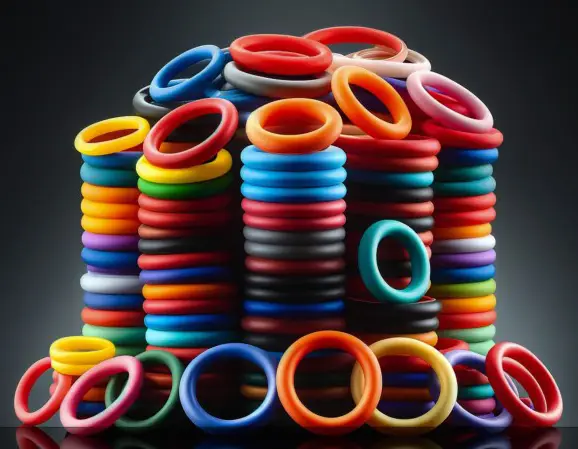
An O-ring is a circular elastomer sealing element with a round cross-section designed to prevent the leakage of liquids or gases between two mating surfaces.
Despite its simple appearance, the O-ring remains one of the most widely used sealing solutions in modern engineering because it offers:
- Reliable sealing performance
- Low manufacturing cost
- Compact installation space
- Easy maintenance
- Compatibility with thousands of fluids
O-rings are used in virtually every industry, including:
- Hydraulic systems
- Pneumatic equipment
- Automotive assemblies
- Food processing machinery
- Medical devices
- Aerospace equipment
- Chemical processing systems
Their effectiveness comes from controlled compression that creates a sealing force between the O-ring and adjacent surfaces. O-rings can be used in both static and dynamic sealing applications.
How Does an O-Ring Work?
When installed inside a properly designed groove, the O-ring is compressed between mating surfaces.
This compression creates a sealing line that blocks the passage of fluids or gases.
As system pressure increases, the O-ring deforms slightly and enhances the sealing force, which is why properly designed O-rings often become more effective as pressure rises.
Static Sealing
Static seals involve little or no movement between sealing surfaces.
Examples include:
- Pipe flanges
- Valve bodies
- Hydraulic manifolds
- Pressure vessel covers
Static sealing is generally the easiest application for O-rings and offers the longest service life.
Dynamic Sealing
Dynamic seals involve relative motion between components.
Examples include:
- Hydraulic cylinders
- Pneumatic actuators
- Rotary shafts
- Pump assemblies
Dynamic applications require careful consideration of:
- Material selection
- Friction
- Lubrication
- Compression set resistance
O-Ring Materials and Their Applications
Material selection is the most important factor affecting O-ring performance.
Selecting the wrong material often causes premature seal failure.
NBR (Nitrile Buna-N)
The industry’s most widely used O-ring material.
Best for:
- Hydraulic oils
- Mineral oils
- Greases
- Fuel systems
Advantages:
- Excellent oil resistance
- Affordable cost
- Good mechanical strength
Typical Temperature Range:
-40°C to +120°C
FKM (Viton®)
Designed for demanding industrial environments.
Best for:
- High temperatures
- Synthetic lubricants
- Aggressive chemicals
Advantages:
- Outstanding heat resistance
- Excellent chemical compatibility
- Long service life
Typical Temperature Range:
-20°C to +200°C
EPDM
Ideal for water-based applications.
Best for:
- Drinking water
- Steam systems
- Outdoor equipment
Advantages:
- Excellent weather resistance
- Ozone resistance
- UV resistance
Not recommended for petroleum oils.
Silicone (VMQ)
Preferred when flexibility is required.
Best for:
- Medical equipment
- Food processing
- Extreme temperatures
Advantages:
- Excellent low-temperature flexibility
- FDA-grade availability
- Wide temperature range
HNBR
Developed for severe industrial environments.
Best for:
- Oilfield equipment
- Automotive systems
- Heavy-duty machinery
Advantages:
- High wear resistance
- Improved mechanical strength
- Better heat resistance than NBR
FFKM
The premium solution for critical sealing applications.
Best for:
- Semiconductor manufacturing
- Pharmaceutical production
- Chemical processing
Advantages:
- Near-universal chemical resistance
- Exceptional temperature performance
- Maximum reliability
KODA O-Ring’s material categories similarly highlight NBR, FKM, EPDM, Silicone, HNBR, FFKM and other specialty compounds because material selection is fundamental to seal performance.
O-Ring Size Standards
One of the most common causes of sealing failure is incorrect sizing.
Major industry standards include:
AS568 O-Rings
Most commonly used in North America.
Applications:
- Hydraulic equipment
- Pneumatic systems
- Industrial machinery
ISO 3601 O-Rings
International metric standard.
Applications:
- Global OEM manufacturing
- Industrial equipment exports
JIS O-Rings
Commonly used in Japanese equipment.
Applications:
- Automotive manufacturing
- Industrial automation
Custom O-Rings
When standard dimensions are unavailable, custom-molded or vulcanized O-rings may be produced to meet application requirements. Various global sizing systems and custom O-ring solutions are commonly used throughout industry.
Understanding O-Ring Durometer
Durometer measures rubber hardness.
The most common scale is Shore A.
70 Shore A
Industry standard.
Suitable for most hydraulic and pneumatic systems.
80 Shore A
Provides improved extrusion resistance.
Suitable for higher-pressure applications.
90 Shore A
Used in demanding environments with elevated pressure and mechanical loads.
Generally:
- Softer compounds seal rough surfaces more easily.
- Harder compounds provide better wear and extrusion resistance.
Specialized O-Rings for Critical Industries
Standard O-rings are not always sufficient.
Specialized designs are available for demanding environments.
FDA O-Rings
Used in:
- Food processing
- Beverage production
- Pharmaceutical equipment
Medical Grade O-Rings
Designed for:
- Medical devices
- Laboratory equipment
- Biopharmaceutical systems
Rapid Gas Decompression O-Rings
Used in:
- Oil and gas systems
- High-pressure gas equipment
Cleanroom O-Rings
Used in:
- Semiconductor manufacturing
- Electronics production
Metal Detectable O-Rings
Help prevent contamination in food production lines.
Many industrial buyers search specifically for application-focused O-rings such as FDA, Medical, Cleanroom, Rapid Gas Decompression, NSF, and Sanitary grades rather than general-purpose compounds.
| Prefix Symbol | Material |
|---|---|
| Material | Shaft tolerance (recommended) |
| A | AFLAS® |
| N | Nitrile |
| BV | Viton® (Brown) |
| V | Viton® |
| E | EPDM |
| HNBR | HNBR |
| HSN | HNBR (Green) |
| F | Fluorosilicone |
| S | Silicone |
| K | Kalrez® (FFKM) |
| P | PERFREZ (FFKM) |
| TEF | Teflon (PTFE) |
| TES | Teflon Encapsulated Silicone |
| TEV | Teflon Encapsulated Viton® |
| C | Neoprene |
| U | Urethane |
| WN | Nitrile (White) |
| WV | Viton® (White) |
| Suffix Symbol | Special Feature |
|---|---|
| Special Feature | Shaft tolerance (recommended) |
| (Blank) | No Special Features |
| ETP | Extreme Temp |
| FDA | FDA-Grade |
| HG | High-Visibility Green |
| HY | High-Visibility Yellow |
| LT | Low-Temp |
| MD | Metal Detectable |
| PC | Peroxide-Cured |
| RGD | Rapid Gas Decompression |
| YW | Yellow |
How to Choose the Right O-Ring
Before ordering, gather the following information:
Fluid Being Sealed
Examples:
- Hydraulic oil
- Fuel
- Water
- Steam
- Chemical solvents
Temperature Range
Minimum and maximum operating temperatures.
Pressure Conditions
Determine whether backup rings are required.
Static or Dynamic Service
Movement significantly influences material selection.
Groove Dimensions
Accurate groove design is essential for sealing reliability.
Industry Certifications
Consider whether FDA, NSF, USP Class VI, or other certifications are required.
Why O-Ring Material Selection Matters More Than Price
Many buyers focus on dimensions alone.
However, two O-rings with identical dimensions can have dramatically different performance depending on:
- Elastomer formulation
- Temperature resistance
- Chemical compatibility
- Compression set characteristics
- Manufacturing quality
A properly selected compound can extend maintenance intervals, reduce leakage, and lower total ownership costs far more effectively than choosing the lowest-priced seal.
Need Help Identifying an O-Ring?
To recommend the correct O-ring, provide:
- Inside diameter (ID)
- Cross section (CS)
- Groove dimensions
- Operating temperature
- Fluid type
- Pressure level
- Static or dynamic application
- Industry requirements
Our sealing engineers can help determine the optimal material, hardness, and size to maximize sealing performance and service life.