
What is a TB Oil Seal?
The TB oil seal is a radial shaft sealing profile designed to control lubricant leakage while providing additional protection against environmental contaminants. Its construction features a spring-assisted primary sealing lip that maintains consistent contact with the shaft, an auxiliary dust lip that helps block the ingress of dirt and moisture, and a rigid metal case that ensures secure retention within the housing.
Thanks to its dual-lip configuration, the TB rotary shaft seal performs particularly well in applications exposed to dust, mud, water, or other contaminants. The secondary lip acts as an extra protective barrier, helping to extend seal life and maintain lubrication integrity under challenging operating conditions.
Unlike the TC oil seal, which relies on a rubber-coated outer diameter for housing retention, the TB design utilizes a metal outer case that provides greater dimensional stability and is often preferred for accurately machined metal housings requiring a precise interference fit. This construction can offer improved positioning and structural support in equipment subject to vibration, temperature fluctuations, or continuous operation.
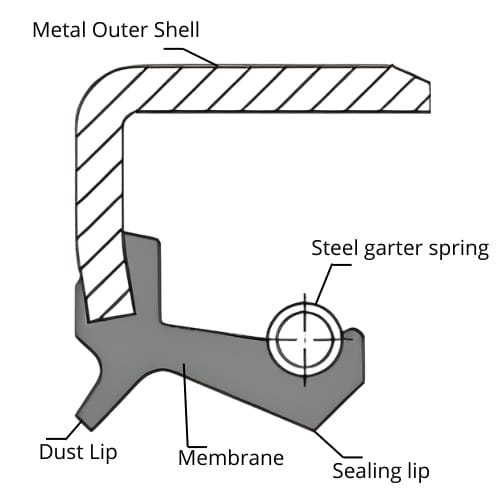
Compared with the SB oil seal, which incorporates only a single spring-loaded sealing lip, the TB profile delivers a higher level of contamination protection through the addition of its dust-exclusion lip. As a result, it is frequently selected for industrial machinery, agricultural equipment, construction vehicles, and other demanding applications where both lubricant retention and resistance to external contamination are critical requirements.
Features and Benefits
The TB oil seal is designed to deliver dependable sealing performance in rotating equipment by maintaining lubricant retention and minimizing the risk of contamination-related failures. Its robust double-lip configuration not only helps prevent oil or grease leakage but also contributes to longer equipment uptime by protecting critical components from harmful environmental influences.
A key feature of the TB profile is its auxiliary dust lip, which provides an additional layer of defense against dust, water, mud, and other contaminants commonly found in industrial and outdoor applications. By limiting the ingress of abrasive particles, the seal helps reduce shaft and bearing wear, supports stable lubrication conditions, and extends maintenance intervals.
Standard TB oil seals are typically manufactured from NBR (Nitrile Rubber), a versatile elastomer that offers excellent resistance to mineral oils while maintaining good flexibility and wear resistance. For applications involving elevated temperatures, aggressive media, or demanding operating conditions, alternative materials such as FKM (Viton®), HNBR, Silicone (VMQ), and other specialized compounds can be selected to meet specific performance requirements.
The metal case is produced from high-quality steel materials in accordance with DIN EN 10139 standards, providing structural strength and secure housing retention. The garter spring is commonly manufactured from spring steel compliant with DIN EN 10270-1, ensuring consistent sealing force throughout the service life of the seal. For environments exposed to moisture, chemicals, or corrosive agents, stainless-steel spring and casing options are available to enhance corrosion resistance.
To achieve higher levels of sealing protection, the TB oil seal can be integrated with complementary sealing components such as axial shaft seals, V-rings, or bore-sealing compounds. These combinations create a multi-stage sealing arrangement that improves contamination exclusion and increases overall system reliability in harsh operating environments.
With its durable construction, broad material availability, and adaptability to different shaft configurations, the TB oil seal has become a trusted sealing solution across a wide range of industries. Whether installed in industrial machinery, agricultural equipment, pumps, motors, or power transmission systems, it provides reliable performance while helping reduce maintenance costs and prolong equipment service life.
Lip Material Options
Lip Material | Temp Range | Properties |
NBR | -40°C to +100°C | Oil-resistant, flexible, cost-effective |
FKM (Viton®) | -20°C to +200°C | High temp and chemical resistance |
HNBR | -30°C to +150°C | Improved heat, oil, and wear resistance |
ACM | -25°C to +150°C | Excellent resistance to hot oil and oxidation |
EPDM | -40°C to +140°C | Strong resistance to water, steam, and some chemicals |
VMQ | -60°C to +200°C | Excellent low-temp flexibility, moderate oil resistance |
Choosing the right oil seal
Choosing the correct TB oil seal requires a careful evaluation of both operating conditions and installation dimensions. Proper seal selection begins with confirming that the shaft diameter and housing bore dimensions correspond to the required seal size and tolerance specifications. Accurate fitting is essential for maintaining sealing effectiveness, preventing leakage, and ensuring long-term operational stability.
The operating environment should also be thoroughly assessed. Factors such as temperature, rotational speed, system pressure, and the type of lubricant or process fluid can significantly influence seal performance and material selection. While NBR is widely used for applications involving conventional mineral oils and moderate temperatures, more demanding environments may require alternative elastomers such as FKM or HNBR to provide improved resistance to heat, oxidation, and chemically aggressive media.
Shaft quality plays a critical role in seal service life. To achieve reliable performance, the shaft should conform to ISO h11 dimensional tolerances and provide a minimum surface hardness of 45 HRC. A finely finished running surface is equally important, with recommended roughness values ranging from Ra 0.2–0.8 µm and Rz 1–5 µm. These specifications help maintain a stable lubricant film while minimizing friction and wear on the sealing lip.
The housing bore must be manufactured to ISO H8 tolerances to ensure proper retention of the metal-cased seal. Surface finish requirements are typically within Ra 0.8–3.2 µm, providing the interference fit necessary to prevent seal movement, leakage paths, or loss of housing retention during operation.
In addition to dimensional considerations, engineers should verify that operating shaft speeds remain within the recommended limits for rotary shaft seals. Excessive speed can increase heat generation and accelerate lip wear, potentially reducing seal life. Reviewing standard speed-rating guidelines and application-specific operating conditions can help optimize both reliability and efficiency.
By carefully evaluating installation tolerances, material compatibility, operating temperatures, shaft conditions, and rotational speeds, users can maximize the performance of the TB rotary shaft seal and achieve longer maintenance intervals, improved equipment protection, and greater overall system reliability.
Applications
TB oil seals are widely utilized across a variety of industrial and mobile equipment where reliable lubricant retention and contamination control are critical. In gearbox applications, they help maintain proper lubrication by preventing oil leakage while blocking the ingress of dust and other foreign particles. Within electric motors, TB seals contribute to bearing protection by keeping lubricants contained and reducing the risk of contamination from the surrounding environment.
These seals are also commonly installed in pumps and compressors, where they provide dependable sealing performance on rotating shafts operating under continuous dynamic conditions. Their dual-lip design helps preserve system efficiency by minimizing lubricant loss and preventing contaminants from reaching sensitive internal components.
In agricultural machinery, construction equipment, and other heavy-duty applications, TB oil seals offer enhanced protection against harsh operating environments. Exposure to dirt, mud, water, and abrasive particles can significantly reduce component life, but the additional dust lip helps shield critical assemblies from external contamination. Combined with their durable metal-cased construction, TB seals are well suited for equipment subjected to vibration, shock loads, and demanding working conditions.
Common Designations and Cross-References
There’s a variety of manufacturers and suppliers which all have their own names for the oil seal. In the table below you’ll find some of the most important ones, relevant to this particular oil seal TB design.
Brand / Standard | Equivalent to TB |
Dichtomatik | WBS |
Anyseals | OS-B11 |
B+S | TR-D |
Chicago R | CRWA1 |
Elring | BS |
Eriks | MST |
FP Paris | L1P |
FST | B1 SL |
Goetze | 822 S |
Kaco | DFS |
Kramp | BC |
National | 47 |
Paulstra | EEL |
Pioneer W | R6 |
Stefa | BC |
Taiwan / NOK | TB |
Vota | B1 SL |
Ebele | B1SL |
Kimman | KBS |
If you would like more information about this oil-seal or you don’t know what size or material you should have, please feel free to contact us.