Why O-Ring Hardness Matters More Than Most Engineers Realize
When selecting an O-ring for industrial sealing applications, engineers often focus on material compatibility, temperature range, pressure resistance, and dimensional tolerances. However, one critical factor is frequently underestimated: hardness. The hardness of an O-ring directly influences sealing efficiency, compression behavior, wear resistance, extrusion resistance, and long-term reliability.
To quantify hardness accurately, the sealing industry relies on durometer scales. These standardized measurement systems help manufacturers, engineers, and maintenance professionals evaluate the physical properties of elastomer materials and select the most appropriate sealing solution for specific operating conditions.
Understanding the O-Ring Durometer Scales Method is essential for preventing leakage, reducing maintenance costs, improving equipment reliability, and extending seal service life.
This comprehensive guide explores the science behind O-ring hardness, explains durometer scales in detail, discusses testing methods, examines application-specific hardness requirements, and provides practical guidance for choosing the optimal hardness level for various sealing environments.
What Is O-Ring Hardness?
O-ring hardness refers to the resistance of an elastomer material to indentation. In simple terms, it measures how soft or hard a rubber compound feels when pressure is applied.
Hardness is not the same as strength, durability, or elasticity. Instead, it represents a specific physical property that influences how an O-ring responds to compression, deformation, pressure, and movement.
A softer O-ring deforms more easily and conforms better to sealing surfaces, while a harder O-ring offers greater resistance to extrusion and mechanical wear.
Finding the right balance is crucial because both extremes can negatively affect sealing performance.
What Is a Durometer Scale?
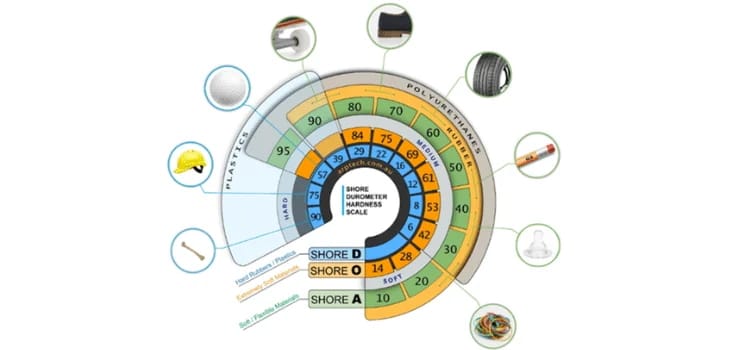
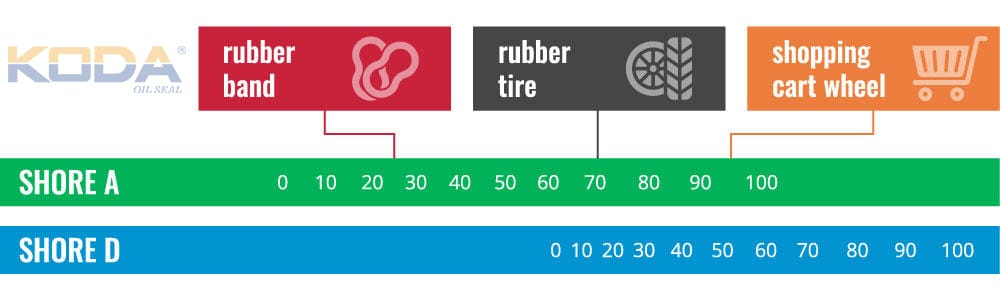
A durometer scale is a standardized measurement system used to quantify the hardness of elastomeric materials such as rubber, polyurethane, silicone, and other flexible polymers.
The term “durometer” refers both to the measurement scale and the instrument used to perform hardness testing.
The scale provides a numerical value that indicates how resistant a material is to indentation under a controlled force.
Higher numbers indicate harder materials, while lower numbers indicate softer compounds.
Examples of Durometer Ratings
30 Shore A = Very soft
50 Shore A = Soft
70 Shore A = Standard hardness
80 Shore A = Firm
90 Shore A = Very hard
The History Behind Durometer Hardness Testing
Hardness testing methods were developed to create a repeatable way of comparing elastomer materials across different manufacturers and industries.
Before standardized hardness scales existed, evaluating rubber compounds often relied on subjective observations. This created inconsistencies in product quality and sealing performance.
The development of Shore hardness testing transformed material selection by providing objective, measurable data that engineers could use for product design and quality control.
Today, durometer testing is recognized globally and incorporated into numerous ASTM, ISO, SAE, and industrial sealing standards.
Understanding Shore Hardness Scales
Several durometer scales exist, but only a few are commonly used for O-ring applications.
Shore A Scale
Shore A is the most frequently used hardness scale for elastomeric O-rings.
It measures soft to medium-hard rubber compounds and is suitable for:
NBR O-rings
FKM O-rings
EPDM O-rings
Silicone O-rings
HNBR O-rings
Typical Shore A values range from 40A to 90A.
Shore D Scale
Shore D is used for harder materials such as rigid polyurethane compounds and engineering plastics.
This scale becomes relevant when seals operate under extremely high pressures or severe mechanical loading.
Micro Shore Scale
Micro Shore testing is occasionally used for miniature seals and highly specialized elastomer components where standard Shore testing is impractical.
How the O-Ring Durometer Scales Method Works
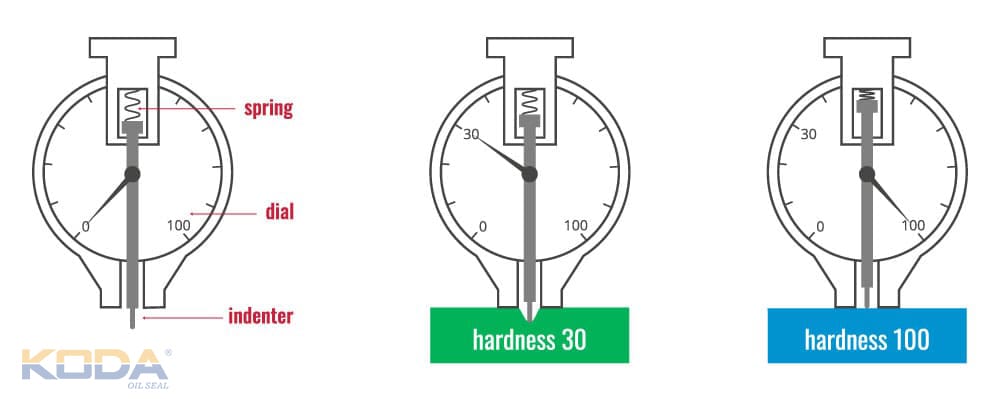
The O-Ring Durometer Scales Method uses a calibrated instrument equipped with a spring-loaded indenter.
When the indenter is pressed against the elastomer surface, the material resists penetration. The depth of indentation is measured and converted into a hardness value.
The softer the material, the deeper the indentation and the lower the hardness reading.
The harder the material, the shallower the indentation and the higher the hardness reading.
Basic Testing Procedure
Prepare the sample
Calibrate the durometer
Apply consistent pressure
Maintain contact time
Record hardness value
Average multiple readings
Accurate testing requires controlled environmental conditions and properly prepared specimens.
Common O-Ring Hardness Levels and Their Applications
40 Shore A O-Rings
These extremely soft O-rings provide excellent sealing on rough or uneven surfaces.
Common applications include:
Vacuum systems
Low-pressure equipment
Fragile assemblies
50 Shore A O-Rings
Softer compounds improve conformity and sealing performance at low pressures.
70 Shore A O-Rings
This is the most commonly used hardness in industrial sealing applications.
It provides:
Balanced sealing force
Good wear resistance
Reliable installation
Broad application compatibility
80 Shore A O-Rings
These compounds offer improved extrusion resistance while maintaining adequate flexibility.
90 Shore A O-Rings
Very hard compounds are selected for high-pressure systems where extrusion risks are significant.
How Hardness Influences Sealing Performance
Compression Characteristics
Softer O-rings compress more easily and adapt well to surface irregularities.
Harder O-rings require greater installation force but resist deformation more effectively.
Extrusion Resistance
High-pressure applications often require harder compounds to prevent material from being forced into sealing gaps.
Wear Resistance
Harder elastomers typically offer better abrasion resistance during dynamic operation.
Leakage Prevention
Excessively hard compounds may fail to conform adequately to sealing surfaces, increasing leakage risks.
The Relationship Between Material Type and Hardness
Hardness values alone do not fully define seal performance.
For example, two O-rings may both measure 70 Shore A yet exhibit significantly different characteristics because they are manufactured from different materials.
NBR, FKM, EPDM, Silicone, and HNBR compounds each possess unique chemical resistance, thermal stability, and aging behavior.
Therefore, engineers should evaluate both material type and hardness simultaneously.
When selecting compounds, consulting resources related to the O-Ring Durometer Scales Method can help identify the most appropriate hardness range for specific environments.
Factors That Can Affect Durometer Readings
Several variables can influence hardness measurements.
Temperature
Higher temperatures generally soften elastomers and reduce measured hardness values.
Material Aging
Long-term exposure to heat, oxygen, UV radiation, and chemicals may alter hardness over time.
Testing Surface Thickness
Samples that are too thin can produce inaccurate readings.
Measurement Technique
Improper testing procedures may introduce variability between readings.
Common Hardness Selection Mistakes
Selecting the wrong hardness remains one of the leading causes of seal failure.
Choosing soft compounds for high-pressure systems
Selecting overly hard compounds for rough surfaces
Ignoring thermal expansion effects
Overlooking chemical compatibility
Failing to account for dynamic movement
Understanding the O-Ring Durometer Scales Method helps engineers avoid these costly mistakes.
Emerging Trends in O-Ring Hardness Technology
Advances in material science continue to improve elastomer performance.
Recent innovations include:
Nano-enhanced elastomer compounds
Smart quality control systems
Automated hardness testing equipment
AI-assisted material selection
Hybrid polymer technologies
These developments enable manufacturers to optimize hardness characteristics while improving chemical resistance, durability, and environmental performance.
Why Durometer Knowledge Improves Seal Reliability
Many sealing failures occur not because of poor materials but because hardness requirements were misunderstood during the design phase.
Engineers who understand durometer scales can optimize sealing performance, reduce maintenance costs, improve equipment uptime, and extend service life.
Whether designing hydraulic systems, industrial machinery, automotive components, or chemical processing equipment, proper hardness selection remains one of the most important factors in successful sealing system design.
Frequently Asked Questions
1. What is the most common O-ring hardness?
70 Shore A is the most commonly used hardness because it provides an excellent balance of flexibility, durability, and sealing performance.
2. What does Shore A mean?
Shore A is a durometer scale used to measure the hardness of flexible elastomer materials such as rubber O-rings.
3. Is a higher durometer always better?
No. Higher hardness improves extrusion resistance but may reduce sealing conformity and increase installation difficulty.
4. Can temperature affect O-ring hardness?
Yes. Elevated temperatures typically soften elastomers, while low temperatures can make them harder and less flexible.
5. Why is hardness important in O-ring selection?
Hardness directly affects compression behavior, sealing force, extrusion resistance, wear performance, and overall service life.