
What is an SC Oil Seal?
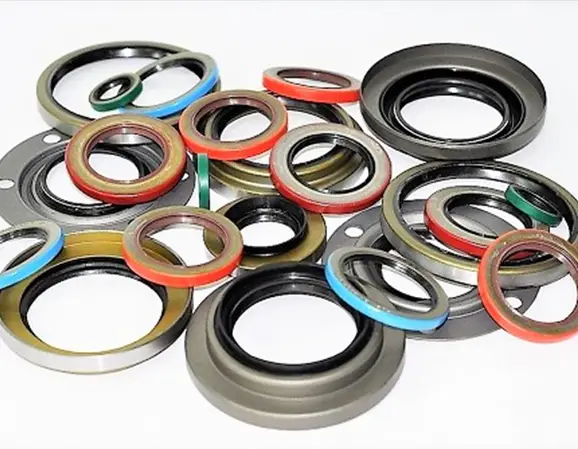
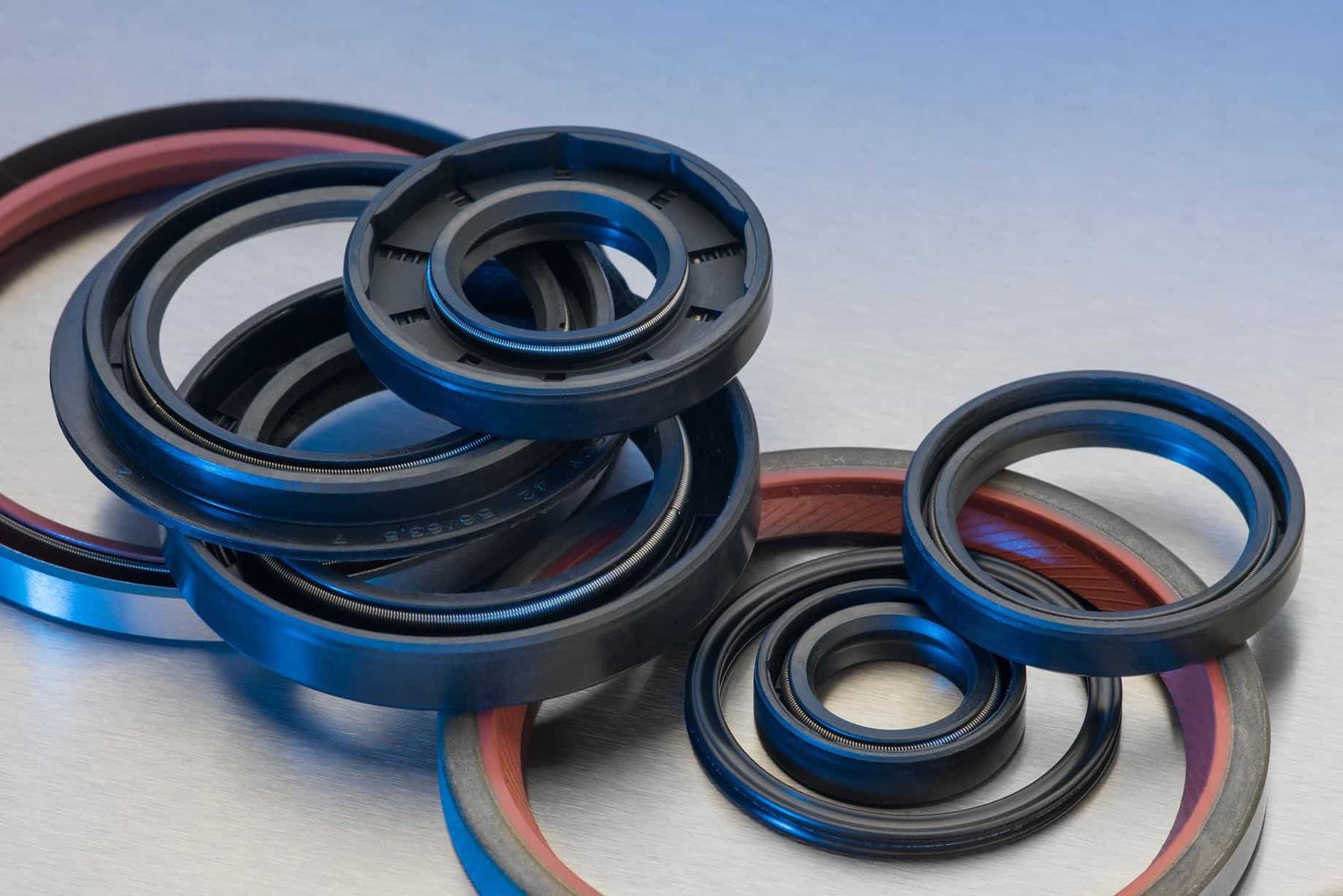
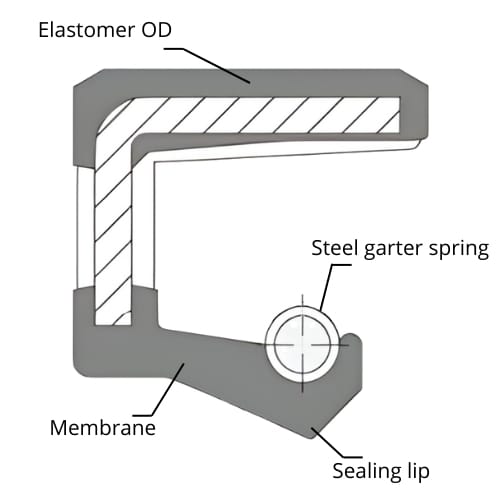
The SC oil seal is a rotary shaft sealing element designed with a rubber-coated outer diameter that ensures secure seating within the housing bore. A steel garter spring is integrated behind the primary sealing lip to maintain continuous radial contact with the shaft surface, ensuring stable sealing performance throughout operation. This spring-energized design helps compensate for wear and thermal variations, allowing consistent lip pressure over extended service periods.
The elastomer-covered outer surface provides enhanced flexibility during installation and helps accommodate minor surface irregularities in the housing, resulting in a reliable press-fit connection. SC seals are available in different rubber compounds to suit a variety of operating conditions and fluid types.
In contrast to TC-type seals, which include an additional dust lip for improved contamination resistance, the SC profile is designed primarily for applications focused on fluid retention rather than external particle exclusion. This simplified single-lip construction reduces frictional resistance and heat generation during operation, which can contribute to improved efficiency and lower energy loss in suitable systems.
SC rotary shaft seals are typically used in clean or controlled environments where exposure to dirt and abrasive particles is minimal. They are well suited for applications involving light lubricants or specific gaseous media, provided that operating pressure remains within the recommended limits.
Due to their streamlined geometry, SC seals generally exhibit lower running friction compared to multi-lip designs, making them a practical choice for high-speed equipment or systems where reduced energy consumption and thermal buildup are important design considerations.
When should you choose an SC Profile?
SC shaft seals are typically applied in systems where operating conditions are clean and well-controlled, and where exposure to external contaminants is minimal. Common application areas include electric motors, light-duty gearboxes, pumps, household appliances, and agricultural machinery equipped with internal lubrication systems.
Due to their simplified single-lip structure and compact design, SC oil seals generate lower friction during operation, which can contribute to improved mechanical efficiency and reduced torque demand. This makes them particularly suitable for installations where energy efficiency, space limitations, or smooth rotational performance are key design considerations.
In environments where dust, mud, or abrasive particles are not present, SC seals provide a reliable and cost-effective sealing solution. Their straightforward construction also reduces system complexity while still delivering consistent lubricant retention over extended service periods in clean operating conditions.
Material Options and Operating Ranges
SC rotary shaft seals can be supplied in a range of elastomer compounds, each selected to meet specific requirements related to temperature resistance, chemical compatibility, and operating media. The selection of the appropriate material plays a key role in ensuring reliable sealing performance and long service life.
Material | Temperature Range | Media Compatibility | Notes |
NBR | -40°C to +100°C | Mineral oils, greases, water | General-purpose; most cost-effective |
FKM | -25°C to +200°C | Synthetic oils, fuels, aggressive chemicals | Excellent chemical resistance |
HNBR | -30°C to +150°C | Oils, coolants, ozone | Good dynamic sealing properties |
VMQ | -60°C to +200°C | Food-grade, dry air, ozone | Silicone-based; low wear resistance |
ACM | -25°C to +150°C | Transmission oils, oxidized oils | Superior heat resistance |
EPDM | -50°C to +150°C | Brake fluids, steam, polar fluids | Not compatible with mineral oils |
Material choice should always be aligned with the characteristics of the application, including the type of lubricant used, expected operating temperature range, and any potential exposure to aggressive fluids or chemical additives. In standard configurations, SC oil seals are commonly produced using NBR (typically 70 Shore A hardness), which provides a well-balanced combination of flexibility, abrasion resistance, and compatibility with mineral oil-based lubricants.
The sealing force is maintained by a garter spring that ensures continuous radial contact between the sealing lip and the rotating shaft. These springs are generally manufactured from carbon spring steel in accordance with DIN EN 10270-1. For applications where enhanced corrosion resistance is required, stainless steel grade 1.4301 is also available as an alternative material option.
This combination of adaptable elastomer compounds and durable spring materials allows SC shaft seals to deliver stable performance across a wide range of industrial and mechanical applications.
Design considerations for shaft and housing
Proper installation of SC oil seals depends heavily on the accuracy of shaft and housing dimensions, as these factors directly influence sealing effectiveness and service life. To achieve stable performance, the shaft surface should be finished to a roughness range of Ra 0.2–0.8 µm, ensuring smooth contact conditions for the sealing lip during operation. In dynamic applications, the shaft should also maintain a minimum hardness of 45 HRC to resist wear and surface deformation over time.
On the housing side, machining accuracy is equally critical. The bore should be manufactured in accordance with ISO H8 tolerance to ensure correct interference fit and secure retention of the seal. The shaft diameter itself is typically specified under ISO H11 tolerance, providing the necessary dimensional consistency for proper assembly and alignment.
These dimensional requirements are particularly important for SC rotary shaft seals, as their sealing function relies solely on a single primary lip without the support of an additional dust exclusion lip. As a result, correct shaft condition, hardness, and surface quality play a decisive role in maintaining sealing reliability and preventing leakage over the long term.
SC vs. Other Oil Seal Profiles
A clear understanding of how SC oil seals differ from other rotary shaft seal designs is essential when choosing the most suitable profile for a given application.
When compared with TC seals, the main distinction lies in the sealing configuration. TC designs incorporate an additional dust lip, providing improved resistance against external contamination in harsh or wet environments. In contrast, SC seals use a single-lip structure, making them more appropriate for internally clean systems where external particle exclusion is not a primary concern.
Relative to TB oil seals, both profiles share a metal-reinforced outer construction; however, TB versions are equipped with a dual-lip arrangement for enhanced sealing and contamination protection. The SC type, with its simplified single-lip geometry, prioritizes lower friction and a more streamlined operating behavior.
Compared with VC-type seals, which are often designed with reinforced structures or specialized materials for more demanding pressure conditions, SC seals are positioned as a general-purpose solution intended for standard industrial applications with moderate operating requirements.
Overall, SC rotary shaft seals are best suited for situations where a balance of simplicity, cost efficiency, and low friction performance is more important than advanced contamination protection. For applications requiring different sealing capabilities, a broader range of rotary shaft seal designs and material options is available to accommodate varying industrial conditions and performance needs.
Cross-Reference of SC Oil Seal Codes
Different manufacturers may use varying part numbers, legacy designations, or internal coding systems to describe SC oil seal profiles. As a result, equivalent products can often appear under multiple identifiers depending on the brand or catalog standard.
A cross-reference list of these alternative codes helps simplify product identification and ensures accurate replacement selection when working across different suppliers or older equipment specifications. By matching equivalent designations, users can more easily locate compatible SC-type rotary shaft seals for maintenance, repair, or system upgrades in multi-brand environments.
Applications and Advantages
SC oil seals are primarily designed for applications operating in relatively clean environments, where the main objective is efficient lubricant retention rather than high-level contamination exclusion. Their compact structure makes them suitable for small to medium-sized rotating assemblies, including automotive pumps, auxiliary mechanical units, and similar equipment where space efficiency is important.
Thanks to their low-friction single-lip configuration, SC rotary shaft seals are also commonly used in industrial rollers and conveyor systems, where smooth operation and reduced energy loss are beneficial. In enclosed electric drive systems, they contribute to improved efficiency and reduced component wear over time, supporting stable long-term performance.
The simplified construction of the SC profile also makes installation easier and more cost-effective compared to dual-lip sealing designs, particularly in applications where additional dust protection is not required. For housings with minor surface imperfections or those subjected to thermal cycling, alternative designs with enhanced outer surface structure, such as ribbed OD profiles (e.g., G10 type), may offer improved static retention.
In higher temperature environments, upgraded versions such as SC Plus (FKM / Viton®) provide the same structural design while offering significantly improved heat and chemical resistance, making them suitable for more demanding operating conditions.
If you require assistance selecting the correct SC oil seal size, material, or configuration for your application, professional technical support is available to help ensure the most suitable solution is chosen.