
Silicone O-Rings
What Are Silicone O-Rings?

Silicone O-rings, also known as VMQ O-rings, are high-performance elastomer seals designed for applications that require exceptional temperature stability, weather resistance, flexibility, and cleanliness.Unlike conventional rubber materials, silicone is based on a silicon-oxygen polymer backbone rather than a carbon-based structure. This unique chemistry allows silicone seals to remain flexible in extremely cold environments while maintaining stability at elevated temperatures.
Because of these characteristics, silicone O-rings are widely used in:
- Food processing equipment
- Medical devices
- Pharmaceutical systems
- Electronics manufacturing
- Outdoor equipment
- Aerospace components
- Electrical enclosures
Why Choose Silicone O-Rings?
Many elastomers perform well within a narrow operating range.
Silicone stands out because it combines temperature resistance, flexibility, and environmental durability in a single material.
Key Advantages
✓ Exceptional low-temperature flexibility
✓ High-temperature resistance
✓ Outstanding UV resistance
✓ Excellent ozone resistance
✓ Weathering resistance
✓ Good electrical insulation
✓ FDA and medical-grade availability
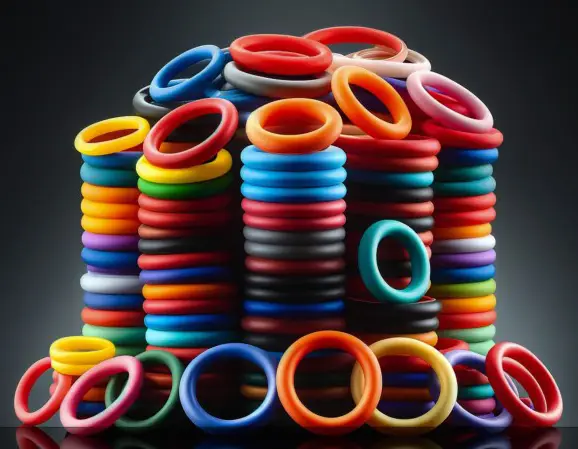
✓ Multiple color options for identification
Silicone remains one of the preferred materials when temperature extremes and environmental exposure are more critical than mechanical wear resistance.
How Silicone O-Rings Differ from Traditional Rubber Seals
Many buyers compare silicone with standard rubber materials such as NBR.
The performance differences are significant.
| Property | Silicone (VMQ) | NBR | FKM |
|---|---|---|---|
| Low Temperature Flexibility | Excellent | Good | Moderate |
| High Temperature Resistance | Excellent | Moderate | Excellent |
| Ozone Resistance | Excellent | Poor | Excellent |
| UV Resistance | Excellent | Poor | Excellent |
| Fuel Resistance | Poor | Excellent | Excellent |
| Abrasion Resistance | Low | Good | Good |
| Food Contact Applications | Excellent | Limited | Moderate |
For outdoor equipment, food machinery, and medical devices, silicone often provides a better balance of performance than traditional industrial elastomers.
Temperature Range of Silicone O-Rings
One of the biggest reasons engineers select silicone is its wide operating temperature range.
Standard Silicone Temperature Range
-60°C to +230°C
Special Compounds
Certain formulations can withstand temperatures approaching +250°C for short durations.
Even at extremely low temperatures, silicone retains flexibility that many elastomers lose through hardening or embrittlement.
Understanding Silicone Polymer Types
Not all silicone compounds are identical.
Different formulations provide different performance characteristics.
VMQ Silicone
The most common silicone elastomer.
Suitable for:
- General industrial sealing
- Food equipment
- Electronics
- Outdoor applications
PVMQ Silicone
Contains fluorinated groups.
Advantages:
- Improved fuel resistance
- Better solvent resistance
- Enhanced aerospace performance
Commonly used in:
- Aircraft fuel systems
- Aerospace equipment
- Specialty industrial applications
Metal Detectable Silicone
Designed for contamination-sensitive industries.
Applications:
- Food processing
- Beverage production
- Pharmaceutical manufacturing
Metal detectable compounds can often be identified by X-ray and metal detection equipment used in quality control systems.
Introduction to the properties of silicone rubber O-ring compounds
| Compounds | Durometer | Color | Temp Range (F) | Description |
|---|---|---|---|---|
| S50-B601 | 50 | Red | -67 to +437 | FDA-Grade |
| S60-C601 | 60 | Red | -67 to +392 | FDA-Grade |
| S70-B001 | 70 | Clear | -76 to +437 | Platinum Cured |
| S70-A601 | 70 | Red | -67 to +437 | FDA-Grade |
| S70-B401 | 70 | Blue | -67 to +392 | ISO 10993-5 Compliant |
| S70-B602 | 70 | Red | -67 to +437 | UL 157 |
| S75-F601 | 75 | Red | -76 to +437 | Metal/X-ray detectable, FDA-Grade |
Peroxide-Cured vs Platinum-Cured Silicone
One of the most important material decisions involves the curing system.
Peroxide-Cured Silicone
The most common industrial option.
Advantages:
- Economical
- Good heat resistance
- Suitable for general industrial use
- Widely available
Applications:
- Industrial machinery
- General sealing systems
- Standard FDA applications
Global O-Ring identifies peroxide curing as the standard curing technology used for most silicone O-rings.
Platinum-Cured Silicone
Premium-grade silicone technology.
Advantages:
- Extremely low volatile content
- Improved purity
- Better flexibility
- Reduced extractables
Applications:
- Medical devices
- Pharmaceutical equipment
- Biotechnology systems
- High-purity processing
Because platinum-cured compounds require clean-room manufacturing and more expensive catalysts, they generally cost more than peroxide-cured silicone.
Recommended working conditions for silicone O-rings
Areas of outstanding performance:
Mineral-based engine oils and transmission fluids;
Diluted salt solutions; Moderate humidity environments;
Dry and hot environments;
Excellent ozone resistance and weather resistance.
Areas where performance was poor:
Highly corrosive media such as concentrated acids and alkalis
Steam environments exceeding 120°C (248°F)
Petroleum-based petroleum products and fuels
Ketone organic solvents
Chemical Compatibility of Silicone O-Rings
Chemical compatibility is often misunderstood.
Although silicone performs exceptionally well in temperature-related applications, it is not a universal chemical-resistant material.
Performs Well In
- Dry heat
- Ozone exposure
- UV exposure
- Atmospheric weathering
- Moderate water service
- Diluted salt solutions
- Electrical environments
Limited Compatibility
Silicone is generally not recommended for:
- Petroleum fuels
- Gasoline
- Diesel fuel
- Concentrated acids
- Strong alkalis
- Ketones
- High-temperature steam
Long-term exposure to these media can cause swelling, softening, or degradation.
How to Select the Right Silicone O-Ring
Before requesting a quotation, gather the following information:
Operating Temperature
Specify:
- Minimum temperature
- Maximum temperature
Media Being Sealed
Examples:
- Water
- Air
- Food products
- Cleaning chemicals
Regulatory Requirements
Examples:
- FDA
- USP Class VI
- ISO 10993
- Medical approvals
Static or Dynamic Application
Silicone performs best in static sealing applications.
Hardness Requirement
Common options:
- 50 Shore A
- 60 Shore A
- 70 Shore A
- 75 Shore A
Different hardness levels influence flexibility, sealing force, and extrusion resistance.
Why Silicone O-Rings Are Often the Best Choice for Extreme Temperatures
Few elastomers can maintain flexibility from sub-zero environments to temperatures above 200°C.
This capability, combined with excellent weather resistance, electrical insulation properties, FDA compliance options, and medical-grade formulations, makes silicone one of the most versatile sealing materials available.
However, successful application requires understanding its limitations. If fuel resistance, chemical resistance, or abrasion resistance are critical, alternative materials such as FKM, EPDM, HNBR, or fluorosilicone may provide a better long-term solution.