In the world of industrial sealing technology, engineers are constantly seeking solutions that offer higher reliability, easier installation, improved pressure resistance, and longer service life. While O-rings remain one of the most commonly used sealing components, they are not always the optimal choice for every application. In many static and dynamic sealing environments, D-Rings provide a unique combination of stability, sealing efficiency, and installation advantages that make them an increasingly popular alternative.
From hydraulic cylinders and pneumatic systems to industrial machinery, automotive assemblies, and fluid control equipment, D-Rings deliver dependable sealing performance while helping engineers overcome challenges commonly associated with conventional round-profile seals.
🔍 Quick Overview: A D-Ring is an elastomer sealing element featuring a flat base and a rounded sealing surface. This distinctive profile improves seal stability, minimizes rolling or twisting, and creates a larger sealing contact area compared with traditional O-rings.
What Are D-Rings?
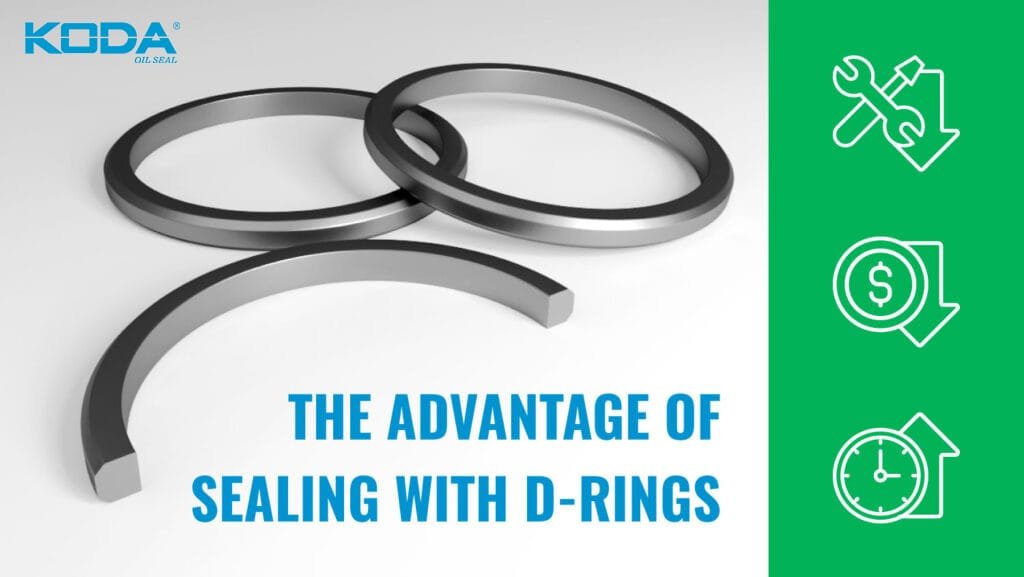
D-Rings are engineered sealing components named after their cross-sectional shape, which resembles the letter “D.” Unlike O-rings that feature a completely circular cross-section, D-Rings have one flat side and one curved side.
This simple geometric difference creates several practical advantages that can significantly improve sealing reliability in many industrial applications.
The flat surface typically sits against the groove base, while the curved section provides the sealing interface. When compressed between mating components, the seal generates a highly effective sealing force while maintaining positional stability.
Because of their design, D-Rings are frequently selected for applications where engineers want enhanced sealing consistency without increasing assembly complexity.
How D-Rings Work
The sealing mechanism of a D-Ring is based on controlled elastomer compression. When installed between two mating surfaces, the elastomer deforms slightly, filling microscopic surface irregularities and creating a barrier against fluid or gas leakage.
The flat base provides a stable foundation that helps prevent movement within the groove, while the rounded portion concentrates sealing force where it is needed most.
As pressure increases within the system, the elastomer responds by increasing contact pressure against the sealing surfaces. This pressure-assisted sealing effect contributes to improved performance in both static and certain dynamic applications.
⚙️ Core Sealing Principle:
• Controlled elastomer compression
• Enhanced groove stability
• Larger contact surface area
• Reduced rolling tendency
• Improved pressure retention
The Unique Advantages of Sealing with D-Rings

The growing popularity of D-Rings is driven by several engineering advantages that address limitations often encountered with conventional sealing solutions.
1. Superior Seal Stability
One of the most significant benefits of D-Rings is their resistance to rolling and twisting during installation and operation.
Traditional O-rings can occasionally roll within their grooves when exposed to movement, pressure fluctuations, or assembly misalignment. This phenomenon may lead to uneven compression, accelerated wear, or premature seal failure.
The flat base of a D-Ring significantly reduces this risk by creating a stable seating surface.
✅ Engineering Benefit: Reduced seal movement translates directly into improved reliability and longer service intervals.
2. Larger Sealing Contact Area
Because of their geometry, D-Rings often create a broader sealing footprint than comparable O-rings.
The increased contact area can provide:
• Better sealing effectiveness
• Improved pressure distribution
• Reduced localized stress
• Enhanced leak prevention
This characteristic makes D-Rings particularly useful in applications requiring dependable long-term sealing performance.
3. Improved Installation Accuracy
Installation errors remain one of the leading causes of seal failures across industrial equipment.
The flat-bottom design of D-Rings naturally helps guide proper positioning during assembly. This reduces the likelihood of twisting, misalignment, or incorrect seating.
For production environments where assembly consistency is essential, this feature can significantly improve manufacturing quality control.
4. Enhanced Pressure Handling
D-Rings often demonstrate excellent performance in pressure-retaining applications.
Their geometry helps maintain sealing integrity under varying pressure conditions, making them suitable for many hydraulic and pneumatic systems.
When paired with proper groove design and material selection, D-Rings can provide highly effective sealing performance across a broad pressure range.
Where Are D-Rings Used?
D-Rings are used across numerous industries because of their versatility and reliability.
Hydraulic Systems
Hydraulic cylinders, valves, pumps, and actuators rely on effective sealing to maintain system pressure and prevent fluid loss.
D-Rings help ensure:
• Pressure retention
• Reduced leakage
• Stable sealing performance
• Extended equipment life
Pneumatic Equipment
Compressed air systems benefit from the low leakage characteristics and positional stability provided by D-Rings.
Applications include:
• Air cylinders
• Pneumatic valves
• Control systems
• Automated equipment
Automotive Components
Automotive manufacturers use D-Rings in various fluid sealing systems where consistent performance and durability are required.
Common applications include:
• Brake systems
• Steering systems
• Fuel system components
• Hydraulic assemblies
Industrial Machinery
Many industrial machines incorporate D-Rings to improve sealing reliability in demanding operating environments.
Industries include:
• Manufacturing
• Food processing
• Chemical processing
• Energy production
• Water treatment
D-Rings vs O-Rings: Understanding the Difference
Although D-Rings and O-rings share many similarities, important differences influence their performance characteristics.
D-Ring Advantages Compared with O-Rings:
✔ Reduced rolling and twisting
✔ Improved groove stability
✔ Larger sealing footprint
✔ Easier assembly positioning
✔ Better performance in specific pressure applications
O-rings remain highly versatile and cost-effective, but D-Rings often provide additional reliability in applications where movement resistance and installation consistency are critical.
Materials Used for D-Rings
The performance of any sealing component depends heavily on material selection.
NBR (Nitrile Rubber)
NBR is widely used due to its excellent compatibility with petroleum-based oils, lubricants, and hydraulic fluids.
Advantages include:
• Cost effectiveness
• Good wear resistance
• Reliable sealing performance
FKM (Viton®)
FKM offers superior resistance to high temperatures, aggressive chemicals, and demanding industrial environments.
It is commonly selected for:
• Chemical processing
• Automotive applications
• High-temperature systems
EPDM
EPDM performs exceptionally well when exposed to water, steam, and weather-related conditions.
Silicone
Silicone compounds provide excellent flexibility across a wide temperature range and are frequently used in specialized applications.
Design Considerations for D-Ring Applications
Achieving optimal sealing performance requires careful attention to system design.
Engineers should evaluate:
• Groove dimensions
• Compression ratio
• Operating pressure
• Temperature range
• Fluid compatibility
• Surface finish quality
• Dynamic or static operation
Proper design ensures the D-Ring functions efficiently throughout its intended service life.
📌 Best Practice: Matching material properties with operating conditions is often more important than selecting the seal profile itself.
How D-Rings Improve Equipment Reliability
Reliability has become a key metric across modern industries. Unexpected downtime can result in significant production losses and maintenance expenses.
D-Rings contribute to reliability improvements by:
• Minimizing leakage risk
• Reducing seal displacement
• Maintaining consistent compression
• Improving pressure retention
• Extending maintenance intervals
These advantages support long-term equipment performance while helping organizations reduce total ownership costs.
Emerging Trends in D-Ring Sealing Technology

The sealing industry continues to evolve as equipment becomes more sophisticated and operating requirements become increasingly demanding.
Future developments involving D-Rings may include:
• Advanced low-friction compounds
• Improved wear-resistant elastomers
• Enhanced chemical resistance
• Sustainable material formulations
• Precision-engineered custom geometries
As industrial equipment continues advancing, D-Rings will remain an important solution for engineers seeking dependable and efficient sealing performance.
Why D-Rings Are Becoming a Preferred Sealing Solution
The demand for higher equipment efficiency, reduced maintenance, and improved reliability continues to drive adoption of D-Ring technology.
By combining installation simplicity, improved sealing stability, and excellent pressure retention characteristics, D-Rings provide a practical solution for many modern sealing challenges.
Whether used in hydraulic equipment, industrial machinery, automotive systems, or fluid handling applications, D-Rings offer a proven approach to achieving long-term sealing success.
Frequently Asked Questions
1. What is the primary advantage of a D-Ring over an O-ring?
The flat base of a D-Ring helps prevent rolling and twisting, providing greater positional stability and improved sealing consistency.
2. Are D-Rings suitable for hydraulic systems?
Yes. D-Rings are commonly used in hydraulic applications because they provide excellent pressure retention and reliable sealing performance.
3. Which materials are commonly used for D-Rings?
Common materials include NBR, FKM, EPDM, silicone, and other specialized elastomer compounds.
4. Can D-Rings be used in dynamic applications?
Yes. Depending on the design and operating conditions, D-Rings can be used in both static and certain dynamic sealing applications.
5. How do I choose the correct D-Ring?
Selection should consider pressure, temperature, fluid compatibility, groove dimensions, movement characteristics, and environmental conditions.