
Understanding Thermal Expansion and Its Influence on Seal Performance
Thermal expansion is one of the most important engineering considerations when designing reliable sealing systems. Every material expands when heated and contracts when cooled, but the expansion rate differs significantly between metals, elastomers, plastics, composites, and engineered polymers. Because sealing components usually operate between two different materials, even small dimensional changes can dramatically influence sealing effectiveness, contact pressure, friction, wear, leakage rate, and long-term durability.
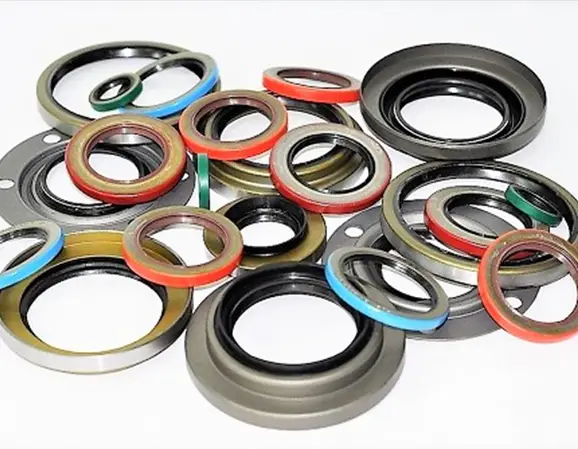
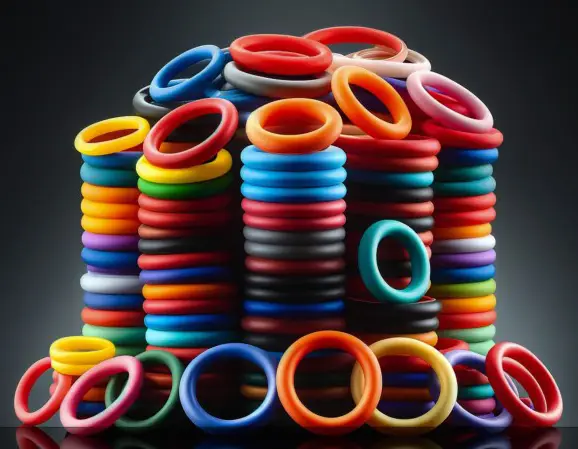
In industrial equipment, thermal expansion affects O-rings, oil seals, hydraulic seals, mechanical seals, bonded seals, gasket systems, PTFE seals, copper washers, metal sealing rings, and rotary shaft seals. Engineers must understand both material properties and operating environments before selecting the correct sealing solution.
✔ Engineering Note
Seal failure is rarely caused by temperature alone. Most failures occur because thermal expansion changes the mechanical relationship between the housing, shaft, groove, and sealing material, causing excessive compression, insufficient squeeze, extrusion, or accelerated wear.
What Is Thermal Expansion?
Thermal expansion refers to the dimensional increase of a material as temperature rises. The amount of expansion depends primarily on:
- Material coefficient of thermal expansion (CTE)
- Temperature change (ΔT)
- Original dimensions
- Material structure
The simplified linear thermal expansion equation is:
ΔL = α × L × ΔT
Where:
- ΔL = dimensional change
- α = coefficient of thermal expansion
- L = original length
- ΔT = temperature difference
Because elastomers generally have thermal expansion coefficients several times higher than steel, sealing interference changes continuously throughout operation.

Why Thermal Expansion Matters for Seal Performance
Every seal relies on a controlled contact force between sealing surfaces. Thermal expansion changes this force continuously.
Temperature Increase May Cause:
- Higher compression force
- Increased friction
- Greater running torque
- Heat generation
- Material softening
- Accelerated wear
- Lubrication breakdown
Temperature Decrease May Cause:
- Loss of sealing interference
- Reduced elasticity
- Material hardening
- Leakage during cold startup
- Cracking under dynamic loads
Successful sealing therefore requires balancing both high-temperature and low-temperature operating conditions instead of optimizing for only one temperature point.
Thermal Expansion Characteristics of Common Seal Materials
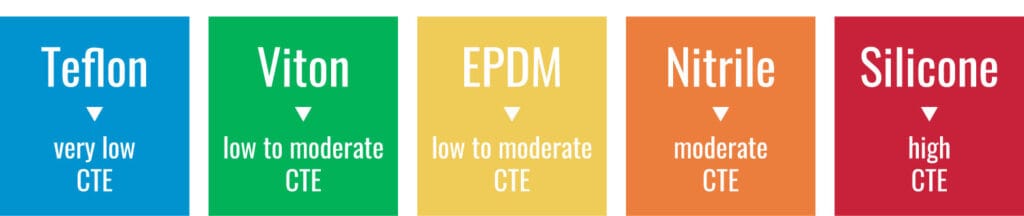
NBR (Nitrile Rubber)
NBR remains one of the most widely used sealing materials due to excellent oil resistance and economical cost. Typical operating temperatures range from approximately -40°C to 120°C depending on formulation.
Advantages include:
- Good wear resistance
- Excellent mineral oil compatibility
- Stable compression characteristics
- Moderate thermal expansion
FKM (Viton®)
FKM offers outstanding resistance to elevated temperatures, fuels, chemicals, and oxidation. Continuous operating temperatures often exceed 200°C.
Thermal expansion is higher than steel but dimensional stability remains suitable for demanding industrial applications.
Silicone Rubber
Silicone provides exceptional flexibility at low temperatures while tolerating temperatures exceeding 200°C in many formulations.
However, silicone generally exhibits relatively high thermal expansion and lower abrasion resistance compared with NBR.
PTFE
PTFE possesses one of the highest thermal expansion coefficients among engineering sealing materials. Designers typically compensate through energized seal designs or spring-assisted structures.
Metal Seals
Steel, stainless steel, copper, aluminum, and nickel alloys generally have much lower thermal expansion than elastomers, making differential expansion particularly important.
Engineering Properties Affecting Thermal Seal Behavior
Besides thermal expansion, several engineering properties influence overall sealing performance.
- Shore A hardness
- Compression set
- Tensile strength
- Elongation at break
- Tear resistance
- Thermal conductivity
- Thermal aging resistance
- Chemical compatibility
- Corrosion resistance
- Elastic recovery
Typical Hardness
Most industrial O-rings operate between 70 and 90 Shore A. Softer compounds improve sealing under low pressure, while harder materials better resist extrusion under higher pressures.
Thermal Conductivity and Heat Transfer
Heat transfer strongly influences seal operating temperature.
Metal housings rapidly conduct heat away from sealing interfaces, whereas elastomers typically exhibit much lower thermal conductivity. Localized frictional heating may therefore become significantly higher than surrounding component temperatures.
Good thermal management reduces:
- Thermal degradation
- Hardening
- Surface cracking
- Lubricant breakdown
- Premature leakage
Differential Thermal Expansion Between Shaft and Housing
Rotary shaft seals frequently operate between steel shafts and aluminum housings.
Because aluminum expands approximately twice as much as carbon steel, housing bores enlarge more rapidly during heating.
This dimensional difference can:
- Reduce interference fit
- Decrease radial lip load
- Increase leakage probability
- Alter lubricant film thickness
Engineers frequently compensate through optimized lip geometry and spring loading.
Annealed Copper Washer Principle
Annealed copper sealing washers are commonly used in hydraulic systems, fuel systems, brake systems, and high-temperature threaded joints.
Annealing softens copper through controlled heating followed by cooling, restoring ductility lost during manufacturing.
Why Annealed Copper Works
- Higher plastic deformation
- Improved surface conformity
- Compensation for machining marks
- Better thermal cycling resistance
- Reliable metal-to-metal sealing
Repeated reuse without re-annealing typically reduces sealing reliability because work hardening increases material stiffness.
Corrosion Resistance Under Thermal Cycling
Temperature fluctuations accelerate corrosion when moisture and aggressive chemicals are present.
Seal materials should therefore resist:
- Oxidation
- Hydrolysis
- Fuel degradation
- Acid attack
- Salt exposure
- Ozone cracking
Proper material compatibility remains equally important as thermal resistance.
Common ASTM and ISO Standards
Engineers often reference internationally recognized standards during seal design and validation.
- ASTM D2000 — Rubber material classification
- ASTM D395 — Compression set testing
- ASTM D2240 — Shore hardness measurement
- ASTM D1414 — O-ring testing
- ASTM D471 — Fluid compatibility testing
- ISO 3601 — O-ring dimensions and quality
- ISO 6194 — Rotary shaft lip seals
- ISO 2230 — Rubber storage recommendations
These standards establish consistent testing methods rather than guaranteeing application-specific performance.
Seal Selection Guide for Thermal Applications
When selecting a seal, engineers typically evaluate multiple operating variables simultaneously.
Selection Checklist
- Operating temperature range
- Pressure
- Media compatibility
- Thermal cycling frequency
- Surface finish
- Shaft speed
- Installation tolerance
- Compression ratio
- Expected service life
- Maintenance interval
For additional sealing solutions, visit Seal to explore industrial sealing technologies and engineering resources.
Proper Installation Methods
Correct installation minimizes damage caused by thermal expansion.
- Clean sealing grooves thoroughly.
- Avoid twisting elastomer seals.
- Use compatible lubricants.
- Protect sealing lips during installation.
- Verify compression percentage.
- Inspect shaft surface finish.
- Avoid excessive installation force.
Installation errors often become more severe after repeated heating and cooling cycles.
Failure Mode Analysis (Industry Experience Example)
Failure Mode Analysis (Illustrative Industry Example)
This example represents a generalized engineering scenario and does not describe an actual customer or proprietary test.
A hydraulic cylinder experienced intermittent leakage after several months of thermal cycling between ambient conditions and approximately 110°C.
Inspection identified:
- Compression set development
- Reduced radial sealing force
- Localized hardening
- Minor extrusion marks
The sealing compound was upgraded to a higher-temperature elastomer while groove dimensions were optimized. Leakage frequency decreased during subsequent validation testing.
Case Example (Engineering Experience)
Case Example (Illustrative Engineering Scenario)
This case is provided solely for educational purposes and reflects common engineering practices rather than actual customer data.
A rotating gearbox operated outdoors with frequent temperature fluctuations from winter mornings to elevated operating temperatures.
Initial leakage occurred primarily during startup.
Engineering improvements included:
- Revised lip geometry
- Higher-performance elastomer
- Improved lubricant selection
- Optimized shaft surface finish
These changes improved sealing consistency across the operating temperature range.
Laboratory Test Example
Laboratory Test Example (Illustrative Only)
The following example illustrates a common laboratory evaluation approach rather than actual published test data.
- Measure initial hardness.
- Record initial dimensions.
- Expose specimens to controlled thermal cycling.
- Measure compression set.
- Evaluate dimensional recovery.
- Inspect for cracking and deformation.
- Repeat fluid compatibility testing.
Such testing helps compare different compounds under identical laboratory conditions.
Typical Industrial Applications
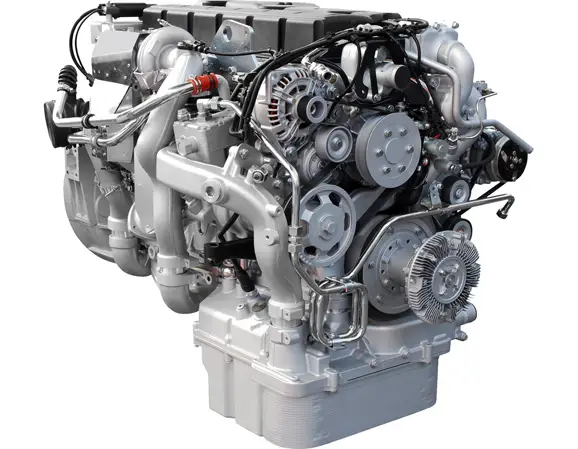
- Automotive engines
- Hydraulic equipment
- Pneumatic systems
- Chemical processing
- Oil and gas equipment
- Industrial pumps
- Compressors
- Marine machinery
- Power generation
- Food processing equipment
Engineering Best Practices
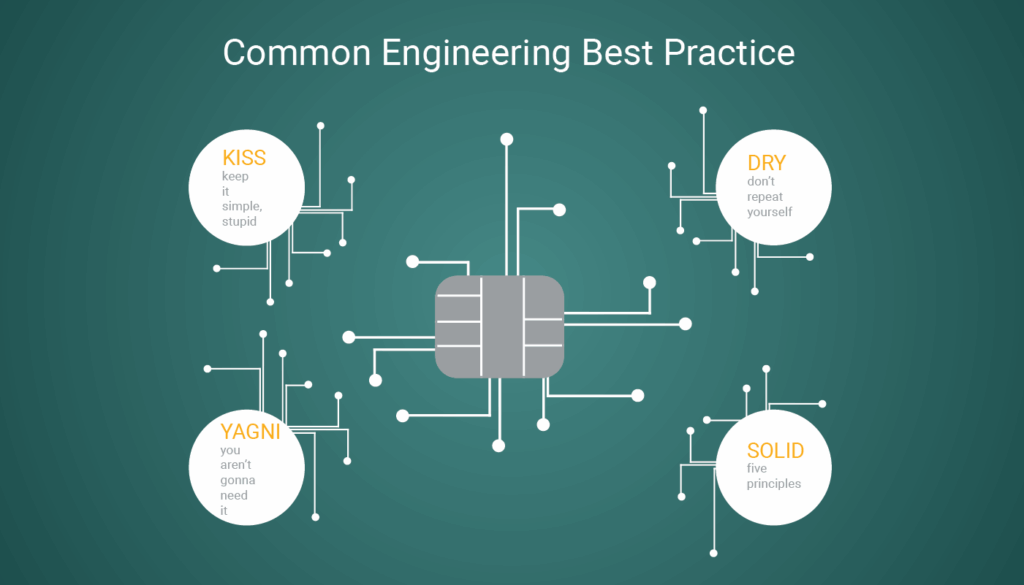
Successful thermal sealing depends on balancing material properties, equipment design, installation quality, and operating conditions. Engineers should always evaluate the complete sealing system instead of considering individual components independently.
Factors including hardness, compression set resistance, thermal conductivity, corrosion resistance, coefficient of thermal expansion, chemical compatibility, groove design, and manufacturing tolerances all contribute to long-term sealing reliability.
For comprehensive guidance on industrial sealing products and engineering, please contact us.
Frequently Asked Questions
1. Why does thermal expansion cause seal leakage?
Different materials expand at different rates. The resulting dimensional changes alter sealing pressure, potentially reducing contact force or creating excessive compression that accelerates wear.
2. Which seal material performs best at high temperatures?
There is no universal best material. FKM, PTFE, silicone, and specialized high-temperature elastomers are selected according to temperature, pressure, chemicals, and mechanical requirements.
3. Why are annealed copper washers used in sealing?
Annealed copper is softer and more ductile, allowing it to conform to mating surfaces, compensate for small imperfections, and provide reliable metal sealing after proper tightening.
4. Which standards are commonly used for seal evaluation?
Frequently referenced standards include ASTM D2000, ASTM D395, ASTM D2240, ASTM D471, ASTM D1414, ISO 3601, ISO 6194, and ISO 2230.
5. How can engineers improve seal performance during thermal cycling?
Optimize material selection, groove geometry, hardness, compression ratio, shaft finish, lubrication, corrosion resistance, and installation quality while validating performance through laboratory testing and engineering verification.