
Material and Variants
TC oil seals are available in several elastomer compounds, each developed to meet specific operating requirements. The choice of sealing material plays a critical role in determining the seal’s resistance to temperature, wear, lubricants, chemicals, and environmental influences.
Different applications place different demands on a rotary shaft seal. For example, some elastomers perform exceptionally well under elevated temperatures, while others offer superior resistance to petroleum-based oils, aggressive chemicals, water, or outdoor weather exposure. Selecting the appropriate material requires evaluating the equipment’s operating environment, media compatibility, shaft speed, and temperature range.
Material | Temperature Range | Suitable For | Notes |
NBR (Nitrile) | −40°C to +100°C | Mineral oils, general industry | Standard and most cost-effective option |
FKM / Viton | up to +200°C | High temperature, chemicals | Offered as oil seal TC Plus for demanding conditions |
HNBR | −30°C to +150°C | Higher loads, improved oil resistance | Suitable for heavy-duty machinery |
ACM | −20°C to +150°C | Automotive oils, ATF fluids | Good heat and oil resistance |
Silicone (VMQ) | −60°C to +150°C | Low-temperature environments | Limited oil and wear resistance |
EPDM / CR | Application-specific | Water, steam, certain chemicals | Not compatible with mineral oils |
In addition to the sealing lip material, the metal reinforcement components can also be customized. Standard TC oil seals typically utilize a carbon steel casing, which provides excellent structural strength for most industrial applications. However, in environments where moisture, chemicals, or salt exposure may cause corrosion, a stainless steel case is often recommended to improve durability and service life.
The garter spring, which maintains sealing force against the shaft, is also available in different materials. Conventional designs commonly use spring steel, while applications involving corrosive fluids, high humidity, or harsh operating conditions may benefit from a stainless steel spring for enhanced corrosion resistance.
Ultimately, the optimal material combination depends on the specific equipment, operating conditions, and surrounding environment. Factors such as contamination levels, chemical exposure, maintenance intervals, and expected service life should all be considered when selecting a TC rotary shaft seal configuration.
Operating Conditions
For optimal sealing performance and maximum service life, TC oil seals should be operated within their recommended design parameters. Under standard operating conditions, most conventional TC seals are capable of functioning in temperature ranges from approximately -40°C to +100°C, depending on the sealing material selected.
While some seal compounds can tolerate temperatures near the upper limit, continuous exposure to excessive heat may accelerate elastomer aging, reduce flexibility, and shorten the overall lifespan of the seal. For long-term reliability, maintaining operating temperatures below 80°C is generally preferred whenever possible.
TC oil seals are primarily designed for applications involving low internal pressure. In most cases, they can accommodate pressures of up to 0.05 MPa. Systems operating above this threshold may require specialized sealing solutions designed for pressurized environments.
The maximum permissible shaft speed is influenced by several operating factors, including shaft diameter, surface finish quality, lubrication conditions, and the viscosity of the medium being sealed. Proper shaft preparation and lubrication are essential for achieving stable sealing performance at higher rotational speeds.
TC rotary shaft seals are commonly used with mineral-based lubricants and are also compatible with many synthetic oils used in industrial and automotive equipment. However, lubricant formulations can vary significantly in their chemical composition. When compatibility data is unavailable, it is advisable to verify the interaction between the sealing material and the lubricant before installation to prevent premature wear, swelling, hardening, or seal failure.
Design Requirements for Shafts and Housings
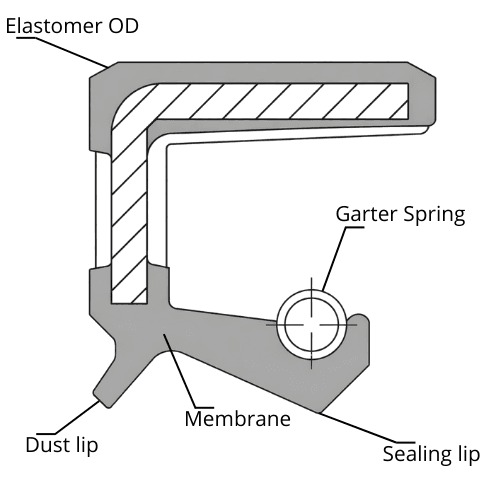
The sealing performance of a TC oil seal is heavily influenced by the quality and dimensional accuracy of the shaft and housing. To ensure reliable operation, the shaft should be manufactured in accordance with ISO h11 tolerance standards and feature a wear-resistant, lead-free running surface with a minimum hardness of 45 HRC.
Surface finish is equally important. A shaft roughness value between Ra 0.2 μm and Ra 0.8 μm helps maintain an effective lubricating film between the sealing lip and the shaft, reducing friction while minimizing wear during operation.
The housing bore should comply with ISO H8 tolerances to provide proper seal retention and alignment. A bore surface roughness ranging from Ra 1.6 μm to Ra 6.3 μm is generally recommended, allowing the rubber-covered outer diameter of the TC seal to achieve a dependable static sealing effect and prevent leakage around the outside of the seal.
By following these installation and machining recommendations, equipment manufacturers can improve sealing reliability, extend service life, and maximize the long-term performance of TC rotary shaft seals in demanding industrial applications.
TC Type Rotary Shaft Seal VS Other Seal Types
Among the various rotary shaft seal configurations available, TC oil seals are frequently selected for applications that require enhanced protection against external contaminants. When compared with other common profiles such as SC and TB, each design offers distinct advantages depending on the operating environment.
The SC oil seal features a single sealing lip and is primarily designed to retain lubricants within the system. Because it lacks an auxiliary dust lip, it is generally better suited for clean operating conditions where exposure to dirt, moisture, or airborne particles is minimal.
The TB oil seal, on the other hand, incorporates a dual-lip arrangement similar to the TC profile. However, its structural design often differs in terms of the outer case construction and sealing interface. Depending on the manufacturer and specification, TB seals may utilize a metal outer diameter rather than a fully rubber-coated exterior.
TC oil seals are often preferred when equipment operates in dusty, wet, or contaminated environments. The combination of a secondary dust lip and an elastomer-covered outer diameter provides additional protection against contaminant ingress while improving sealing performance between the seal and housing. This design is particularly beneficial for applications requiring reliable static sealing, vibration resistance, or improved accommodation of housing surface irregularities.
As a result, TC seals have become a popular choice in agricultural machinery, construction equipment, industrial gearboxes, pumps, and other systems where sealing reliability is critical under demanding operating conditions.
Alternative Names for the Oil Seal TC
TC oil seals are widely recognized across global industries, but different manufacturers and sealing brands often apply their own product coding systems and part number conventions. As a result, the same seal design may be marketed under various reference names depending on the supplier, catalog standard, or regional specification.
Despite these naming differences, the fundamental construction remains unchanged—a rotary shaft seal featuring a primary sealing lip, an auxiliary dust lip, and a rubber-covered outer diameter designed for effective dynamic and static sealing performance.
Understanding these equivalent designations is important when sourcing replacement seals, comparing supplier catalogs, or identifying interchangeable products. The cross-reference table below highlights the most commonly used TC oil seal equivalents, helping engineers, distributors, and maintenance professionals quickly locate compatible alternatives from different manufacturers around the world.
Fabrikant / merk | Code(s) / typebenamingen |
Dichtomatik | WAS |
Anyseals | OS-A11 |
B+S | TR-E |
Chicago (R) | HMSA7 |
Elring | AS |
Eriks | RST |
FP Paris | GP |
FST | BA SL |
Gaco | FA |
Goetze | 827 S |
Kaco | DGS |
Kramp | CC |
National | 32 |
Paulstra | IEL |
Pioneer W | R23 |
Rolf | RP |
Stefa | CC |
Taiwan / NOK | TC |
Vota | BA SL |
Ebele | RP |
Kimman | KAS |
Where TC Oil Seals are Used
Thanks to their excellent ability to prevent the ingress of dust, moisture, and other contaminants, TC oil seals are widely utilized in equipment operating under demanding environmental conditions. Their robust sealing design makes them a preferred solution across industries where machinery is regularly exposed to dirt, vibration, and fluctuating operating loads.
Typical applications include agricultural machinery, construction and earthmoving equipment, conveyor and transport systems, industrial transmissions, pumps, and electric motors. In these environments, maintaining lubricant retention while preventing external contamination is essential for reliable equipment performance.
The combination of a dual-lip sealing structure and a rubber-coated outer diameter allows TC seals to maintain a secure fit within the housing while providing additional protection against environmental factors. This design helps compensate for vibration, minor housing imperfections, and thermal expansion, contributing to consistent sealing effectiveness over extended operating periods.
For maintenance engineers, equipment manufacturers, and industrial operators, the TC profile is often regarded as a dependable sealing choice whenever long service life, reduced maintenance requirements, and reliable operation in contaminated environments are key priorities.
Choosing the Right Oil Seal TC
Selecting the most suitable TC oil seal requires careful consideration of several operating factors to ensure reliable sealing performance and long service life. Key selection criteria include the type of fluid being sealed, operating temperature range, equipment design specifications, and the environmental conditions in which the seal will operate.
The sealing material should always be chosen based on media compatibility and thermal requirements. For standard industrial applications involving mineral oils and moderate temperatures, NBR (Nitrile Rubber) is often the most economical and widely used option. In contrast, applications exposed to higher temperatures, aggressive chemicals, or synthetic lubricants may benefit from FKM (Viton®), which offers superior heat and chemical resistance.
Proper installation conditions are equally important. Shaft dimensions, surface finish quality, and housing tolerances should be verified to ensure the seal can maintain effective contact pressure and prevent leakage throughout its service life.
Environmental factors should also be taken into account. Applications operating in dusty, muddy, or contaminated surroundings typically require enhanced sealing protection. In situations where additional retention or improved sealing between the housing and the outer diameter is needed, specialized designs such as G11-style ribbed outer diameter seals can provide increased static sealing capability and improved housing grip.
By evaluating these factors during the selection process, engineers and maintenance professionals can identify the most appropriate rotary shaft seal solution for their specific operating conditions and reliability requirements.
Ordering TC Oil Seals
We supply TC oil seals in an extensive selection of dimensions, sealing compounds, and metal case configurations to accommodate a wide variety of industrial applications. By using the product filters available on this page, you can quickly narrow your search based on shaft diameter, housing diameter, seal width, and material specifications.
Whether your application requires a cost-effective NBR oil seal for general-purpose equipment or a FKM (Viton®) seal for elevated temperatures and chemically demanding environments, the TC profile provides reliable protection against lubricant leakage and external contamination.
If you are unsure which seal size, material, or design is most suitable for your equipment, our technical team is ready to assist. Contact us for expert guidance on product selection, material compatibility, and application requirements to ensure the best sealing solution for your operating conditions.