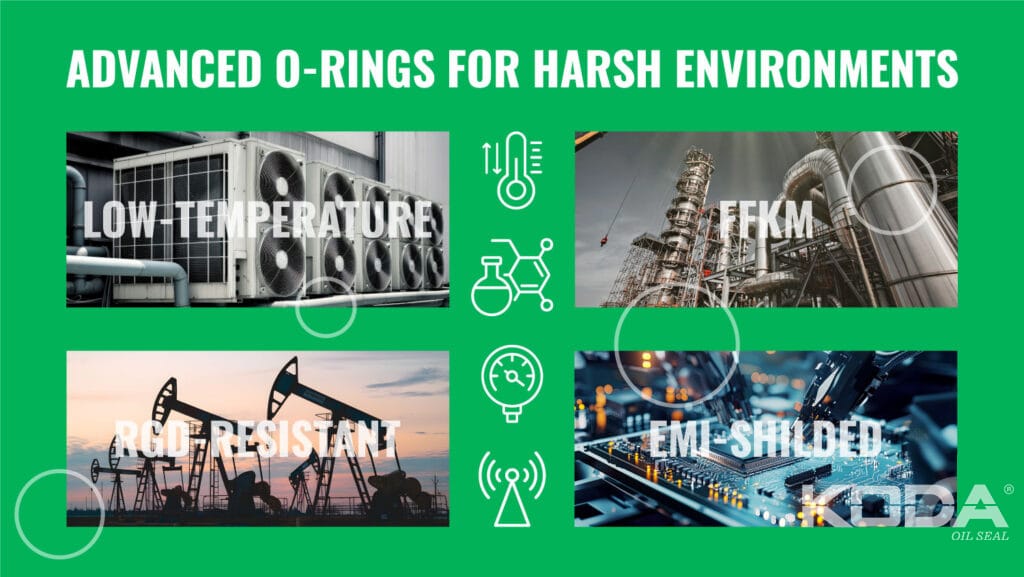
Advanced O-Rings for Harsh Environments: Engineering Performance, Materials, and Reliability
Advanced O-rings designed for harsh environments represent a critical sealing technology used across aerospace, oil & gas, chemical processing, semiconductor manufacturing, automotive systems, and high-pressure hydraulic equipment. In extreme conditions such as high temperature, aggressive chemicals, vacuum, radiation exposure, or dynamic pressure cycling, standard elastomer O-rings often fail due to material degradation, compression set, or extrusion.
Engineering-grade sealing systems require a deep understanding of polymer chemistry, thermomechanical stress behavior, gland design standards, and failure mechanisms. This article provides a structured technical overview aligned with industrial practice and commonly referenced standards such as ASTM D2000 and ISO3601.
✔ Key Engineering Insight: Harsh environment O-ring performance is determined less by geometry and more by material selection, thermal stability, and chemical compatibility.
Definition of Harsh Environment Sealing Conditions
A harsh environment refers to operating conditions that exceed the long-term stability limits of standard elastomers. These conditions include:
- Temperatures above 120°C or below -40°C
- Exposure to aggressive chemicals (acids, fuels, solvents)
- High-pressure hydraulic systems (>10 MPa)
- Vacuum or low-outgassing environments
- Radiation exposure (nuclear or space applications)
- High-frequency dynamic motion or vibration
Each condition imposes specific degradation mechanisms such as chain scission, swelling, oxidation, or compression set failure.
Advanced O-Ring Material Systems

Material selection is the most critical engineering factor in advanced sealing systems. Common elastomer and polymer families include:
1. FKM (Fluorocarbon Rubber)
FKM materials are widely used in chemical processing and automotive fuel systems. They offer excellent resistance to hydrocarbons, high temperatures up to 200°C, and good compression set resistance.
2. FFKM (Perfluoroelastomer)
FFKM provides near-universal chemical resistance and is used in semiconductor and chemical processing industries. It can withstand extreme chemical exposure and temperatures exceeding 300°C in certain formulations.
3. HNBR (Hydrogenated Nitrile Butadiene Rubber)
HNBR improves thermal stability and ozone resistance compared to standard NBR. It is commonly used in automotive and oilfield hydraulic systems.
4. EPDM (Ethylene Propylene Diene Monomer)
EPDM is highly resistant to steam, water, and polar chemicals but unsuitable for petroleum-based fluids.
Engineering Standards for O-Ring Design
Reliable O-ring performance depends on standardized groove design and material qualification. Common standards include:
- ISO 3601 – O-ring dimensions and tolerances
- ASTM D2000 – Rubber classification system
- SAE AS568 – Standard imperial O-ring sizes
- ISO 6149 – Hydraulic connections sealing systems
⚙ Design Principle: Proper squeeze ratio (typically 15–30%) and correct gland fill (70–85%) are essential to avoid extrusion or premature compression set.
Mechanical and Thermal Performance
Advanced O-rings must maintain elasticity across wide temperature ranges while resisting permanent deformation. Key performance parameters include:
| Property | Standard NBR | Advanced FKM/FFKM |
|---|---|---|
| Temperature Range | -30°C to 100°C | -20°C to 250°C+ |
| Chemical Resistance | Moderate | Excellent |
| Compression Set | Medium | Low |
| Service Life | Standard | Extended |
Extrusion Resistance and Backup Rings
In high-pressure environments, O-rings may be forced into the clearance gap between mating components, leading to extrusion failure. Advanced systems often incorporate anti-extrusion backup rings made of PTFE or PEEK.
Engineering Note: Increasing system pressure requires reducing extrusion gap or increasing hardness (durometer) of the elastomer. Typical hardness ranges from 70 Shore A to 90 Shore A for high-pressure applications.
High-performance sealing assemblies often combine elastomer O-rings with rigid support elements similar in concept to metal sealing systems used in hydraulic washers and Advanced O-Rings assemblies.
Chemical Compatibility and Degradation Mechanisms
Chemical attack is one of the most common causes of O-ring failure in harsh environments. Degradation mechanisms include swelling, embrittlement, and chain scission.
- Hydrocarbon exposure → swelling in NBR
- Ozone exposure → cracking in unsaturated rubbers
- High temperature oxidation → hardening and loss of elasticity
- Acid exposure → surface degradation in EPDM or NBR
Installation and Assembly Guidelines
🔧 Best Practice Installation Steps
- Inspect groove dimensions per ISO 3601
- Ensure surface finish Ra ≤ 0.8 μm for dynamic sealing
- Avoid twisting during installation
- Use compatible lubricants for assembly
- Prevent sharp edges or burr damage
- Verify squeeze and gland fill after assembly
Case Example (Engineering Experience)
Example Only — Industrial Engineering Scenario
In a high-temperature hydraulic system operating near 180°C, standard NBR O-rings exhibited rapid compression set failure. After upgrading to FKM-based advanced O-rings and optimizing groove fill ratio, leakage frequency was significantly reduced. The improvement was attributed to enhanced thermal stability and reduced molecular chain breakdown at elevated temperatures.
Laboratory Test Example
Illustrative Test Scenario — Not Real Production Data
A controlled compression set test compares NBR and FKM O-rings under identical thermal aging conditions at 150°C for a defined period. Results typically show significantly higher residual deformation in NBR samples, while FKM retains elasticity and sealing force more effectively.
Failure Mode Analysis
Typical Failure Modes in Harsh Environments
- Compression set due to thermal aging
- Chemical swelling and softening
- Extrusion under high pressure
- Installation damage (cuts or twisting)
- Ozone cracking in unsaturated elastomers
- Loss of elasticity in vacuum conditions
Selection Strategy for Engineers

Selecting advanced O-rings requires balancing temperature, chemical compatibility, pressure rating, and dynamic movement. Engineers typically prioritize chemical resistance first, followed by thermal stability and mechanical durability.
For mission-critical systems such as aerospace hydraulics or semiconductor vacuum chambers, FFKM or specially formulated perfluoroelastomers are often specified despite higher cost.
Frequently Asked Questions
1. What makes an O-ring suitable for harsh environments?
Material resistance to temperature, chemicals, and pressure determines suitability, along with correct groove design and installation practices.
2. Which material is best for high temperature O-rings?
FKM and FFKM materials are commonly used for high-temperature applications due to superior thermal stability.
3. Why do O-rings fail in hydraulic systems?
Common causes include extrusion, compression set, chemical incompatibility, or incorrect installation.
4. Can standard NBR O-rings be used in harsh environments?
NBR is suitable for mild conditions but generally not recommended for high temperature or aggressive chemical environments.
5. What is the role of backup rings?
Backup rings prevent extrusion of the O-ring into clearance gaps under high pressure, significantly improving system reliability.