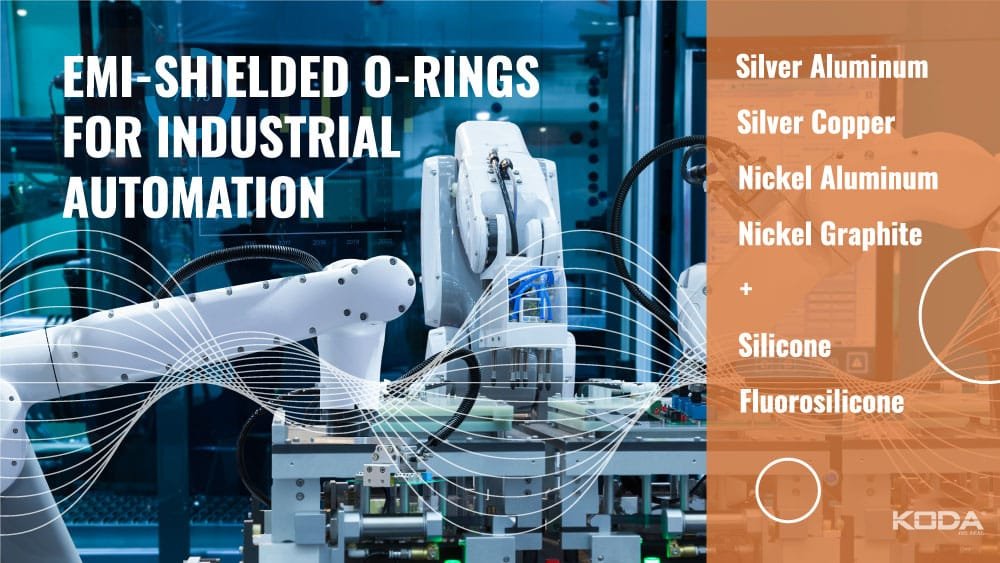
Understanding EMI Shielding in Industrial Automation
Industrial automation systems increasingly operate in environments filled with electromagnetic interference (EMI), radio frequency interference (RFI), vibration, moisture, chemicals, and temperature fluctuations. As robotics, PLC cabinets, servo drives, autonomous production lines, and smart sensors become more integrated, maintaining both environmental sealing and electromagnetic compatibility (EMC) becomes a critical engineering requirement.
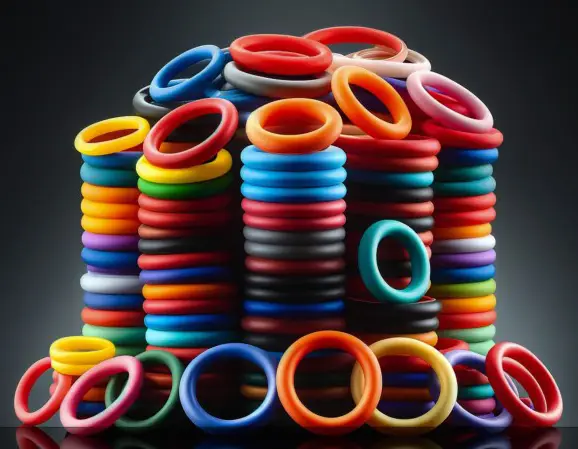
🔶 EMI-Shielded O-Rings combine conductive elastomers with precision sealing technology, allowing a single component to provide environmental sealing while simultaneously attenuating electromagnetic leakage between conductive housings.
Unlike conventional rubber O-rings that only prevent fluid or dust ingress, EMI-shielded versions are engineered using conductive fillers dispersed throughout silicone, fluorosilicone, EPDM, or fluorocarbon elastomers. When compressed between metallic surfaces, they create a continuous conductive path capable of reducing EMI emissions while maintaining IP-rated sealing performance.
For engineering specifications and available products, visit EMI-Shielded O-Rings.
Why EMI Protection Matters in Modern Automation
Factories adopting Industry 4.0 technologies rely on thousands of interconnected electronic devices. These include:
✔ Industrial robots
✔ Servo controllers
✔ Variable Frequency Drives (VFD)
✔ PLC control cabinets
✔ Vision inspection systems
✔ Wireless communication modules
✔ Industrial IoT gateways
Every electronic device both emits and receives electromagnetic energy. Without effective shielding, interference may cause communication errors, false sensor readings, unexpected machine shutdowns, or reduced equipment reliability.
A properly designed EMI sealing solution reduces electromagnetic leakage through enclosure joints, which are often the weakest point in an otherwise shielded metal housing.
How EMI-Shielded O-Rings Work
The sealing principle combines two mechanisms:
🛡 Mechanical sealing prevents dust, water, oil, chemicals, and contaminants from entering equipment.
⚡ Electrical conductivity forms a continuous conductive circuit between mating metal surfaces, allowing electromagnetic energy to dissipate rather than radiate.
Conductive fillers commonly include:
- Silver-plated aluminum particles
- Silver-plated copper particles
- Nickel-coated graphite
- Pure silver particles
- Carbon-based conductive fillers
Each filler offers different combinations of conductivity, corrosion resistance, galvanic compatibility, weight, and cost.
Common Conductive Elastomer Materials
Conductive Silicone
Conductive silicone remains the most widely specified material due to excellent weather resistance, low compression set, UV stability, and operating temperatures typically ranging from -55°C to +200°C.
Conductive Fluorosilicone
Suitable for aerospace and fuel-rich environments because fluorosilicone resists aviation fuels, hydraulic fluids, and aggressive solvents while maintaining EMI shielding.
Conductive FKM
Fluorocarbon elastomers provide excellent resistance to oils, fuels, and chemicals with continuous service temperatures approaching 200°C depending on compound formulation.
Conductive EPDM
EPDM performs exceptionally well in outdoor applications involving ozone, steam, and weather exposure but is generally unsuitable for petroleum oils.
Typical Material Properties
Typical hardness: 60–80 Shore A
Compression: 15–30%
Volume resistivity: depends on conductive filler system
Shielding effectiveness: commonly 60–120 dB depending on frequency and material
Operating temperature: approximately -55°C to +200°C depending on elastomer
Thermal conductivity: conductive fillers generally increase thermal conductivity compared with conventional elastomers
Relevant Engineering Standards
Although no single international standard governs every EMI O-ring application, engineers commonly reference:
- ASTM D2000 — Rubber material classification
- ASTM D2240 — Shore hardness testing
- ASTM D395 — Compression set testing
- ASTM B117 — Salt spray corrosion testing
- ISO 3601 — O-ring dimensions and tolerances
- IEC 61000 Series — Electromagnetic compatibility
- MIL-DTL-83528 (reference for conductive elastomer applications)
Selection should always consider both sealing requirements and EMC performance rather than relying solely on shielding effectiveness.
Industrial Automation Applications

🏭 Robot controller enclosures
⚙ CNC electrical cabinets
📡 Industrial communication gateways
🔋 Battery management systems
📷 Machine vision cameras
🤖 Autonomous mobile robots (AMR)
📦 Automated warehouse equipment
More technical details can be found here: EMI-Shielded O-Rings.
Design Considerations
Compression
Proper compression is essential for achieving both sealing integrity and electrical continuity. Excessive compression may accelerate compression set, while insufficient compression reduces shielding effectiveness.
Surface Finish
Smooth, conductive mating surfaces reduce electrical contact resistance. Surface oxidation or contamination may significantly decrease shielding performance.
Galvanic Compatibility
Engineers should match conductive fillers with enclosure materials to minimize galvanic corrosion over long service periods.
Installation Best Practices
✔ Clean all sealing surfaces.
✔ Remove oxidation before assembly.
✔ Avoid twisting the O-ring.
✔ Maintain uniform bolt torque.
✔ Verify groove dimensions according to ISO 3601 recommendations.
✔ Inspect periodically for compression set.
Failure Mode Analysis (Industry Experience Example)

Example only — not based on a specific customer.
An industrial robot cabinet experienced intermittent communication faults after several years of operation. Inspection revealed oxidation on the aluminum enclosure flange combined with permanent compression set of the conductive O-ring.
After replacing the gasket, restoring the conductive contact surfaces, and applying proper assembly torque, EMI emissions returned to acceptable levels while maintaining environmental sealing.
Laboratory Test Example
Illustrative laboratory procedure only.
Engineers may evaluate shielding effectiveness by installing conductive O-rings between standardized metallic test fixtures and measuring attenuation across multiple frequency bands using calibrated EMC equipment following applicable test procedures.
Additional testing commonly includes compression set, thermal aging, salt spray exposure, chemical resistance, and repeated assembly cycles.
Case Example (Engineering Experience)
Illustrative engineering scenario.
A machine builder upgrading to high-speed servo drives observed increased electromagnetic emissions around enclosure seams. Engineers replaced conventional silicone O-rings with conductive silicone EMI-shielded O-rings while maintaining the same groove dimensions. Internal EMC verification demonstrated improved enclosure shielding together with continued IP-rated sealing performance.
Selection Guide
Engineers should evaluate:
- Operating temperature
- Chemical exposure
- Required shielding effectiveness
- Compression characteristics
- Housing material compatibility
- Expected service life
- Maintenance interval
- Environmental protection rating
Frequently Asked Questions
1. What makes an EMI-shielded O-ring different from a standard O-ring?
An EMI-shielded O-ring provides both environmental sealing and electrical conductivity through conductive elastomer compounds, whereas standard elastomer O-rings only provide sealing.
2. Which conductive filler provides the highest shielding performance?
Silver-filled compounds generally provide the highest electrical conductivity, while nickel-graphite systems often offer a balance between performance, corrosion resistance, and cost.
3. Are EMI-shielded O-rings suitable for outdoor automation equipment?
Yes. Conductive silicone and conductive EPDM compounds are commonly selected for outdoor environments because of their excellent resistance to weather, ozone, and UV exposure.
4. How often should conductive O-rings be replaced?
Replacement depends on compression cycles, environmental conditions, temperature, chemical exposure, and maintenance schedules. Periodic inspection for compression set and surface damage is recommended.
5. Can existing equipment be upgraded with EMI-shielded O-rings?
In many cases, yes. Existing groove dimensions may accommodate conductive O-rings, although engineers should verify compression, electrical continuity, enclosure materials, and EMC performance before implementation.