T-Seals Designed for High-Pressure Working Conditions
Summary
In high-pressure hydraulic, pneumatic, and hydrodynamic systems, traditional O-rings and basic elastomer seals are frequently subjected to extrusion, deformation, torsion, and rapid wear, leading to leaks, premature failure, and unplanned downtime. For engineers and maintenance teams, selecting a sealing solution that combines stability, extrusion resistance, and long service life under high pressure is crucial. T-Seals (T-rings) have emerged as a favored high-performance alternative, designed to overcome the limitations of traditional seals under harsh pressure conditions.
Introduction to T-type Seals
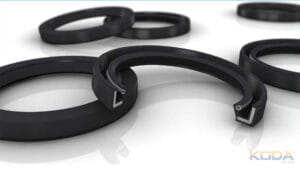
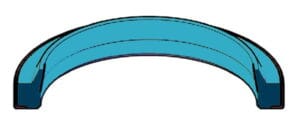
T-type seals are composite sealing elements with a T-shaped cross-section, typically composed of an elastomer and an anti-extrusion ring, combining sealing performance with pressure resistance. They achieve stable sealing through their own structure, resisting extrusion, withstanding high pressure, and not being easily twisted. Suitable for both reciprocating motion and static sealing applications, they are widely used in hydraulic cylinders, high-pressure oil circuits, and construction machinery. They can replace traditional O-ring and retaining ring combinations, offering longer service life and more reliable sealing.
Design features of T-type seals
The T-type seal features a T-shaped cross-section design, ensuring uniform stress distribution and preventing twisting or overturning during installation and operation. Its high-fitting sealing lip provides a sensitive sealing response, and the integrated structure effectively enhances its resistance to extrusion and high pressure, making it suitable for frequent reciprocating motion and high-pressure conditions. Compared to traditional O-ring combinations, it offers greater structural stability, lower friction, and a longer service life, maintaining reliable sealing in demanding hydraulic and pneumatic systems for extended periods.
Structural Advantages of T‑Seals in High‑Pressure Environments
Unlike O-rings, which rely solely on a circular cross-section for sealing, T-type seals feature a T-shaped elastomer core with anti-extrusion support rings on both sides. This integrated structure provides superior stability under high pressure:
The central T-shape provides the primary elastic sealing force.
The symmetrical support rings prevent the elastomer from being extruded into the gap between mating parts, even under extreme pressure.
This geometry eliminates twisting, squeezing, and rolling—common failure modes of O-rings in dynamic or high-pressure applications—that are often encountered during installation and operation.
Customers frequently ask why O-rings fail under high pressure. The answer lies in their insufficient anti-extrusion capability. T-type seals solve this problem with a mechanically stable shape design that evenly distributes pressure stress, enabling reliable operation even where standard elastomer seals fall short.
Common types of T-type seals

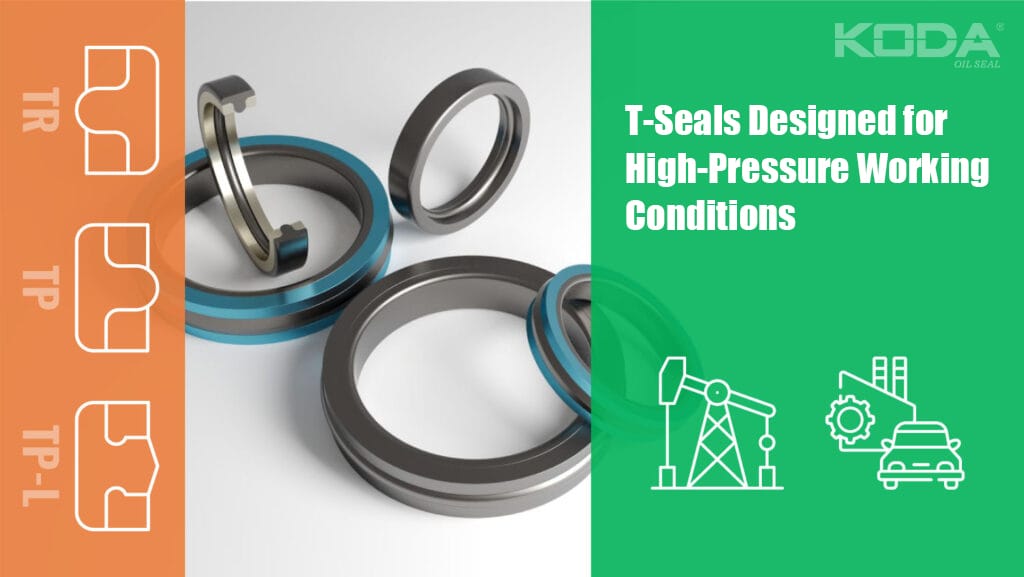
T-rings play a crucial role in sealing systems of various equipment due to their versatility and adaptability. To adapt to different working conditions and operational requirements, T-rings have evolved into various structural styles, each specifically optimized for particular application scenarios and working pressures. The mainstream T-rings on the market are mainly the TR, TP, and TP-L series, each further subdivided into standard, medium, and wide-base types, clearly distinguishing structural differences to more accurately match application scenarios and ensure sealing performance and product lifespan.
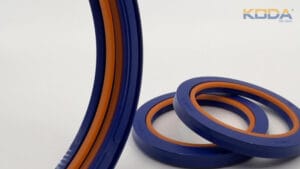
TR-type T-rings are a common choice for piston rod seals. The main body is a T-shaped nitrile rubber elastomer, reinforced with hard plastic retaining rings on both sides, significantly improving high-pressure resistance and extrusion resistance. This seal can be directly installed in the groove of a standard O-ring and maintains a stable seal under alternating pressure, making it a universal sealing solution for hydraulic cylinders, pneumatic systems, and various rod-driven mechanical equipment.
TP-type T-rings are specifically designed for piston sealing, can withstand bidirectional pressure, and are suitable for various mechanical and hydraulic systems. Its structure also employs a T-shaped sealing body, coupled with double-sided plastic support rings, allowing the sealing ring to expand and compress evenly during operation. The exposed structure ensures stable sealing performance and enhances the overall structural strength of the component, enabling stable operation under various complex conditions.
The TP-L type T-shaped sealing ring focuses on high-performance piston sealing applications, equipped with a locking anti-extrusion retaining ring to ensure that the sealing ring does not shift or become misaligned during installation and operation, resulting in stronger structural integrity. This model is particularly suitable for bidirectional high-pressure applications, effectively preventing sealing failure caused by sealing ring displacement, and is applicable to core sealing environments with more stringent operating conditions and higher safety requirements.
T-type seals are also available in three base sizes: standard, medium, and wide, to accommodate different gland sizes and assembly requirements: The standard base is suitable for most general applications, balancing sealing performance and ease of installation; the medium base can be interchangeably installed in grooves that accommodate O-rings with a single support ring, providing a more reliable seal for medium and high-pressure applications; the wide base is suitable for grooves that accommodate O-rings with double support rings, can handle ultra-high pressure environments, or provide additional support for the sealing structure.
Core Performance Characteristics for High‑Pressure Applications
T‑seals are purpose‑built for high‑pressure operating conditions, with performance characteristics that directly resolve real‑world customer problems:
1. Excellent Extrusion Resistance
Backup rings—typically made from PTFE, nylon, or thermoplastic materials—support the elastomer core and resist extrusion at pressures often exceeding 35 MPa, and even higher in specialized designs. This prevents edge damage, cracking, and permanent deformation.
2.Stable Sealing Under Pressure Fluctuations
In systems with frequent pressure spikes or pulsation, T‑seals maintain consistent contact with the sealing surfaces. Their shape prevents displacement, ensuring no loss of sealing force during rapid pressure changes.
3.Low Friction and Long Wear Life
Especially in dynamic applications (reciprocating or oscillating motion), T‑seals produce less friction than O‑rings in high‑pressure conditions. Reduced friction lowers heat buildup, reduces abrasion, and extends service life.
4.Compatibility With Most Fluids and Temperatures
When paired with high‑performance elastomers such as NBR, HNBR, FKM, or PU, T‑seals resist mineral oils, synthetic fluids, fuels, and chemicals. They perform reliably across a wide temperature range, supporting use in heavy industry, mobile hydraulics, and offshore equipment.
Material selection for high-pressure T-type seals
Material choice directly determines whether a T‑seal will perform in a specific high‑pressure environment. As technical professionals, we help customers select materials based on three key factors: pressure, temperature, and fluid medium.
NBR (Nitrile Butadiene Rubber)
Cost‑effective, good oil resistance, suitable for medium‑pressure, general‑purpose hydraulic systems.
PU (Polyurethane)
High strength, excellent wear and extrusion resistance, ideal for high‑pressure reciprocating hydraulics.
HNBR (Hydrogenated Nitrile Butadiene Rubber)
Improved temperature and oil resistance compared to NBR, used in severe industrial and automotive high‑pressure systems.
FKM (Fluoroelastomer)
Outstanding high‑temperature and chemical resistance, used in extreme high‑pressure, high‑heat environments.
Backup ring materials are equally important: PTFE for low friction, nylon for high rigidity, and thermoplastic polyesters for ultra‑high‑pressure conditions.
Installation and Application Best Practices

Customers often report seal damage even after choosing high‑performance T‑seals. In most cases, the issue stems from improper installation.
Key installation guidelines:
Do not stretch or twist the T‑seal during assembly.
Ensure grooves are clean, deburred, and correctly dimensioned according to the seal manufacturer’s specifications.
Apply compatible lubrication to reduce installation friction and prevent initial surface damage.
Avoid passing the seal over sharp threads, holes, or edges without protective sleeves.
When installed correctly, T‑seals provide consistent performance from the first cycle to thousands of operating hours, greatly reducing maintenance frequency.
Performance Comparison: T-rings vs. O-rings
In hydraulic and pneumatic sealing systems, both T-rings and O-rings are widely used sealing elements, but they differ significantly in structure, performance, and applicable operating conditions. O-rings are simple in structure, easy to install, and low in cost, making them a common choice for general low- and medium-pressure applications. However, in high-pressure, reciprocating motion scenarios, they are prone to problems such as compression, twisting, creeping, and rapid wear, resulting in relatively limited sealing stability.
T-rings employ a T-shaped cross-section structure and are typically used with two retaining rings, fundamentally improving their resistance to extrusion and motion stability under high pressure. Compared to O-rings, T-rings are less prone to flipping or misalignment during reciprocating motion, exhibit smoother friction, show no significant creeping, and have a longer service life, making them more suitable for harsh conditions such as high pressure, high speed, and alternating loads.
Regarding sealing performance, O-rings rely on their own compression for sealing, making them prone to deformation and failure under increased pressure. T-rings, through structural optimization and cooperation with retaining rings, maintain stable sealing even under high pressure, resulting in a lower leakage rate. In terms of application scenarios, O-rings are mostly used for static sealing, low-pressure dynamic sealing, and general equipment; T-rings are more suitable for applications requiring high reliability and durability, such as hydraulic cylinder piston rods, piston seals, construction machinery, hydraulic valves, and automated equipment.
Overall, O-rings excel in low cost and versatility, making them suitable for ordinary working conditions; T-rings, on the other hand, offer significant advantages in high-pressure, dynamic, and long-life applications, resulting in lower overall costs and more stable systems.
Conclusion
Designed specifically for high-pressure operating environments, T-type seals represent a reliable and cost-effective upgrade to traditional sealing solutions. Their unique T-profile, anti-extrusion support ring, and customizable material options directly address the most common high-pressure seal failures, including extrusion, torsion, wear, and leakage. From structural design and material selection to proper installation and sustained performance, every aspect of T-type seals is meticulously designed to maximize their stability and service life under harsh conditions. For customers seeking to minimize downtime, improve system safety, and reduce long-term maintenance costs, T-type seals are not just an alternative, but a proven professional solution for modern high-pressure engineering systems. For more information about T-type seals or how they can be used in your projects, please contact KODA. The superior performance and reliability of T-type seals will significantly improve your operational efficiency.